Community Nonprofits & Volunteers
A New Volunteer Can Read the Guide. Can They Finish One Task?
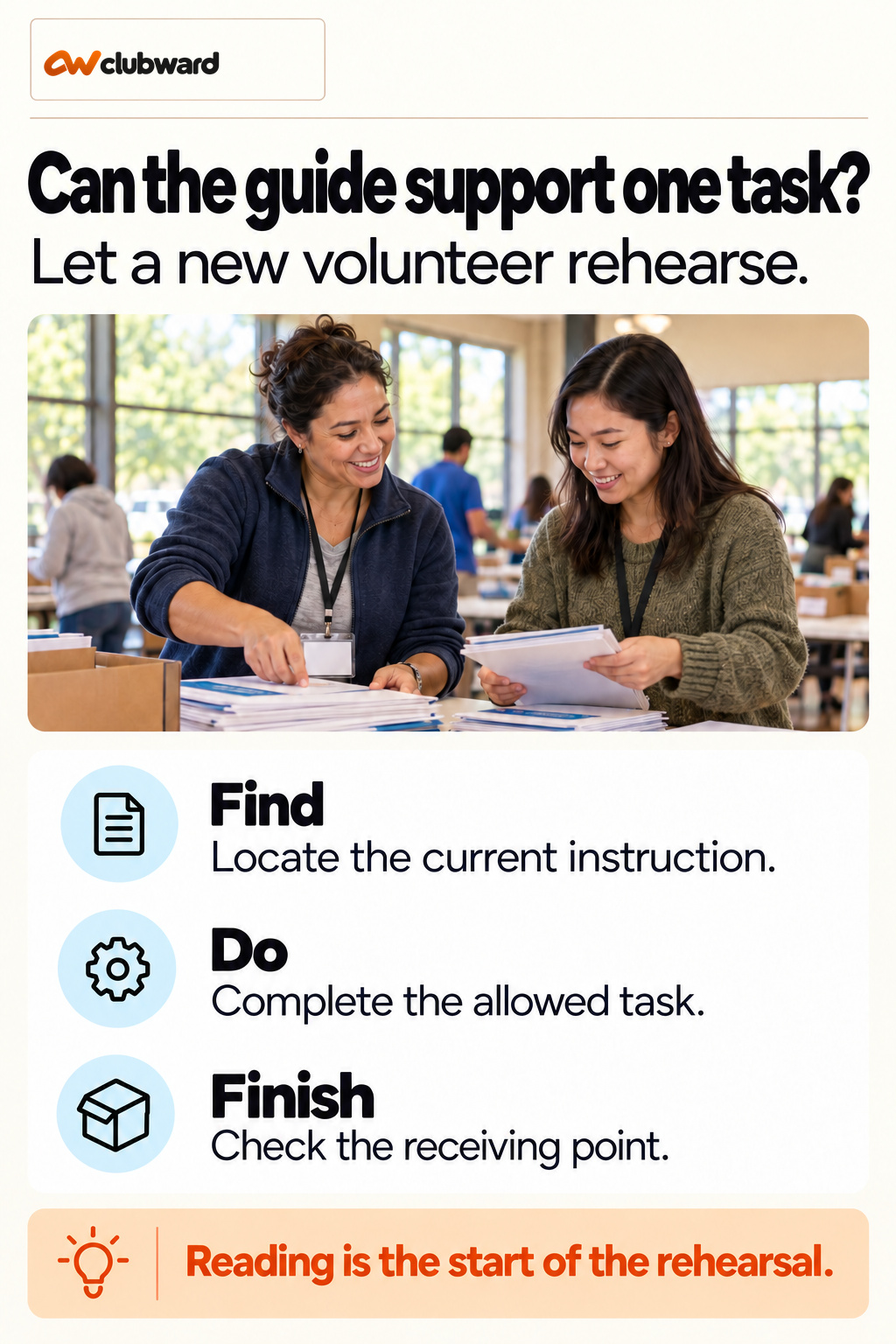
Let a new volunteer find the current instruction, practice one allowed task and check the endpoint and help route before first use.

Test a volunteer guide by asking a new volunteer to find the current instruction, complete one allowed task and identify the point where they would ask for help. Use approved practice materials and let the person work through the guide before explaining it. The useful question is not whether they read the page. It is whether the instruction supports the action your program needs.
This evaluation is for community nonprofit leaders, program managers and volunteer coordinators preparing a first task. Start with a role already approved for the person and keep the rehearsal within its current responsibilities. Do not use practice to grant new access or ask a volunteer to make decisions outside the assignment.
Choose a bounded task with a visible endpoint, such as preparing a workshop welcome station. Your deliverable is a short record of what the person could find, do and finish, plus one correction with an owner. Keep participant information and live records out of the exercise when blank materials can demonstrate the same step.
Choose a task that has a real endpoint
Pick something the new volunteer will actually do, such as arranging approved workshop materials or routing a routine question to the program lead. State where the task starts and what completion looks like.
Avoid beginning with a broad instruction to help with the program. That leaves too many possible actions and authority questions. A bounded first task lets the coordinator observe which part of the guide supports the work.
Identify the receiving role if the task includes a handoff. Preparing a packet and delivering it to the designated lead are different endpoints. Agree which one the volunteer is assigned before drafting the rehearsal.
Keep the task proportionate to the person's approved role. A first rehearsal should not depend on private participant records, unfamiliar equipment or an unapproved decision. Choose a safe practice route that reflects the allowed work.
Confirm the role and guide belong together
Locate the current assignment and the guide intended for that role. Ask the procedure owner to confirm that the instruction describes the task the volunteer will perform. An older general handbook may provide background without serving this particular action.
Check the guide's owner and current version through your organization's normal process. The volunteer should know where to find the instruction they are expected to use. Keep history separate from the current point of use.
Identify the role's allowed actions and decision limits. A volunteer preparing materials may be able to arrange a table while another person decides changes to the participant process. Put that boundary beside the relevant task step.
Resolve an unclear assignment before asking the person to practice. A missing permission or disputed responsibility needs an authorized answer. More detailed wording cannot substitute for knowing what the role is allowed to do.
Prepare the practice materials
Use blank forms, sample packets or other approved materials that represent the task without exposing private information. The rehearsal should let the person perform the sequence and recognize the endpoint.
Arrange the materials in the normal working context where practical. A guide tested beside the actual welcome table can reveal a missing location instruction that a quiet desk review would not show.
Tell the volunteer what task they are practicing and whom to ask when something is unclear. Keep the exercise supportive and let them decline if they are uncomfortable. It should improve the procedure, not put someone on the spot.
Identify when the coordinator will intervene. Protect people, equipment and records throughout the rehearsal. Observation does not require allowing an avoidable problem to continue just so the evaluator can collect a finding.
Test whether the instruction can be found
Ask the person to locate the guide using the normal route for their role. Give the task question without naming the heading that contains the answer. Observe the wording and location they try first.
Check whether the title matches the task in ordinary language. A volunteer preparing welcome packets may not recognize a heading called intake administration. The procedure can retain approved organizational terms while making the task route clearer.
If the person cannot open the guide, distinguish access from wording. An inaccessible reference needs the normal authorized access review. A useful answer buried under an unrelated heading may need a clearer route within the guide.
Record the obstacle specifically. “The assignment message links to last month's packet guide” identifies a next action. “The volunteer did not understand the instructions” may hide the fact that they could not reach the current page.
Let the person begin without coaching
Ask the volunteer to perform the allowed first step with the guide available. Give them time to interpret it and explain what they believe should happen next. Observe before supplying the answer where it is safe to do so.
The purpose is to test the instruction, not memory. Let the person refer back to the guide as often as needed. A usable procedure can support the task without requiring someone to recite every step.
Watch for the point where they substitute a guess for an instruction. Ask what information they looked for. That can reveal a missing material, an unclear sequence or a decision limit that needs to be more visible.
Keep assistance practical. If the task stops, provide the approved guidance and record what helped. The rehearsal should leave the volunteer supported and the coordinator with a concrete correction to consider.
Work through a workshop welcome-station example
Imagine a community nonprofit asks a new volunteer to prepare a welcome station before an adult workshop. The current task includes arranging the approved blank packets, placing the program sign and handing the ready station to the shift lead.
The guide says to prepare registration materials but does not name the packet set or receiving role. Ask the volunteer to use the instruction and show what they would arrange. The uncertainty concerns the task's materials and endpoint.
Use approved practice packets to clarify the sequence with the procedure owner. Then ask the person to locate the corrected instruction and repeat the preparation. Observe whether they can select the materials without relying on the coordinator's memory.
Finally, ask the shift lead to receive the prepared station through the normal process. Both sides should agree on what ready means. A table that looks tidy is not a completed handoff if the receiving person still needs a missing step.
Make each step lead to an observable action
Review the verbs in the guide. Prepare, collect or check can be useful, but the person may still need to know which material, where it belongs and how to identify completion. Add the detail required for the actual task.
Keep the sequence close to the order of work. If a volunteer must obtain a material before arranging the station, explain that route before the setup instruction. Do not make them discover a dependency only after they reach a later paragraph.
Separate task instructions from background. The organization's purpose can help someone understand why the work matters, but it does not replace the next action. Keep broader context available without burying the practical step.
Ask the procedure owner to approve any changed instruction. Clearer wording should express the current process. A proposed new permission, participant-handling rule or receiving responsibility needs the organization's established decision route.
Check the endpoint with the receiving person
Ask the volunteer what shows that the task is complete. Then ask the receiving lead what they expect to find. Compare the answers before treating the rehearsal as finished.
The endpoint might be materials arranged in a designated place and checked by the shift lead. Choose it from the real procedure. “Everything is ready” can conceal different expectations about the supplies, record or handoff.
Identify what the volunteer records, if anything, through the approved route. Avoid adding an administrative checkbox merely to make the test measurable. The completion record should support the next person's work.
If the receiving role is absent, use the existing backup arrangement. A guide should not leave the volunteer with no permitted next action after preparation. Record a missing covering route as an unresolved procedure question.
Add one situation that should reach the lead
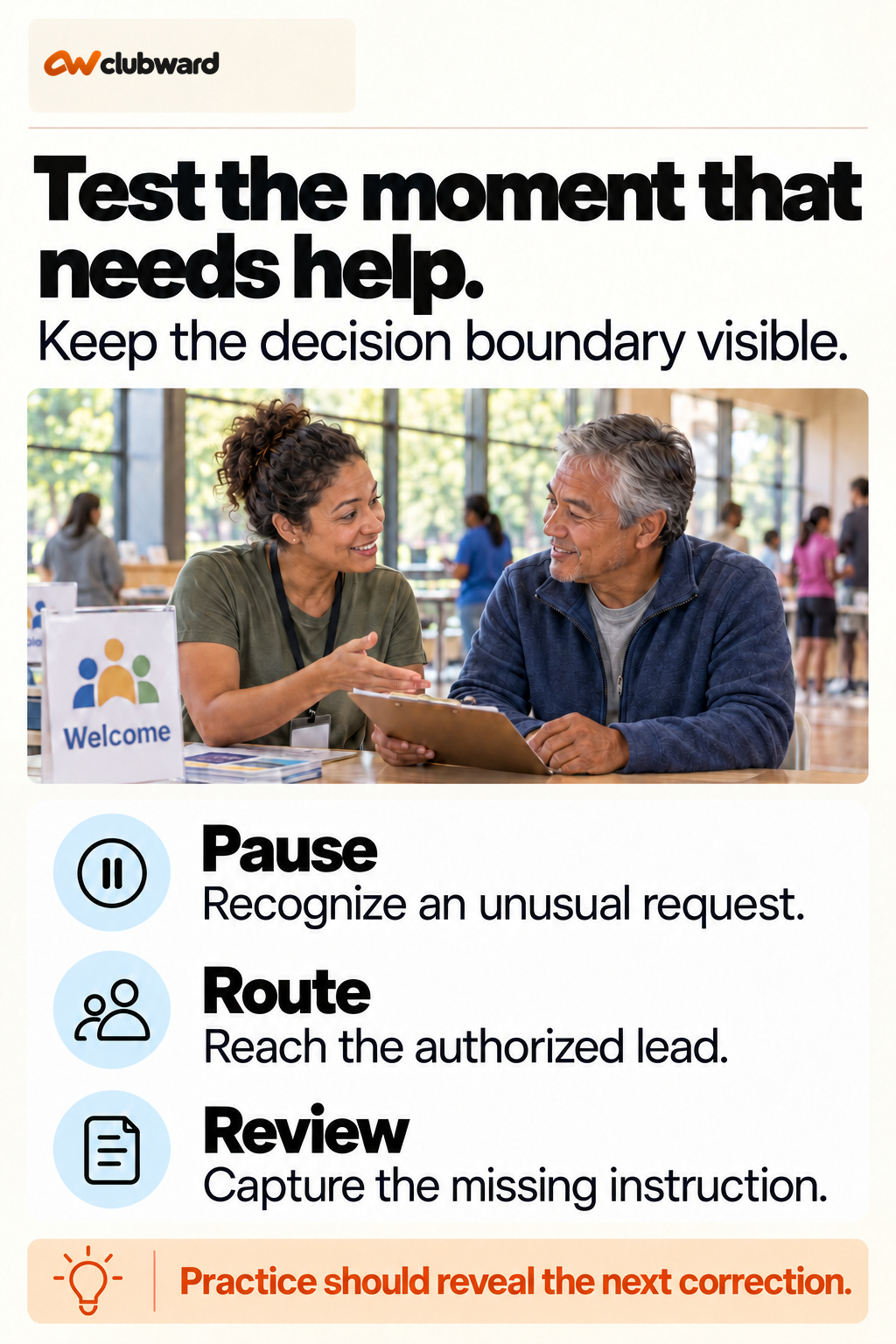
Choose an exception within the actual task context, such as a request to replace the approved packet with another version. Ask the volunteer to identify what they may do and what decision belongs to the lead.
Use the organization's current authority boundaries. The desired response may be to pause the affected step and route the question. It should not be a confident improvised answer outside the role.
Ask what information the receiving lead needs. A task reference, the requested change and the current instruction may be sufficient. Avoid asking the volunteer to collect unnecessary private details just because the question is unusual.
Check the backup contact when the ordinary lead is occupied. The volunteer should know how to reach the approved covering person and keep the task question visible. A personal phone number copied into a public guide is not the default solution.
Distinguish a question from a procedure failure
A volunteer asking for clarification can be following the guide correctly, especially when the task reaches a decision boundary. Do not treat every question as proof that the instruction failed.
Look at the question and the expected route. “The packet version differs; should I pause?” may show that the person recognized a meaningful condition. “Which packet does this step mean?” may show that the ordinary instruction lacks necessary detail.
Record the part of the guide that helped or failed to help. This keeps the review focused on the supported action rather than a broad judgment about someone's readiness or commitment.
Ask the person where they hesitated without making them responsible for redesigning the process. Their account can help the procedure owner locate the next correction. Keep feedback optional and connected to the task.
Check the guide in the format used during the shift
Use the printed sheet, phone view or approved shared reference the volunteer will actually encounter. A guide readable at the coordinator's desk may be harder to use beside materials during a busy program.
Keep essential steps in readable text. A visual can reinforce the sequence, but the person should not depend on small image labels to learn where the materials go or whom to contact.
Check the working links and any necessary reference access through the authorized route. A correct step that points to an unavailable file still interrupts the task. Record the broken handoff with its owner.
Ask whether the guide can be consulted without disrupting the permitted work. The practical answer may be a better location, clearer heading or shorter point-of-use instruction. Choose from the observation rather than automatically adding another page.
Record the rehearsal as evidence
Create a concise note with the task, current guide, actions practiced, completion point and exception route. Identify which parts were observed and which were discussed without performance.
Record the exact uncertainty and the instruction available at that point. A specific finding gives the owner a correction to make. Avoid a simple passed label that hides the step requiring help.
Keep the observation bounded. One rehearsal can show how the guide supported this task under these conditions. It does not establish organization-wide training effectiveness or guarantee that every volunteer will encounter the same situation.
Use role or practice-case references instead of unnecessary personal information. Store the note within the organization's normal access rules. The improvement record should help maintain the procedure without becoming a broad volunteer performance file.
Choose one correction before adding more content
If the material name is missing, identify it. If the receiving role is unclear, confirm the handoff. If the help route does not work, ask the responsible owner to establish the covering arrangement.
Do not respond to every hesitation with a longer introduction. The guide needs the detail that enables the next action. Additional background can make a point-of-use instruction harder to search without resolving its missing step.
Review the correction with the procedure owner and receiving role. They should agree that the instruction expresses the current allowed process. Keep a proposed policy change separate until the appropriate decision is made.
Give the correction a named owner and a review point. The coordinator should know who updates the operating copy and who checks the next rehearsal. A suggested edit alone is not a completed improvement.
Repeat the affected task with the corrected guide
Ask the volunteer or another willing colleague to locate the new instruction through the normal route. Use the same bounded task so you can identify whether the previously missing answer is now available.
Let them work through the affected step before coaching. Observe what the corrected wording enables and what question remains. Keep the help route available throughout the exercise.
Compare the action with the approved endpoint and the receiving person's expectation. The guide has improved when the specific handoff becomes usable, not merely when the document is shorter or more polished.
If a new uncertainty appears, record it separately. Do not erase the original useful correction or claim the guide is fully complete. Choose the next change from the evidence and keep the task scope manageable.
Prepare the shift lead for first use
Tell the shift lead which task the new volunteer rehearsed and which instruction is current. Share the preparation information appropriate to their role. They need to know the next support action without receiving an unnecessary account of the whole exercise.
Confirm the first task, materials and help contact for the actual shift. A rehearsal can be accurate while the operating setup changes afterward. Check the relevant conditions before the person begins.
Give the lead a way to record a remaining question through the normal improvement process. They should supply approved guidance when needed and return to the procedure review after immediate program work is supported.
Keep the volunteer's arrival and orientation needs visible separately. A person can understand the task yet still need to find the station or know who welcomes them. Coordinate those handoffs without making the task guide carry every program detail.
Review the first task after the shift
Ask the volunteer and receiving lead about the task's beginning and endpoint. Did the guide match the materials? Was the ordinary sequence usable? Did the exception route identify the person who could decide?
Record new conditions that differed from practice. A relocated station, updated packet or absent receiver may explain a new question. Avoid assuming that every issue arose from the volunteer's interpretation.
Preserve useful feedback without inventing a result. A completed task and a positive conversation are observations, not proof of measured productivity gains. Report the specific outcome your team actually checked.
Assign any next correction through the procedure owner. The review should leave the organization with an action, responsible person and suitable follow-up point. Keep the supporting record accessible to the covering coordinator.
Maintain the guide for the next person
Keep the current instruction's owner, version and related approved references together. Identify changes that require another review, such as new materials, a different receiving role or revised authority boundaries.
Check the operating copy when those conditions change. An updated master file may not replace a printed sheet or earlier assignment link automatically. Name who checks the point of use in your actual process.
Retain a small practice setup that can be reproduced for another new volunteer. Use approved blank materials and the current task. The exercise should test the updated procedure rather than teach an outdated remembered arrangement.
Add another task only when it serves a different meaningful need. A manageable set of rehearsed instructions can support continuity without turning the first orientation into a full handbook recitation. Keep each task's endpoint and help route clear.
Compare instruction use with a verbal rescue
During the welcome-station rehearsal, record whether the volunteer can find the approved packet set from the guide or only after the coordinator points to it. Both routes may get the table ready, but they reveal different support needs for the next shift.
A verbal explanation can be appropriate immediate help. The useful follow-up is to ask which part belongs in the point-of-use instruction. If the answer was simply the label on the approved packet shelf, adding that reference may close the gap. If it was an unresolved choice between two packet versions, the procedure owner must clarify the decision first.
Repeat the step when the coordinator is not standing beside the station. Keep the authorized help contact available, but let the volunteer use the current guide to identify the material. This checks whether the useful explanation became a maintained instruction rather than remaining one person's memory.
Ask the receiving lead to observe the endpoint again. The task should still match the program's approved preparation, including any required receiving check. A volunteer finding the packet quickly does not prove that the whole station handoff is complete.
Record the result in practical terms: which reference supported the action, what still needed help and who owns that correction. This gives a covering coordinator a usable next step without turning the rehearsal into a score for the volunteer.
Keep the verbal help available during program work. Use the later review to improve the maintained instruction and preserve the volunteer's supported route to help.
Explore the role and first-task workflow
Clubward's staff operations support positions, roles and granular access. Bring the volunteer's first task and decision boundary to a walkthrough to discuss the information and responsibilities your organization needs to coordinate.
Ask the team to demonstrate the relevant role and procedure journey in your proposed setup. Keep the program coordinator responsible for explaining the task and reviewing practice. Assess the demonstrated workflow without assuming that software independently verifies every person's readiness.
For your next volunteer intake, choose one task, let the person find and use the guide, then check the endpoint and help route. Give the missing instruction an owner. To explore that process in a club management platform, book a personalized volunteer onboarding and handoff demo.
From Clubward Editorial Team
More from Clubward