Community Nonprofits & Volunteers
The Policy Changed. Did Returning Volunteers Get the Message?
A revised handbook is not the same as an operational change. Help returning volunteers understand what changed, when it starts and what to do on shift.

A community program updates its welcome-desk procedure. New volunteers learn the new steps during onboarding. Returning volunteers arrive on Saturday and follow the routine they were taught last season. No one is careless; the organization simply changed the rule without completing the handoff.
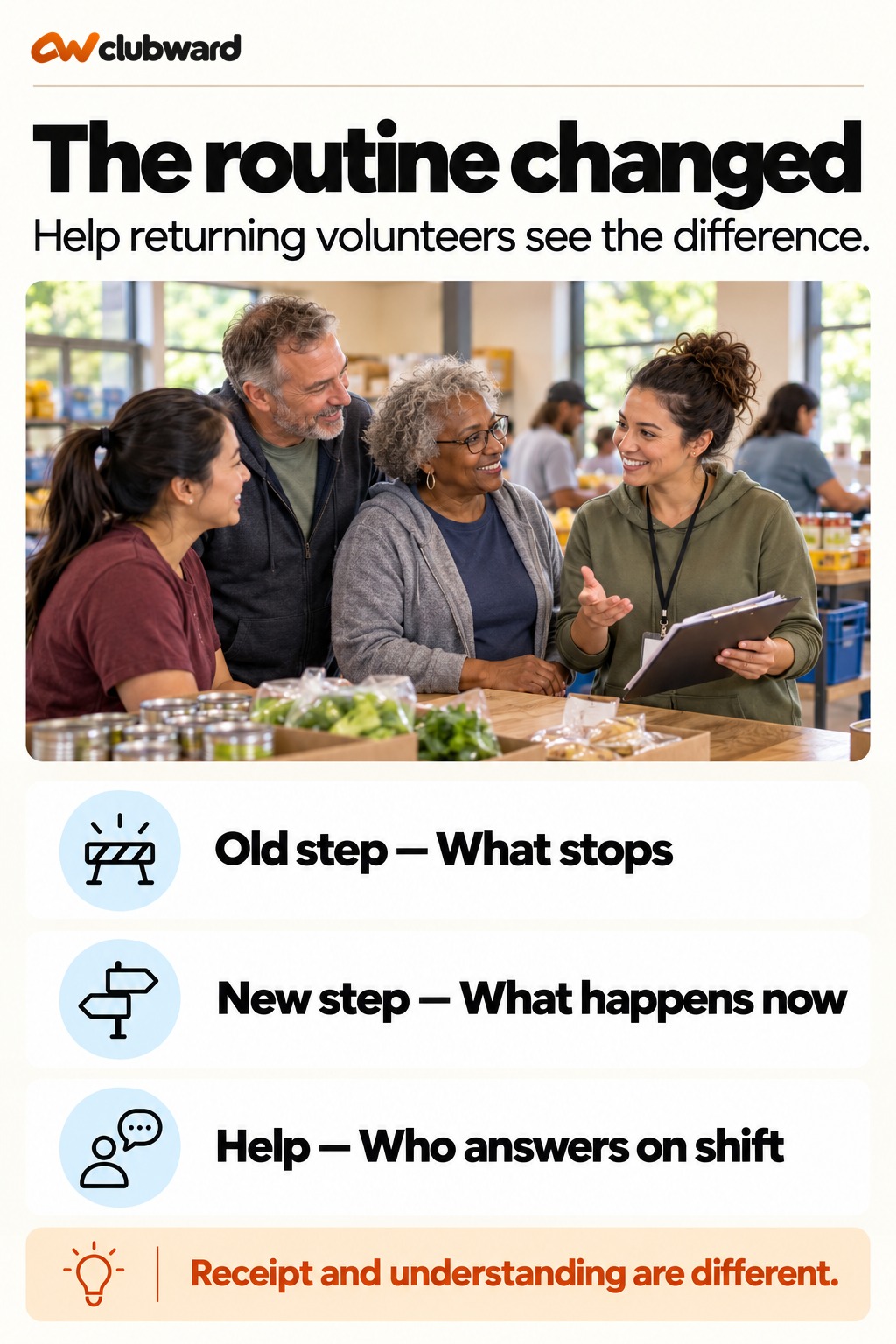
Publishing a revised handbook is not the same as changing day-to-day behavior. Returning volunteers already have a mental model of the work. They need a concise explanation of what changed, why it matters operationally, when it takes effect, which roles are affected, what action is now expected and who can answer questions.
The practical process is a policy-change cycle: approve one clear version, translate it into role instructions, deliver the update through a known channel, capture acknowledgment where appropriate, support the first affected shift and revise the instruction if the real workflow exposes ambiguity. That cycle respects volunteers’ time while giving coordinators evidence that the new process reached the people who must use it.
Why a simple change becomes a complicated shift
- The update is a link with no summary: “Please review the revised handbook” makes every volunteer search for the change and decide whether it affects their role.
- New and returning volunteers are treated alike: New volunteers need the whole role. Returning volunteers need the difference between the old and new process.
- Acknowledgment is mistaken for understanding: A checked box proves receipt, not the ability to apply the change. Add a practical question or first-shift check when the update affects real decisions.
- The coordinator is the only help contact: If that person is absent, volunteers may revert to the old routine. Name a backup or on-shift escalation path.
- Old materials remain in circulation: A printed quick guide or saved message can quietly override the new instruction. Include obsolete copies in the rollout checklist.
Build a handoff packet people can actually use
- Plain-language change: State the old approach and the new expected action without policy jargon.
- Practical reason: Explain the operational purpose without inventing urgency or sharing private details.
- Effective date: Tell volunteers exactly when to begin using the new process.
- Affected roles: Separate the people who act differently from those who only need awareness.
- Acknowledgment or practice: Choose a proportionate confirmation, from a short acknowledgment to a scenario check.
- Help path: Name the on-shift role and backup who can resolve uncertainty.
Move the decision from one role to the next
1. Approve one source version
Confirm the decision owner, effective date and final wording before training begins. Remove draft language from public and volunteer-facing fields.
2. Translate the change by role
Write what the welcome desk, program leader, setup team and other affected roles do differently. Do not make every volunteer interpret a general policy.
3. Choose the right delivery method
Use a brief message for a small procedural change, a short guide for a multi-step workflow and live practice when judgment or safety-critical coordination is involved.
4. Confirm receipt proportionately
Ask for acknowledgment when the change matters to access, money, participant information or other controlled work. Add one practical question when application matters more than recall.
5. Support the first real shift
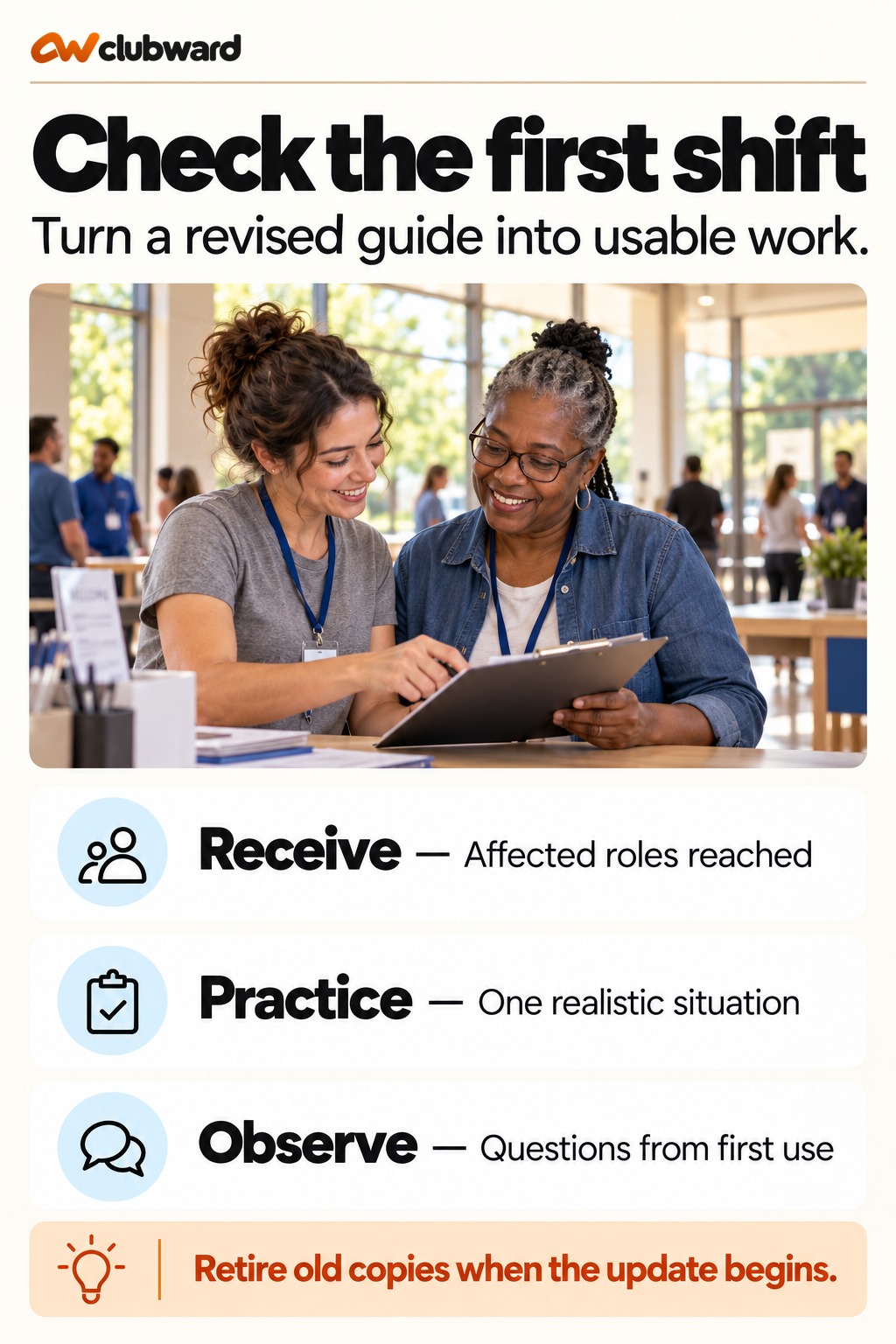
Give the on-shift lead a list of affected roles, the current guide and a way to note questions. Treat confusion as feedback about the instruction, not automatically as volunteer failure.
6. Retire the old process
Replace printed cards, shared files, saved messages and orientation slides. Record the date the outdated version was removed.
A worked handoff example
Suppose a community food program changes the welcome-desk escalation path for participants whose registration cannot be found. The old routine sent every question to the program coordinator. The new routine asks the desk volunteer to check one approved list, collect only the minimum information and contact the on-shift lead before interrupting the coordinator.
The policy owner approves the change for October 5. Returning welcome-desk volunteers receive a two-minute update that shows the old and new steps, the reason for the change, the effective date and the on-shift lead role. Setup volunteers receive only an awareness note because their work does not change. New welcome-desk volunteers learn the full procedure during role training.
Before the first shift, affected volunteers answer one scenario question: “The participant is not on the list; who do you contact next?” The shift lead watches the first few arrivals and records two wording questions. After the shift, the coordinator clarifies the quick guide. Old printed cards are removed. The organization now has an operational change, not merely a revised document.
Measure whether the handoff works
- Affected-role reach: Confirm that every scheduled person in an affected role received the update before the effective shift.
- Scenario accuracy: Use one or two practical questions to find ambiguous instructions before volunteers face the situation.
- Old-material removal: Track whether printed and digital quick guides were replaced.
- First-shift questions: Collect the points that required escalation; repeated questions often indicate unclear wording.
- Process reversion: Watch for use of the old routine and determine whether the cause is access, training, timing or instruction design.
Test the update with someone who knows the old routine
Ask a returning volunteer to review the update without first showing them the full policy. Give them the same message, quick guide and acknowledgment step the rollout will use. Then present one realistic situation and ask what they would do. Their answer will reveal whether the new action is clear or whether the old routine is still more memorable.
Invite the volunteer to point out familiar words that now mean something different, steps that depend on information they cannot access and moments when no help contact is available. This is not asking them to approve policy. It is testing whether the instruction can be used on shift. Revise the guide so the volunteer can distinguish the new path without rereading an entire handbook.
Next, test the shift lead’s view. Can they see who received the update, which roles are affected and which question remains open? Can they coach the first case without searching several messages? After the effective shift, hold a ten-minute debrief and record only the changes needed. A successful rollout respects returning volunteers’ experience while making the new expectation unmistakable. It also leaves future coordinators a record of what was taught, when it began and how the organization checked the first use.
When the change affects several roles, publish a small role matrix. Put roles down one side and actions across the top: must learn, must acknowledge, must practice and awareness only. The matrix prevents broad messages from creating unnecessary work while an affected role is accidentally missed. Keep it with the rollout record so the next coordinator can see why different volunteers received different instructions.
Connect the role to the work
Clubward supports positions, roles and granular access through staff operations. Bring one policy update and two affected volunteer roles to a personalized walkthrough. Ask how your team would make the current instruction accessible, record questions and support first use. Keep the coordinator responsible for teaching and checking the change.
Write the difference before sending the whole policy
Begin with the action that a returning volunteer will recognize. State what they previously did, what they should do now and when the change begins. The update should be understandable without comparing two long documents. Link the current full procedure for context, but make the changed action visible in the message the volunteer receives before the shift.
For the welcome-desk example, the old action is contacting the program coordinator whenever a participant cannot be found on the registration list. The new action is checking the approved list, collecting the permitted minimum information and contacting the on-shift lead. The coordinator remains available through the defined escalation path. That difference should be the center of the briefing.
Use a short explanation of the operating purpose: the on-shift lead can handle the first question while the coordinator continues program work. Do not imply that the old procedure was foolish or that returning volunteers have been doing the job badly. The organization changed the expected route. Its responsibility is to make the new route clear and usable.
Include the effective date and the help role. “Use the new process from Saturday’s opening shift; ask the duty lead if the list does not resolve the question” provides a boundary. If the policy is approved but not yet effective, say when the old process ends. A returning volunteer should not have to choose between the version they learned and a message with no start date.
Map the update to the roles that act differently
Build a small role list before distributing the update. Separate roles whose actions change, roles that support the new action and roles that only need awareness. A welcome-desk volunteer may need the new lookup and escalation sequence. A shift lead may need the decision limits. A setup volunteer may only need to know who now handles registration questions.
Check the actual upcoming roster against that list. Include returning volunteers, occasional substitutes and the backup lead where relevant. The person who attends every meeting is not necessarily the person opening the desk this weekend. A distribution list based only on frequent participants can miss the volunteer who most needs a concise update.
Give each role an appropriate instruction. The desk volunteer’s guide should state the next action and stop point. The lead’s guide should state what they can decide and what goes to the coordinator. An awareness message can remain brief. Sending the same long document to everyone creates unnecessary reading while leaving the important differences unstated.
Keep the role list current as assignments change. If a returning volunteer moves from setup to the desk after the initial briefing, they need the desk instruction before beginning that work. Add the role change to the preparation check rather than assuming an earlier awareness message supplied the full procedure. The update follows the task, not just the person’s name.
Choose a confirmation that matches the change
For a simple location update, a short acknowledgment may be enough to confirm receipt. For a changed decision path, ask one practical question. For a task that requires coordinated action, arrange a brief rehearsal with the shift lead. Choose the confirmation because it reveals readiness for the work, not because it produces a larger completion count.
In the registration example, ask: “The participant is not on the approved list after your permitted check. Who do you contact next?” The volunteer should be able to find the answer in the current guide. If they name the old coordinator route, clarify the new lead role and check whether the guide gives a usable contact method.
Treat uncertainty as information about the rollout. A volunteer may understand the new step but not know who the duty lead will be on Saturday. Another may not have access to the approved list. Those are operational gaps, not failed memory. Assign someone to resolve them before marking the volunteer ready to use the changed procedure.
Record the result proportionately. The coordinator may need to know that the affected role received the update, asked a question and completed a short practice. They do not need a public scoreboard of individual mistakes. Keep sensitive performance or personal matters in the organization’s authorized management process. The rollout record should support preparation and continuity.
Teach the stop point as clearly as the next step
A procedure should tell the volunteer when to stop searching or deciding. For the sample desk process, define the permitted list, information to collect and point at which the duty lead takes over. Avoid vague instructions such as “try everything first.” They can lead a volunteer to use information or make a decision outside their role.
Practice a case where the participant is still missing after the approved check. The volunteer should use the next contact without guessing at eligibility, promising entry or collecting additional information beyond the process. The lead then handles the case within their own decision boundary. If the lead needs the coordinator, the guide should make that escalation clear too.
Give the participant a natural explanation. A sample desk response is: “I could not find the registration in the list I use. Our shift lead will help with the next check.” That communicates the immediate action without blaming the participant, disclosing internal uncertainty or suggesting an outcome the volunteer cannot approve.
Make the help route work when the coordinator is absent. Name the duty lead, backup contact and the decisions that must wait for an authorized owner. A returning volunteer should not be expected to improvise authority because the usual person is away. The procedure can preserve a pending state while someone receives a clear next update.
Retire the old materials where people actually find them
List the places where volunteers use the old instruction: printed desk cards, a shared folder, an orientation slide, a saved message or a local copy. Assign an owner to each replacement. Publishing a new master document does not remove the old card taped inside the welcome-desk drawer. Check the work location as well as the central file.
Put a readable version date on the current guide and identify its approved owner. A volunteer should be able to tell whether the paper in front of them matches the effective update. Keep previous versions in the organization’s appropriate archive if needed, while making the current operating copy unambiguous. Do not ask volunteers to choose between equally prominent versions.
If an old copy is discovered during a shift, replace it through the agreed process and tell the duty lead. Record where it was found so the next review can check similar locations. Avoid treating the discovery as proof that the volunteer ignored the message. They may have followed the instruction the organization left at the task.
For a later policy revision, update the version and the role-specific summary together. A changed full policy with an unchanged quick guide can recreate the original problem. The owner should confirm that the action, effective date, help path and point-of-use materials agree. Retiring the old process is part of the change, not an optional housekeeping task.
Support the first shift without taking over every task
Before opening, the lead gives affected volunteers a brief reminder and checks that the current guide is available. They name the help route and invite questions before participants arrive. The purpose is to prepare the changed action, not to repeat every part of role training. Returning volunteers still bring useful experience with the unchanged work.
During the first use, the lead observes a small number of appropriate cases and answers questions within their role. Look for points where the volunteer searches for a missing fact, hesitates between the old and new route or cannot locate the current contact. These observations show what the instruction needs to make easier.
After the shift, record the questions that affected action. “Which list is approved?” calls for a clearer source. “Who is the lead today?” calls for a visible assignment. “What if the lead is helping another participant?” calls for a backup or waiting instruction. Keep the question specific enough that the next coordinator can make a useful correction.
Do not revise policy casually in the debrief. A wording clarification may be within the procedure owner’s authority; a new eligibility rule may require a separate decision. Mark proposed changes accordingly and keep the approved current action visible until an authorized revision begins. The rollout should improve the instruction without creating competing policies through conversation.
Prepare the update for a future coordinator
Save the approved change, effective date, affected roles, delivery route, confirmation approach and first-shift questions together. A backup coordinator should be able to see who still needs a briefing and which issue remains assigned. The record should not depend on a private explanation from the person who introduced the change.
Use a simple pending list for volunteers who have not yet worked the affected role. Record the next appropriate preparation opportunity and owner. A returning volunteer who comes back next month should receive the relevant change before their first desk assignment, even if the initial rollout is otherwise complete. The update remains part of that role’s current preparation.
Check whether the new instruction works after the first weekend
Compare the intended action with what volunteers actually needed to do. If the new route reduced one coordinator interruption but created uncertainty at the duty lead, refine the lead’s guide. If the lookup step required information the volunteer could not access, change the handoff through the authorized process. Acknowledgment alone cannot reveal those practical mismatches.
Ask a returning volunteer to explain the current route using the guide available at the desk. Ask the backup coordinator to name the unresolved rollout items. Both should be able to answer without reconstructing earlier messages. Keep the useful change, assign the remaining correction and check it on the next shift. That is how a revised policy becomes reliable program work.
Check an occasional volunteer before their first affected task
Choose someone who missed the initial briefing and is returning for a later shift. Give them the current role summary, point-of-use guide and help contact. Ask the same practical question used during rollout. This tests whether the preparation process reaches occasional volunteers without relying on attendance at one meeting.
Record any missing preparation before assigning the changed task. A lead can explain the update, arrange a short practice or assign a different approved duty while readiness is checked. The choice should be visible to the coordinator. A volunteer’s willingness to help is valuable, but it does not replace a usable instruction for a responsibility that changed.
Assign any remaining preparation to the shift lead.
Final checklist
Before marking the handoff complete, confirm the following items in the saved record:
- Approved source version
- Decision owner
- Effective date
- Old action
- New action
- Operational reason
- Affected roles
- Delivery channel
- Acknowledgment method
- First-shift lead
- Question and feedback path
- Old materials retired
From Clubward team
More from Clubward