Community Nonprofits & Volunteers
A Volunteer Changed Roles: A Permission Change Checklist
Connect a volunteer role change with permitted actions, old access removal, current instructions, supervised practice, and a named shift lead.

When a volunteer changes roles, review what they may do in the new role, what access they no longer need, and which tasks they should practice before working independently. Do not treat an updated roster as a completed permission change. Follow the transition through the actual records, physical access, instructions, and responsible supervisor.
Use one role-change checklist to connect duties with allowed actions. Name the person who authorizes the change, the person who applies each access update, and the person who verifies readiness. A volunteer should arrive knowing their first task, decision limits, and help contact.
This guide is for community nonprofit leaders, program managers, and volunteer coordinators. It uses a welcome-desk transition to show a practical method. Adapt the duties and approval boundaries to your own program; the checklist does not grant permission by itself.
Begin with the work that is changing
Write the old role, new role, effective date, and the duties that change. “Alex moves from event setup to welcome-desk support on Monday” is a useful beginning, but it needs the actions behind the title. Will Alex check arrivals, direct participants, update a roster, or simply help people find the right room?
Compare the old and new duties before reviewing access. A role title can hide several responsibilities, and two programs may use the same title differently. Identify the actual tasks the volunteer will perform during the upcoming shift.
Name the role owner who can confirm those duties. The coordinator may organize the transition while a program lead decides which actions the role permits. Do not assume that the person editing the roster also has authority to grant access.
Keep the effective date explicit. If the new role begins next week, decide when old-role access ends and new-role preparation starts through your established process. A transition can need a supervised practice period without creating unrestricted permission in both roles.
Separate duties, access, and decision authority
A duty describes the work: checking a participant's arrival, preparing materials, or directing a family to a room. Access describes what the volunteer can open or use. Decision authority describes what they may approve or change. Review all three.
A welcome-desk volunteer might need a permitted arrival list but lack authority to alter enrollment or approve an exception. A supply volunteer might use a storage key but have no reason to see participant records. Keep each permission tied to the task it supports.
Do not use broad access as a substitute for an unclear procedure. If the new volunteer cannot finish a task, ask whether the instruction, handoff, or escalation route is incomplete before expanding their permissions.
Write a boundary beside each task that could require a decision. “Direct a participant to the program lead when their name is not on the permitted list” gives the volunteer an action without asking them to decide eligibility independently.
Build a role transition sheet in seven fields
The sheet should make the change understandable to the volunteer and the responsible owners. Keep it brief enough to use before the shift and complete enough to show what remains open.
- Role and effective date: What is changing, and when does the new assignment begin?
- Required duties: Which tasks must the volunteer perform in the new role?
- Allowed actions: What may they view, use, enter, or decide for those duties?
- Access to remove: Which old-role permissions, keys, lists, or group memberships are no longer needed?
- Instruction and practice: Which current procedure must they use, and what task will they rehearse?
- Owners: Who authorizes, applies, and verifies each change?
- Open items: What remains unresolved, and how will the shift be handled until it is complete?
Use an authorized record for the access detail. A broad volunteer announcement needs the new assignment and contact, not a list of private account permissions. Give each owner only the information needed to complete their part.
Record actual completion separately from a requested change. “Access removal requested” and “access removal verified” are different states. The sheet should show that distinction so the coordinator does not assume the transition is complete.
Map the new role's allowed actions
For each new duty, ask what information or resource is necessary. If the welcome task is directing arrivals, the volunteer may need the room schedule and approved participant guidance. If they check attendance, identify the permitted list and the allowed method for recording an arrival.
Ask what they must not change independently. A volunteer may mark attendance without editing the program's capacity or moving someone between classes. Their instruction should point to the owner who handles a request beyond the routine task.
Include physical resources as well as digital ones. A room key, supply cupboard, radio, or printed roster can carry access just as an account does. Identify where the item is obtained, how it is used, and how it is returned through the established procedure.
Keep permissions proportionate to the actual assignment. A temporary welcome-desk shift should not automatically copy the program manager's access. Confirm the appropriate scope with the person authorized to approve it.
Review what the old role no longer requires
List the resources tied to the previous role. That can include a storage key, an event planning group, a shared document, or an account permission. Ask which remain necessary for a retained duty and which should be removed.
Do not assume that adding new-role access removes old-role access. Review the two sides independently. A roster update may change an assignment label while leaving the old resource available until a responsible owner completes the access action.
For a continuing duty, record the reason access remains and its appropriate scope. “Alex still returns event equipment on Mondays” gives a useful explanation for a limited retained resource. “They might need it someday” leaves the transition open-ended.
Identify the owner who can apply each removal through the authorized process. The coordinator should not claim an account change is complete because they sent a request. Ask for confirmation and verify the relevant result through your normal access-review procedure.
Work through a welcome-desk transition
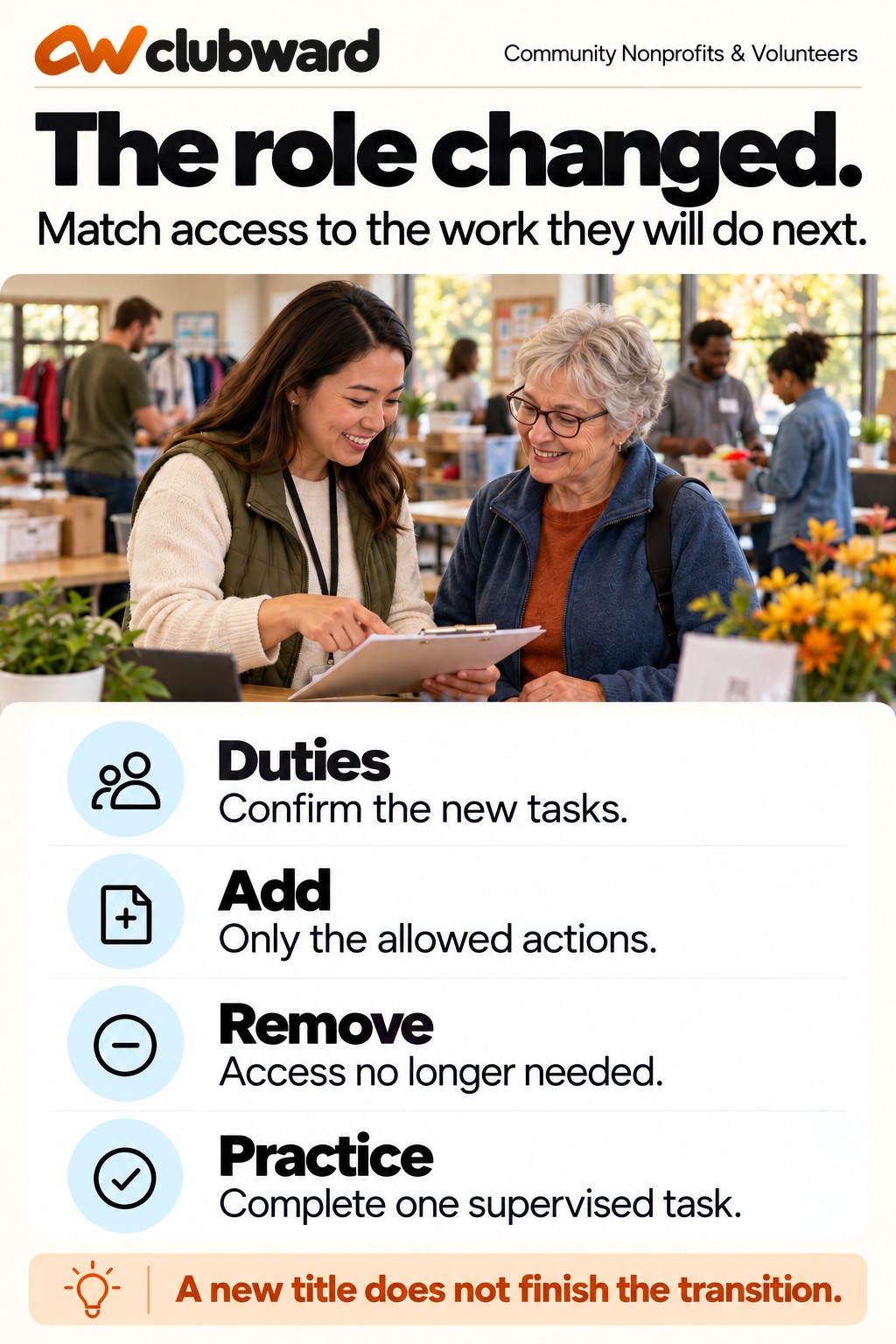
Consider a volunteer who previously prepared event supplies and now supports the Monday welcome desk. The new role involves greeting participants, checking the current room schedule, recording arrivals through the approved method, and directing unresolved questions to the shift lead.
The program lead confirms the duties and boundaries. The volunteer receives access to the permitted arrival information and current desk instruction. The old setup group and supply access are reviewed separately; anything no longer needed is assigned for removal through the appropriate owners.
The volunteer practices three cases with the supervisor: a routine arrival, a participant whose name is not on the list, and a room-change question. They should be able to perform the routine action and identify when the shift lead must decide.
The coordinator checks that the actual access changes are complete and the current instruction is available. If one item remains unresolved, they arrange an approved supervised task or different assignment rather than assuming the volunteer can work independently.
Use the current instruction for the first task
Identify the procedure that applies to the new role today. Confirm its owner and where the volunteer can find it during the shift. A training document shared last season may not describe the current arrival process or escalation contact.
Lead the instruction with the task the volunteer will do first. “Open the current room schedule, identify today's program, and direct the participant to the listed room” is more practical than a broad welcome paragraph about the organization's mission.
Include the routine action, the common exception, and the help route. The volunteer should know what to do when information is missing rather than improvising a decision to keep the line moving.
Keep the language suited to the role. Explain relevant terms and avoid assuming familiarity with an internal system or committee history. A returning volunteer can know the organization well and still need a clear instruction for a different job.
Practice an allowed task and an escalation
Ask the volunteer to complete one representative task using the actual approved instruction and permitted resources. Observe the sequence without supplying every next step. The purpose is to discover an instruction or readiness gap before the live shift.
Then introduce an exception that exceeds the role's authority. For the welcome desk, a participant may ask to join a full session despite not appearing on the list. The volunteer should recognize the boundary and reach the shift lead through the specified route.
Give feedback about the task, not a broad judgment of the person. If they cannot locate the help contact, fix the instruction or resource. If the procedure is clear but the action needs practice, arrange another supervised attempt.
Record what was practiced and which task remains supervised. Reading a guide and completing a task are different readiness checks. Do not describe the role as ready simply because the volunteer opened the document.
Verify the access result through the authorized owner
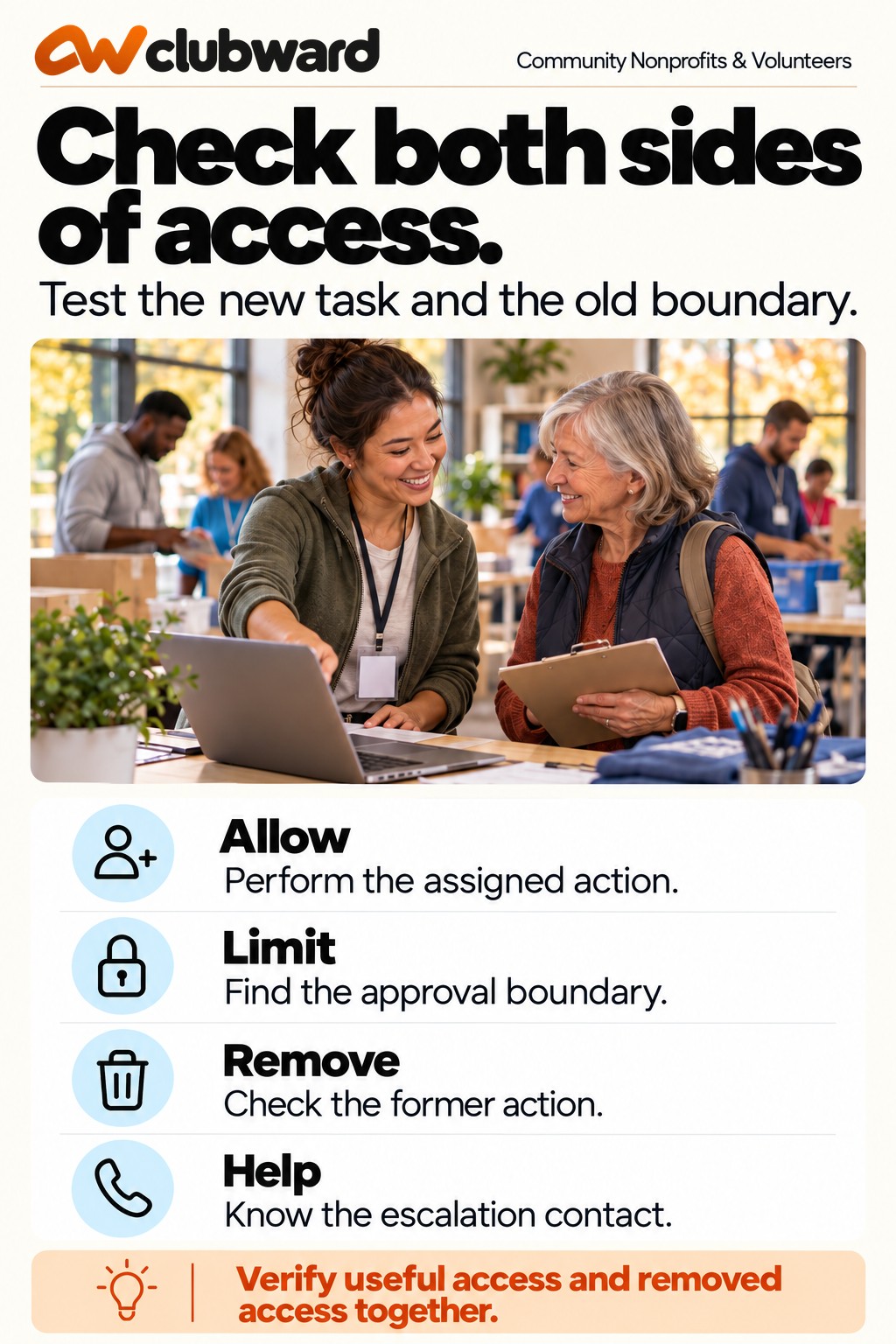
Ask each responsible owner to confirm the actual permission change. Check the scope and the effective date against the transition sheet. A request for welcome-desk access should not be treated as complete if it granted unrelated program-management actions.
Use your normal approved verification process to confirm that required access works and no-longer-needed access has been removed. Do not ask the volunteer to bypass restrictions or use another person's account to complete a task.
If the volunteer encounters an unexpected permission, record the resource and action, then refer it to the authorized owner. The coordinator can describe the mismatch without changing sensitive access outside their responsibility.
Keep verification evidence in the appropriate internal record. The useful completion note identifies the action, owner, and check date. It should not expose credentials or private participant data in a shared shift message.
Plan the first shift around open items
Before the shift, review anything not yet completed. Determine whether the volunteer can perform an approved subset of duties with supervision, needs a different assignment, or should wait for the required change. Follow the role owner's decision rather than improvising at the desk.
Tell the volunteer the actual plan. “You will greet arrivals and use the room schedule; the shift lead will handle attendance until your approved access is ready” gives a clear boundary. “Everything should be fine” leaves them to discover the gap with a participant waiting.
Name the supervisor and backup contact. Confirm that both know the open item and the permitted work. A plan dependent on one person who is unexpectedly absent needs a defined fallback.
Recheck the item when the responsible owner completes it. Do not let a temporary supervised arrangement become the permanent process without review. The transition sheet should identify when the new role can operate as intended.
Handle a role with retained duties explicitly
Some volunteers change their primary role while keeping a limited old duty. Write the retained duty beside the new assignment and identify the resources it still needs. This prevents a necessary permission from being removed blindly or unrelated access from being retained indefinitely.
For example, the welcome-desk volunteer may still return event equipment after the Monday shift. The program lead can confirm that task and the appropriate physical access through the established procedure. It does not imply continued access to every setup planning record.
Set a review trigger when the retained duty ends or changes. The resource owner should know when to revisit the permission. A temporary arrangement needs a clear purpose and endpoint rather than an informal assumption.
Test the retained duty in the same way as a new duty: instruction, necessary resource, decision boundary, and help route. The fact that someone did the task before does not establish that the current procedure remains unchanged.
Give the shift lead a useful transition handoff
Lead with the effective assignment, duties ready for independent work, and tasks still supervised. Include the relevant instruction location and help contact. The shift lead should not need to read the full access-change history to run the program.
Keep private permission details with the authorized owners. The shift handoff can say that attendance access is pending and identify who handles the task. It does not need to include account settings or unrelated participant records.
Ask the shift lead to confirm the actual arrangement before the volunteer arrives. They should know who covers each required duty and what happens if an open item affects the shift. A message sent without acknowledgment may leave the coverage question unresolved.
After the first shift, ask about the task sequence and any unexpected boundary. Did the volunteer find the instruction? Could they reach the lead? Did another employee ask them to do something outside the agreed role? Use those details to complete the transition.
Close the change with evidence, not an assignment label
A completed transition identifies the confirmed duties, applied access changes, removed resources, practiced task, and first-shift outcome. Record any remaining supervised duty separately with its owner and next action.
Do not mark the transition complete merely because the roster shows the new title. The title can be correct while an old key remains unreturned, a permission request is pending, or the volunteer cannot locate the current procedure.
Keep the completion record useful to the next coordinator. They should be able to see why a retained resource is still needed and which owner confirmed it. That context helps later reviews avoid repeating the same uncertainty.
When several role changes expose the same gap, improve the transition method. Add the missing resource owner, clarify a common boundary, or revise the first-task instruction. Choose a change that addresses the observed problem rather than adding another generic reminder.
Include physical materials in the transition check
Look beyond account permissions. A printed arrival list, stored program binder, spare key, or radio can continue giving a volunteer access or responsibility after their assignment changes. Identify each item that belongs to the old role and decide what happens to it.
For a returned item, name the receiving owner and record the actual return through your normal procedure. “Key return requested” is not the same as the key being received. If the item is retained for an approved duty, record that purpose and the appropriate review point.
Check whether a printed instruction still describes the old task. A volunteer can follow an outdated binder confidently because it looks familiar. Give them the current role-specific procedure and identify where the authoritative working instruction is kept.
Do not include unnecessary participant information in the new role's materials. If the welcome task needs a limited arrival list, ask the authorized owner to provide the appropriate version. An old binder should not become the default source simply because it is already on the desk.
Ask the incoming shift lead to inspect the desk setup before arrival. The permitted materials, current instruction, and help contact should be available where the volunteer works. A completed digital permission request cannot repair a physical desk that still presents the wrong procedure.
Prepare a bounded change request for each resource owner
Write the request in terms of the duty and the required result. Identify the volunteer, new role, effective date, resource, allowed action, and authorization through your established process. Keep private access detail in the appropriate channel.
For example, the program lead can request the approved arrival-record access needed for Monday welcome-desk support, while a separate request addresses no-longer-needed setup resources. Keeping the actions explicit makes it easier to verify both sides of the change.
Ask the owner to confirm what was applied, not merely that the message was received. The coordinator should compare the completed action with the authorized scope and record any difference for review. A broad permission change should not be accepted as equivalent to a narrow request without checking it.
When a resource has no clear owner, identify that gap before the shift. The coordinator can arrange the approved temporary work plan while the program lead determines responsibility. Avoid distributing access informally to overcome the uncertainty.
Close each request with its result and verification reference. If it remains pending, keep the duty affected and next action visible. That gives the first-shift supervisor a clear account of what the volunteer can do now.
Review an unexpected request during the first shift
Suppose another volunteer asks the new welcome-desk helper to edit an enrollment record because the line is growing. The helper should use the stated escalation boundary rather than accepting the task simply because a colleague requested it.
The shift lead checks the participant question and assigns it to the authorized owner. Afterward, the coordinator reviews whether the desk instruction made that boundary clear. The issue may require a reminder to the team about the role's limits, not additional access for the new helper.
Record the practical lesson without blaming the volunteer for following the agreed boundary. A role transition works when people can complete permitted tasks and ask for help with other actions. Use the event to improve the handoff so the next shift does not recreate the same informal pressure.
Give the returning volunteer a chance to describe any instruction that was hard to use. Ask about the specific step and revise the procedure with its responsible owner where needed. Keep the updated instruction available to the whole role, so the improvement helps future volunteers instead of remaining a personal explanation that only one supervisor knows.
Bring one role change to Clubward
Clubward supports staff roles and granular access. Bring a volunteer role transition and its checklist to a walkthrough. Ask how the relevant permissions, procedures, and human approvals fit your program's actual responsibilities.
Use a routine task, an old resource to remove, and an exception that needs the shift lead. Include one supervised practice step. The useful test is whether the volunteer can do the permitted work and recognize where their decision authority ends.
Book a personalized Clubward demo around that transition. Your next shift should begin with a clear role, appropriate resources, practiced instructions, and a named person ready to help.
From Clubward Editorial Team
More from Clubward