sports-social-clubs
Plan Next Month's Invitations Around One Member-Reported Barrier
Choose one member-stated participation barrier, prepare a small invitation trial and set a review date for what the response actually shows.

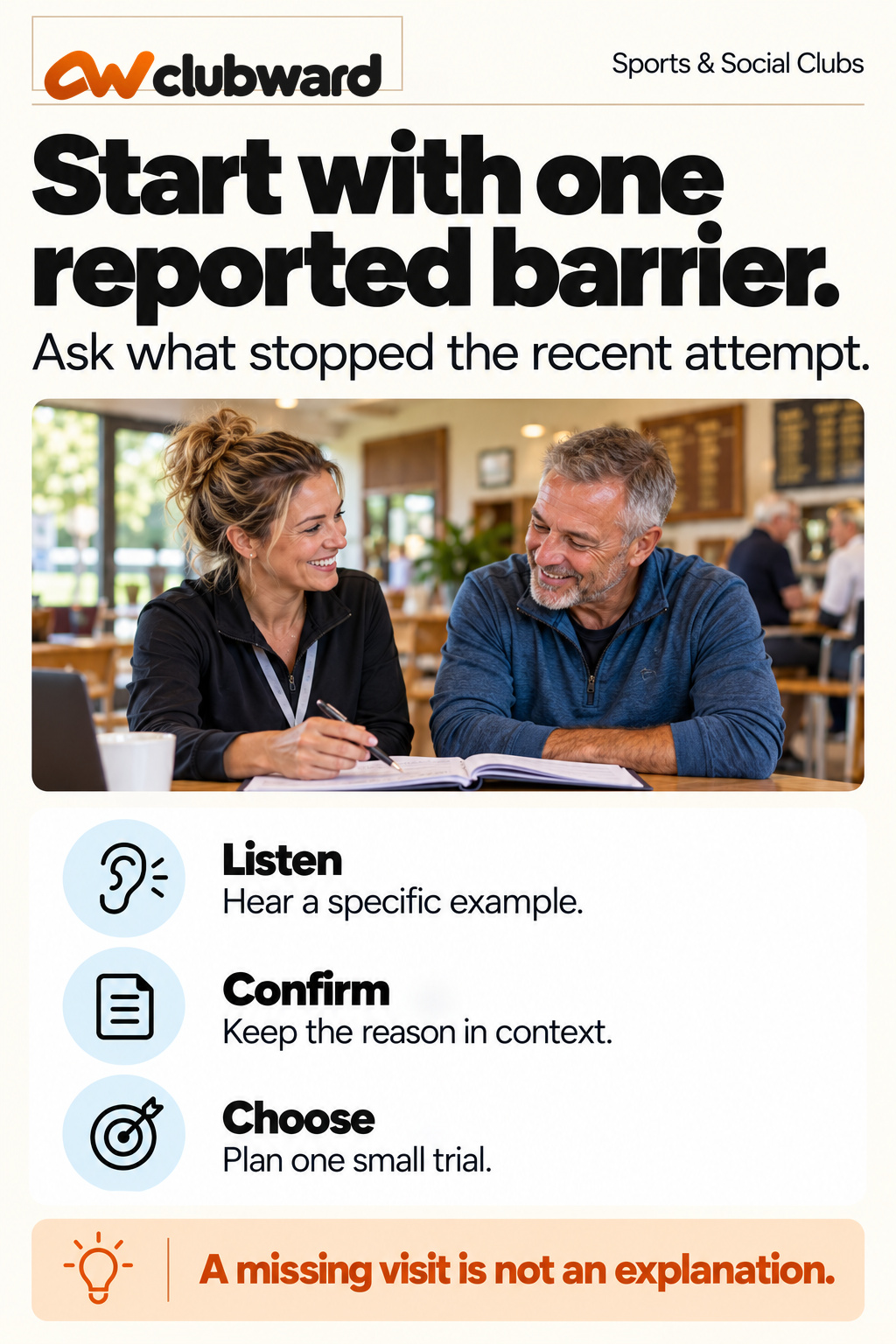
Plan next month's invitations around one barrier a member has actually reported. Ask about a recent attempt to participate, confirm the obstacle in their own context, and choose one small change your club can deliver. Write the audience, offer, owner, and review date before sending. Treat the response as evidence about that invitation, without claiming it explains every quiet member.
A member who has not attended lately may have many reasons, and an attendance record does not supply their explanation. Start with a respectful conversation rather than assigning a motive. Your preparation task is to connect a stated obstacle with a useful next opportunity, not to turn every gap in visits into another promotional message.
Choose a question your club can act on
Select one participation question for the coming month. Perhaps members want to attend an evening social but cannot tell whether arriving alone is welcome. Perhaps a new activity's level is unclear. Choose a question that your membership and program teams can answer through a proportionate change rather than a broad promise to transform engagement.
Define the recent situation you want to understand. Ask about an activity the person considered, how they found it, and what happened next. This gives the conversation an anchor. A general question about why members do not attend can invite guesses or polite suggestions that are difficult to connect with a practical next step.
Separate the question from your preferred solution. If you begin by asking whether a discount would help, you may never learn that the activity time or joining instructions were the obstacle. Prepare open questions first. The GOV.UK Service Manual recommends focusing interviews on people's experiences and asking open questions rather than leading them. Using in-depth interviews explains that approach.
Keep the conversation within the person's willingness to participate. Explain why you are asking and how the information will inform the next invitation. Do not ask for private circumstances that are unnecessary to the operational question. A member can decline to explain their decision, and your club should respect that answer.
Listen for a specific reported barrier
Ask the member to describe the recent attempt in sequence. Which activity did they consider? What information did they find? What did they need before deciding? Let them explain the point that made participation difficult. Record the relevant reason accurately through your approved member-information process.
A reported barrier is the person's stated obstacle, not your interpretation of their absence. I could not tell whether beginners were welcome gives you a useful instruction question. Member lacks confidence adds an inference. Keep the original context so the team can choose a response without treating an assumption as established evidence.
Ask a clarifying question when the practical detail is unclear. If the member says the activity was inconvenient, ask which part of the timing or route they mean, if they are comfortable explaining. Avoid requiring a complete personal account. You need enough information to understand the participation step your club could improve.
Confirm your understanding before planning the trial. You considered the social evening but could not find whether someone arriving alone could join a table is a useful paraphrase. Let the person correct it. Do not turn their answer into a statement about all members or attach a label they did not use.
Distinguish a communication gap from an operating limit
Ask whether the obstacle concerns missing information or the activity itself. If beginners are already welcome but that fact is absent from the invitation, a clearer instruction may be appropriate. If the activity genuinely requires prior experience, changing the wording alone would create a misleading promise.
Check the proposed answer with the person responsible for the program. Can a host greet people arriving alone? Is there a suitable introductory session? Is an alternative time actually available? The invitation should reflect an arrangement the club has agreed to deliver. Do not use a welcoming phrase to conceal an unresolved operating question.
Some barriers may require a larger decision your team cannot make in this small trial. Record that need through the appropriate planning route. Give the member an honest current answer where possible. A focused invitation experiment should not silently change capacity, eligibility, staffing, or another rule requiring separate authority.
Choose the smallest useful response that matches the reported obstacle. That might be a clear arrival instruction, a named host, or a specific description of the activity level. Keep the change connected to the reason given rather than adding discounts, urgency, or several unrelated offers.
Define who receives the invitation
Use the reported reason to define the initial audience through your approved communication process. If one member expressed a joining question, start with the people for whom that question is actually relevant and whose contact preferences permit the message. Do not assume an entire inactive list shares the same barrier.
Keep the audience decision understandable to the team. Describe the operational context without exposing private explanations in a broad campaign brief. For example, members who asked how to join the introductory session is more precise than disengaged members. The first description connects the invitation with a question your club knows exists.
Check for duplicate or conflicting contact. A member should not receive several near-identical messages from different staff because each team prepared its own list. Name one invitation owner and use your existing coordination process. Keep the communication relevant to the agreed question rather than adding every upcoming event.
Respect a person's decision not to receive follow-up or not to discuss the topic further. Do not treat a declined conversation as another engagement problem to fix. Use the contact and preference rules your club already applies. The trial should support a useful opportunity while preserving a respectful relationship.
Write one intent-matched invitation
Begin with the activity and the practical answer the member needs. If the barrier was uncertainty about arriving alone, explain the agreed joining route. Name the time and location, the person welcoming arrivals if confirmed, and the action needed to reserve or respond. Keep the wording direct and proportionate.
A possible invitation reads: you asked how to join the next social evening when arriving on your own. Our confirmed host will meet arrivals at the welcome table before the session. Here is the event time and the reservation route. Reply to the membership contact if you need help finding the current details.
Replace that wording with the actual arrangement your club has approved. Do not imply a host exists merely because the sample sentence includes one. The invitation should answer the member's question early, then provide one next step. Avoid an exaggerated promise that the activity will solve loneliness or improve wellbeing.
Keep the message focused. The member should not need to read a long account of your research or a campaign rationale to find the joining instruction. Those notes belong in your internal preparation. The public message should describe the useful opportunity and the practical action the person can take.
Prepare the operating side of the offer
Ask the program owner to confirm that the promised arrangement is ready. If the invitation names a host, confirm the assignment and the backup route. If it describes an introductory level, confirm the activity content. If it offers help with reservation, ensure the named contact can answer through the agreed process.
Check capacity and availability before directing people to a place. A clear message can still produce a poor experience if the next step leads to a full activity with no useful answer. Use the club's current reservation and eligibility rules, and prepare the response for a member who cannot obtain a place.
Give the front desk the same practical instruction. If a person arrives because the invitation explained a welcome table, staff should know where that table is and who is covering it. The member should not become the messenger between marketing and the operating team.
Decide what happens if the offer changes after sending. Name who updates the member, the reservation record, and the receiving staff. Keep the revised instruction connected to the original invitation. Avoid leaving the old promise in circulation while the team works from a different plan.
Choose a review date before sending
Set a review point connected to the activity and the question you are testing. For an invitation to a particular session, review the relevant responses and the completed operating handoff afterward. Do not choose a review date so early that the member has had no reasonable chance to consider the opportunity.
Write what the trial can establish. You might learn whether recipients understood the joining route, whether they used the next step, and whether the operating team delivered the promised arrangement. Those are different observations. Decide which matters to the original barrier and how you will check it appropriately.
Choose the evidence your existing records can support. A delivered message does not prove it was read. A reply does not prove attendance. A completed reservation does not explain the person's reason for joining. Keep those distinctions in the review so a neat report does not overstate what happened.
Assign the review owner and the next decision. The owner should bring the observed result, any remaining member question, and a recommendation to continue, change, or stop the trial. The review should lead to a proportionate action rather than automatically expanding the audience after one favorable reply.
Work through a joining-route trial
Suppose a member considered a weekday social evening but did not reserve because the invitation seemed to assume people would attend with friends. In a conversation, they ask how someone arriving alone would join. Keep that stated question as the trial's starting point, without inventing a broader explanation for their participation history.
The program owner confirms a welcome-table arrangement and a host for the next session. The membership team prepares one invitation explaining that route, with the current reservation step. The desk receives the same instruction. The trial changes the joining information and handoff; it does not promise a different activity or unlimited capacity.
Before sending, the owner writes the review question: did the invitation make the arrival route clear, and was the promised welcome available? Afterward, the team checks the evidence it is authorized to use. A member's reply about understanding the route can inform the communication question, while the host's check informs the operating question.
If the member does not reserve, avoid declaring the trial a failure without further context. They may have made another choice for a reason they have not shared. Record the absence of a reservation accurately. If appropriate and welcome, offer one respectful chance to clarify the remaining question rather than repeatedly chasing participation.
Work through a level-description trial
Consider a different reported barrier: a member could not tell whether a club activity suited someone new to it. The team should first check the actual program level and support arrangement. If the activity is suitable, the invitation can describe the expected starting point and the help available.
If it is not suitable, provide an accurate alternative only when one is confirmed. Do not label an advanced session beginner friendly simply to make the invitation more appealing. The operating answer must come before the copy. Record any need for a new introductory offering through the appropriate program planning route.
For a suitable activity, keep the next step simple: view the confirmed session details and use the normal reservation route. Explain what participants should bring or know where relevant. Avoid overwhelming the invitation with every option the club offers. The purpose is to answer this joining question.
Review whether the description and actual session agreed. If the member's remaining question concerned equipment or arrival, record that narrower obstacle for the next preparation step. Do not assume that one clearer description resolves every participation barrier for every new member.
Record responses without assigning motives
Keep the response log tied to the invitation and the stated question. Record the next action taken or the reason the member voluntarily gives. If no response is received, record no response rather than uninterested. If the member declines, preserve the actual answer without replacing it with a judgment about commitment.
Use exact counts only when the underlying record supports them, and explain what they count internally. Invitations sent, replies received, reservations completed, and actual visits are separate stages. Do not combine them into a single success total. A small trial can inform a practical decision without pretending to establish a general participation trend.
Keep private member explanations out of a widely shared results summary. The program team may need to know that joining instructions were unclear without receiving the person's full account. Follow your existing information and permission process. A useful operational lesson should not require unnecessary personal disclosure.
If the evidence is incomplete, state the open question. Perhaps the team knows the invitation reached the contact route but has no reliable observation of the next step. Do not fill that gap with an assumed outcome. Choose the next proportionate check or leave the result unresolved.
Decide whether to continue, change, or stop
At the review, compare the result with the original barrier. If the practical answer was clear and the operating arrangement was delivered, consider whether the same instruction would serve other members with that known question. Keep the audience expansion connected to evidence and your existing communication permissions.
If the invitation was understood but the promised arrival arrangement was not delivered, repair the operating handoff before sending another version. More appealing copy will not resolve a missing host or an unclear desk instruction. Name the task owner and confirm readiness through the normal procedure.
If the barrier was misunderstood, return to the member's explanation where appropriate. A useful correction may be smaller than a new campaign. For example, the issue might be a particular timing detail rather than arriving alone. Record the corrected understanding and choose one response that fits it.
Stop the trial when the offer is no longer available, the audience does not want follow-up, or the evidence does not justify continuing. A respectful stop is a valid planning decision. Keep the lesson in the next month's preparation notes so the same unsupported assumption is not repeated.

Prepare a one-page invitation brief
Write the reported barrier, relevant audience, confirmed offer, one next step, operating owner, communication owner, and review date. Add the evidence you will use and the conclusion it can support. Keep the member's private context in its authorized location rather than copying it into the brief.
Ask the receiving team to read the brief and explain the promised experience. If the program owner and membership contact describe different arrangements, resolve that before sending. The brief should connect the invitation with the actual activity, not become a separate planning document nobody uses.
Keep the public message free of internal labels and rationale. Members do not need to be told they are part of a barrier-based trial. They need an accurate useful invitation and a respectful choice. The internal record should support learning without turning the communication into an account of your production process.
Check the reservation route before the message goes out
Follow the next step from the finished invitation. Check that it leads to the intended activity, displays the current time and location, and gives the member a usable action. A helpful explanation of arriving alone loses its value if the reservation route opens a different session or an outdated event description.
Ask the invitation owner to compare the route with the operating plan. If the activity has limited places, the next instruction should use the current availability and your established rules. Do not promise a reserved place merely because the message was sent personally. Keep eligibility and reservation confirmation distinct from the invitation itself.
Check the response route as well. If members are invited to reply with a question, identify who receives it and who covers that contact while the owner is away. Prepare the answer to the likely joining question. An unattended inbox can recreate the uncertainty the trial was meant to address.
If the next step is unclear, correct it before sending. Record the specific repair internally and follow the revised route once more. The member-facing invitation should contain the useful answer and action, without a note about the team's checking process. Keep production details separate from the opportunity the member sees.
Keep the invitation useful for someone who declines
A member may appreciate a clear joining route and still choose not to attend. Make that choice easy to communicate when a response is appropriate. Avoid wording that implies they owe the club a visit because someone listened to their question. The conversation should support participation while preserving their freedom to decide.
If the member offers another reason, record it accurately through the approved process and ask whether they want any further help. Do not immediately turn that answer into a second promotional offer. The next action might be answering a practical question, sharing a confirmed alternative, or simply acknowledging the decision.
At the review date, separate the usefulness of the answer from the attendance outcome. The member may say the joining instruction is clearer without making a reservation. That tells you the wording helped answer their joining question. Keep the lesson proportionate so next month's plan builds on what the club actually learned.
Keep that distinction visible when the team chooses its next invitation to prepare.
Connect the invitation with the member's next step
Clubward's member experience workflow connects members with program information and reservations through a member portal. Its programs and shared spaces tools include shared-space reservations and program planning. Use these concrete tasks to examine how your club supports the opportunity described in the invitation.
Bring one member-reported barrier, with private information removed, to a personalized Clubward demo. Show the confirmed offer, the joining route, and the staff handoff. Follow the member's next step rather than assuming a missing visit supplies their reason. That gives your team a practical invitation workflow to discuss for next month's invitations.
From Clubward Editorial Team
More from Clubward