community-recreation-centers
Next Week's Room Blocks Are Set. Did You Allow for Setup and Staffing?
Build room blocks around setup, session coverage, departure and reset, then confirm who owns the transition to the next program.

Review next week's room blocks as complete operating windows: setup, participant arrival, the session, departure, and reset. Then put the required staff roles beside those periods. A room can look free between two classes while the people preparing it have no workable transition. Choose one busy changeover and check it with the instructor, front desk, and setup team before Monday.
Begin with the actual work, not a standard buffer copied onto every booking. A seated discussion and a movement class may need different arrangements. Your plan should show what must change, who changes it, and when the room becomes ready for the next group. Where an answer is uncertain, name the person who will confirm it.
Find the transition worth checking first
Choose a pair of programs that share a room and require a meaningful change between sessions. Look for a furniture change, equipment movement, different arrival pattern, or a staff role that serves both programs. The first review should answer a real next-week question rather than building a complicated model of every possible use.
Read the current program and room records together. Confirm dates, session periods, location, and any approved changes. Include the people expected to prepare the room. If one team has a revised plan while another has the old arrangement, resolve that disagreement before calculating a transition period.
Ask which moment is most vulnerable. It may be early participant arrival, an instructor leaving before equipment is returned, or the setup team finishing another task elsewhere. Write that moment as a concrete question: who prepares the tables while the desk receives the next group? This will guide the rest of the review.
Keep the scope to coordination. Use your center's approved capacity, accessibility, equipment, and safety procedures for the underlying requirements. This plan does not supply universal staffing ratios or room limits. It helps you put your actual requirements into the next week's working schedule.
Separate the session from the room block
The session period describes the activity participants attend. The room block should also reflect the preparation and reset work your center needs. Give those periods their own start and finish in the working plan. Do not assume the advertised class time includes every task merely because the room reservation uses the same label.
List what must be ready before participants enter. Depending on the program, that may include furniture, equipment, materials, an instructor check, or directions at the desk. Use the approved setup instructions rather than guessing from the program title. A general label such as arts class may cover several different arrangements.
List what must happen after the activity. Identify which materials are returned, which arrangement is restored, and who confirms that the space is ready for the next use. Include departure work where your procedure requires it. An instructor ending the teaching does not necessarily mean the room is available immediately.
Keep the public session time clear while recording the operating window internally. Participants need an accurate arrival instruction; staff need the preparation period as well. Sending the entire internal schedule to families may create confusion, while omitting it from the staff plan can leave the work without a place to happen.
Describe the actual setup tasks
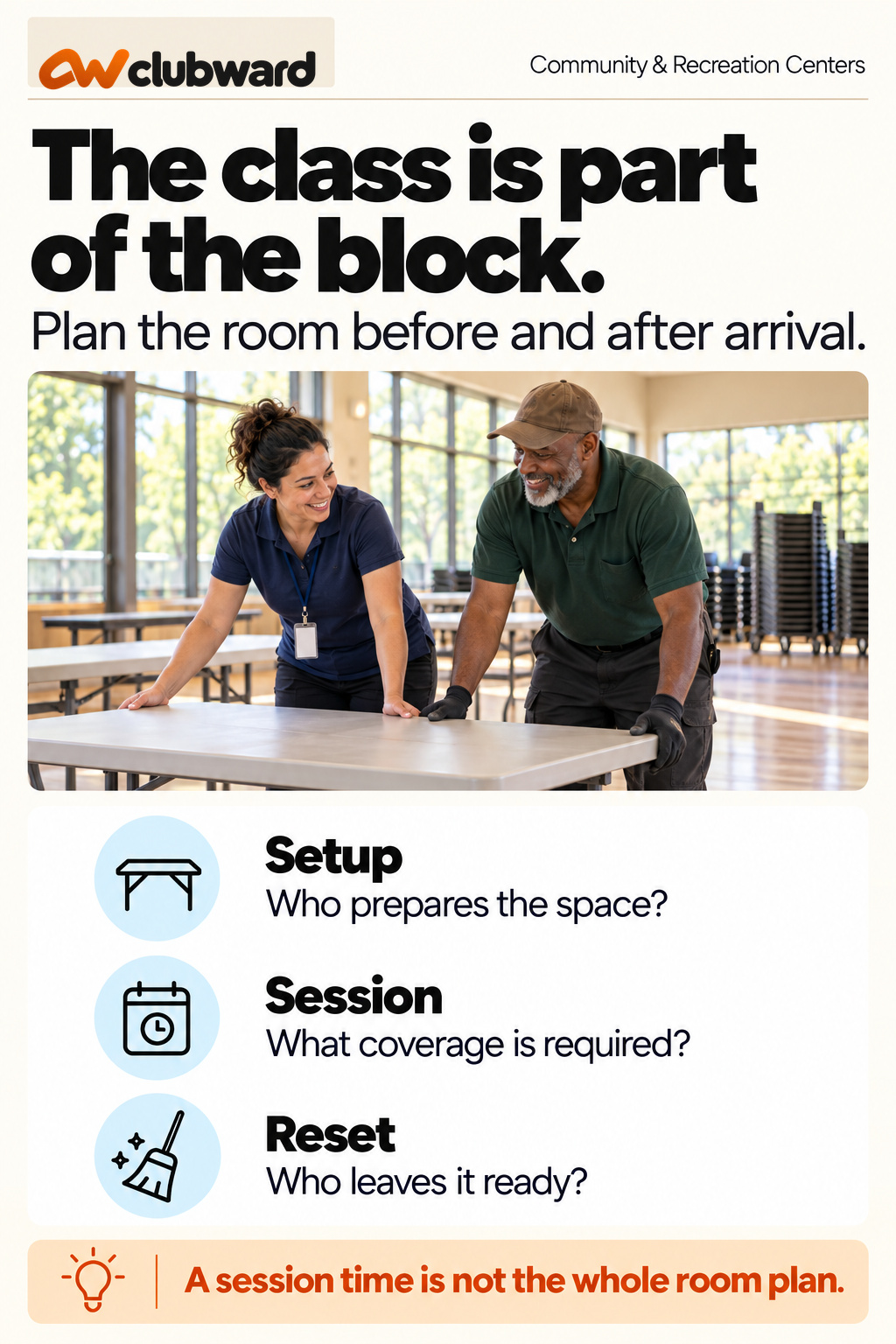
Walk through the room arrangement with the person doing the preparation. Name the tasks in order: retrieve materials, move the approved furniture, place equipment, check the arrangement, and make the room available. Remove tasks that do not apply. Add any locally required checks through the procedure your team already uses.
Identify dependencies. If equipment cannot be brought in until another group leaves, show that relationship. If materials can be prepared in an approved storage area beforehand, distinguish that work from work requiring the room itself. This helps you avoid treating every preparation task as though it needs exclusive room time.
Ask how the task duration will be established. Use an observed ordinary setup or the responsible team's confirmed estimate, and label an estimate as an estimate. Do not present a guessed buffer as measured evidence. If the period matters to a tight changeover, confirm it before relying on it.
Check who has access to the necessary equipment and space. A person can be available on the schedule yet unable to retrieve materials or open the room. Resolve those practical conditions through your normal access process. The preparation plan should not depend on borrowing credentials or finding an unavailable colleague.
Plan the reset for the next program
Ask the next instructor what ready means for their session. The answer may differ from the default room arrangement. Compare it with the departing group's reset instructions so nobody assumes another team will move the tables. Record the agreed handoff point and the person who checks it.
Separate reset ownership from teaching responsibility when your operation uses different people. An instructor may return materials while a setup employee changes furniture. Name both tasks and the shared completion check. A single broad instruction to clean up can leave important work unnamed.
Include the transition's endpoint. Room reset complete is useful only if everyone understands the condition it describes. Write the arrangement or check that establishes readiness. If the next group needs a different configuration, the endpoint should reflect that configuration rather than merely an empty room.
If the reset period is uncertain, prepare a question for the responsible team before the week begins. Avoid solving the uncertainty by shortening the period in the calendar. A neat timetable does not establish that the work can be done. The plan should reflect the work your team confirms is feasible.
Put roles beside each period
For the chosen transition, name the required roles across setup, arrival, session, departure, and reset. Use duties rather than headcount alone. Two people present in the building do not establish that one can greet arrivals while the other completes the room arrangement. Check the actual assignment and permitted task.
Look for a person assigned to overlapping work. If the front desk lead is also named for furniture setup, ask who receives participants during that period. If an instructor is expected to prepare a room while still teaching elsewhere, flag the conflict. Do not count one person's availability twice.
Confirm coverage with the people responsible. A draft schedule may contain a name without an accepted assignment. Record the current coverage state and the owner of any open role. If a substitute is required, check readiness for the task and the approved decision route rather than assuming any available person can perform it.
Keep staffing decisions within your center's procedures. The preparation sheet should show what work requires coverage and where a gap remains. It should not invent a qualification, ratio, or authority level. Bring those questions to the person responsible and record the resulting requirement in the plan.
Work through a sample room transition
Suppose a discussion group finishes at 5:00 and a craft session begins at 5:30. For this example, the team confirms that departure takes ten minutes, changing the room arrangement takes fifteen minutes, and the next instructor needs ten minutes to check materials before participants enter. Confirm your own periods with the operating team.
If those tasks must happen in that sequence inside the room, they need thirty-five minutes after the discussion finishes. The thirty-minute gap does not fit the confirmed sequence. The issue is not simply that the calendar is busy; it is that the actual transition ends after the next session's planned start.
Now ask which dependency can change through an approved practical arrangement. Perhaps materials can be prepared earlier in another suitable area, or the instructor check can occur alongside the furniture change if the responsible team agrees. Alternatively, the next session time or room may need review. Do not choose a solution before confirming its feasibility.
| Period | Sample task | Question to resolve |
|---|---|---|
| 5:00 to 5:10 | Discussion departure | Who supports the departing group? |
| 5:10 to 5:25 | Room arrangement change | Who completes the furniture task? |
| 5:25 to 5:35 | Instructor materials check | Can this happen earlier or alongside approved setup? |
The next decision should identify an approved sequence, its owners, and the revised participant instruction if needed. Do not claim the transition is solved merely because a buffer label was added. Recheck the resulting periods and ask the receiving instructor to confirm the readiness endpoint.
Check arrival against setup
Find the earliest arrival your center tells participants to make for the chosen program. Compare it with the room-ready time. If the instruction encourages people to arrive before the room is available, decide where they should go through your normal procedure and who explains that route.
Give the front desk a current answer. Include the room, session time, arrival route, and contact for an unresolved change. The desk should not have to determine whether the setup team has finished by interpreting an internal calendar note. Identify how readiness is confirmed and communicated.
Consider the people arriving for other programs at the same time. A setup task that pulls the only assigned desk person away may affect more than the selected class. Review the overlapping duty and agree coverage before Monday. Keep the solution proportionate to the actual work and your center's approved operation.
If the arrival instruction changes, update the relevant routes deliberately. Check the participant notice, instructor instruction, and desk information. A new room block is not a completed communication handoff. Name the person who confirms that the affected audience received the current practical answer.
Check equipment shared between rooms
Identify equipment needed by both programs or by another session in a different room. A room may be available while its equipment remains in use elsewhere. Record where the item starts, who moves it, and when it becomes available for the next task. Use the actual inventory and approved handling instructions.
Look for a movement task hidden between two bookings. If a staff member must return equipment before collecting another set, show that sequence beside their assignment. Do not assume the room's reset period and the equipment's movement period are interchangeable. They may need different people or different access.
Where a substitute item is possible, obtain the instructor's or responsible person's agreement through the normal route. Do not quietly change a program's equipment to fit the timetable. Record the approved alternative and the instruction staff need. If no alternative is confirmed, keep the requirement open.
Before the week begins, check one shared item at the actual transition point. Can the assigned person locate it and follow the movement route? Does the receiving team know when it will arrive? A practical check can identify missing context without requiring a redesign of every room booking.
Prepare the instruction for a changed plan
Choose a named owner for a room or coverage change during the week. State who may decide the change and who communicates it. A front desk employee might report a problem without having authority to relocate a session. Keep the report, decision, and notification responsibilities distinct.
Prepare a compact change instruction containing the affected program, current location, effective period, participant route, and contact. Add the setup consequence and coverage consequence in the appropriate staff record. Avoid a message that announces the new room but leaves equipment and staffing attached to the old one.
Check the receiving instructor's acknowledgment through your established process. If a person has not received the change, identify the next contact route. A sent message does not establish that the person preparing the class is working from the new arrangement. Make that remaining step visible.
Do not create a universal fallback room. Any alternative must meet your center's actual requirements and availability. Prepare the decision route for an unsuitable or unavailable space instead. A clear holding instruction is more useful than an assumed relocation that creates another conflict.
Use a preparation sheet for one busy block
Write the program, room, public session period, and internal operating period at the top. Beneath it, list setup, arrival, session coverage, departure, and reset in sequence. Give each stage an owner, confirmed condition, and open question where needed. Keep the sheet short enough for the involved team to review together.
Attach or link the current approved arrangement in its normal location. Do not redraw a floor plan from memory or circulate an outdated diagram. If the arrangement has changed, identify who confirms the new version. The sheet should point to the operating instruction rather than create an unofficial competing version.
Use the sheet to mark unresolved work honestly. Equipment location needs confirmation or reset owner not assigned describes an action. Ready should mean the agreed preparation conditions have been met. Avoid turning every blank cell green to make the plan look finished.
Give the final check to a person who understands the whole transition. Individual tasks may be assigned correctly while their sequence still conflicts. Ask the reviewer to follow the room and the people through the entire block, then identify the first moment that does not have a feasible answer.
Review the block with the operating team
Bring the instructor, setup representative, and desk lead into the review through the route your center uses. Ask each to describe their first task and the condition they depend on. Compare those answers with the working plan. Different assumptions are useful findings to resolve before participants arrive.
Check a normal transition rather than rehearsing an unrealistic perfect day. Use the confirmed task sequence and current assignments. If an estimate needs testing, arrange an appropriate practical check. Record the observation and its context without treating one attempt as a guarantee for every future session.
Ask what happens if a required person is absent or the preceding session finishes late. Identify the authorized decision route and current holding step. Do not make the team invent an alternative during the rehearsal. The goal is to establish a usable response within your approved procedure.
Record the decisions made and the questions that remain. Give open questions an owner and return time. Before Monday, compare the revised plan with the current calendar and desk instruction. The preparation meeting is useful when its result reaches the people doing the work.
Learn from the first transition
After the chosen block runs, compare the expected sequence with the observed work. Record which preparation and reset tasks occurred as planned and which encountered a problem. Keep participant information private. The follow-up should explain the coordination issue, not turn individual attendance details into a public report.
Separate an unusual event from an unclear routine instruction. If equipment was unavailable because its location was never assigned, improve that handoff. If a one-time disruption affected an otherwise understood sequence, record the event and review the relevant response. Choose the next action from the evidence available.
Change one practical element when appropriate and check it again. That might be the setup owner's notification route, a confirmed preparation period, or the readiness acknowledgment. Avoid claiming that the change improved attendance or saved staff time unless your actual evidence supports that conclusion.
Carry the confirmed arrangement forward into the next week's plan. Keep the original source and the responsible owner clear. A successful transition should improve the instruction the next team uses rather than remain a story known only to the people who happened to work that evening.
Choose the change that resolves the actual conflict
When the transition does not fit, compare possible changes by the dependency they address. Moving a materials task earlier helps only if it no longer requires the occupied room. Assigning another person helps only if the task can safely and appropriately happen alongside the other work under your approved procedure. A later session time helps only if the resulting arrival instruction is feasible.
Write the effect of each option before choosing it. For the worked transition, an earlier instructor materials check would remove ten minutes from the sequential room work only if that check can genuinely occur beforehand. Do not subtract time merely because the task is renamed. Ask the responsible instructor to confirm the changed sequence.
Consider who else the change affects. A different room may require new participant directions and equipment movement. A changed start time may affect the instructor's next assignment. Additional setup coverage may alter another duty. Record those consequences through the appropriate planning route instead of treating the selected room block in isolation.
Choose the option your center can actually deliver and document its owner. If none is confirmed, keep the conflict open and bring it to the authorized decision maker. A working plan can contain an unresolved decision honestly; it should not display a completed transition that the operating team has not accepted.
Check the plan from the next team's position
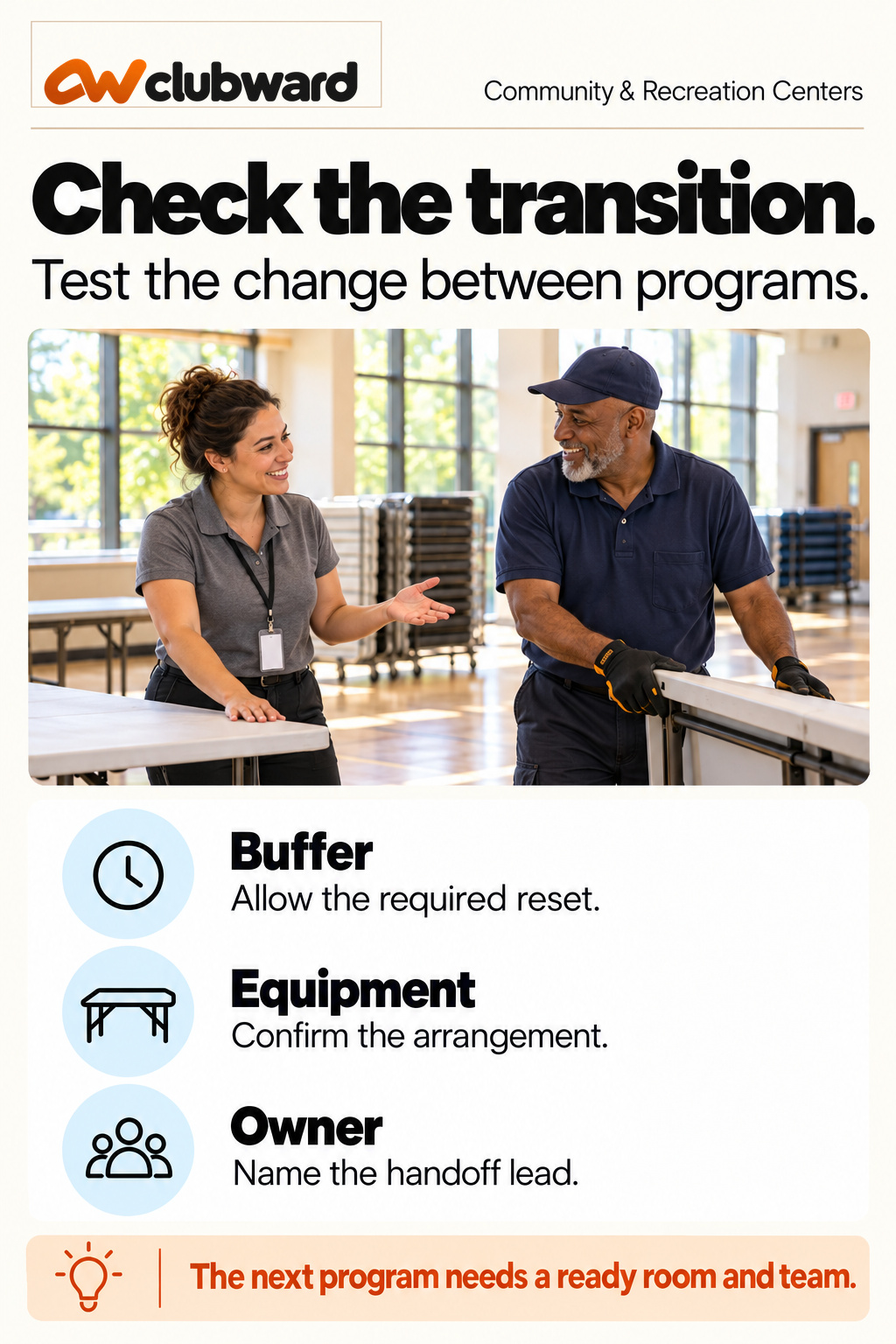
Ask the receiving team to begin with only its normal instruction. Can it identify the room-ready point, the equipment it will receive, and the person confirming the handoff? This checks whether the plan carries enough context across the transition. The departing team's knowledge should not be the only source of the answer.
Then check the last departure task. Does its owner know the condition the next team needs, or only the condition the previous program prefers? Resolve that difference before the schedule begins. A useful transition has an agreed endpoint on both sides, with the current instruction available where each team works.
Check the agreed endpoint again after a material program change. The previous arrangement may remain useful, but the current room, equipment, coverage, and arrival instruction must still describe the same transition.
Connect the room plan with your team
Clubward's programs and shared spaces workflow includes program planning and shared-space reservations. Its staff operations tools include schedules and coverage review. Use those connected tasks to examine the room block and the people who prepare it in your selected setup.
Bring the chosen transition to a personalized Clubward demo. Show the session period, the preparation work, the equipment handoff, and the coverage question. Follow the plan from the first setup task to the next group's arrival. That gives your recreation team a concrete room workflow to discuss before the coming week begins.
From Clubward Editorial Team
More from Clubward