sports-social-clubs
How Sports and Social Clubs Can Evaluate the Full Member Journey
Follow one person from joining through booking, arrival, change, and a reviewed next action to evaluate a club platform as a complete operation.

A sports or social club platform should be evaluated by following one person from interest to a meaningful return visit. Membership, reservations, events, access, and engagement may all appear on a feature list, but the operational value comes from the connections between them. If each step creates a new record or a new staff conversation, the club still carries the member journey by hand.
Use one realistic prospective member as the thread. Give the person a reason to join, a preferred activity, a first booking, an event they might attend, and one change that tests follow-through. The scenario should help membership, operations, and program staff answer a shared question: can the platform support the next useful action without turning participation into a generic sales signal?
Map the journey before reviewing the product
Write the steps your club wants a new member to experience. Begin with inquiry or invitation, continue through joining and orientation, then include the first reservation or activity, the first arrival, and a reason to return. Mark where staff currently re-enter information, send individual reminders, or depend on memory. These are the handoffs the evaluation should expose.
Keep the map specific to the club. A racquet club may focus on courts, clinics, and social play. A civic or social club may focus on events, rooms, interest groups, and recurring gatherings. A multi-activity club may need to understand which part of membership drew the person in. The test should reflect the decisions your team actually makes rather than forcing every organization into the same funnel.
- Join: give the person a clear first step and preserve the chosen membership context.
- Book: show useful availability and the rules that shape the choice.
- Attend: make arrival welcoming and operationally clear.
- Participate: connect the person to the event, program, facility, or group they selected.
- Change: handle a cancellation, waitlist, or schedule update without losing context.
- Return: help staff identify a relevant next step that still receives human judgment.

Begin with the first promise
Ask the presenter to create the member’s starting point. What information is collected, what does the person choose, and what does staff need to review? The first interaction should create useful context without demanding unnecessary detail. Ask how the person learns what happens next and how a staff member can see an incomplete step.
Continue into membership. Confirm that the member’s household or individual context matches the club’s model. Ask how access, communications, interests, and relevant permissions relate to the membership. Do not assume that a completed payment or form means the person is ready to participate. Define the club’s operational meaning of active and test how the platform represents it.
Add one decision that needs a person. The prospective member asks about a category, access condition, or first activity that falls outside the easiest path. Watch whether the question reaches the right employee with enough context to answer it. A status without an owner is not a workflow, and an automatic message should not replace judgment where the club has intentionally kept it.
Move directly into the first booking
Have the new member find and book a court, room, activity, or event that fits the original interest. Ask what availability means. Is it only an empty time, or does it reflect the applicable rules, capacity, and member eligibility? The system should help the person make a valid choice and help staff understand why the booking is allowed.
Change the booking. Move the time, add a guest where appropriate, or switch to another activity. Check whether the member receives a clear update and whether staff see the current plan. The change should not create a second version that remains active in another view. Ask how the member can tell which confirmation is current.
At arrival, give the front desk or host the scenario. That person should be able to confirm the member, the booking or event, and any immediate next action without searching unrelated systems. If the member is early, brings a guest, or asks where to go, the employee should not have to reconstruct the membership story.
Ask what happens after every change
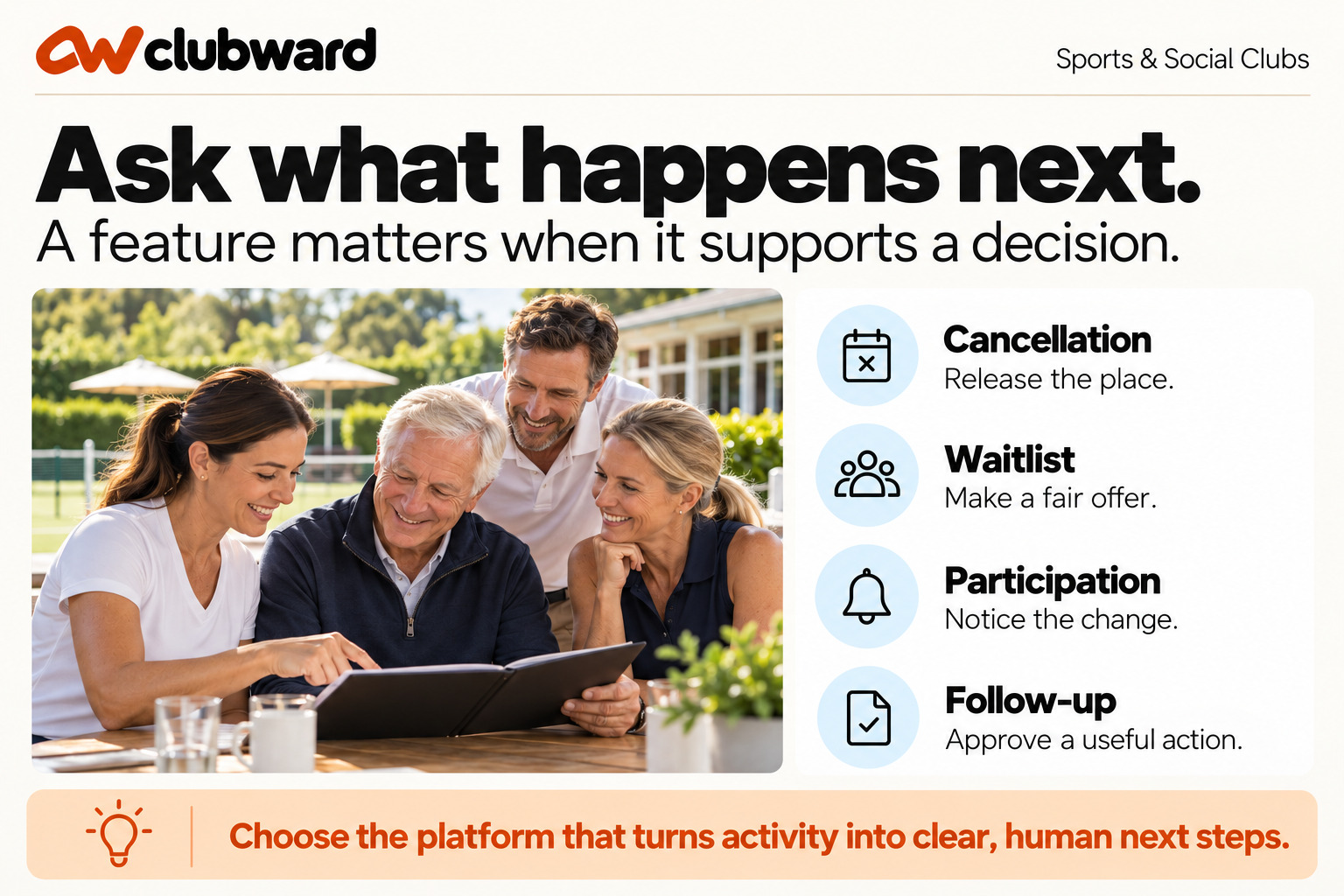
Cancel the first booking. Ask whether the place or time becomes available according to the club’s process and what the member receives. If another person is waiting, test how an offer is made and what happens if it is not accepted. A waitlist is not useful merely because names can be stored; the offer, time window, ownership, and final place must remain clear.
Then change the participation pattern. The member attends one event but not the next, books a facility without joining the related group, or cancels twice. The club should not jump to a conclusion. The evaluation should show whether authorized staff can see relevant operational context and decide whether a welcome, reminder, schedule change, or no action is appropriate.
Ask the presenter to distinguish a signal from a decision. Participation information can prompt attention, but it should not manufacture a claim about a member’s satisfaction or intent. The most credible workflow gives a staff member enough context to review a suggested next step and preserves human approval before outreach.
Score the member journey as an operation
Use a four-point score: one for a separate manual process, two for repeated workarounds, three for a connected workflow with one named manual step, and four for a connected workflow with clear ownership throughout. Keep a short evidence note with every score and identify non-negotiable dimensions before comparing products.
- Identity continuity: Does the same person remain understandable from joining through participation?
- Useful availability: Do booking choices reflect the rules and eligibility that matter?
- Arrival clarity: Can staff welcome the member and act without rebuilding context?
- Change handling: Do cancellations, waitlists, and schedule changes reach affected people?
- Participation context: Can authorized staff understand activity without making unsupported assumptions?
- Human follow-up: Is a suggested action reviewable, relevant, and owned?
- Record quality: Can another employee understand what happened and what comes next?
Do not reduce the decision to a single total. A high score for appearance should not offset a weak arrival workflow or unclear member identity. Ask each evaluator to choose the two dimensions most important to the club’s strategy and the one weakness they believe would create the most staff work.
Include membership and operations in the same room
Membership staff understand joining and communication. Operations staff understand reservations, arrivals, and facility consequences. Program or event leaders understand participation. A platform evaluation should include all three perspectives because the member experiences them as one club.
Assign roles during the demonstration. One person acts as the member, another handles joining, another owns the booking or event, and another works the arrival. Change the booking after the membership employee has handed it off. The exercise makes missing context visible and prevents a polished membership flow from hiding operational work.
Ask what happens when the usual employee is unavailable. Can another authorized person continue from the record? Are there clear assignments and unresolved items? If the original staff member must summarize the member’s story in a private message, the club still depends on individual memory.
Evaluate relevance without overreach
Engagement features should be judged carefully. A club can use participation, reservations, and membership activity to notice a change, but a data point does not explain why the change occurred. Evaluate whether the platform keeps the underlying context visible and allows a person to review any suggested action.
Test three possible responses to the same signal. A cancellation may call for no outreach, a practical schedule suggestion, or a personal check-in from someone who knows the member. Ask how staff choose, approve, and record the action. The platform should support the club’s judgment rather than replacing it with a generic message.
Define who can see participation context and who can initiate communication. The membership director, activity lead, and front desk may need different information. Review permissions using the scenario and confirm that a temporary event volunteer does not receive broad member visibility simply because they support one arrival.
Test a policy and calendar change
Change a booking rule, event capacity, or program schedule. Ask how existing commitments are handled, how members learn the effective date, and how staff identify bookings that need review. The change should not silently invalidate a member’s plan or leave two versions active.
Then create a facility or event interruption. Move the activity, cancel it, or substitute a host. Follow the member message, staff assignment, arrival information, and any next step. This reveals whether the calendar is simply a display or part of a connected operating workflow.
Record every remaining manual step and decide whether it is intentional. A personal welcome call may be a valuable chosen step. Re-entering the same cancellation in three places is not. The evaluation should distinguish high-touch service from avoidable duplication.
Plan a first journey for implementation
Select one membership type, one activity or facility, one arrival process, and one follow-up scenario for the first phase. Identify the records, rules, roles, and messages required. Name the people who approve the setup and the employees who run the acceptance test.
Repeat the demonstration as the launch test: join, book, attend, cancel, move a waitlist place, review a participation change, and approve or decline a follow-up. Use desktop and mobile views where staff will work. The journey is ready when each role can complete its part and explain any manual handoff.
After launch, review a small sample of member journeys. Look for incomplete memberships, booking questions, confusing arrivals, unresolved waitlists, and outreach without a clear owner. Use the findings to adjust the workflow and training without inventing claims about engagement or retention.
Make the final decision explainable
Create a one-page decision record with the journey tested, the most important evidence, the accepted workarounds, the implementation owner, and the first review date. Keep open questions separate and assign each one. A platform recommendation is stronger when leadership can see the operating model that comes with it.
Include the reasons for not choosing an option as well as the reasons for the recommendation. The record helps future leaders understand which assumptions mattered and when the club should revisit them. A different program mix, access model, or staffing structure may change the answer later.
Test the quiet period, not only the launch
A journey can look connected during the first week and become less useful when participation changes. Move the scenario forward several weeks. The member has attended one activity, cancelled another, and has no future booking. Ask what authorized staff can see, what the platform suggests, and what it does not know. The absence of a reservation is a signal, not proof of dissatisfaction.
Have the team decide among three actions: no outreach, a practical reminder about a relevant activity, or a personal check-in from someone with an existing relationship. Ask how the decision is approved and recorded. This test helps leaders determine whether the platform supports thoughtful service or encourages broad, context-free messaging.
Then introduce a positive change. The member joins a new activity or attends an event outside the original interest. Ask whether that information helps staff offer a more relevant next step without erasing the person’s earlier choices. The goal is not to score the member; it is to give the club a clearer basis for a human decision.
Review service and support responsibilities
Ask who on the club team owns member-data quality, reservation rules, event setup, permissions, and follow-up practices. Then ask what help is available when an administrator needs to change configuration or understand a workflow. Product support can explain the system, while the club must retain authority over membership and service decisions.
Create an escalation path for the first phase. A front-desk employee should know when to resolve an ordinary question, when to send it to membership, and when an operations or program owner must decide. Record the path in the implementation plan and test it with the same member journey before launch.
Finally, set a review date after the first meaningful activity cycle. Compare the accepted workflow with actual staff questions and member handoffs. The review should focus on clarity, ownership, and unnecessary duplication. This gives the club a disciplined way to improve the journey without waiting for a large problem or assuming every new feature should be adopted immediately.
Evaluate Clubward against the member journey
Clubward is a club management platform. Its sports and social club workflow connects memberships, reservations, access, programs, events, and communications. LookForward uses club activity and workflow signals to surface suggested responses for team review. The club should evaluate those capabilities against its own member experience, privacy choices, and staff responsibilities.
The useful question is whether identity, participation, reservations, arrival, and a reviewed next step remain connected for the journey your club wants to support. Any necessary workaround should be recorded with an owner before selection.
Choose the platform that supports the next useful action
Return to the original member. Can the team explain how the person joined, what they chose, what changed, how they arrived, and why a particular next action is or is not appropriate? Can another employee understand the same story without a private handoff? If so, the evaluation has tested membership as an operation rather than a count.
Book a personalized Clubward demo and bring one member journey from interest through a first return. Ask what happens next after every booking, cancellation, waitlist move, and participation change before your club makes its decision.
From Clubward
More from Clubward