hoa-condo-communities
Prepare Monday's Amenity Review: Decisions, Expirations and Named Owners
Prepare a focused amenity agenda around an expiring exception, a pending booking decision and the owner who carries each answer to staff.

Prepare Monday's amenity review around three items: one permission that is about to expire, one booking that needs a decision, and one action that needs a named owner. For each, bring the current record, the question to resolve, and the instruction someone will need afterward. This gives the board and manager a practical agenda without turning every routine request into a meeting topic.
Start with the next operating day. Ask what the clubhouse desk, amenity attendant, or association manager could be unable to answer on Monday morning. Choose the matters whose timing makes a decision useful now. A complete history can stay available in supporting records; the agenda should make the immediate choice clear.
Choose the decisions before collecting the updates
An amenity review can become a sequence of reports: reservations received, questions answered, complaints forwarded, and notices sent. Those reports may contain useful context, but they do not automatically tell the board what it must decide. Prepare each proposed item by completing this sentence: on Monday, someone needs an answer about this specific action.
For an expiring permission, the action might be ending temporary guest access. For a reservation, it might be confirming whether the requested setup fits the approved booking. For a communication issue, it might be replacing an outdated desk instruction. If you cannot name the action, reconsider whether the item belongs on this short review agenda.
Keep routine work within established authority. A manager should not need a fresh board decision simply to carry out a rule the board has already approved. The Community Associations Institute describes community managers as implementing board policies and coordinating association operations. Use that distinction when separating a policy question from an operational follow-through question. Responsibilities of a community manager explains these responsibilities clearly.
Check your association's own decision procedures before choosing who will resolve an item. This preparation method does not change delegated authority, governing documents, or meeting requirements. Its purpose is to make the question and next action easier to understand within the procedures your association already uses.
Build a small agenda with a clear finish
Give each agenda item a short working title that names the situation. Temporary guest permission ends Monday is more useful than access update. Saturday clubhouse request needs setup confirmation is more useful than reservations. Desk instruction needs a current contact is more useful than communications. The title should help a reader anticipate the decision.
Under that title, record five things: current position, decision needed, evidence available, decision owner, and next action. Avoid placing several unrelated choices beneath one broad heading. An item about guest permission should not quietly include a request to change all guest rules. Separate that larger proposal and give it the preparation it needs.
Set a practical finish for the review. By the end, each selected item should have either an agreed action or a clear reason it cannot be resolved yet. A deferred decision still needs an owner, missing information, and a return date. Otherwise, the same unanswered question can arrive at the next meeting with no additional context.
Use a brief agenda rather than compressing every detail into small type. Put source records behind the item or link to their approved location. The person making the decision should be able to read the question without searching a long message chain, while still being able to inspect the evidence when necessary.
Item one: prepare the expiration question
Select a temporary permission whose end date affects the coming week. Read the original approval and any later amendment. Record the household or request identifier in the appropriate restricted record, the permitted activity, the effective period, and the person authorized to decide an extension. Do not copy private circumstances into a widely distributed agenda.
Separate historical approval from permission that remains current. A note saying approved last month does not answer whether the same arrangement applies next Tuesday. Find the actual end date and any conditions that must still be met. If the record contains no clear endpoint, bring that uncertainty as a question rather than supplying one yourself.
Check whether the next action is already determined. If an approval clearly ends Sunday and the association's procedure requires no further decision, Monday's task may be confirming the operational change. If an extension has been requested, the task may be obtaining an authorized decision before staff promise continued access. These are different agenda items.
Prepare the answer staff will need at the point of use. State the amenity, permitted action, effective time, and contact for an unresolved question. A receptionist does not need the full discussion behind an exception to know whether a guest may enter. Keep the sensitive decision record separate from the practical instruction.
For example, suppose a household received permission to bring an additional guest for a weekend gathering. The approval ends Sunday evening, while the resident has asked to repeat the arrangement Monday. Bring the original period, the new request, and the authorized decision route. Staff should not infer Monday permission from Sunday's completed visit.
Do not treat expiration as punishment. Explain it as the endpoint of the agreed arrangement. If the association chooses to extend permission, document the new period and conditions. If it declines, prepare a respectful answer and the ordinary options still available. The operational objective is a consistent current answer.

Item two: prepare the booking decision
Choose a reservation whose next step is genuinely blocked. Read the current request, the relevant booking rule, and any approval already given. Identify whether the question concerns eligibility, availability, setup, access, or another defined requirement. A request that lacks information may need a follow-up rather than a board vote.
Write the decision in a form someone can answer. Can the requested furniture arrangement proceed within the existing room rules is specific. What should we do about clubhouse bookings is too broad. If several factors are unresolved, identify which one must be settled first and which can remain within the manager's routine process.
Show the timing of the booking and the operational work around it. A gathering may require room preparation before the resident arrives and a return to the normal arrangement afterward. Include those practical periods when they affect the decision. Do not assume that an available event time proves the whole operating window is available.
Bring the information that supports the choice, not every message about the request. The useful evidence might be the requested attendance, the room arrangement, a competing reservation, or an unanswered setup question. State what is confirmed and what remains unknown. Avoid turning an estimate into an established fact.
Suppose a resident has approval for a Saturday afternoon gathering but now requests earlier access for decorating. The meeting question is whether the earlier access can be allowed under the existing booking arrangement. The next action must also identify who opens the room and what staff should say if the resident arrives before that time.
Keep the resident's confirmation aligned with the actual decision. If earlier access is still pending, the confirmation should not suggest it is approved. After a decision, update the operational record and send the current instruction through the association's normal route. A revised request should not remain buried in an earlier confirmation.
Item three: assign the action after the decision
Select an action that currently has several possible owners or no clear owner. It might be updating signage, confirming room readiness, answering a resident, or checking that an old access instruction has been removed. Phrase the item around the work to complete rather than the department that should generally be responsible.
Name one person who will carry the action to completion. That person may ask others to perform parts of the work, but the agenda should make clear who checks the result. Shared responsibility can be useful during preparation; it becomes difficult to follow when nobody knows who will confirm that the instruction reached the desk.
Distinguish the decision owner from the action owner. A board may approve an exception, while the association manager prepares the notice and the amenity supervisor briefs attendants. Those roles need not be combined. Record them explicitly so the person authorized to decide is not assumed to be the person completing every operational step.
Include a deadline connected to the work. Before the next affected opening is clearer than as soon as possible. If a task cannot be finished before that opening, identify the interim instruction and who may authorize it. Do not leave staff to create an informal workaround because a meeting action has no practical timing.
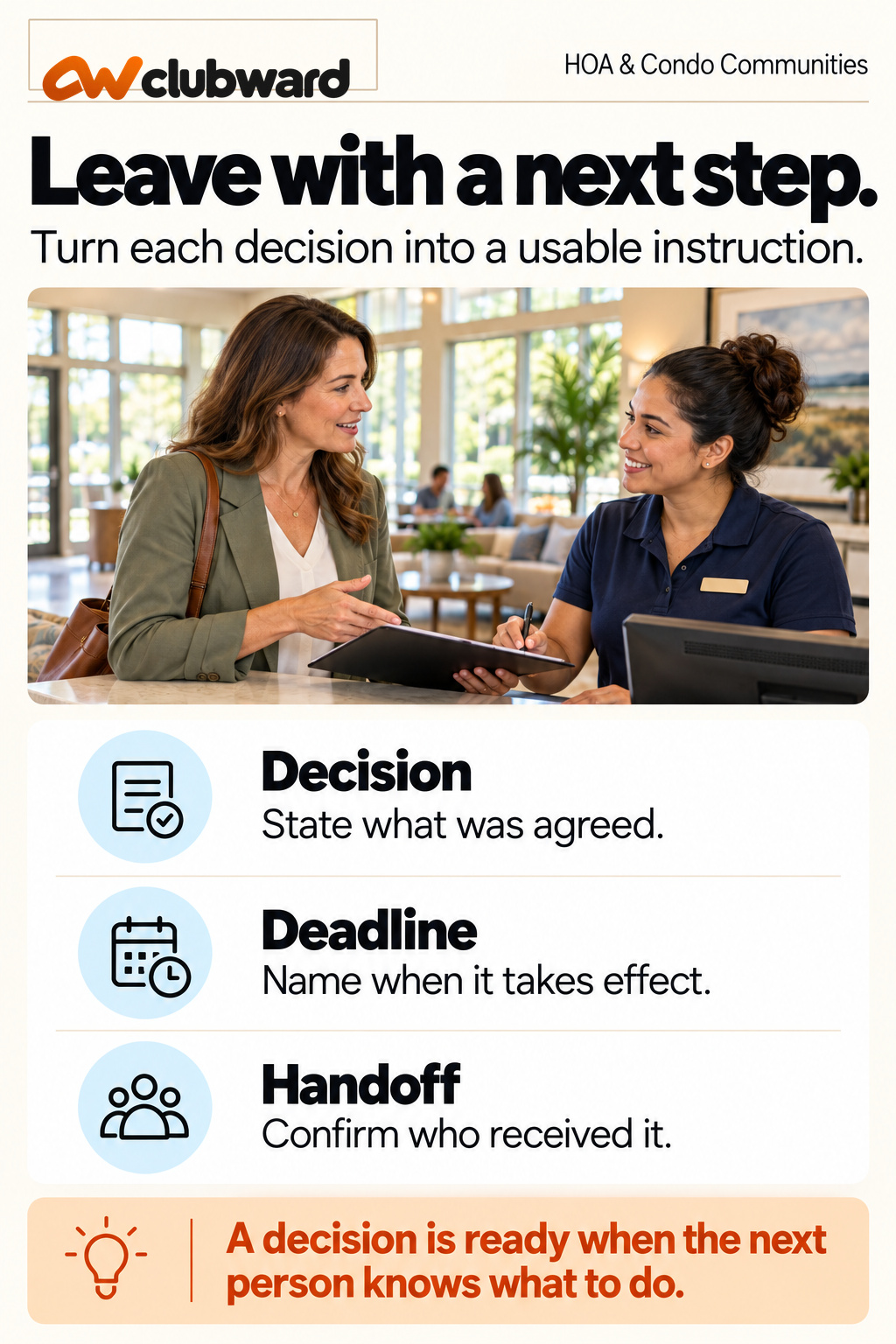
Define evidence of completion. For a notice, that might be confirmation that the current version is displayed in the agreed place. For a desk instruction, it might be the supervisor confirming that the next shift received it. Sending a message is an action; confirming the operational handoff is a separate check.
Use a worked Monday agenda
Consider a short review for a neighborhood clubhouse. The temporary additional-guest permission ends Sunday. A Saturday booking needs an answer about early decorating access. The contact named in the attendant guide is away next week. These three matters belong together because each could affect a staff answer during the coming operating week.
For the permission item, the agenda reads: original approval ends Sunday evening; extension requested for Monday; authorized decision needed before opening; manager will communicate the answer and check the desk record. If the extension request has not arrived in the required form, record that missing information instead of suggesting the decision is ready.
For the booking item, the agenda reads: gathering remains approved for Saturday afternoon; earlier decorating access requested; room preparation window must be checked; reservation owner will issue the current confirmation after the decision. The underlying reservation keeps its original identity so the change does not appear to be a separate approved event.
For the handoff item, the agenda reads: regular contact away Monday through Thursday; backup contact to be confirmed; supervisor will update the attendant instruction and check the next shift's understanding. If the backup can answer routine questions but cannot approve exceptions, include that decision limit in the instruction.
After the review, write the resulting actions in the same order. This lets someone compare the question with the answer without reconstructing the discussion. Do not erase a deferred item or rewrite it as completed. State what is waiting, who is obtaining it, and when the association will revisit the matter.
Keep supporting records useful and proportionate
Prepare a current record for each selected item before the meeting. Check dates, identifiers, attachments, and later changes. If two records disagree, label the disagreement and identify the person who can resolve it. A polished agenda cannot compensate for an uncertain underlying approval, and a copied sentence should not become the deciding evidence.
Use only the information each participant needs for their role. A board decision may require context that an attendant does not need. A staff instruction may require an effective time that a public update does not need. Prepare those versions deliberately instead of forwarding the same detailed packet to every recipient.
Keep the source of the decision recoverable. A later manager should be able to find the original approval and understand what changed. Use the association's established filing and retention practices. This review method does not prescribe a retention period or a legal record format; it asks that the current action remain connected to its authority.
Separate confirmed facts from proposals in the agenda. Use labels such as requested, approved, awaiting information, and assigned when those accurately describe the record. Avoid language that makes a proposed extension look active. If a status is uncertain, resolve it before issuing an instruction that staff or residents will rely on.
Prepare the desk handoff before the meeting ends
Ask one final operating question for each decision: what would the next attendant say if the affected person arrived tomorrow? Read the proposed instruction aloud. If the answer requires someone to search the minutes, identify a simpler current instruction and the location of the supporting record.
Make the instruction specific enough to act on. State which request it concerns, what action is allowed, when it applies, and where uncertainty goes. Avoid vague phrases such as board approved or manager aware when they do not tell staff what to do. Preserve any decision limits that remain in place.
Choose the delivery route used by the people doing the work. A notice in a board folder may not reach a seasonal attendant. A message to a supervisor may still need a shift briefing. Agree who sends the instruction, who receives it, and who checks that the affected shift can find the current answer.
Check the handoff once through a normal scenario. Ask the backup receptionist to locate Saturday's decorating time or Monday's current guest permission. This is a practical find-and-answer check, not a test of memory. If the person cannot find the answer, improve the location or wording before assuming more explanation will solve the problem.
Decide what can wait
A short Monday review does not need to settle every amenity concern. Keep broader policy changes, long-term budget choices, and unrelated maintenance decisions in their appropriate process. Bring them forward when the association has the evidence and authority required. The immediate agenda should not become a shortcut around a more careful decision.
Use a separate follow-up list for recurring questions that deserve later review. Record the question, its practical consequence, and the person gathering information. For example, repeated requests for early decorating access might justify reviewing the booking procedure. Monday's individual request still needs a current answer while that broader review is prepared.
Do not manufacture urgency to fill the agenda. If there is no expiring permission that needs attention, say so and choose another genuine operating decision. The three-item structure is a preparation aid, not a requirement to produce problems. A shorter accurate review is more useful than a meeting padded with hypothetical issues.
Check the next day's answers against the agenda
On Monday, compare the three agreed actions with the operating records people actually use. Begin with the item whose timing comes first. If guest permission changes at opening, check that instruction before reviewing a later reservation. This order keeps the follow-up connected to the real day rather than the order in which messages happened to arrive.
For an expiration, ask whether the current record reflects the authorized decision. If the extension was deferred, the record should not imply that an extension exists. Check the language residents receive as well as the language staff see. Two versions that describe different effective periods will create another question even when both were sent promptly.
For a booking, compare the final confirmation with the room preparation plan. If decorating access was approved for a particular time, identify the person providing entry and the task that must be complete first. If access was declined, remove any earlier draft that staff might accidentally treat as the current answer.
For the backup contact, check whether the person is available during the affected shift and can find the same current instruction. A name alone does not establish readiness. Ask the backup to describe which ordinary questions they can answer and which decisions still need the association's authorized route. Resolve any mismatch before the regular contact leaves.
Record a follow-up result without exaggerating it. The desk located the current instruction is a specific observation. All handoffs are now perfect is a conclusion the check does not support. If an instruction was difficult to find, record the location problem and the change made. Keep the review useful by describing what was actually checked.
Handle a decision that remains open
Sometimes the review cannot produce the requested answer. The booking details may still be incomplete, the authorized decision maker may need another record, or an exception request may require a different process. Give the unresolved item a holding instruction that reflects existing authority. Do not present a temporary staff answer as a new approval.
Write a short resident response explaining the missing step and the person handling it. For example, the reservation owner is checking the requested setup and will respond before the agreed confirmation deadline. Avoid promising an answer by a time nobody has accepted. If a decision deadline changes, communicate the change through the normal contact route.
Keep the unresolved item visible at the next review, with the new evidence beside it. Ask what changed since Monday rather than repeating the entire original discussion. If nothing changed, identify why the assigned action did not move forward. The purpose is to find the missing step, not to create a longer account of the same uncertainty.
Before closing the follow-up, make sure the record answers who is acting next, what they are obtaining, and when the matter returns. Those details let another manager continue the work if someone is absent. They also help the board distinguish a decision awaiting evidence from an action awaiting completion.
Keep that return date beside the open item so the next reviewer can see the commitment without searching previous minutes or asking board members.
Connect the review with daily amenity work
Clubward's programs and shared spaces tools include shared-space reservations. Use a club management platform walkthrough to examine how your clubhouse booking record supports the decision and the resulting staff instruction. Bring one current request with private information removed, along with the operating question your association needs to answer.
For arrival questions, Clubward's front desk and guest access workflow brings member lookup, status, and guest access into the staff view. Ask to see how your approved rules and exception process would be represented in your setup. Keep the association's decision authority clear throughout the discussion.
Choose one Monday item to use in a personalized Clubward demo: an expiration, a changed booking, or a backup-contact handoff. Show the question, the record supporting it, and the instruction the next person needs. That gives your team a concrete way to evaluate the daily workflow around your community's actual amenity decisions.
From Clubward Editorial Team
More from Clubward