hoa-condo-communities
How HOA Boards Can Evaluate an Amenity Platform Against Real Rules
A practical way for HOA and condo boards to test whether an amenity platform can carry real rules, exceptions, handoffs, and decisions.

An amenity platform should not be judged by how quickly it completes an easy clubhouse reservation. HOA and condo boards need to know whether it can carry the association’s actual rules from a resident request through a staff decision, an exception, and a clean record of what happened. The useful question is not “Does it have reservations?” It is “Can our people apply our rules consistently when the request is ordinary, unusual, urgent, or disputed?”
That distinction matters because boards govern a collection of related decisions. A household may be eligible to reserve one space but not another. A guest may be allowed only when a sponsor is present. A booking may require a deposit, a buffer between events, or approval from a named role. A move-in or move-out may temporarily change access. If those rules live in separate inboxes, documents, and memories, a polished screen does not remove the work; it merely gives the work another place to begin.
Start with the rules that create the most questions
Before reviewing any platform, collect a small set of scenarios that represent the board’s real operating pressure. Do not begin with every rule in the governing documents. Begin with the rules that repeatedly trigger clarification, handoffs, or second decisions. Those are the rules that reveal whether a system can support your process or only record the final answer.
- A standard request: an eligible household books a common amenity during an open time.
- A conflicting request: two households want overlapping times, setup access, or equipment.
- An exception: a resident asks for a different guest count, time window, or use than the published rule allows.
- A status change: a household is moving, adding a member, changing a vehicle, or resolving an account issue that affects amenity access.
- A handoff: a manager starts the review, a committee member decides, and front-desk or gate staff must apply the result.
For each scenario, write the rule in one sentence, identify who decides, name the information that person needs, and describe what the resident and staff should see afterward. This short preparation prevents a vendor demonstration from drifting toward attractive but irrelevant features. It also exposes internal ambiguity. If the board cannot state who owns an exception, the software cannot supply that governance decision for you.

Follow one request from beginning to end
Choose one difficult but common scenario and ask the presenter to run it without skipping steps. A good example might be a resident who wants to reserve the clubhouse for an evening event, add several guests, enter early for setup, and use the pool during a period with separate access rules. The point is not to create a trick. The point is to see whether information remains connected when the request crosses more than one operational boundary.
Begin with the household record. Confirm which people belong to the household, which contact should receive messages, and what information staff can see when the request arrives. Then move into the reservation. Ask how the platform applies capacity, hours, buffers, guest conditions, or approval requirements. If the request falls outside a rule, watch what happens next. Does the request stop with a clear explanation? Can it be routed to an authorized reviewer? Is the original request preserved, or does staff have to retype it in an email?
Continue through the decision. The reviewer should be able to understand the request, the relevant context, and the action being requested without reconstructing the story from several systems. After approval or denial, check what the resident receives, what on-site staff see, and what remains in the record. Finally, change one fact: increase the guest count, alter the time, or assign a different decision owner. A platform that only works while nothing changes is not supporting the full operation.
Test the exception, not only the happy path
Boards often spend the most time on requests that do not fit neatly. That makes exception handling a central evaluation criterion, not an edge case. Bring one scenario that has previously produced a long email chain or repeated phone calls. Remove names and private information, but preserve the sequence of decisions.
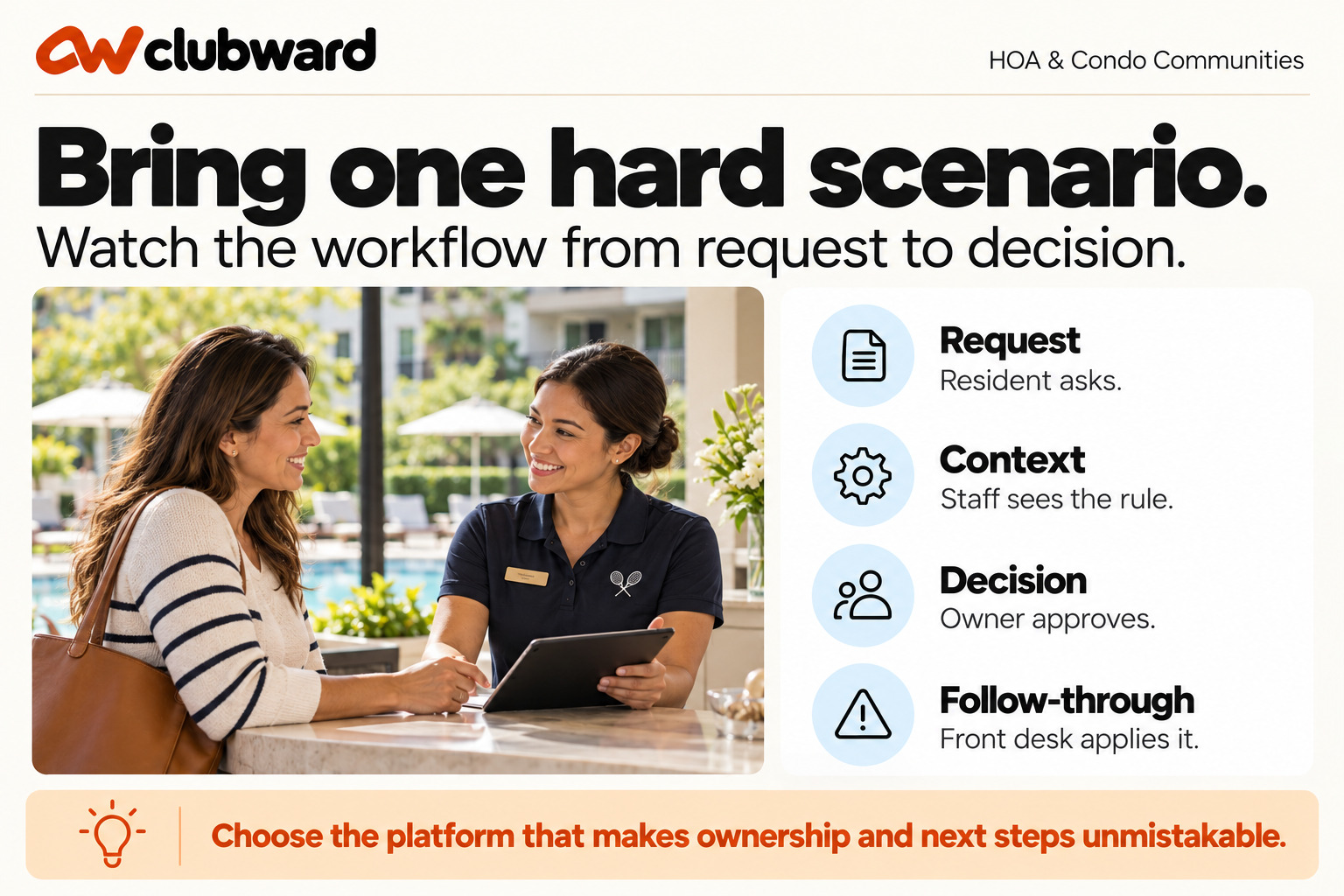
Ask the presenter to show how the request is captured, how the approved policy is available to the reviewer, and how the correct person receives the decision. Watch for hidden manual work. If staff must copy details into another message, remember a rule from a separate file, or notify the front desk independently, record that as an operational dependency. Manual steps are not automatically disqualifying, but they must be visible so the board can decide whether the process is acceptable.
Next, ask what happens when the reviewer is unavailable. Can another authorized person see the same context? Is there a clear indication that a decision is waiting? What prevents a well-meaning staff member from making a decision outside their role? The answers should align with the association’s chosen oversight model. Software can make a handoff visible, but the board still needs to define which decisions belong to staff, management, a committee, or the board.
Score the workflow in board language
A feature checklist makes unlike things look equal. “Reservations,” “communications,” and “access” may all receive check marks even though the actual workflow between them remains fragmented. Replace the flat checklist with a short scorecard that reflects how the association operates. Score each scenario from one to four on the following dimensions:
- Rule fit: Can the normal rule be represented clearly enough for staff and residents to follow it?
- Exception control: Does an unusual request reach the right decision owner with its context intact?
- Handoff clarity: Can the next person tell what happened, why it happened, and what they must do?
- Resident clarity: Does the household receive a useful answer without needing to ask what comes next?
- Record quality: Can an authorized person later understand the request, decision, and follow-through?
- Operating effort: How many additional messages, documents, or duplicate entries remain necessary?
Define the scores before the demonstration. A one can mean the scenario requires a separate manual process; a two can mean it works with significant workarounds; a three can mean it works with a manageable documented step; and a four can mean the full scenario is clear in the normal workflow. The exact labels matter less than using the same standard for every option.
Do not combine every score into a single number without discussion. A low score on visual preference is not equivalent to a low score on decision ownership or resident access. Identify two or three dimensions that the board considers non-negotiable. A platform should not win on convenience while failing a rule that protects fair use or keeps staff from improvising.
Invite the people who carry the handoffs
The evaluation group should include more than the final buyer. A board or committee representative can speak for policy and oversight. The community manager can test the day-to-day request flow. A front-desk, gate, or amenity staff member can identify the missing detail that becomes important at the moment of service. If an outside management company supports the association, include the person who will configure or maintain the workflow.
Give each participant a role during the demonstration. One person plays the resident, another handles the initial request, another makes the exception decision, and another applies it at the amenity. This makes handoff quality visible. It also prevents the meeting from becoming a series of abstract questions that never show how the work reaches the people who do it.
Run a configuration rehearsal before choosing
Ask how one of your real rules would be translated into the platform. Use a rule with several parts, such as permitted booking windows, maximum duration, guest conditions, and an approval threshold. Have the presenter identify which parts are configuration, which parts remain staff procedure, and which parts need a separate decision. Record the answer in ordinary language. The board should leave knowing not only that a setting exists, but also who will maintain it and how a change will reach residents and staff.
Then test a policy change. Suppose the board shortens weekend reservation windows, creates a seasonal guest limit, or changes who can approve an exception. Ask what must be updated, whether existing reservations are affected, what message residents receive, and how staff know the effective date. This reveals the difference between a rule stored as usable operational logic and a rule that is only described in a note.
Include a privacy and permission conversation without turning it into a generic security checklist. Identify the least information each role needs. Front-desk staff may need to confirm eligibility and see the next action without seeing unrelated household details. A committee reviewer may need the request and policy context without broad administrative access. Ask how permissions support those boundaries and how a departing staff member or volunteer is removed from the workflow.
Plan the first 30 days before the contract
A responsible selection includes a modest implementation plan. Choose a limited first workflow, name the records that must be prepared, identify the people who will configure and test it, and decide how residents will learn the new process. Avoid launching every amenity and every exception at once simply because the platform can hold them. A narrower first release makes questions easier to identify and correct.
Define what success will look like in observable terms: fewer requests that need to be re-entered, fewer decisions without a named owner, clearer messages at the amenity, and a record that another authorized person can understand. These are process observations, not promised results. Collect a small sample after launch and compare it with the workflow you approved during evaluation.
Check ownership after implementation
A platform decision includes the operating model that will surround it. Ask who maintains rules, blackout dates, capacity limits, household information, and staff permissions. Decide who approves changes and how those changes are communicated. Determine where an employee or volunteer goes when the rule and the system appear to disagree. A practical launch plan assigns names to these jobs instead of assuming the software will absorb them.
Set a review point after the first month or first meaningful amenity cycle. Examine a small sample of ordinary requests and exceptions. Look for repeated workarounds, unclear resident messages, stalled approvals, and staff questions. Those observations are more useful than a general “How is it going?” conversation because they reveal whether the chosen workflow is actually reducing ambiguity.
Compare the operating cost of every workaround
When a scenario requires a manual step, estimate its effect rather than labeling it simply good or bad. Ask how often the step occurs, which role performs it, what context must be copied, and how another person knows it is complete. A deliberate board review may be worth preserving. Re-entering the same household and reservation details in a private email is different because it creates work without adding governance.
Record the workaround beside the scenario and assign an owner. If the association accepts it, include it in the staff procedure and implementation plan. If no one can own it consistently, treat it as a product-fit risk. This approach helps the board compare real operating effort instead of assuming that every check mark has the same practical value.
Also consider how the workaround behaves during turnover. A step that depends on one manager remembering an exception may appear small during the evaluation and become significant after a handoff. Ask a second evaluator to complete the step using only the documented context. If they cannot, the process needs clearer ownership or a more connected workflow before launch.
Place Clubward in the right part of the decision
Clubward is a club management platform for community amenity operations. Its HOA software overview describes connected household records, access, guest passes, reservations, facility management, communications, reporting, and LookForward within that amenity-focused scope. An association should evaluate those capabilities against its own rules and handoffs, while keeping governing documents, financial accounting, legal decisions, and other systems in their appropriate roles.
That scope is useful for evaluation because it encourages a concrete question: can the household, reservation, access decision, and staff follow-through remain connected for the situations your board actually handles? If the answer depends on a workaround, document it. If the workflow fits, record the configuration and ownership required to keep it dependable.
Make the decision with one page of evidence
After the demonstrations, prepare a one-page decision record. List the scenarios tested, the non-negotiable requirements, the highest operational risks, the workarounds accepted, and the people responsible for configuration and review. Include the reason for the recommendation in plain language. This record helps future board members understand why the association selected the platform and which assumptions should be revisited if policies or operations change.
The strongest choice is not the product with the longest feature list. It is the platform that allows your board, managers, and amenity staff to apply the association’s approved rules with fewer hidden handoffs and a clearer record. Request a personalized Clubward workflow demo and bring one standard request plus one difficult exception so the evaluation begins with your real operating decisions.
From Clubward
More from Clubward