property-management-companies
Before Monday's Move-Ins, Reconcile the Amenity Handoff List
Reconcile households, credentials and arrival instructions before Monday, with ready, blocked and exception-pending states and a named next step.

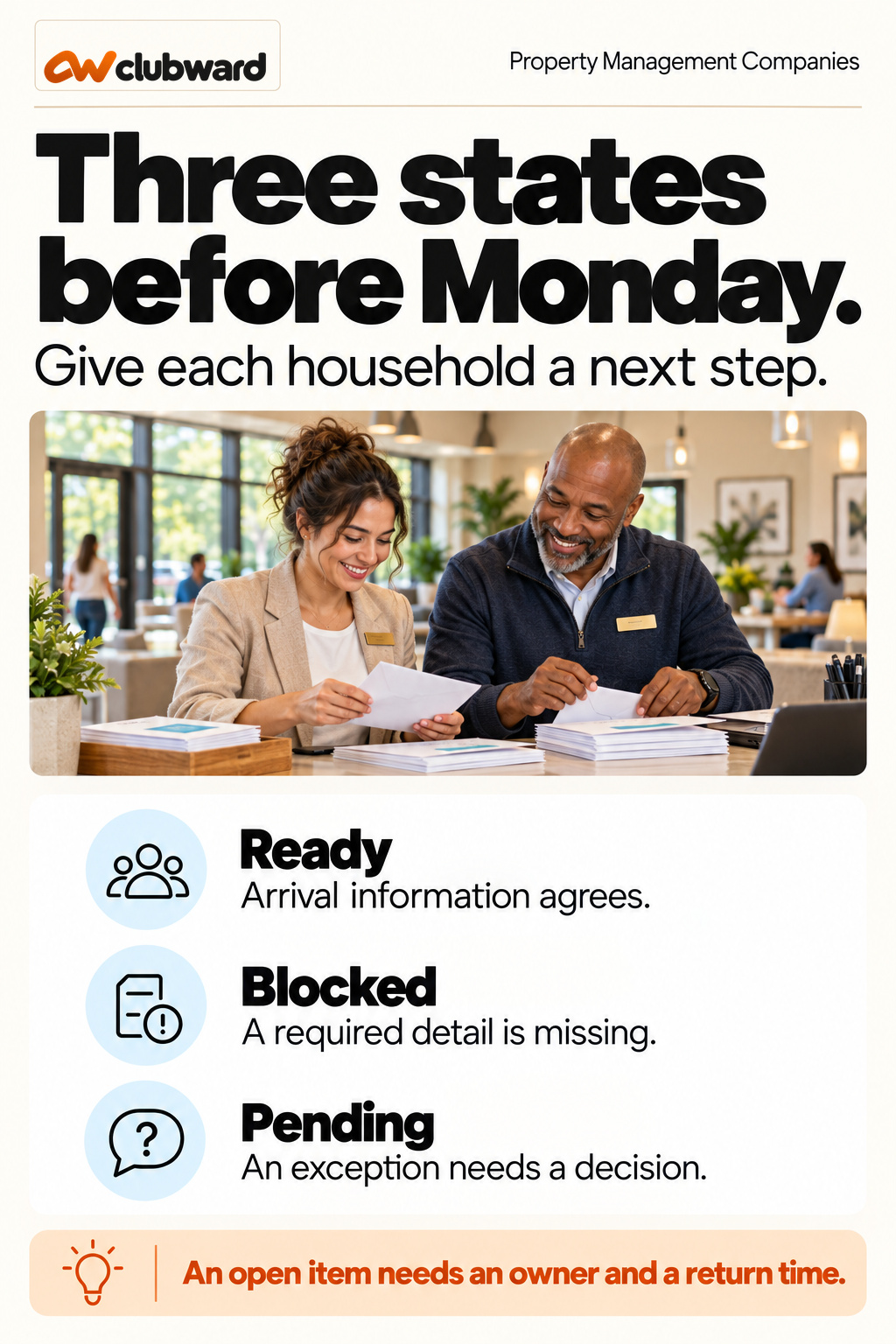
Before Monday's move-ins, reconcile the amenity handoff list into three states: ready, blocked, and exception pending. A ready household has the information and approved access needed for its first amenity visit. A blocked household is missing a required step. An exception-pending household needs an authorized decision. Give every open item one owner and a return time before the welcome desk opens.
Start with the approved resident information your property team already uses. This review concerns amenity onboarding after the relevant property approval; it does not replace leasing, occupancy, or other property processes. The practical question is narrower: when this household reaches the clubhouse, will the staff member have a current, usable answer?
Define Monday's population
Choose a clear cutoff for the first review. Include households expected to begin amenity use on Monday, plus earlier arrivals whose amenity handoff remains unresolved. Keep future arrivals available separately. A list that mixes every upcoming household with every historical problem makes it difficult to identify which question could affect the next operating shift.
Use the household identifier accepted by your team rather than relying on a surname alone. Confirm the property, unit or other appropriate reference, and effective arrival period against the approved source. Keep personally sensitive details within the authorized record. A desk checklist should contain only the context staff need to perform their amenity role.
Check changes received after the first list was prepared. A move-in date may have changed, a household detail may have been corrected, or an amenity request may have been withdrawn. Record the current state and the source of the change. Do not keep both old and new entries as though they describe two separate arriving households.
Assign one person to reconcile this population. Others can contribute missing information, but the review needs a person who checks the whole handoff. That owner should know which source establishes the current household and which team is responsible for an unresolved detail. An amenity desk should not be asked to infer property approval from an informal message.
Agree what ready means
Write a small readiness definition before marking any record ready. Include the household's correct identity, the applicable amenity start period, the permitted facilities, the required credential or arrival method, and the resident's next instruction. Add any locally required onboarding step through your established procedure. Avoid a vague label such as completed when different teams mean different things by it.
A record can be ready for one amenity and unresolved for another. If your process permits that distinction, state it explicitly. For example, a household might have a confirmed fitness-room arrival method while a separate clubhouse reservation remains pending. Do not turn one unresolved booking into an unexplained blanket label, or make a partial readiness state look complete.
Check the time as well as the date. If access begins after a particular handoff or opening, the desk instruction should reflect that. A Monday start may not mean access at midnight or before staff are present. Use the actual approved arrangement and avoid inventing a universal rule for every property.
Define the evidence that supports readiness. A credential requested is different from a credential issued and checked. Instructions drafted are different from instructions delivered through the normal route. Match the readiness label to the completed steps your team has agreed to require. If one is unfinished, identify it instead of rounding the record up to ready.
Use the three states consistently
Ready means the agreed amenity handoff requirements are complete for the relevant arrival period. Blocked means a specified requirement is missing or inconsistent. Exception pending means a request falls outside the routine route and an authorized decision has not yet been recorded. These labels are proposed working states; adapt them to your existing process without changing approval authority.
For a blocked record, describe the obstacle as an action. Household member detail needs confirmation is more useful than data issue. Credential pickup time needs arranging is more useful than onboarding incomplete. The owner should be able to read the line and know what to obtain, where to obtain it, and what completion will look like.
For an exception-pending record, name the decision and its authorized route. A resident requesting guest access before the usual start period is asking for a decision, not merely missing a form. Record the requested action and the person responsible for obtaining an answer. Staff should not interpret a pending request as permission.
Avoid using blocked as a judgment about a resident. It is a description of work that remains open. Keep resident-facing language respectful and concrete: the team is confirming a detail, arranging a credential handoff, or waiting for the authorized answer. The internal state should help staff act without creating an unnecessary argument at arrival.
Reconcile the household details
Compare the amenity record with the current approved household information. Check for duplicate entries, misspelled identifiers, an old unit reference, and changes in the people authorized for the relevant amenity process. Do not make changes from memory. If sources disagree, ask the responsible property contact to confirm the correct information through the established route.
Review the actual people affected by the handoff. A message saying the household is ready may conceal a missing step for one person. Where your rules distinguish household members, guests, or other permitted users, check the applicable record rather than assuming the same treatment for everyone associated with an address.
Keep changes traceable to their source. If the property team corrects a detail on Sunday, the amenity owner should know which record now supplies the current answer. Avoid repeatedly forwarding a spreadsheet that becomes detached from later changes. Choose the source your team treats as current and identify how the desk finds it.
Remove unnecessary information from the working list. The person checking a credential does not need the resident's full property file. Share only the fields and context required for the amenity task through approved channels. A useful handoff gives staff enough information to act while keeping unrelated private details out of circulation.
Check credentials and arrival instructions separately
Follow the credential from approval to the first visit. Identify how the resident receives it, who prepares it, and how the desk checks it. A card, pass, or other arrival method should correspond to the right household and effective period. Use your actual arrangement rather than assuming that a record update automatically completes every physical handoff.
Check the instruction the resident receives. It should tell them where to go, when the amenity process becomes available, what they need to bring if anything, and whom to contact for an unresolved question. Keep the instruction aligned with the current record. A friendly welcome message should not promise access that remains unconfirmed.
Review the desk's instruction alongside the resident's version. If one says collect a credential at reception and the other says credentials will be delivered, resolve the disagreement before Monday. Staff should not have to explain a mismatch that the preparation review could have found. Record the corrected route and its owner.
If a credential cannot be ready in time, use only an interim arrangement authorized by your procedure. State its scope, period, and decision owner. Do not silently borrow another household's credential or rely on an informal recognition rule. A holding step should give staff a current answer while the required work is completed.
Prepare a compact reconciliation row
For each household, keep the working row short enough to use during the review. Include the approved identifier, amenity effective period, readiness state, open action, owner, return time, and instruction location. Store supporting details in the appropriate record. The row should point to the work rather than becoming a second private household file.
Use action wording in the open-action field. Confirm the additional household member with the property contact describes a task. Awaiting response may be accurate but does not say whose response or what question is waiting. Add the specific missing detail so a backup manager can continue without reconstructing the entire exchange.
Write a return time that someone has accepted. If the owner cannot obtain the detail before opening, agree what the desk will say in the meantime and when the resident will receive another update. Do not put an arbitrary deadline in the row simply to make every item appear to have a neat completion plan.
Keep the working list current through the handoff. If a blocked item becomes ready after the review, update the state and notify the person relying on it. Do not leave the desk with Sunday's earlier version while the property team works from Monday's correction. The owner should close that information gap deliberately.
Walk through three Monday households
Suppose three households are expected to use the amenities on Monday. The first has a confirmed start period, matching household information, a prepared credential, and delivered arrival instructions. Mark it ready for the relevant amenity and record the desk instruction location. No separate exception decision is required under the agreed routine process.
The second household has a confirmed arrival period, but one household member detail differs between the property message and the amenity record. Mark it blocked on that detail. Assign the property contact to confirm the current information, and the amenity owner to update the record after confirmation. State the holding instruction permitted by your procedure.
The third household asks to bring additional guests before its routine access period begins. Keep that request exception pending until the authorized decision is recorded. The owner must obtain the answer and communicate the approved scope, if any. A request entered in a list does not create a new guest entitlement.
At the next review, check the result of the open actions. If the second household's detail is confirmed, complete the remaining handoff checks before changing the readiness state. If the third household's request is declined, record the ordinary options and the respectful answer. Keep the household record separate from the outcome of that individual request.
Check Monday's first arrival
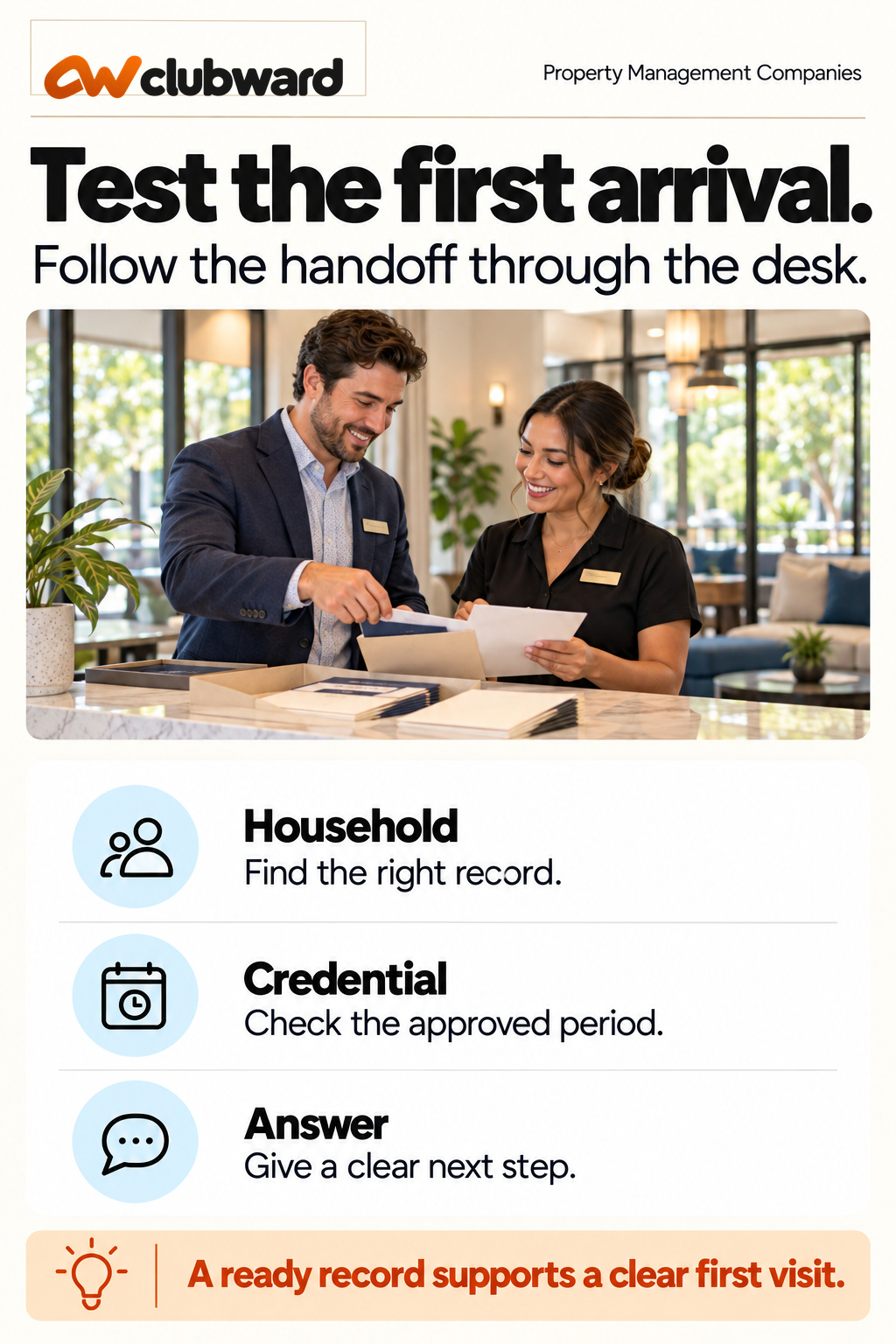
Before opening, ask the desk lead to find one ready household using the normal lookup route. Check that the relevant identity, amenity period, and arrival method agree. Use a practice record or an appropriately authorized check; do not circulate private household information merely to create a demonstration.
Then ask the lead to find one open item. Can they see what remains unresolved and who owns the next step? Can they give a clear answer without implying an unapproved exception? This checks the handoff's usefulness for the person receiving the resident, rather than only whether the list contains all its columns.
Include the backup shift in this check when it will handle an affected arrival. A manager's understanding is not enough if the person covering reception cannot find the instruction. Make sure the backup knows the current information location and the escalation contact. Avoid relying on a memory of Sunday's briefing.
Record what the check actually showed. The desk found the correct credential period is a specific result. All onboarding is seamless is a broader claim the exercise does not establish. If a step failed, document the obstacle and repair the handoff before treating the affected household as ready.
Handle changes after the cutoff
Choose a route for late changes. Identify who receives an updated move-in date, corrected household detail, or new amenity exception request after the initial review. That person should assess whether the change affects a current instruction and tell the owner of the affected handoff. A cutoff organizes the review; it should not make later information disappear.
Retain the original household identity when a detail changes. Do not create a second arrival entry simply because the timing or credential arrangement has changed. Compare the updated instruction with the earlier version and remove the old version from the operational location where it could mislead staff.
If the change arrives while the desk is busy, communicate the immediate effect first. State which household is affected, what current action staff should take, and where the complete instruction is stored. Send the deeper context through the appropriate record. Avoid a long message that hides the one timing change the attendant needs now.
For an unresolved late exception, keep the routine position clear. Tell staff which action remains permitted and which request is waiting. Give the resident an owner and the next response step. Do not treat the inconvenience of a late request as evidence that approval can be assumed.
Keep the review inside amenity operations
Property teams may use other processes for leases, rent, accounting, or occupancy approvals. This amenity reconciliation should use the relevant approved information from those processes without pretending to replace them. Document the input and owner your amenity team needs, then follow the established property route when that input is missing.
Similarly, a client update should describe amenity handoff work accurately. Report the households ready for the relevant period, the open actions, and the decisions waiting. Avoid implying that a readiness list measures the entire property's performance. A narrow operational report can still be useful when its scope and evidence are clear.
Review recurring obstacles after the immediate arrivals are supported. If credential pickup arrangements repeatedly remain unclear, inspect that handoff. If household corrections arrive late, agree the responsible input and notification route. Change the process that produced the repeated issue rather than adding more unrelated fields to the list.
Keep your next review small. Begin with Monday's unresolved items and the next group of arriving households. Carry forward the relevant open actions, not every resolved detail. This helps the team see what needs work while the completed records remain available in their established location.
Resolve a disagreement between teams
If the property contact says a household is ready but the desk sees an unfinished requirement, identify exactly what each person means. Ask which amenity, which effective period, and which step is being described. The disagreement may concern two different tasks rather than one wrong record. Make the distinction before changing a status.
Use the agreed readiness definition to compare the evidence. If the property approval is complete but the credential has not been delivered, preserve the approval and leave the amenity handoff open on delivery. Do not undo a confirmed input because a later step remains unfinished. Record the outstanding action at the point where it actually sits.
If the underlying information itself disagrees, send the question to the owner of that input. The desk should not choose whichever message seems more recent without understanding its authority. Once the source owner confirms the correct detail, update the affected operational record and tell the people relying on the previous instruction.
Keep the resident's immediate answer proportionate to what is known. Explain the specific step being checked and the person handling it. Avoid describing an internal disagreement in unnecessary detail or asking the resident to coordinate between teams. The handoff owner should carry that work and give the resident a useful next response.
Prepare a backup for the open list
Choose a backup who can continue the amenity reconciliation if the usual owner is unavailable on Monday. Give that person the current working list, the approved information location, and the contacts for missing inputs. Check their access through your normal permissions process. Sharing a file is not enough if they cannot perform the assigned task.
Walk through one unresolved household together. Ask the backup to identify the missing action and the next contact. Then ask what they would tell the desk before the action is complete. This reveals whether the row contains useful context or depends on knowledge held only by the original manager.
State the backup's decision limits. They may be able to confirm a credential pickup arrangement without being able to approve an early access exception. Preserve that distinction in the contact instructions. A backup role should not quietly enlarge someone's authority merely because another person is absent.
Give the backup a return route for new information. If the property team confirms a detail while the usual manager is away, identify who updates the amenity state and who informs the desk. Avoid creating two parallel lists that each look current. Keep one agreed operational answer connected to the underlying approved input.
Close the reconciliation after the arrivals
After the affected arrivals, compare the working list with the actual handoffs completed through your normal records. Check whether residents received the promised instruction and whether staff could use it. A household that did not visit may still have a completed preparation record; absence alone does not prove that onboarding failed.
Carry unresolved actions into the next review with their owners and current evidence. Close items only when the agreed requirements are met. Record any changed arrival period so another team does not chase a household for a visit that is no longer expected. Keep the follow-up tied to the current situation.
Before archiving the working list, check that open questions remain visible in the next owner's view. A tidy completed file should not hide an unfinished resident answer. Preserve the current contact and return time wherever the team continues that remaining work.
Evaluate the connected amenity handoff
Clubward's member and household records bring household information and membership status into an organized workspace. Its front desk workflow supports member lookup, check-in, and guest access. Use those connected amenity tasks as the starting point for a club management platform walkthrough.
Bring one ready case, one blocked case, and one exception-pending case with private information removed. Ask how your authorized property input, amenity start period, and desk instruction would fit your setup. Follow each case to the first arrival and the resident's next answer. Assess the handoff your team needs rather than assuming every surrounding property process belongs in the same platform.
Use a personalized Clubward demo to walk through Monday's amenity list. Show the information your property team supplies, the step the desk completes, and the unresolved decision that needs an owner. A concrete arrival scenario gives your team a practical basis for discussing the setup and workflow that would support your residents.
From Clubward Editorial Team
More from Clubward