swim-tennis-clubs
Prepare a Renewal Test Household Before Opening the Window
Prepare one authorized test household and follow package, charge, waiver and arrival eligibility through the renewal process before opening.

Before opening renewal, prepare one test household and write its expected outcome from package selection through the first visit. Include the people covered, the season, the approved charge, the required waiver step, and the date access begins. Then follow that household through the renewal route your team intends to use. Keep the window closed until any unresolved result has an owner and a release decision.
This is a preparation exercise for your club's actual renewal setup. It is different from checking whether the household list is tidy or watching a vendor demonstrate a generic renewal. Your task is to establish what one representative household should experience in the coming window, then verify that the relevant steps agree.
Choose a representative household
Pick a common membership arrangement that matters to the upcoming renewal period. If most returning members renew as households, start there. If a particular package changes between seasons, choose a record that exercises that change. Avoid beginning with the most unusual exception; first establish whether the ordinary route works as your team expects.
Use a dedicated test record in an authorized environment or the approved testing method for your setup. Do not renew a real household merely to see what happens. Agree how test charges, messages, passes, and other outputs are prevented from affecting real members. Obtain the necessary operational instructions from the person responsible for the system.
Give the test household enough detail to produce a meaningful result. Include the number of covered people, their permitted membership roles, the current package, and the proposed next-season package. Use sample information that does not expose private member records. The record should represent your rules, not pretend to be an actual member's renewal.
Keep the case small enough to follow. One household with one intended renewal is easier to reconcile than a dozen scenarios introduced at once. Record the starting state clearly. Later, add one changed condition at a time so the team can identify which rule or step produced a different outcome.
Write the expected answer first
Before clicking through renewal, write what should happen. Name the eligible package, the next-season period, the people it covers, the approved amount, and the required completion steps. Identify which source establishes each answer. Use current approved club rules and fee information rather than last season's message or a staff member's recollection.
Separate the membership period from the renewal window. A household may be allowed to complete renewal now while its next-season access begins later. Record both periods. A successful renewal transaction should not automatically be interpreted as permission to enter every facility immediately; the expected arrival answer must follow your approved arrangement.
Include what the household should see when a step remains incomplete. If a waiver or another required condition is unfinished, decide what status and next instruction are appropriate under your procedure. Do not wait until testing to discover that the membership team and check-in team have different expectations.
Write these expectations in plain language. The household renews the approved family package for the next season, pays the approved charge, completes the required waiver step, and becomes eligible for the specified first visit is a useful starting statement. Replace every general phrase with your actual approved test value before running it.
Prepare the package and people
Check the package definition used for the upcoming season. Confirm what people it covers and which facilities or activities it includes in your arrangement. If package names have changed, record the relationship between the current package and the intended renewal choice. A familiar label does not prove that the next-season conditions are identical.
Compare the household composition with the package rules. Check which person is renewing and who is included. If your membership rules require a separate action for an additional person, include that action in the expected sequence. Avoid assuming every name in a household record automatically receives the same entitlement.
Look for a package choice that should not be available to this test case. Record why it is inappropriate and what the member should be told instead. This is a useful boundary check, but it should be based on a real club rule. Do not create a new restriction simply to make the test more complicated.
Keep the explanation understandable to the member-facing team. If the household asks why one package is available and another is not, staff should be able to find the approved rule and give the next option. A technically correct restriction can still create unnecessary follow-up if nobody can explain it.

Prepare the charge without mixing balances
Write the expected renewal charge and its approved basis. Include any applicable components your club actually uses, and identify which are part of membership renewal. If a credit may affect the charge, confirm its classification and permitted use through the appropriate account procedure. Do not apply an unrelated prepaid balance simply because it appears beside the household.
Keep membership credits, deposits, prepaid funds, and unpaid charges distinct. In this exercise, record the treatment expected for each relevant balance. If the test household has no special balance, say that in the internal test record and keep the first pass ordinary. Add a balance scenario only after the basic renewal path is understood.
Check the amount the household sees against the expected amount before completing any authorized test payment. If they differ, identify the component responsible. A total alone may conceal a duplicated charge, missing credit, or package mismatch. Follow your established financial review route rather than changing values to make the test appear to pass.
Prepare the question staff will answer afterward: what was charged, what was paid, and what remains open? The expected account explanation should be consistent with the renewal state. A receipt or confirmation should not be treated as evidence that every separate membership requirement has been completed.
Prepare the waiver step as a separate condition
Use the waiver requirements your club has already approved for this membership and period. Identify the required person, document, and completion route through your existing process. Ask the responsible decision maker to clarify an uncertain requirement before testing. The preparation task is to check whether your actual renewal sequence handles the requirement you use.
Record the expected outcome when the waiver step is complete and when it is incomplete. Specify the current member-facing instruction and the check-in consequence under your approved rules. If those answers are uncertain, resolve the operational question before opening renewal rather than asking attendants to improvise at the gate.
Check whether an earlier completion applies to the new period under your club's approved arrangement. Do not assume a previous document is current, and do not assume a new document is required without checking. Bring the question to the responsible decision maker and record the answer used for the test.
Keep sensitive documents in their authorized location. The test log can identify the expected condition and observed status without copying a real signature or private document. Give the person reviewing the exercise enough context to understand the result while preserving the boundaries of the member record.
Prepare the first arrival answer
Choose a first-visit date within the intended next-season access period. Specify the facility, the person arriving, and the identification method your club uses. Record the expected answer at check-in. This connects the renewal preparation to the practical moment the front desk must support.
Then choose a visit before that period begins. State what staff should see and say under your approved rules. The two visits test the distinction between renewal completion and current access. They should not be used to invent an automatic restriction or exception that your club has not approved.
Include a household member other than the person who completed renewal when that is relevant to your package. Can the desk find the right person and the correct current membership context? Check the real expected treatment for that person's role rather than assuming the purchaser's result covers every household member.
Prepare a route for an uncertain arrival answer. Name the staff role that can review the discrepancy and the holding instruction permitted while it is checked. A test that ends at an unresolved gate question has found useful work, but it has not completed the preparation needed for release.
Run the ordinary case in order
Start from the recorded initial state. Follow the member's intended renewal route and note the package options presented. Compare the selected package and period with the expected answer. If the ordinary case fails here, stop that pass and investigate; continuing through unrelated steps can make the resulting record harder to interpret.
Next, compare the displayed charge with the expected amount. Follow only the authorized testing procedure for payment and confirmation. Record the outcome of the account step separately from the outcome of the membership step. A successful payment test does not by itself establish the correct package, household coverage, or access period.
Complete the required waiver step through the approved test method and check the resulting instruction or status. Then inspect what the household would receive as confirmation. It should accurately describe the completed renewal and any next action. Avoid language that suggests all access is current if the new season begins later.
Finally, follow the first-arrival cases through the normal desk route. Compare the household, period, and required conditions with the expected answer. Ask a second authorized staff member to locate the result so the test does not depend on the person who prepared the record explaining every step.
Add one changed condition
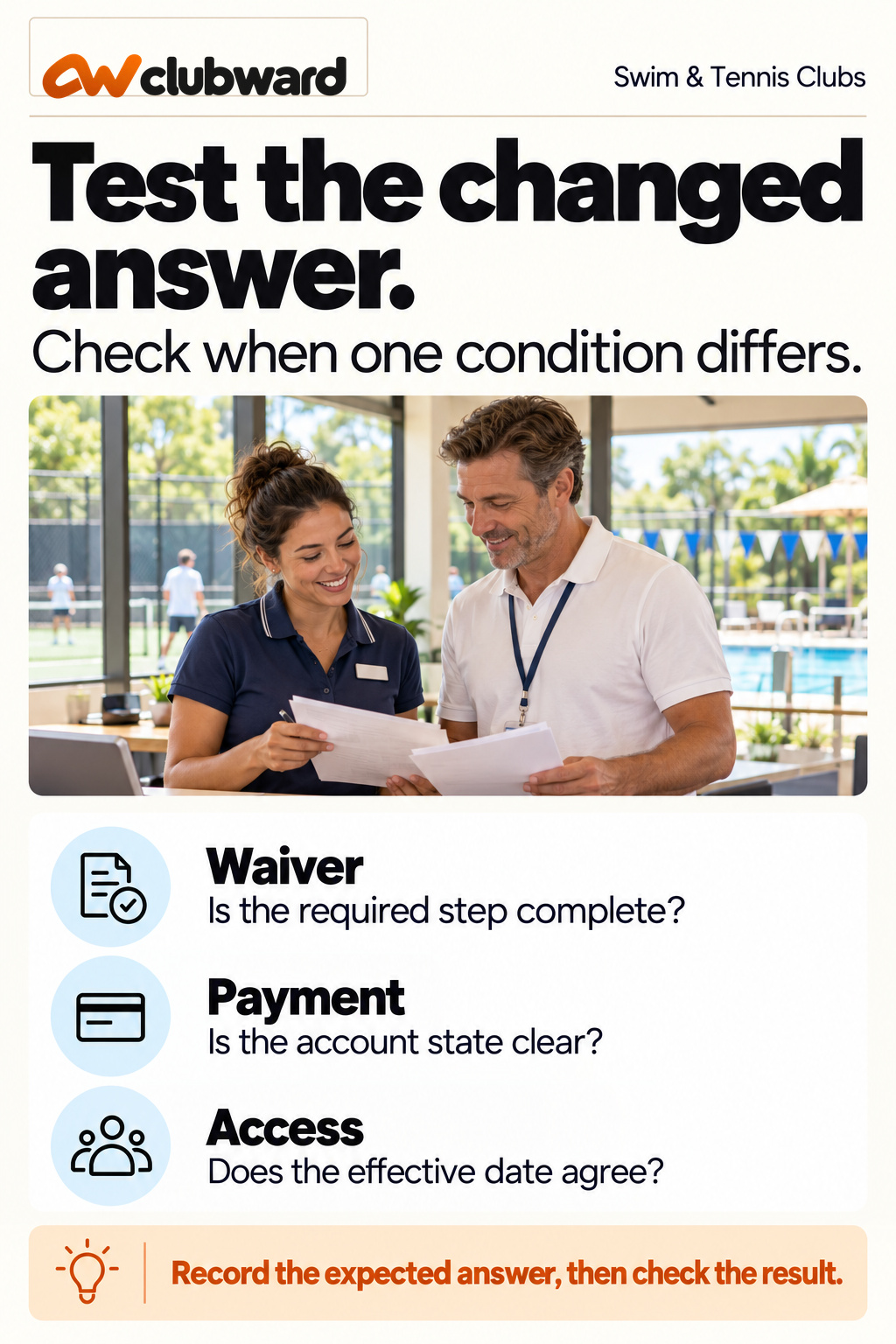
Once the ordinary case is understood, change one condition that could matter during the upcoming window. You might test an incomplete required waiver step, a future-effective package change, or a permitted household adjustment. Choose a condition that answers a real operational question, not a collection of unrelated edge cases.
Write the expected difference before running it. If the waiver remains incomplete, which next instruction should appear and what arrival answer follows your rules? If the package changes for the next season, which current entitlement remains in effect before that date? The changed case should have a precise expected result.
Restore or isolate the starting state using the authorized method. Otherwise, the changed case may inherit an earlier completion and produce a misleading pass. Record which condition changed and which conditions stayed the same. This makes it possible to connect the observed difference with the rule being tested.
Afterward, compare the ordinary and changed outcomes. If both produce the same answer where your approved rules require a difference, investigate that point. If they differ as expected, record the specific result. Avoid describing a single successful case as proof that every renewal situation has been covered.
Use a worked preparation record
Suppose your club offers a next-season household package covering the approved people in a sample household. Renewal opens before the season begins. Prepare the package, its period, its approved charge, and the required waiver step. The ordinary case completes every required renewal step while preserving the correct future access period.
At the first next-season visit, the expected desk answer is that the relevant person has the approved current eligibility. At a visit before that season, the answer follows the household's existing arrangement rather than the future package alone. Write those answers explicitly so the membership and desk teams evaluate the same scenario.
For the changed case, leave the required waiver step incomplete using the authorized test method. Record the instruction the household should receive and the resulting eligibility answer under your rules. If staff cannot distinguish that case from the ordinary completion, the preparation review has located a specific gap to resolve.
The test log now contains a starting state, expected sequence, observed result, and open action. Keep each checkpoint beside the person responsible for resolving any difference before the window opens. Its value is operational: the team knows which answer has been checked and which point still needs work before the window opens.
Record the result and the owner
Use one row for each meaningful checkpoint: package, household coverage, charge, required condition, confirmation, and arrival. Record expected answer, observed answer, result, owner, and next action. Keep screenshots or other evidence only where they are authorized, current, and free of unnecessary private information.
A pass should state what matched. The approved package and period were presented is more useful than looks good. A failure should state what differed. Confirmation describes access as current although the package begins later gives the owner a concrete question to investigate. Keep the wording factual and proportionate.
For an unresolved result, identify the person responsible for investigating and the person authorized to decide whether the window can open. They may be different roles. Record the next review point and any temporary operating instruction. Do not convert an unresolved issue into a pass because the planned opening time is approaching.
After a correction, rerun the affected sequence from a known state. Check that the correction resolves the observed issue without changing another expected answer. Preserve the test history through your normal record process so the next person can see what was checked and why the release decision was made.
Prepare the people who answer renewal questions
Share the practical answers with the membership team and the staff who will handle the first visits. Explain the package period, required steps, and route for unresolved questions. Give them the current instruction location. The internal test log may be detailed; the desk guidance should be concise enough to use during a normal arrival.
Ask staff to find one answer without help from the test owner. Can they explain why a completed renewal may still refer to a future season? Can they locate the next step for an unfinished requirement? Use the difficulty they encounter to improve the instruction rather than assuming the problem is a lack of attention.
Include a backup contact for the opening period. State which questions that person can resolve and which require another decision. If the regular membership manager is unavailable, the team should still know where to take a discrepancy. A list of names is useful only when the people know their responsibilities.
Keep member communication aligned with the checked result. Do not promise a feature, automatic action, or exception treatment that was not established in your setup. If an unresolved requirement changes the opening plan, communicate the concrete next step through the approved route and preserve the accurate current status.
Check the opening decision against the evidence
Before opening the window, separate completed checks from questions still waiting. Review the ordinary case first: package, people, amount, required conditions, confirmation, and arrival. Then review the changed case. A partially completed test should remain identified as partial even if the steps observed so far look correct.
Ask whether an open issue affects the household's ability to understand or complete renewal. A misleading amount, unclear required step, or incorrect effective period needs an explicit decision before members rely on that answer. Record who makes that decision and which evidence they considered. Do not let an informal discussion replace the club's established release process.
If the window must wait, prepare a member-facing next step that reflects the actual plan. Avoid a vague promise that everything will be ready shortly. State the information your club is authorized to share and the route for further updates. Keep the preparation record detailed internally while the public message remains useful and accurate.
If the club proceeds under an approved temporary process, write exactly which task changes and who performs it. Check that staff can follow the instruction and that the household's confirmation remains accurate. A temporary step should have an owner and a review point, rather than becoming an undocumented permanent exception.
Clear the test outputs responsibly
After the exercise, follow the authorized procedure for test records and outputs. Check whether any sample message, charge, credential, or confirmation needs to be removed, voided, or retained as evidence. Do not delete records blindly; use the instructions appropriate to the testing environment and the people responsible for it.
Keep the evidence needed to understand the release decision in the approved internal location. Preserve the expected answer, the observed result, and the correction history. Avoid retaining unnecessary sample personal details or distributing raw screenshots outside their permitted audience. The next reviewer needs the conclusion and its basis, not a folder of unexplained captures.
Tell the opening team which record is the current operating instruction. A test checklist should not accidentally become the member-facing renewal guide, and a sample household should not appear in a real arrival list. Check those boundaries during cleanup so the preparation exercise supports the coming season without adding a new source of confusion.
Carry one useful lesson into the next preparation review: the specific rule, wording, or handoff that required clarification. Record what changed and which future case should be checked again. This lets the next season begin with a known question rather than an unsupported assumption that the previous test covered every possible renewal.
Keep the opening instruction beside the accepted test result so a backup manager can understand the decision without repeating the exercise.
Bring the test household to the workflow discussion
Clubward's memberships and payments workflow brings household records, renewal context, and payment history together. Its front desk and guest access tools support member lookup and status checks. Use these connected tasks to discuss the renewal-to-arrival workflow your swim and tennis club needs.
Keep the test's requirements separate from assumptions about product setup. Ask how your package period, charge treatment, required waiver process, and arrival answer would be handled for your selected configuration. Follow the ordinary case and one changed condition. The useful demonstration is the one that answers your club's actual preparation question.
Bring the test household and its expected outcome to a personalized Clubward demo. With private information removed, show the package, the required completion steps, and the first visit your team wants to support. That gives the conversation a concrete finish: a clear account of the renewal workflow and the remaining decisions before renewal opens.
From Clubward Editorial Team
More from Clubward