swim-tennis-clubs
How to Collect Club Membership Dues Online
Set up online club dues with clear household records, payment status, receipts, reminders, and a finance handoff your team can explain.

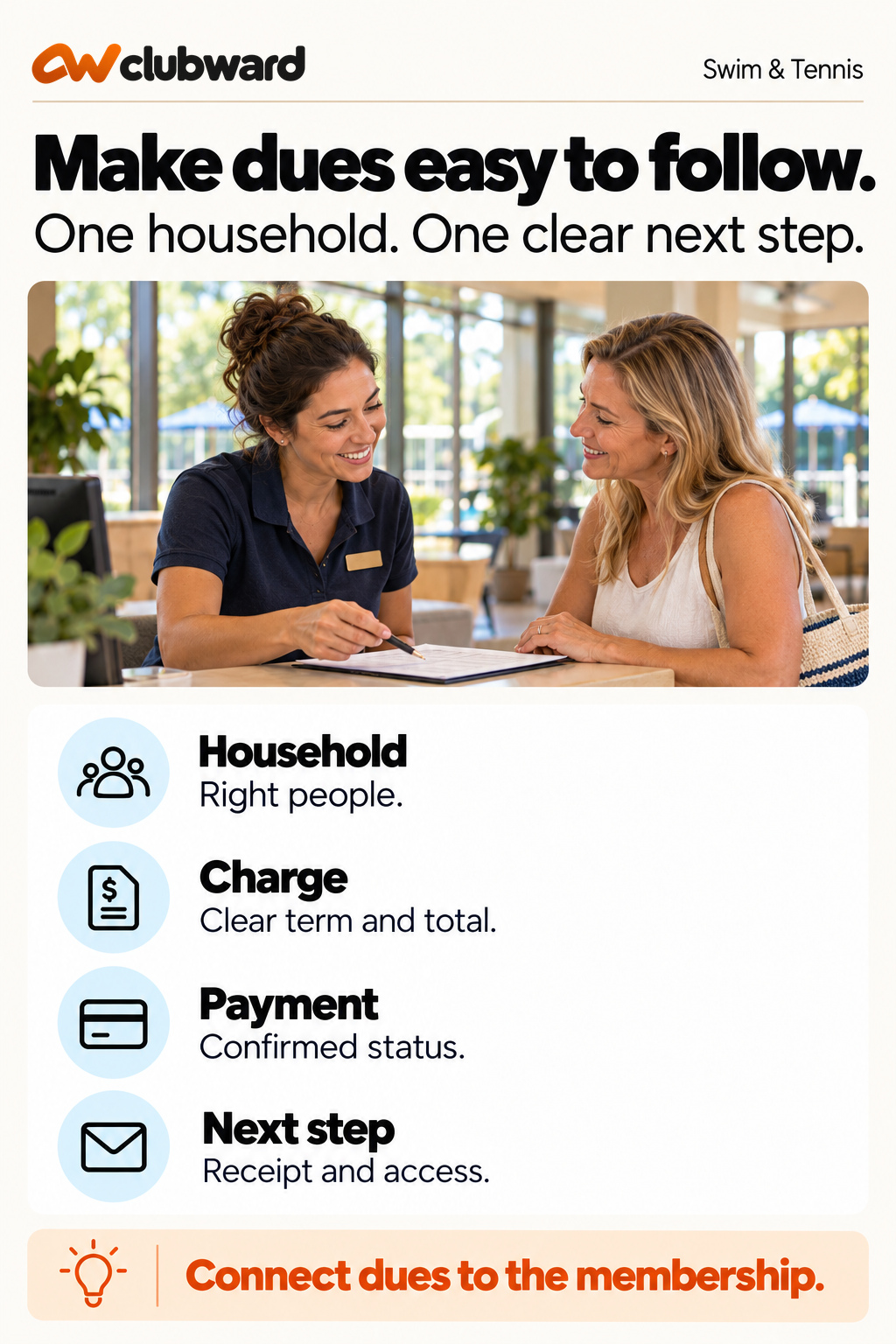
To collect club membership dues online, connect each charge to the correct member or household, give the payer a clear payment route, confirm the result, and explain what happens to their membership afterward. A payment link is part of that process. The complete experience also includes receipts, reminders, exceptions, and records your treasurer can understand.
If you are moving away from checks, scattered invoices, or a spreadsheet maintained by one heroic volunteer, the first improvement does not have to be complicated. Start with one membership type and follow it from the invitation through the finance handoff. You will have a more useful starting point than a long list of payment features.
This guide focuses on that setup: how to collect membership fees online while keeping the member, the money, and the next action connected.
A clear dues policy comes before the payment form
The practical starting point is agreement on what members are paying for. A seasonal family membership, an annual individual membership, and a monthly installment arrangement need different explanations. The form should reflect those decisions rather than becoming the place where someone first discovers that the policy is unclear.
A useful fee description names the membership, the period covered, the people included, the amount due, and any approved adjustments. Keep an earlier account balance separate from the new dues charge. Someone renewing for next season should be able to tell whether an additional amount is an old balance, an optional purchase, or part of the renewal.
Approval responsibilities deserve the same clarity. A coordinator might correct an address, while a treasurer approves a credit and a manager decides an access exception. Naming those responsibilities gives staff a route for questions that the payment form cannot answer.
A copyable dues setup worksheet
- Membership: Name, included people, and start and end dates.
- Charge: Dues amount, due date, and approved discounts or credits.
- Payment arrangement: One payment, recurring dues, or an installment schedule.
- Completion rule: The conditions that make this membership ready to use.
- Exceptions: Decision owner, review date, and member contact route.
- Finance handoff: Required records and the person responsible for checking them.
The worksheet belongs with your approved policy. A changed offer needs a consistent explanation in the form and the guidance staff use.
The right collection model depends on your club's work
A hosted payment link can be a useful starting point when the charge is straightforward and someone owns the record update afterward. Stripe's Payment Links, for example, support one-time and recurring payments without requiring a custom checkout. That describes the payment tool; it does not establish how a particular club's membership record will update.
A personalized invoice is worth evaluating when members owe different amounts or need a clear account reference. A membership platform is worth evaluating when payment needs to remain connected to household records, renewal decisions, and staff visibility. The important question is which handoffs remain after the member pays.
| Approach | Useful starting situation | Question to resolve |
|---|---|---|
| Hosted payment link | One clear charge and a manageable manual follow-up | How will the payment reach the correct membership record? |
| Individual invoice | A specific account balance or personalized amount | How will adjustments and reminders stay current? |
| Connected membership platform | Households, renewals, balances, and several staff roles | Which steps are supported, configured, or still manual? |
These are evaluation prompts, not universal rankings. A small club with one careful administrator may accept a manual update. A club with rotating volunteers may need another person to understand the account without asking the original coordinator. Include that continuity requirement in your choice.
A useful form identifies the membership being purchased
The payer and the member are not always the same person. One adult may pay for a family membership that includes a partner and children. Another relative might help with the payment. Give the transaction a reliable household or account reference rather than assuming the payer's email identifies everyone covered.
Useful form fields support the membership decision: the responsible contact, the relevant household, the selected package, and necessary acknowledgments. Keep payment-card entry inside your chosen provider's approved payment flow. Avoid requesting card details through email or adding a card-number field to an ordinary club intake form.
The Federal Trade Commission's business guidance recommends collecting and retaining sensitive information only when it serves a legitimate need, and limiting access to people who need it for their jobs. Apply that principle when deciding which fields and staff permissions belong in your dues process.
The member should see the membership term and total before paying. If an optional donation, guest package, or program fee appears alongside dues, make the choice understandable. A selected extra should not look like an unexplained change to the membership price.
After submission, staff need a way to locate the account using information the member can comfortably provide. A reference number and responsible contact are more useful for support than asking a family to remember the exact wording of a payment screen.
A worked example: one household, one understandable balance
Imagine a swim and tennis club offering a family membership for $600. The Rivera household has an approved $50 credit from a previous adjustment. For this example, the amount due for the new term is $550. The offer explains the membership dates and names the people included.
The coordinator checks the credit before sending the invitation. The payer sees the $600 charge, the $50 credit, and the $550 balance together. After payment, the treasurer can trace the transaction to that household and understand why the collected amount differs from the standard price.
Now change one detail: a second adult pays using a different email address. The payment still needs to reach the Rivera membership. That is why a stable account reference matters. A correct amount with an uncertain household remains unfinished work for the team.
Finally, suppose a required membership acknowledgment is outstanding. The payment result and the membership completion rule should remain distinct. Staff can explain that the dues were received while identifying the remaining action.
Payment methods need to fit your actual arrangement
When evaluating cards, bank payments, or recurring collection, use your provider's current terms for your country, account, and setup. Ask about supported methods, total fees, payment timing, refunds, and what members see when something fails. Avoid building a launch plan around a generic price or timing quoted for another account.
For bank payments, leave room for a pending result. Stripe's ACH Direct Debit settlement guidance describes different settlement options and eligibility. Your staff explanation should match the method actually enabled, rather than promising that every submitted payment is immediately complete.
Recurring dues and installments deserve separate wording. A recurring membership charge continues according to its terms; an installment arrangement divides an agreed amount into scheduled payments. Explain the amount, timing, authorization, and cancellation or change route that applies to your arrangement. Have the responsible adviser review required terms before launch.
For members who need help, define an approved assisted route. That might involve guiding someone to the member-facing payment page or recording an accepted offline payment through your established procedure. Assistance should still preserve the account reference and a clear record of what happened.
Hosted payments still come with responsibilities
Outsourcing payment processing does not remove all merchant responsibilities. The PCI Security Standards Council explains that merchants using third parties still have responsibilities for protecting payment data and validating the applicable compliance requirements. Confirm your particular obligations with the organization managing your compliance program.
Your operating plan needs an owner for reviewing the provider arrangement, staff access, and account changes. Keep approved support instructions available to volunteers. Someone helping a member should know where a payment question belongs without needing broad financial permissions.
Review the member's route into checkout as well. Use recognizable club wording and an explanation of the destination. If members contact you about an unfamiliar payment page, investigate the journey before sending more reminders. Trust is part of making the task understandable.
Payment status should explain the next step
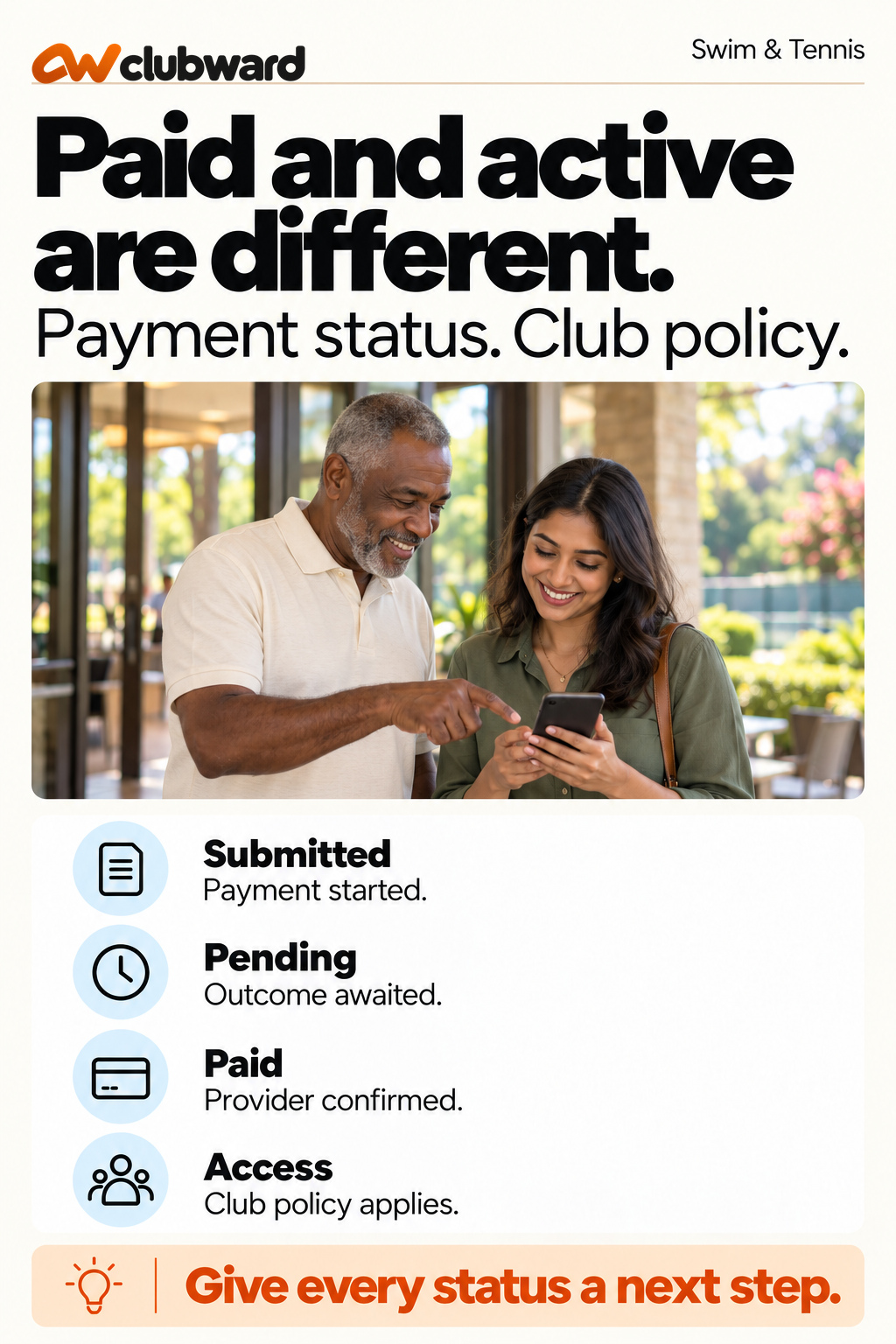
Clear status definitions give the team a shared starting point before the first dues invitation goes out. The following operating definitions are a starting point; adapt them to your provider's actual events and your club's policy. A label should tell staff what they know, what remains uncertain, and who acts next.
| Working status | Meaning for staff | Next step |
|---|---|---|
| Not started | No payment attempt is recorded | Offer the correct payment route |
| Pending | The provider's outcome is not yet confirmed | Monitor; avoid requesting a duplicate payment |
| Paid | The required payment has a confirmed successful result | Check membership completion conditions |
| Needs attention | A failure, mismatch, or adjustment needs review | Assign the appropriate owner |
A screenshot supplied by a member is useful context for an investigation. Your procedure should still specify where staff verify the recorded payment and account match. The same applies when a member says that a bank debit appears on their statement.
Access decisions need their own rule. Your club might require payment and a completed waiver, or allow a documented grace period. State the policy clearly and identify who approves exceptions. Avoid asking a front-desk volunteer to infer access eligibility from an ambiguous financial note.
Receipts and confirmations answer different questions
A payment receipt helps explain the transaction. A membership confirmation explains what the member can do next. Design both messages so a person knows whether another action is required, which period the payment covers, and where to ask a question.
If you use Stripe, its email receipt guidance explains receipt configuration. Check the settings in your actual payment flow and test delivery rather than assuming that collecting an email address guarantees the desired confirmation.
Your club's message can add the membership context: household, term, remaining requirements, and the route to account information. If the payment is still pending, the message should say so. Avoid congratulating someone on a completed renewal when the completion conditions have not been met.
Give the support contact enough context to help without asking the member to send sensitive payment data. A transaction reference, membership reference, and short description of the question are a useful starting point. Staff can then inspect the appropriate records through their authorized access.
Helpful reminders reflect the current account
Before sending another dues reminder, review who actually needs one. Separate unpaid accounts from pending payments, approved payment arrangements, and questions awaiting staff action. Someone who has already paid should not have to reassure the club that its records are current.
A helpful reminder names the membership period, explains the remaining amount or action, provides the correct account route, and offers a way to ask a question. Avoid sending sensitive account detail in a broad group message. For a renewal cycle, use the membership renewal readiness checklist to coordinate records, invitations, and follow-up.
A simple reminder template
Hello [name], your [membership] dues for [term] are ready to review. The remaining amount is [amount], due [date]. You can review your account and follow the payment steps at [account link]. If you have already submitted payment or need help with the amount, contact [club contact] so we can check the record before you try again. Thank you for being part of [club].
Replace every placeholder and verify the account before sending. A friendly tone works best when the underlying information is accurate.
The treasurer needs an understandable handoff
The finance handoff works best when its required records are agreed before online collection opens. Useful fields may include membership reference, charge, approved credit, transaction reference, payment status, fee, refund, and payout reference where available. Decide which system supplies each field and who investigates a missing match.
Review refunds under the provider's actual pricing agreement. Stripe's refund fee guidance explains that treatment depends on pricing and fee arrangements. Do not assume that reversing a member charge reverses every related cost.
For a simple planning example, suppose a dues collection records $550 received and a separately verified $10 processing cost. The arithmetic leaves $540 before any other adjustments. This is an example amount, not a processor quote or a promised deposit. The actual handoff needs the real transaction and payout records.
For more detailed reconciliation work, use the club payment reconciliation guide. Keep this launch focused on establishing a reliable collection trail, with deeper accounting review owned by your treasurer or bookkeeper.
A launch test includes ordinary and awkward payments
A useful test follows the member's whole route: invitation, account identification, membership selection, payment, confirmation, staff review, and finance handoff. Use the provider's approved testing facilities and sample records. Review the experience on a phone as well as a desktop.
- A household pays the standard amount and receives the expected confirmation.
- A different adult pays for the same household.
- An approved credit changes the amount due.
- A payment remains pending or fails.
- A member returns after stopping partway through.
- A refund or offline payment needs a documented update.
- Payment succeeds while another membership requirement remains outstanding.
For every case, record what the member sees, what staff see, and the expected next action. A pass means the result is understandable in the saved records, not merely that the payment button responded. Recheck failed cases after corrections.
Invite someone who did not configure the form to try it. Their questions can reveal an unclear label or missing explanation. Give rotating volunteers a short practice session using the same cases so the launch does not depend on one person's memory.
A smaller first group makes review manageable
A clearly defined membership group and a named support owner make the first rollout easier to oversee. Explain what is changing, when the new route begins, and what happens to existing balances or payment arrangements. Avoid telling members to abandon a current method until the replacement has been checked.
During the first collection window, review unresolved accounts by reason: no action, pending payment, failed attempt, amount question, or record mismatch. Keep completed membership units separate from individual household members when counting progress. That makes the denominator match the thing you are collecting.
Choose a few measures your team can maintain consistently: completed accounts, unresolved exceptions, duplicate-payment concerns, and time spent answering recurring questions. Compare like periods and definitions. Use the observations to improve a specific step rather than declaring that a new payment tool solved every billing problem.
Keep a launch log. Note the question, affected step, correction, and person who checked the change. Reviewing that log after the group finishes gives the collection cycle a starting point instead of reinvention.
An offline payment should still reach the same record
If your club accepts checks or another offline method, give those payments an explicit place in the process. The administrator needs to know who received the payment, which household it belongs to, what charge it covers, and which authorized person confirms it. A separate handwritten list should not become the only explanation available when a member asks about their balance.
Members and volunteers need an understandable recording timetable. If an offline payment is awaiting review, describe that situation accurately instead of leaving the household in an unexplained overdue group. Once the finance owner confirms the result, check the account balance and the reminder audience together.
This also belongs in your migration plan. Existing arrangements should have a documented owner and next action before the new online route opens, so members receive consistent instructions.
An exception note helps the next staff member
A good exception note records the question, the verified facts, the responsible person, and the promised follow-up. For example: the household expected a credit; the current record shows the standard charge; the treasurer is reviewing the approval; the coordinator will respond on Thursday. That preserves the situation without deciding the outcome prematurely.
Keep sensitive details out of general staff messages. Record the issue in the appropriate account location and give each role only the context needed to act. When the question is resolved, include the decision and the related record change. The next person should be able to continue the conversation without asking the member to retell it.
Questions to settle before opening online dues
Should every membership use automatic recurring payments?
The membership agreement and the experience your team can support should guide that choice. A seasonal renewal may involve a new household decision each year, while another membership follows an ongoing arrangement. Confirm what members authorize, how they change payment details, and how they request a change. Do not turn a one-time dues offer into a recurring charge without the appropriate member agreement.
What if a member says they paid twice?
Pause further collection requests while the authorized finance person checks the transaction references and household account. Record the concern and explain when the member can expect a response. Follow your approved refund or correction procedure after confirming the facts. A quick promise of a refund should not replace the check that establishes what actually happened.
What should a board see in the launch review?
A useful board review brings together the approved dues rules, the collection journey, unresolved exceptions, and the responsibilities that remain with the club. Include actual test outcomes and any accepted manual steps. That gives the board a concrete process to review, rather than an attractive payment page with unanswered questions behind it. Preserve the decisions for the next coordinator.
A Clubward walkthrough built around your dues workflow
Clubward connects member and household records with membership and payment history. Its billing and statements capabilities connect dues, invoices, credits, payment activity, and statements to the account. Capabilities vary by plan and selected modules, so your walkthrough should confirm the arrangement your club needs.
Bring the dues worksheet, one ordinary household, and one exception. Ask to follow the charge, payment result, member confirmation, staff view, and finance handoff. Identify which steps are supported directly, which need configuration, and which remain your team's responsibility.
Book a personalized Clubward demo to work through that journey with our team. The aim is a collection process your members can complete and your staff can explain, with a clear next step when something needs attention.
From Clubward
More from Clubward