swim-tennis-clubs
How Swim and Tennis Clubs Can Test Renewal-to-Check-In Before Choosing a Platform
Follow one household from renewal through programs, guests, and a busy arrival to test whether a club platform supports the full season.

A swim or tennis club platform should be evaluated as a season-long member journey, not as a collection of attractive screens. The decisive test is whether one household can move from renewal through opening-day arrival with its membership, people, guest rules, program context, and front-desk action still connected. If staff have to reconstruct that story at the busiest check-in, the system has not removed the seasonal friction that matters.
Use a single household as the thread for the evaluation. Give it ordinary complexity: two adults, two children, one child enrolled in lessons, a guest expected on opening weekend, and one item that needs staff review. No private member information is necessary. The scenario should feel familiar enough that managers, volunteers, and front-desk staff can recognize where work normally appears.
Write the journey before the demonstration
Begin with the moment the renewal invitation is sent. What does the household need to confirm? Which people are included? Which choices or acknowledgments belong to the household, and which require staff action? Continue through payment status, access eligibility, program registration, guest preparation, and arrival. Write every handoff in order, even if your current process uses different tools.
This map gives the evaluation a boundary. It prevents the meeting from becoming a tour of isolated features and helps the team notice when the same household information is entered again. Mark the places where seasonal staff typically ask a manager for help. Those moments deserve more attention than a rarely used administrative option.
- Renew: confirm the membership package, household, contact information, and required decisions.
- Prepare: resolve anything that prevents access or participation before the family arrives.
- Enroll: place the correct participant in the correct lesson, team, clinic, or activity.
- Invite: apply the club’s guest rules and preserve the member sponsor.
- Arrive: give the front desk a clear eligibility answer and the next action.
- Follow through: keep the household record understandable after opening day.
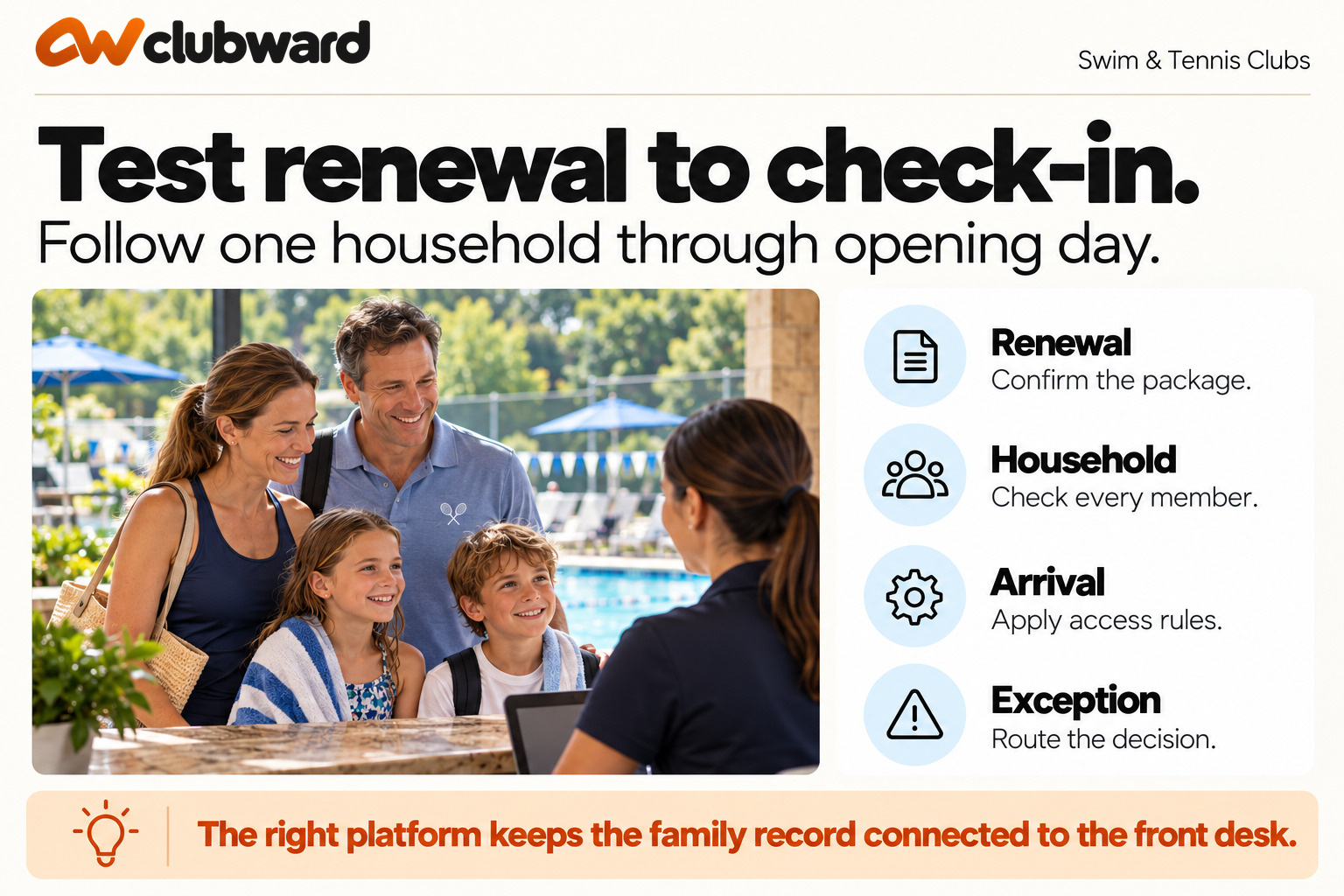
Test renewal as a connected decision
Ask the presenter to renew the household without skipping the member-facing steps. Watch how the package is selected, how household members are confirmed, and how staff can identify an incomplete decision. If a child is no longer participating or another adult has been added, does the update remain connected to the household? Can the staff member tell what changed without comparing two exports?
Add one question that requires review. Perhaps the family selected an option that does not match its current membership, or one person needs a staff decision before access is active. The system should make that unresolved item visible without forcing the entire household into a vague status. Ask who receives the work, what the family sees, and how another manager can continue if the original reviewer is unavailable.
Do not treat a payment screen as proof that renewal is complete. The operating definition of complete should include the household decisions your club actually needs before service: current people, accepted requirements, program choices where relevant, access eligibility, and a clear staff view. Define that standard before the demo so the team can tell the difference between payment completion and operational readiness.
Carry the same household into programs and reservations
Next, enroll one child in a lesson or clinic and reserve a court or activity for an adult. The evaluation is not about creating the records quickly. It is about whether the participant, household, schedule, capacity, and staff context remain linked. Ask what happens if the child changes level, the family changes the session, or the court time moves.
Introduce a capacity issue. Place the lesson near its limit or create a waitlist situation. Ask what the family and staff see when a place opens. Then cancel the adult’s reservation and observe whether the availability can be handled according to the club’s process. These changes reveal whether the platform supports the sequence around participation or merely stores a calendar entry.
Look for duplicate identity work. A child should not become a disconnected program record that staff cannot relate to the household. A guest should not appear without a sponsor. A reservation should not require the front desk to search for a separate membership status. Record every point at which the presenter must leave the household journey to rebuild context elsewhere.
Bring the busiest arrival
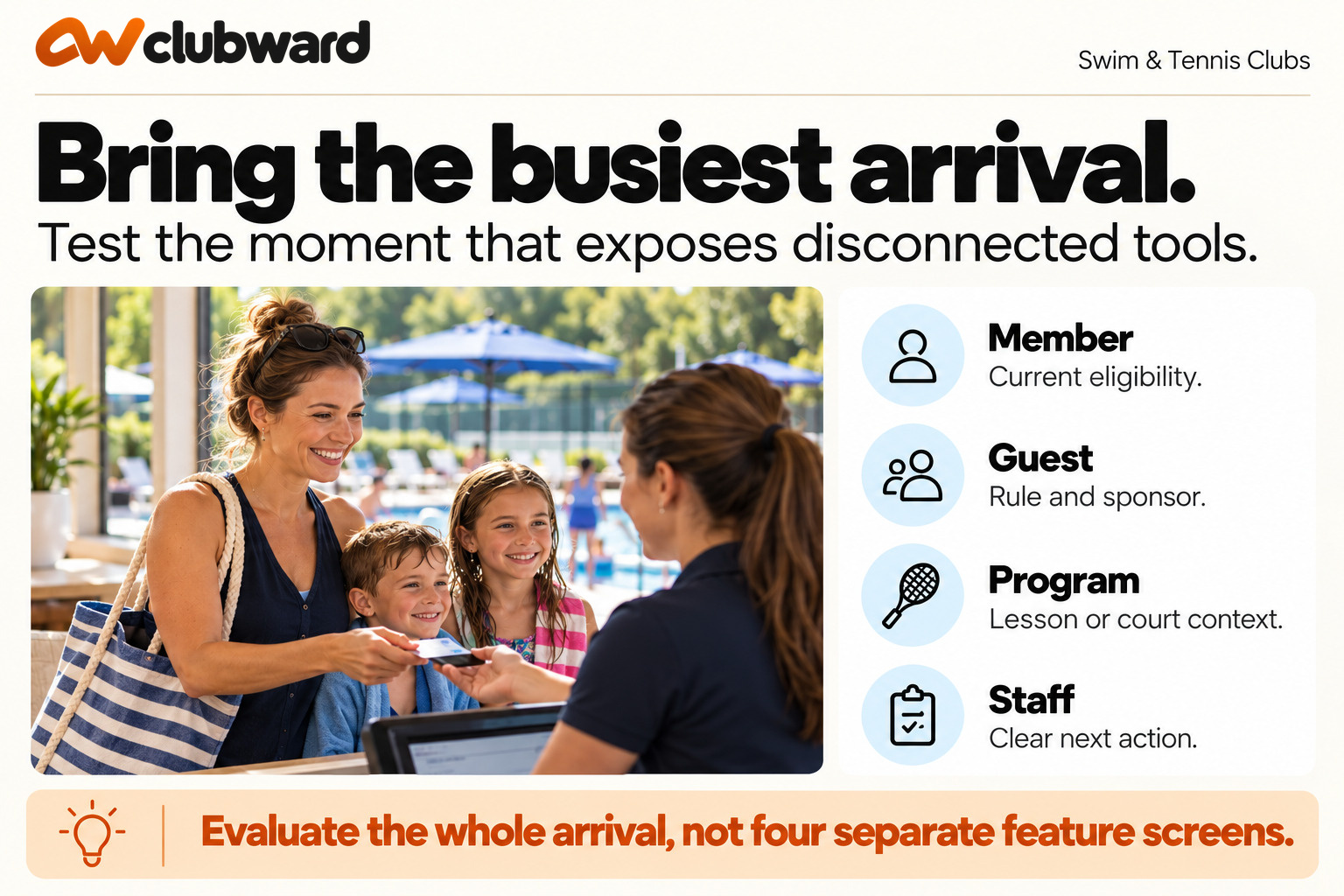
The strongest test happens at the desk. Imagine the family arrives just before lessons begin. The children need to move toward their program, one adult expects a guest, another asks about a court reservation, and the line is growing. Ask a seasonal employee—not only the manager—to explain what the screen tells them to do.
The employee should be able to confirm the household and current eligibility, understand the guest relationship, see the relevant program or reservation context, and identify any unresolved item. If the screen shows only a warning, ask whether the warning explains the next step. “See manager” may be appropriate for a sensitive exception, but routine questions should not require the employee to interpret policy from memory.
Change one fact during the arrival. The guest is different, a child is attending a different session, or the person presenting the household is not the usual primary contact. Watch whether staff can update the right record and whether the change creates a clear follow-up. A system that performs well only when the family arrives exactly as expected will not protect the busiest part of the day.
Score the moments that protect the season
Use a scorecard built around the household journey. Rate each dimension from one to four, with one meaning a separate manual process, two meaning repeated workarounds, three meaning one documented and owned step, and four meaning the workflow stays connected. Do not average away a critical weakness; identify the dimensions that the club considers non-negotiable.
- Household continuity: Can staff understand the people, membership, and current decisions in one context?
- Renewal clarity: Can the family and staff tell what remains incomplete and who owns it?
- Participation context: Are programs and reservations tied to the correct individual and household?
- Guest control: Is the sponsor and applicable rule clear at preparation and arrival?
- Front-desk action: Can a seasonal employee act without guessing or opening several tools?
- Exception routing: Does an unusual case reach an authorized person with the story intact?
- Change visibility: Can the team see what changed before it becomes an opening-day surprise?
Ask each evaluator to score independently before discussing the result. A manager may value configuration depth while a front-desk employee notices that the next action is unclear. A volunteer board member may focus on oversight and fairness. The differences are valuable because they show where a platform decision must be supported by procedure or training.
Test staff turnover before it happens
Seasonal operations change hands. Ask what a new employee needs to learn to complete the scenario and which parts the platform makes visible. Then remove the experienced manager from the exercise and have another participant continue. If the process depends on a private explanation, the club still has a continuity risk.
Review permissions by role. A front-desk employee may need eligibility and next-action context without broad access to financial or administrative information. A program lead may need rosters and attendance. A manager may need to resolve exceptions and review activity. The evaluation should test whether each role has enough context to work without receiving unnecessary access.
Ask how staff access is added, changed, and removed across the season. A clean departure process matters as much as a clean invitation. Assign an owner for reviewing roles before opening, after major staffing changes, and at season close. That is an operating responsibility, not a setting to configure once and forget.
Rehearse a policy change
Seasonal clubs frequently adjust details as conditions change. During the demonstration, change one guest rule, reservation window, or program capacity. Ask which current records are affected, how members learn the effective date, and what staff see. The team should understand whether the change updates future behavior, existing commitments, or both.
Then reverse the change. This reveals whether the platform preserves an understandable sequence or simply replaces the old value. The club may not need a detailed audit for every setting, but managers should be able to explain which rule was active when a decision was made. If that requires a separate spreadsheet, include it in the true operating cost.
Plan a limited opening-day rehearsal
Before choosing, outline the first implementation phase. Select one membership package, one program type, one reservation flow, and one guest scenario. Name the data that must be prepared, the people who approve rules, the staff who test the front desk, and the messages members will receive. This turns implementation from a vague future project into part of the selection decision.
Run a rehearsal with several sample households and a short line of arrivals. Include one ordinary family, one guest, one program participant, and one exception. Time is not the only measure. Watch whether employees hesitate, whether messages contradict the desk, and whether a manager can see unresolved work before the doors open.
After launch, review a sample of journeys rather than relying on overall impressions. Look for incomplete renewals, households with unclear people, program changes that do not reach the desk, guest questions, and exceptions without owners. Use those observations to improve configuration and training without inventing performance claims.
Evaluate Clubward against the whole journey
Clubward is a club management platform. Its swim club workflow describes household memberships, renewals, guest access, programs, reservations, staff scheduling, communications, reporting, and LookForward. A swim or tennis club should test those capabilities as one operating journey and keep its own policies, staffing decisions, accounting responsibilities, and judgment clearly assigned.
The right question is whether the household record can remain useful from renewal through the busiest arrival—not whether each feature exists in isolation. Record any necessary workaround, name its owner, and decide whether it is acceptable before selection.
Compare support and change ownership
Selection should also include the work that begins after configuration. Ask where managers go when a seasonal employee encounters a workflow they cannot complete, who can change the setup, and how the club confirms that a correction has reached the front desk. Separate product support from the club’s internal decision path. A support team can explain how a capability works, but only the club can decide whether a household is eligible or whether an exception should be approved.
Create a simple ownership table with four columns: situation, first responder, decision owner, and record location. Include an incomplete renewal, a household change, a program move, a guest exception, an access question, and a staff-permission change. Fill in the table for the proposed workflow. Blank or disputed cells reveal preparation the club must complete before launch. They also help the vendor understand which parts of the demonstration deserve a precise answer.
Ask how upgrades or configuration changes are communicated to administrators. Determine who on the club side reviews those changes and whether a seasonal procedure needs to be updated. Avoid assuming that every new option should be turned on immediately. A stable operating season may benefit from a controlled change window, with nonurgent adjustments reviewed after peak activity. Record this governance choice as part of the implementation plan.
Make the final comparison visible to the board
Summarize the evaluation in a one-page brief rather than forwarding screenshots and notes. List the household scenario, the non-negotiable moments, the accepted workarounds, the implementation owner, the first-phase scope, and the reasons for the recommendation. Include any open question with a named person and a decision date. This gives the board a reviewable operating proposal instead of a general endorsement.
Keep the demonstration scores with the brief, but add the evidence behind them. “Front desk: three” is less useful than “The employee could confirm eligibility and guest sponsorship in one place; a manager still owns the unusual program change.” Specific evidence makes later review possible and prevents a high score from hiding an important qualification.
Finally, identify what would cause the club to revisit the choice: a major policy change, a new program model, a different access process, or a shift in staffing. A selection should support the upcoming season without pretending that the club will never change. A clear review trigger helps leaders improve the workflow intentionally instead of accumulating workarounds until the original decision no longer fits.
Choose with an opening-day answer
Return to the original family. Can staff see who renewed, which people are included, what each person is doing, how the guest fits, what is unresolved, and what to do next? Can another employee understand the same answer without calling the manager? If so, the evaluation has tested the season rather than the presentation.
Book a personalized Clubward demo and bring one realistic household journey. Ask to follow it from renewal through a program or reservation, a guest decision, and opening-day check-in before your club makes its platform choice.
From Clubward
More from Clubward