Property Management Companies
A Property Manager’s Plan for Amenity Service Visits
Prepare an amenity service visit with a clear work brief, agreed booking changes, an arrival contact and a responsible handback before residents return.

The contractor is expected at nine. A resident has booked the clubhouse for eleven, the cleaner is finishing another building, and the person with the arrival details is off today. Everyone knows that a service visit is happening. Nobody has quite the same picture of what the room will be like when residents arrive.
A useful visit plan connects five answers before the provider comes: what work is agreed, which space and time are affected, who handles arrival, what residents need to know, and who decides when the amenity can return to its usual use. The appointment is one part of that plan. It is not the whole operating answer.
For a property management team, the practical goal is a short brief that a covering colleague can use. It should explain the visit without requiring them to reconstruct the original request, search a private inbox or make a new promise about a booking that someone else already confirmed.
The visit starts with a defined piece of work
A request to “look at the clubhouse door” leaves several possible jobs inside one sentence. The provider might be inspecting the problem, replacing an agreed component or returning to check earlier work. Those visits can need different arrangements, even when they involve the same doorway and the same contact.
The brief becomes more useful when it identifies the agreed task and its boundary. An inspection appointment can end with findings and a proposed next step. A planned replacement can have an agreed completion check. Neither description should quietly become permission for additional work or a guarantee that the amenity will reopen immediately.
The responsible manager can settle uncertainty with the provider before the visit. A covering colleague then needs the accepted scope, relevant reference and route for a changed request. They do not need every technical detail. They need to recognize when the proposed work has moved beyond the arrangement they were asked to support.
An appointment and an availability hold are different answers
The provider's arrival window describes when somebody is expected. The amenity hold describes when a space is unavailable under the property's agreed plan. Setup, access arrangements, cleaning and the responsible person's handback review may extend beyond the conversation at reception.
That distinction matters before accepting another booking. Suppose a visit is expected between nine and ten, but the operating team needs the room clear until eleven for the agreed review and reset. A calendar that only records the expected visit can leave the next colleague with a misleading gap.
The useful planning conversation considers the whole affected period. If its end is uncertain, the brief can explain the next decision point instead of presenting an estimate as confirmed availability. The person responsible for booking decisions needs to accept that approach before the resident receives a promise about when the space will be ready.
The room name needs to mean the same thing to everyone
A property can have a clubhouse, lounge, meeting room and adjoining terrace that people describe differently. The provider may have an equipment location while the resident knows only the name on a booking confirmation. A useful brief connects those names to one recognizable place.
The affected area may also be narrower than the whole amenity. Work in a storage room could have a different effect from work at the only agreed entrance. The manager needs to establish the operating consequence with the responsible people, rather than infer it from the size or apparent simplicity of the job.
A plain location description, approved arrival route and clear boundary help the covering team understand the arrangement. Sensitive access information belongs in its authorized location. A general resident notice does not need the same details as the person assigned to meet the provider.
The existing booking deserves its own decision
A reservation already accepted should appear explicitly in the visit review. The manager needs to know whether the agreed work and the booking can coexist, whether the booking needs an approved alternative or whether the proposed visit should move. Those are decisions, not automatic consequences of adding an appointment.
A practical review includes the booking's setup time as well as the event itself. A resident preparing a family gathering may need access before their guests arrive. A hold that ends at the event start can therefore leave a real conflict unresolved even when two calendar entries do not overlap.
The person with authority over the booking can explain the accepted outcome and record it beside the arrangement. If an alternative is offered, its availability and conditions need confirmation too. A well-meant suggestion becomes another unanswered request when nobody has actually reserved the replacement space.
One colleague owns the visit brief
The person coordinating the brief does not have to perform every task. Their role is to keep the accepted arrangement understandable: the provider's appointment, the amenity hold, the booking decision, the arrival contact and the next update. Each can have a different responsible person.
A brief with several named contacts is useful when their responsibilities are clear. The provider needs to know who handles arrival. The resident needs a route for their booking question. Reception needs somebody who can resolve an unexpected change. Listing everyone's number without explaining those roles leaves the covering employee to choose.
Coverage matters as much as the original assignment. If the coordinator will be unavailable, the covering colleague needs the current brief and an accepted decision boundary. They should understand which arrangements they can confirm and which questions must return to the manager or another authorized person.
A visit brief the next shift can use
The brief can be a short record in the team's established working location. Its value comes from connecting the decisions, rather than from introducing another form that must be copied into several places. A colleague should be able to find the current version from the relevant amenity or work reference.
- Work: the agreed task, provider reference and scope owner.
- Place: the affected amenity, area and authorized arrival route.
- Window: expected arrival, accepted availability hold and next review point.
- People: arrival contact, covering contact and changed-work decision owner.
- Residents: affected bookings, accepted arrangements and update owner.
- Handback: the person reviewing the result and communicating the operating answer.
Unknown details can remain visible as open questions with owners. A blank space is less useful because the covering employee cannot tell whether somebody forgot the detail or deliberately left it undecided. The brief should make that difference understandable before the shift begins.
Arrival needs a workable arrangement
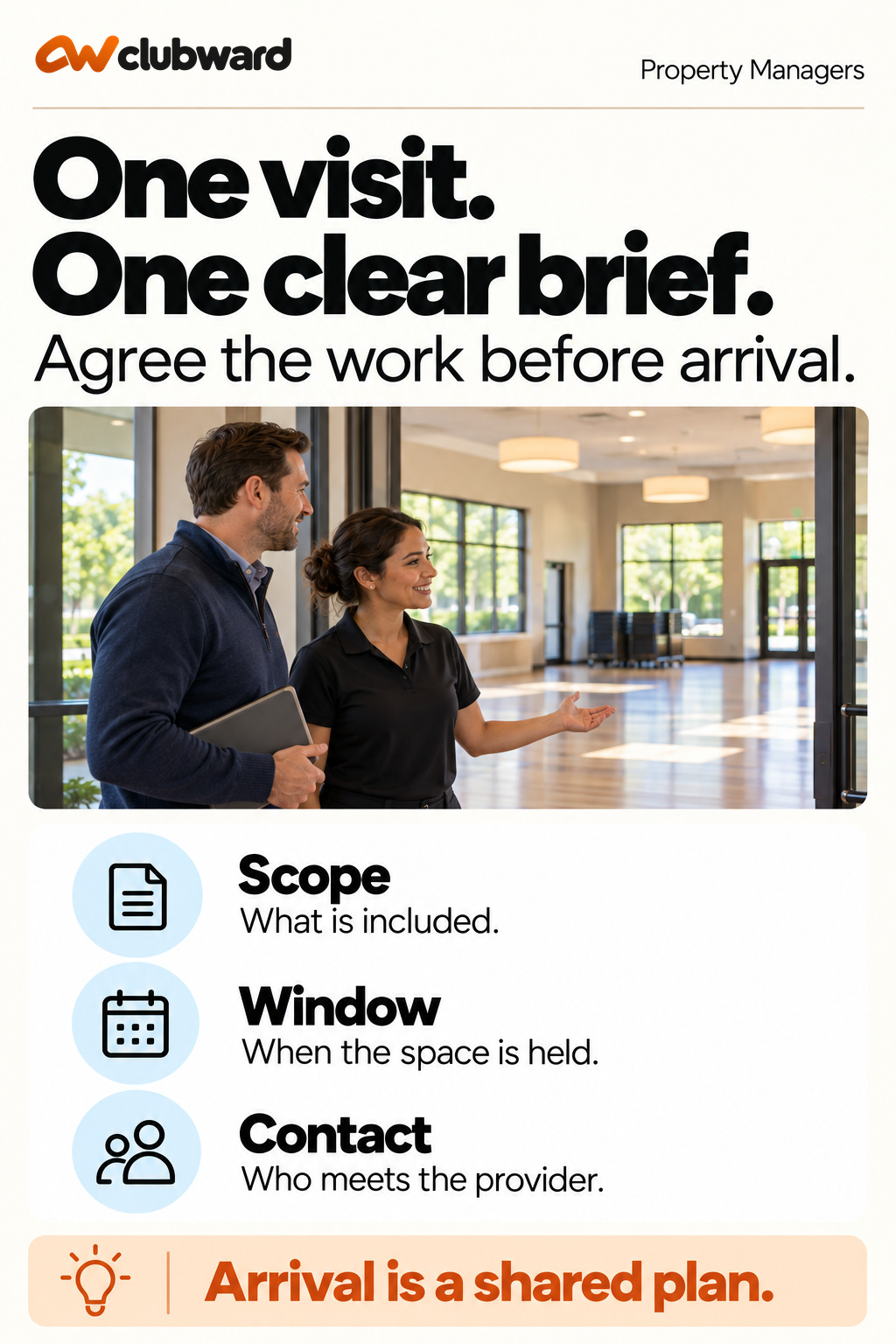
The provider's contact details do not establish that somebody will be there to meet them. A practical arrival arrangement includes the expected contact method, the person covering it and the agreed response if the provider arrives outside the accepted window.
For a managed community with several buildings, the address alone may not identify the intended entrance. The coordinator can confirm the appropriate location and arrival instructions through the property's authorized process. The front desk then has an explanation that matches the arrangement rather than an instruction to improvise access.
The same clarity helps when a different technician attends. Reception needs the property's normal verification and escalation process, together with the visit reference. A familiar company name should not require the employee to make an unfamiliar access decision without the information or authority needed to resolve it.
Resident communication follows the operating decision
The resident needs the practical effect: which amenity is affected, when the accepted restriction applies, what happens to their booking and where a question should go. They rarely need the full history of the request or the provider's internal work description.
A useful message might explain that the community room is unavailable during the agreed service window and that a named contact will confirm its next availability update. If a resident has an accepted alternative, their individual confirmation should describe that arrangement instead of making them infer it from a general notice.
The UK Government Service Standard recommends connecting online and offline channels and keeping frontline staff informed of changes. For this visit, that means the resident notice, booking answer and desk instruction should describe the same accepted arrangement. The guidance offers a useful service-design principle; the property's own procedures determine the actual decisions.
The covering employee needs the current answer
A resident might ask reception about the room before opening an email. Another might reply to the booking confirmation that was sent earlier. The colleague receiving the question needs the current answer and a route for correcting an older message that no longer describes the arrangement.
The handoff can include a short explanation of what changed, which booking decisions are settled and which questions remain open. The employee should be able to acknowledge the resident's concern without guessing at a completion time or repeating a provider estimate as a promise.
Keeping that explanation with the visit reference gives later shifts a place to begin. If the arrangement changes again, the update owner can identify which instructions and messages need attention. The aim is one understandable operating answer, even when several people help deliver it.
A printed arrival sheet can be useful at a desk, provided its owner knows when the arrangement changes. A simple version date and current-record reference help the next colleague recognize an older copy. The update owner can then replace the sheet when a revised arrival time or booking decision has been accepted.
When the provider changes the arrival time
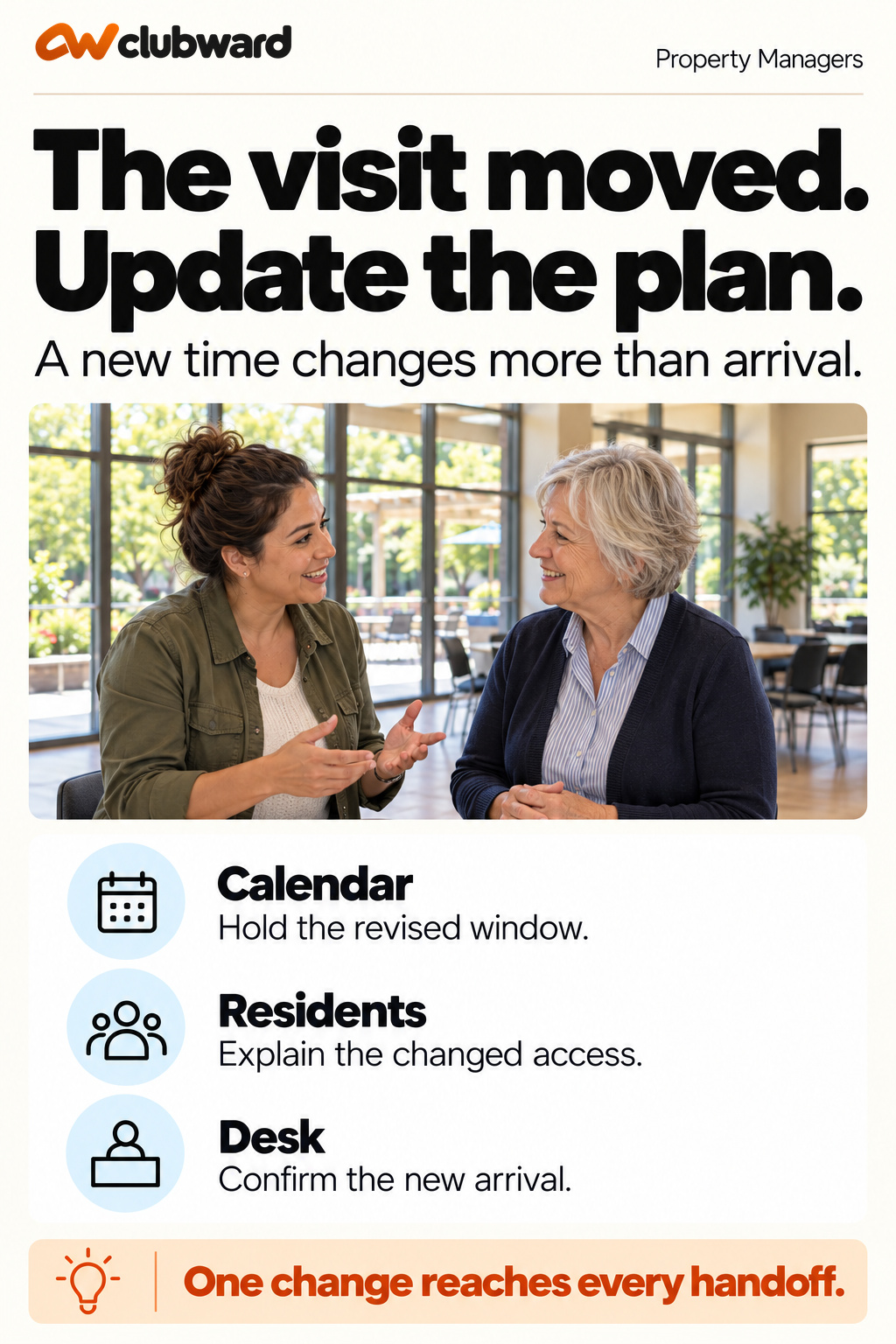
A new arrival time deserves more than moving a calendar entry. It can change the person available to meet the provider, the period the room is held and the booking that follows. The coordinator needs to reopen those connected questions before confirming the revised arrangement.
Suppose the provider moves a morning visit to the afternoon. The morning booking may now be possible, while an afternoon reservation becomes affected. Neither outcome follows automatically. The booking owner needs an accepted decision before staff reverse one notice and send another.
A simple change record can state the former arrangement, the revised proposal, the person accepting it and the people who still need an update. When the proposal is not yet accepted, the brief should retain that uncertainty. A tentative message should not quietly become the new instruction used at the desk.
A worked example at Maple Court
Imagine Maple Court has a community room reserved for a residents' craft session at eleven. A provider is expected at nine to inspect a sticking internal door. The property manager initially plans a room hold until ten, with the caretaker meeting the provider and reporting the result.
During preparation, the craft organizer explains that their accepted booking includes setup from ten. The caretaker also points out that the provider's task is an inspection, so the team cannot assume the problem will be resolved during that appointment. These details change the question the manager needs to settle.
The manager agrees a clear plan with the responsible people. The room remains held while the inspection and operating review take place. The craft session is offered an available alternative room under an accepted booking change. The organizer receives the new setup details and a contact for any remaining question.
The caretaker's brief identifies the inspection scope, the arrival contact and the manager who will decide the operating answer afterward. It does not ask the caretaker to approve a new repair or guarantee a reopening time. Reception can explain the changed craft booking without interpreting the technical findings.
Now suppose the provider asks to arrive at one instead. The coordinator revisits the room hold, covering contact and later bookings before accepting. The original morning explanation is no longer sufficient. The revised brief records the accepted arrangement and identifies which residents and staff need a fresh update.
The result can create a new decision
An inspection may identify work that needs another appointment. A planned job may finish with a question the responsible reviewer still needs to answer. The visit record should distinguish the provider's reported result from the property's accepted decision about the amenity's use.
This is where the preparation brief hands over to the existing closeout process. The guide to checking an amenity repair before closing the request follows that later stage. It helps the team connect reported work, the agreed review and the resident's final operating answer.
A provider leaving the property does not by itself settle the booking calendar. The designated person needs to confirm the next accepted availability or explain the remaining restriction and review point. That answer can then reach the desk, relevant residents and the person maintaining the booking record.
The management company needs a consistent minimum
A management company can use the same brief headings across properties while leaving local arrangements intact. One community may have an on-site caretaker; another may rely on a visiting manager. The headings identify the questions without pretending the staffing, access or booking rules are identical.
A regional operations lead can review whether each property has an accepted arrival contact, a decision about affected bookings and a clear handback owner. That is more useful than comparing how many appointments appear on each calendar. The review concerns the quality of the arrangement, not a competition between properties.
Local exceptions should remain visible in ordinary language. If a property uses a particular authorized route for after-hours visits, the covering employee needs its current procedure. Copying another property's instructions because the buildings look similar can leave the actual decision boundary unexplained.
A short rehearsal before the first visit
A covering colleague offers a useful test of the brief. They can follow one ordinary question: the provider is at the entrance, the coordinator is unavailable and a resident asks whether their booking will proceed. Their explanation reveals which parts of the arrangement are clear enough to use.
The rehearsal does not need a staged technical fault. It can use the accepted visit details and the team's ordinary communication route. The colleague should find the current reference, identify the arrival owner and explain which booking decision is confirmed. An unanswered question becomes a specific improvement to the brief.
A second pass can change one condition, such as a late arrival or an unavailable contact. The useful result is an understandable next action within the employee's authority. A rehearsal that only works while the original coordinator supplies missing details has identified preparation work that is still worth doing.
A request for additional work changes the arrangement
The provider may arrive, examine the problem and suggest a different task. The colleague meeting them needs to know who can consider that proposal. Being the arrival contact does not automatically make someone the person authorized to change the scope, accept a new amount or extend the amenity restriction.
A useful handoff records what has been proposed, why the provider says it is needed and which parts of the existing arrangement would change. The decision owner can then review the proposal through the property's normal process. Meanwhile, reception needs an accurate holding answer rather than an informal assurance that the extra work will be quick.
Suppose the planned inspection identifies a component that could be replaced later that afternoon. The manager's review includes the proposed work, the accepted approval route, access coverage and affected bookings. The decision may be to arrange another visit. It may be to accept a revised plan. Either outcome should reach the same people who were relying on the original brief.
A cancelled appointment still has a closeout step
A cancellation can leave a room held unnecessarily or make an unresolved problem disappear from view. The coordinator needs to distinguish the cancelled visit from the status of the amenity and the underlying request. Those three records answer different questions.
If the amenity remains unavailable under the accepted operating decision, removing the provider's appointment should not suggest that normal use has resumed. The booking owner needs the current answer and a next review point. If the space can be offered again, that decision needs to reach the person maintaining availability and any resident already discussing an alternative.
The covering colleague should also know whether a replacement appointment is confirmed or merely being requested. “We are arranging a new visit” and “the provider will return Thursday” create different expectations. A short update can explain the settled position without filling the uncertainty with a date nobody has accepted.
An owner update can explain the decision without the inbox
The client contact may need a concise account of the arrangement rather than copies of every provider message. A useful update separates the agreed visit, its effect on amenity use, the accepted resident arrangements and any decision still needed. The original references remain available in the authorized working record.
This format makes an open question easier to recognize. “The inspection is booked, but the afternoon availability decision is pending” tells the reader more than “maintenance is being handled.” It also gives the manager a specific next update to own instead of suggesting that the appointment itself has resolved the problem.
After the visit, the same headings can carry the confirmed result and remaining action. The client then sees what changed, which resident arrangements were affected and who holds the next decision, without receiving unnecessary private account details.
Shared-space planning and the visit conversation
Clubward supports shared-space reservations and a connected view of programs and the places they use. That booking context can provide a starting point for discussing an affected room or amenity. Capabilities vary by plan and selected modules.
A useful walkthrough can follow one resident booking through a proposed service window, a changed arrival and the accepted return to use. The team can ask where the booking answer is maintained and how colleagues find the relevant context. The provider's work instructions and access decisions still need the property's agreed process.
The strongest preparation begins with a visit your team can explain together. Plan a Clubward shared-space walkthrough around one amenity service visit, bringing the booking question and the handoff your covering colleague needs to understand.
From Clubward Editorial Team
More from Clubward