Property Management Companies
A Booking Form Passes the Easy Case. Can It Handle a Changed Request?
Follow a clubhouse request through its original submission, approved revision and final confirmation to check the resident and staff handoff.

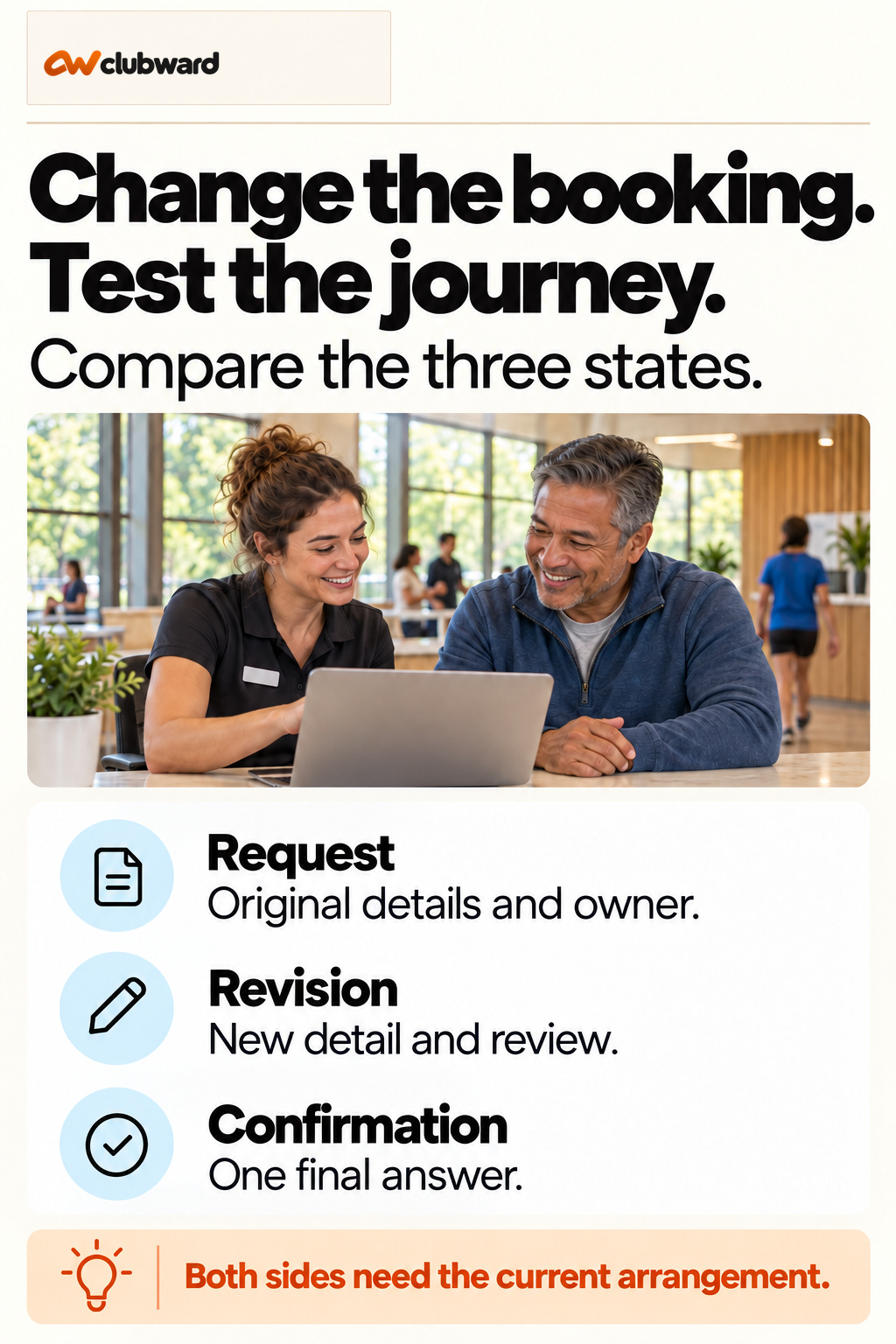
Test a changed clubhouse request by following it through three states: the original submission, the approved revision and the final confirmation used by the resident and operating team. Change one meaningful detail, such as the date or room setup, and check who reviews it, what remains reserved and which answer the resident receives. A form that collects the first request well has passed only the first part of the journey.
For a professional property management team, the useful result is a clear account of what happens after a resident changes their mind. Keep the evaluation focused on amenity administration. Use a practice booking or an authorized example, and avoid making live reservation changes just to see what happens.
Begin with your current website, form and staff instructions. You can use this evaluation before changing tools or when checking a process already in place. The deliverable is a three-state record showing the current request, the responsible owner and the evidence that the final answer reached both sides.
Pick a change that affects the decision
Choose a request change that your team actually encounters. Moving a booking to another evening, increasing the expected attendance or asking for additional setup time can test a meaningful review. Correcting a spelling mistake may not exercise the approval boundary.
Keep the case manageable. Start with one room, one request and one changed detail. Add complexity later if the initial evaluation works. A large scenario involving several amenities can hide which handoff caused the uncertainty.
State what the evaluation should reveal. For a date change, ask whether the new time is checked, whether the earlier booking is still held and whether the resident sees a definite answer. These are separate questions.
Agree who can authorize a live change before using a real record. A practice walkthrough can explain the intended process without altering availability. Keep the method within your team's current permissions and the community's approved reservation rules.
Record the original request completely
Begin from the resident's normal route, such as a clubhouse page and request form. Note the requested date, room, purpose and other details that the actual review needs. Avoid adding information simply because a sample form has room for it.
Check what confirms that the request arrived. The resident should be able to distinguish receipt from approval. In your test record, identify the confirmation message and the owner who receives the submission for review.
Locate the request inside the team's normal work system. A website notification may show arrival while the amenity coordinator works elsewhere. Follow the actual handoff between those locations rather than assuming they describe the same current state.
Write the original state in one sentence. For example, “The resident requested the clubhouse on Tuesday evening; the request is received and awaiting the amenity coordinator's review.” This is the reference point for assessing every later change.
Separate receipt, review and approval
Use the status words your team has approved, but define their operational meaning. Received, under review and approved should lead to different staff actions. A resident should not need to guess which phrase permits them to plan the event.
Identify what evidence supports the first approval. The reservation rule, available space and any required owner review belong in the test record. The evaluation checks whether the team can follow its process, not whether a particular event should receive special treatment.
Check who may communicate the approval. If a desk colleague answers resident questions but cannot decide availability, the guide should make the distinction clear. The resident needs a reliable response route even when the decision owner is occupied.
Keep the original confirmation accessible through the approved record. The changed request may later require staff to explain which details were agreed before the revision. Avoid relying on whichever email happens to be most recent in an individual inbox.
Give the resident a supported way to request a revision
Find how the resident is told to change an approved booking. That route may be an existing form, a staffed contact or a supported account workflow. Test the route actually offered rather than choosing a convenient internal shortcut.
Ask whether the resident can identify the booking being changed. A reference and the current date may help the team locate the right case. Do not require the person to resubmit unnecessary private details merely to connect the revision.
The change request should distinguish the current arrangement from the proposed one. “Move the booking from Tuesday to Thursday” is clearer than “please change my date.” Check how your process records that distinction.
Confirm what happens while the change is awaiting review. The resident needs to know which arrangement, if any, remains approved. Use your community's established policy rather than implying that a submitted revision automatically replaces the reservation.
Name one owner of the pending change
Assign the revision to a role that can coordinate the necessary review. A website inbox, front desk and property office may each receive a message, but the request still needs one identifiable owner for its next action.
Give the owner a bounded question. “Check Thursday availability and the resident's proposed setup window” is actionable. “Handle this booking” leaves the reviewer to discover which detail changed and why it matters.
Identify a covering route when the usual person is away. Use existing authority and staffing responsibilities. The evaluation should expose a missing backup rather than informally giving someone approval rights to make the test look successful.
Check how the pending case remains visible to the next shift. The covering colleague should see the requested change, current state and next decision. A general reminder to check email is not evidence that the right person can find the request.
Compare the new detail with the booking rule
Apply the ordinary review to the changed detail. A new evening may have different availability or operating hours. A different attendance estimate may affect the room choice under your community's existing rules.
Keep unaffected details visible. If the room and purpose remain the same, the owner should not need to infer them from memory. The revision record can show what changed and what remains part of the request.
Record any information needed before a decision. If the revised setup time is unclear, mark the case as awaiting that answer and identify who asks the resident. Do not label a request approved because most fields are complete.
Use the approved decision route for exceptions. The evaluator can ask how an unusual request would be routed without approving it. Keep the authority question separate from whether the form can technically store the proposed detail.
Work through a date-change example
Imagine a resident has an approved Tuesday clubhouse booking and asks to move it to Thursday. The amenity coordinator checks the requested Thursday window, including any setup and cleanup time required by the actual process.
The test should show the proposed Thursday request as pending until the review is complete. Ask which state the resident sees and which reservation the operating team relies on during that period. Use the community's current policy to answer.
If Thursday is approved, inspect the final record and the instruction used at the clubhouse. Both should identify the agreed date and relevant conditions. Check what your process does with the earlier Tuesday booking rather than assuming it disappeared.
If Thursday cannot be approved, check the response to the resident. It should explain the actual outcome and supported next choice. The original arrangement should retain whatever status your policy specifies, with that status clear to the person planning the event.
Check the old arrangement deliberately
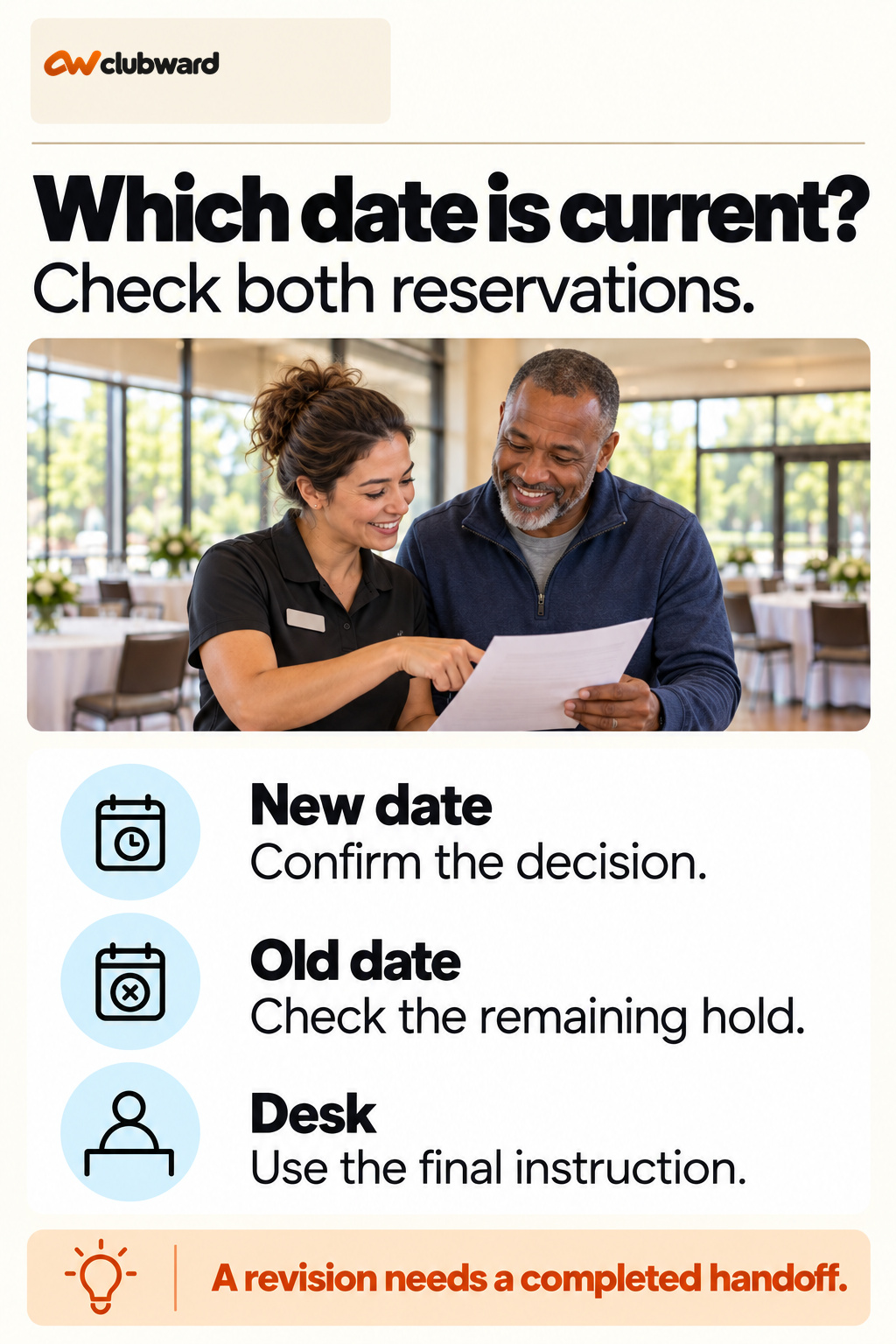
Treat the earlier reservation as its own check after the revision is decided. A new approval does not by itself show what happened to the previous time window. Locate the relevant record in your actual reservation process.
Ask whether the old arrangement remains held, is released or requires a separate action. Each possibility affects availability and staff instructions. Record the answer and the owner responsible for completing that step.
Check that the old confirmation cannot be mistaken for the current operating instruction. Preserve history within the approved system while making the current booking easy to identify. Do not solve the problem by deleting evidence the team needs.
If the old arrangement is unresolved, keep the case open for the responsible owner. A resident receiving a correct Thursday message is only one part of completion. The operating team also needs a coherent account of Tuesday.
Inspect the approved revision as a separate state
Write the approved revision in a concise sentence identifying the new arrangement, decision owner and conditions. This gives the evaluator a clear state to compare with the original request and the final resident confirmation.
Locate the evidence supporting the approval. That might be a recorded decision, a reservation record or another approved reference. Follow the normal process rather than introducing a new spreadsheet that becomes a competing source.
Ask a covering colleague to explain the change from the record alone. If they must call the original reviewer to understand which date is current, the handoff needs clearer context or a better route to the evidence.
Keep the evaluation focused on usability and consistency. A neat status label is helpful only if it corresponds to the actual decision and operating action. Record a mismatch even when the screen or form looks orderly.
Compare the resident's final confirmation
Open the actual message or approved confirmation template used after the decision. Check the date, time, room and conditions against the final booking. The resident should be able to plan from this answer without interpreting staff notes.
Check the route for another question or change. A completed confirmation should identify how to reach the appropriate team. Avoid making a general website contact the only help route if your actual process requires a particular owner.
Keep the message proportionate to the outcome. A revision approval should say what is now agreed. A request for missing information should say what is needed and what happens next. Neither should imply a decision that has not occurred.
Record whether the confirmation was prepared, sent or received, using evidence available through your process. These are different states. Do not describe delivery as confirmed because a draft message exists in the request record.
Compare the operating team's final instruction
Find what the clubhouse colleague uses on the day of the booking. A desk list, room schedule or controlled reservation view should reflect the final arrangement. Check the actual point of use rather than only the property manager's master record.
Ask the colleague to identify the current date and any relevant setup conditions. They may need less detail than the approval owner, but their instruction must agree with the decision. Record the specific disagreement if it does not.
Check how the instruction reaches a covering shift. A colleague who was present during the revision discussion may understand the change without finding it in the record. The next person needs a supported route that works without that conversation.
Do not expand the handoff into unrelated resident administration. This evaluation concerns amenity requests and reservations. Keep lease, rent and other property management activities within their separate established processes.
Test an incomplete revision
Add a proposed change with one genuinely missing detail. For example, the resident asks for a later ending but does not specify the new time. Ask whether the reviewer can identify the question and request the necessary answer.
The current state should remain understandable while waiting. Check that the resident and covering staff can tell what is still under review. Use the policy that applies to the original booking rather than making up a temporary arrangement.
Give the missing information a named owner and follow-up point. That owner may ask the resident, consult a facility colleague or route an exception. Record the particular next action instead of a general pending label.
When the answer arrives, follow it back into the same case. A separate email should not become an unconnected approval. Check that the reviewer can see the updated detail and that the final response uses the resulting decision.
Test two messages about the same booking
Imagine the resident submits a revision through the website and also calls reception. Ask how the team recognizes that both communications concern one request. The objective is to prevent competing review paths without ignoring the resident's question.
Locate the booking reference and current state before beginning another review. The desk colleague should know how to route the call to the existing owner. Do not require them to resolve the requested change outside their authority.
Check how relevant information from the second contact reaches the case. A useful note can identify the new detail and its source without reproducing unnecessary personal information. Keep the controlled record and responsible owner clear.
After the decision, check which confirmation the resident receives. Several internal messages can support one clear answer. The evaluation should reveal whether the process accidentally sends conflicting decisions or leaves one communication unanswered.
Observe the process on the device people use
Follow the resident's route on the phone or computer normally used to make the request. Check whether the booking reference, change route and current response are readable without relying on a colleague's explanation.
Then inspect the staff route in its actual working context. A property manager at a desk and a covering amenity employee may use different views. Test the information each role needs at the point where it acts.
Keep essential instructions in readable text. An attachment or diagram can help explain the sequence, but it should not be the only place where the next action is stated. Check links and any required document access.
Record the exact obstacle when something is difficult to use. “The revision contact is below an unrelated section” suggests a clear improvement. “The site is confusing” does not identify what the next owner should repair.
Use a three-state evaluation record
Create one row for the original request, one for the approved revision and one for the final confirmation. Include the current details, responsible owner, supporting record and next action where something remains unfinished.
Compare the three rows rather than counting form fields. The evaluation succeeds when the changed detail moves through review to a coherent resident answer and operating instruction. A longer form is not automatically a better process.
Separate observed evidence from proposed improvements. If the evaluator could not find the old booking's release action, state that gap. Do not describe a desired workflow as something the current process already performs.
Keep the record concise enough for another manager to understand. Link to the approved references and use a case identifier. The evaluation sheet should explain the test without becoming another live reservation system.
Choose the correction that closes the handoff
A missing revision route may need a clearer resident instruction. An unowned change may need a covering arrangement. A conflicting desk list may need a controlled update step. Choose the correction from the actual finding.
Assign one coordinating owner and an appropriate review date. Give that person the observed state and the expected endpoint. Avoid handing over a broad redesign task when the evidence identifies one specific gap.
Rehearse the same change after the correction. Check the original request, approved revision and final confirmation again. Closing a support task is useful, but the repeated evaluation shows whether the resident and staff journey now agrees.
Retain the findings for future staff handoffs. A new employee should be able to understand which route was tested and what remains unresolved. Keep the sample's limits visible without treating one successful case as proof for every amenity request.
Compare the status words with the next action
Give a covering property manager three short notes about the practice booking: “Changed,” “Date change requested; Tuesday remains the current approved arrangement while Thursday is reviewed,” and “Thursday approved; the old Tuesday hold still needs the assigned release check.” Ask what action each note permits under your community's procedure.
The first note does not establish whether someone asked for a change, approved it or completed the operating handoff. The other notes identify a state and remaining action. Their precise details should come from your actual rules; the evaluation is about preserving that meaning when staff summarize the case.
Ask the resident-facing reviewer to make the same comparison. They should be able to explain what the resident can plan now and which request is still being decided. If the staff note and proposed message imply different arrangements, send that mismatch to the change owner before communication.
Then inspect the final confirmation after the practice revision is complete. Does it identify the current date without suggesting that an earlier pending message was an approval? Is the new contact route usable if the resident needs another change?
Use the findings to choose wording that supports the actual next action. You may need a clearer pending-state sentence rather than additional form fields. Keep the terminology consistent across the request record, covering instruction and resident response, while allowing each role an appropriate level of detail.
Use the agreed wording in the covering team's next rehearsal. Ask which action remains pending and where the final decision is recorded. If their answers differ, return the specific mismatch to the owner before considering the resident's changed booking fully ready.
Explore your changed-request workflow
Clubward's programs and shared spaces include shared-space reservations and program planning. Bring one clubhouse request and a meaningful revision to a walkthrough to discuss how your amenity team would coordinate the record, review and final answer.
Ask for the specific change journey to be demonstrated in your proposed setup. Assess what the resident and covering colleague would see at each state. Record questions about configuration and responsibility rather than assuming that a website connection performs every handoff.
Before redesigning your booking form, follow one changed request to completion. Confirm who reviews it, what happens to the original arrangement and which final instruction both sides use. To explore that process in a club management platform, book a personalized resident amenity-workflow demo.
From Clubward Editorial Team
More from Clubward