Swim & Tennis Clubs
A Household Has Two Credits. Which One Applies to Renewal?
Trace the purpose and history of two household balances before explaining which amount applies to membership renewal.

A household opens its renewal message and asks a reasonable question: “We have two credits on our account. Why does the renewal still show an amount due?” One entry may relate to membership billing. Another may be prepaid spending money or a deposit connected to a different activity. The shared label does not establish that both can reduce the renewal.
Before applying either amount, identify what created it, who owns it, what it can be used for, and whether an authorized decision has already changed it. Then check the current renewal and explain which amount applies. Keep unresolved entries separate from a confirmed answer.
This is a record-and-handoff problem before it is a payment conversation. A membership administrator needs enough context to answer the household without guessing. The reviewer responsible for financial decisions needs an accurate question. The next employee needs to understand what was decided and what still requires action.
Start with the entries, not the combined number
Open the individual entries behind the household's apparent balance. Identify the dates, descriptions, linked activities or charges, and current state. A total can tell you that something remains on the account while hiding the distinction that matters for renewal.
Check whether the entries belong to the household or to a particular person. The club's records may distinguish a household membership from an individual's program or spending activity. Use the actual ownership information and approved terms. Do not transfer an amount between people simply because they share a membership record.
Find the event that created each amount. It might be an approved adjustment, a cancelled activity, a payment that exceeded a particular charge, a prepaid reload, or an event deposit. Those examples describe questions to investigate; they do not establish that every club uses the same balance categories.
Keep the original entry and subsequent activity connected. If a credit has been partly used or an adjustment has been reversed, the original amount is not the current amount available for a new purpose. The administrator should be able to follow the relevant changes before explaining the household's renewal.
Use names that describe the permitted purpose
Agree on the names your team uses for membership credits, prepaid funds, deposits, and unresolved adjustments. Define each category according to the club's actual setup and approved terms. A broad label such as “account credit” may be convenient while being too vague to answer a renewal question.
A membership billing credit should identify its connection to a membership charge or approved billing adjustment. Prepaid funds should identify the spending purpose and account owner. A deposit should remain connected to its associated booking or activity and the decision that determines its next step.
Keep an unresolved adjustment clearly marked for review. An employee's note that a household “should get a credit” is different from an authorized adjustment that has been recorded. The member-facing answer should reflect the completed decision, rather than converting an informal intention into available funds.
Use the same terms in staff instructions and household messages. If the counter calls an amount a wallet balance while the office calls it a membership credit, a household may reasonably assume they describe the same thing. The explanation should tell the person what the amount relates to and where it can be used.
Build a small classification record
For each questioned entry, collect the minimum information needed for a decision. The administrator should not need to rebuild the entire account history every time a member calls. Keep the classification linked to the original record and relevant evidence.
- Origin: The payment, activity, cancellation, or authorized adjustment that created the entry.
- Owner: The person, household, or account identified by the club's record.
- Purpose: The permitted use established by the relevant terms or decision.
- Current amount: The entry after recorded use, adjustments, or reversals.
- Timing: Any applicable effective period or review point.
- Decision owner: The role authorized to resolve an unclear use or correction.
- Outcome: Applicable to this renewal, reserved for another purpose, or awaiting review.
Do not add a field merely because it is available. Every field should support the actual question. If a detail is sensitive or outside the membership team's responsibility, use the club's established handoff to the appropriate reviewer rather than copying it broadly into renewal notes.
Record the evidence beside the classification. A description without its source can become another unsupported assertion when an employee changes shifts. Another authorized colleague should be able to identify where the answer came from.

Check the renewal before choosing a credit
Identify the current membership package, renewal period, applicable charges, and the record that the household is reviewing. A previous season's invoice or a draft renewal estimate may differ from the current renewal. Staff should explain the actual transaction or statement involved.
Check whether an applicable credit has already been reflected in the displayed amount. A household may see the original credit entry and assume it remains unused even after it has reduced a charge. Trace the application rather than subtracting the amount a second time during the conversation.
Distinguish an adjustment to the charge from a payment toward it. The club's financial reviewer should determine how an approved correction is represented in the records. The membership administrator's operating task is to explain the current result using that recorded decision, not to invent an accounting treatment.
If the household has a different question about the package or renewal eligibility, route it separately. A billing credit should not silently change the membership arrangement. Keep the membership decision and the money explanation connected while preserving the authority required for each.
Work through a household with two different amounts
Consider a household with an approved membership adjustment and unused prepaid counter funds. The member asks whether both reduce the next renewal. The administrator opens the two entries instead of treating their combined total as a single membership credit.
The membership adjustment links to a recorded decision and identifies its permitted renewal use. The prepaid funds link to counter activity and the club's spending arrangement. The administrator verifies the current amount of each and checks whether either has already been applied elsewhere.
The renewal record shows the membership adjustment reflected in the amount due. The counter funds remain available for their designated purpose under the club's actual terms. The administrator explains those two outcomes separately, using the same names that appear in the household's records.
If the member asks to transfer the counter funds, the administrator follows the club's established review procedure. They identify the request, the amount, the account owner, and the intended use. Until an authorized decision is recorded, the existing classification remains the basis for the answer.
The completed handoff states which amount affected renewal, where the other amount remains, and whether a transfer request is still open. The next employee can continue the conversation without asking the household to tell the entire story again.
Keep a deposit connected to its own decision
A deposit connected to a clubhouse event, court activity, or other arrangement may appear in the same household conversation. Keep it linked to the associated event and the club's approved terms. Its presence does not, by itself, establish that it is available to offset membership dues.
Check the current event state and the decision that determines the deposit's next step. The relevant reviewer may need to confirm completion, a cancellation, or another condition. The membership team should route that question with the event reference rather than relabel the deposit to simplify the renewal.
When the decision is complete, record the outcome and provide a clear household explanation through the agreed route. If the result changes an available amount, check that the current records reflect that change before another employee gives an answer.
Do not make general promises about refunds or expiry. Explain the specific club arrangement and recorded outcome. If the applicable terms are unclear, identify the appropriate reviewer and the next update rather than filling the gap with an assumed rule.
Make the review request easy to resolve
An unresolved credit question should have a specific owner and a usable question. “Member has a balance issue” gives the reviewer little to act on. “Confirm whether the adjustment linked to the cancelled clinic can apply to this household's October renewal” identifies the decision.
Provide the relevant records, the household's requested outcome, and the current classification. Keep the original history intact. If there are conflicting descriptions, show the conflict without choosing a convenient interpretation. The reviewer needs to resolve the actual uncertainty.
Give the household a clear next step while review is open. Explain which amount has been confirmed and which requires a decision. Use the club's established update timing. Avoid presenting the entire renewal as unresolved if only one entry needs attention.
When the reviewer responds, complete the handoff. Record the decision, its scope, and any action the member or staff must take. Confirm the current renewal amount from the saved record before telling the household the matter is finished.
Answer the member in ordinary language
Begin with the result the household needs. For example: “Your approved membership adjustment is already included in this renewal. The other amount is your counter balance and remains assigned to counter purchases under your club arrangement.” Use the actual recorded terms, rather than presenting that example as a universal rule.
Then explain the evidence briefly. Name the relevant entry and its purpose, and identify the current renewal or statement. The household should be able to recognize the records you mean. Avoid using internal shorthand or financial labels that staff have never explained to members.
If action remains, say who is doing what. A transfer request might be with the authorized reviewer; a corrected statement might be awaiting a confirmed update. Tell the household how they will receive the answer. Do not leave them to infer progress from a note they cannot see.
Keep the tone factual and helpful. The member's question may be completely reasonable given the labels they encountered. Use it to improve the explanation. A clearer category name or confirmation can be more useful than teaching every household the club's internal record structure.
Test the explanation at the counter as well as the office
A member may ask about the same balance during renewal and later at the snack bar. Give each role the information needed for its own task. Counter employees should understand the applicable spending balance and the escalation route, while membership staff handle the renewal question within their authority.
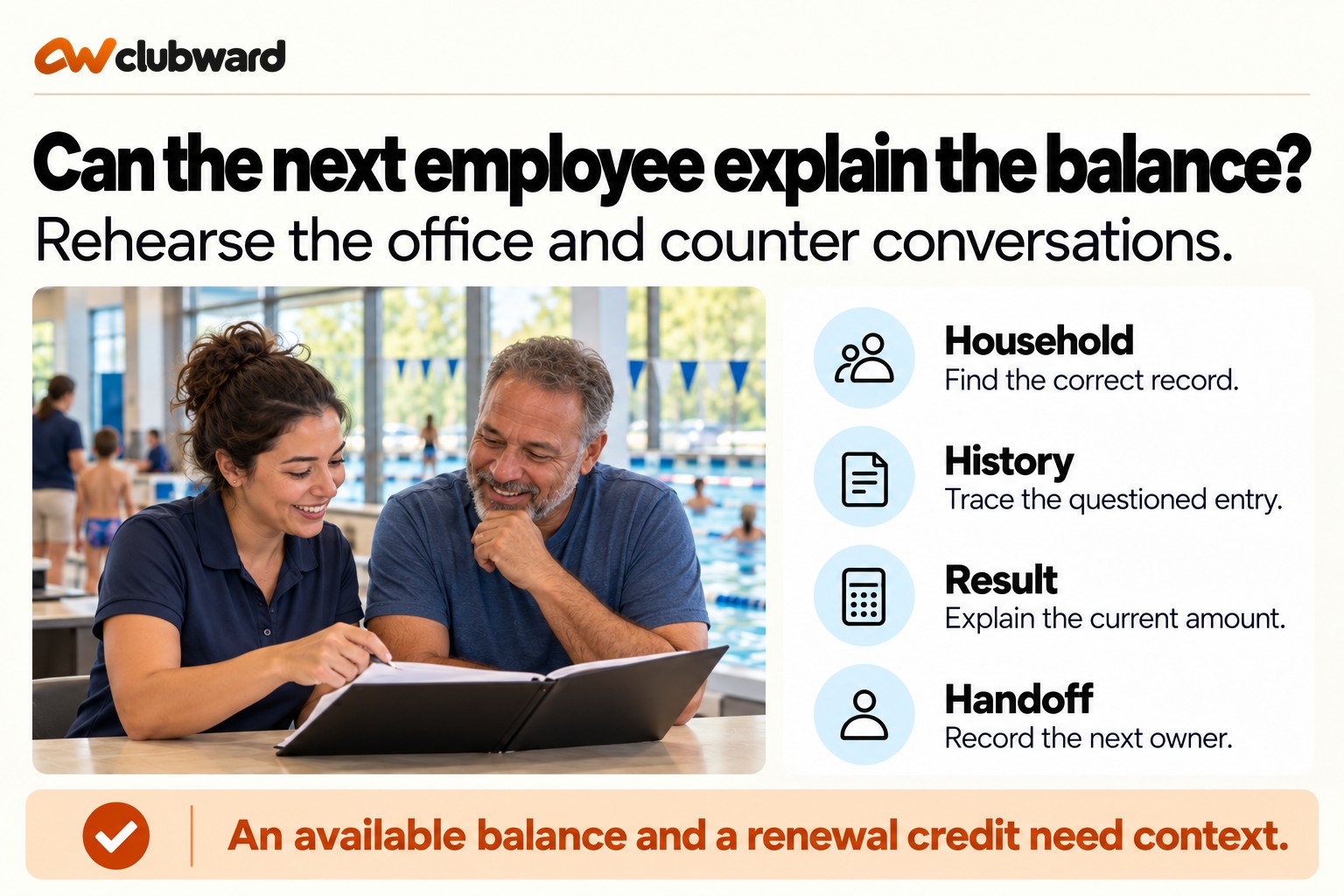
Use a sample household to rehearse both conversations. Ask the office employee to explain the renewal, then ask the counter employee to explain an available purchase balance. Each should use the relevant current record rather than rely on a private message from the person who made the adjustment.
Introduce a recent purchase, an approved correction, or a request to change the permitted use. Ask the employee to identify what changed and which question needs a reviewer. The test should reveal where a shared total hides different purposes or where staff cannot find the history they need.
Record the remaining manual handoff honestly. A colleague may still need to review a transfer or confirm a correction. That is a workable part of the process when the owner and next action are clear. An invisible handoff is what turns one member question into repeated calls.
Prepare a renewal review before messages go out
Choose a small sample of households with adjustments or other balances before sending renewal messages. Check the original entry, its current amount, its classification, and the renewal result. Include a household with an amount reserved for another purpose and one with an unresolved review.
Look at the message the household will receive. Does it distinguish the renewal amount from other balances? Does it give a useful route for a question? If the message uses a broad credit label, revise it to reflect the actual categories your club uses.
Confirm the review coverage for the opening period. Membership employees should know who can resolve unclear entries and how to send a complete question. The reviewer should know which cases remain open before members begin responding to renewal messages.
Keep a short record of the sample findings and corrections. If the same label confused several employees, address the label or instruction. Avoid assuming that repeated questions prove households are inattentive when the record itself is difficult to explain.
Check the household record when the story does not match
If a household remembers a different amount, first confirm that staff are viewing the correct record and period. A similar name, an older household arrangement, or a duplicate entry can make a reasonable question appear inconsistent. Follow the club's established identity and account lookup procedure before discussing individual information.
Ask the member to identify the transaction or confirmation they mean. Use that reference to trace the relevant activity. Avoid asking them to recreate every purchase or payment from memory when a dated receipt or confirmation can narrow the review. Keep the conversation focused on the questioned entry.
If the evidence points to a different record, send a precise question to the authorized reviewer. Identify both references, the apparent mismatch, and the outcome that needs confirmation. Do not merge records or transfer an amount simply to make the total resemble the member's recollection. The correction should follow the club's approved procedure.
After the review, check the household view and staff view together. The correct answer should be understandable in both. If one still presents an older amount or broad label, identify the remaining update and its owner rather than announcing that every part of the question is resolved.
Handle old records as evidence, not automatic permission
A club may have older balances documented in an earlier system, spreadsheet, or paper record. Keep the origin visible when those entries are brought into the current workflow. An imported description should not acquire a broader permitted use merely because a new screen displays it beside membership information.
Choose a sample entry and compare the original record, the imported amount, the account owner, and the current classification. Identify the approval or terms that explain its purpose. If that evidence is incomplete, mark the question for review instead of treating the migration as confirmation that the amount can reduce renewal.
Record the review outcome with the imported entry. Another employee should be able to find the decision without searching through the entire migration project. Keep a clear distinction between the original information, the authorized correction, and the current usable amount.
Include one migrated entry in the renewal rehearsal. Ask an employee who did not perform the import to explain its origin and permitted use. Their questions show which context needs to accompany the record. A successful transfer of data is only one part of making the balance understandable to the people serving members.
Make a correction leave an understandable trail
When a reviewer identifies an error, follow the club's approved correction process. Keep the reason, the affected record, the authorized outcome, and the person responsible for completion connected. The membership team needs to understand the resulting answer; the appropriate financial role should determine how the correction is recorded.
Check whether the household has already received a renewal message based on the earlier information. If so, prepare a clear updated explanation through the agreed contact route. Name the current result and any member action. Avoid leaving an old statement and a new adjustment unexplained beside each other.
Verify the correction from the saved record before closing the case. Compare the original issue, the authorized decision, and the current renewal or spending result. The completion check should show that the intended outcome occurred, not simply that an employee wrote a note saying the matter was fixed.
Use the correction to improve one repeatable step. An ambiguous category may need a clearer name. A missing source reference may need a better handoff. A repeated question about already-applied credits may need a different renewal explanation. Keep the change specific so the next household receives a more understandable answer.
Keep the renewal timetable visible while a credit question is under review. Identify the next member action and the date relevant to it under the club's procedure. If the unresolved entry affects that action, ask the authorized reviewer what instruction the household should receive. Staff should not assume that asking a billing question changes a renewal deadline or membership decision. Record any approved accommodation clearly so the next employee can distinguish it from the ordinary process. Check that the next shift understands this instruction.
Before closing the conversation, ask the household whether the explanation answers the question they brought. They may understand which amount applies while still needing to know where the other balance appears or how to request its review. Give that remaining question an owner. Confirm the current result and the next contact route in one useful message. A complete handoff lets another employee continue from the recorded decision instead of restarting the discussion from the combined number.
Evaluate the household and billing handoff together
Clubward brings member records, households, renewals, and payment history together. Use a household with two different balance purposes to evaluate the conversation your team actually needs to support. Follow the current membership, the questioned entries, the renewal result, and the staff handoff.
Ask the presenter to show the ordinary answer and an unresolved case. Determine what your membership team can explain, what requires an authorized financial reviewer, and how another employee finds the current result. Check your chosen setup and modules rather than assuming every balance is interchangeable.
Repeat the scenario after a relevant change. A purchase, corrected entry, or approved renewal adjustment should lead to an understandable current answer. Keep the evidence with the evaluation so the club can identify accepted manual steps and setup responsibilities.
Bring the scenario to a personalized Clubward demo. Ask one practical question: can the next employee explain which amount applies to renewal and why? A clear answer starts with distinct purposes, recorded decisions, and a handoff the whole team can follow.
From Clubward Editorial Team
More from Clubward