Swim & Tennis Clubs
Check-Ins Look Healthy. Which Swim Club Families Have Gone Quiet?
Strong total attendance can hide families whose normal routine has changed. Use household-level context to decide whether any follow-up would actually be useful.

Saturday attendance is strong. The parking lot is busy, lessons are full and the snack bar has a line. Nothing in the club-wide total suggests a participation problem. Yet several families who usually visit twice a week have not checked in for a month.
Both facts can be true. Aggregate activity can stay healthy while an individual household’s routine changes. That change is not automatically a retention risk, and it is not permission for intrusive outreach. Vacations, weather, school schedules, injuries, travel teams, missed scans and seasonal habits can all explain the pattern. The value is in noticing the change early enough to consider the context.
Review quiet-household signals as questions, not conclusions. Compare the family with its own recorded activity, check whether the data is complete, consider known seasonal or program changes and let staff knowledge add context. Then choose one proportionate response: no action, correct the record, offer useful information, invite the family back or assign a personal follow-up to someone who already knows them.
Read the signal without rushing to a conclusion
Operational signals are useful because they direct attention. They are dangerous when a team treats them as an explanation. A higher count, lower count or changed routine does not identify the cause by itself. Begin with the recorded event, check whether the data was captured consistently and add the context that the people closest to the work can provide.
Use a defined comparison period and keep unlike events separate. A policy question is not the same as a broken credential. A registered participant is not the same as an attendee. An interested volunteer is not the same as a confirmed shift. Clean categories protect the decision from a dramatic total that combines several different problems.
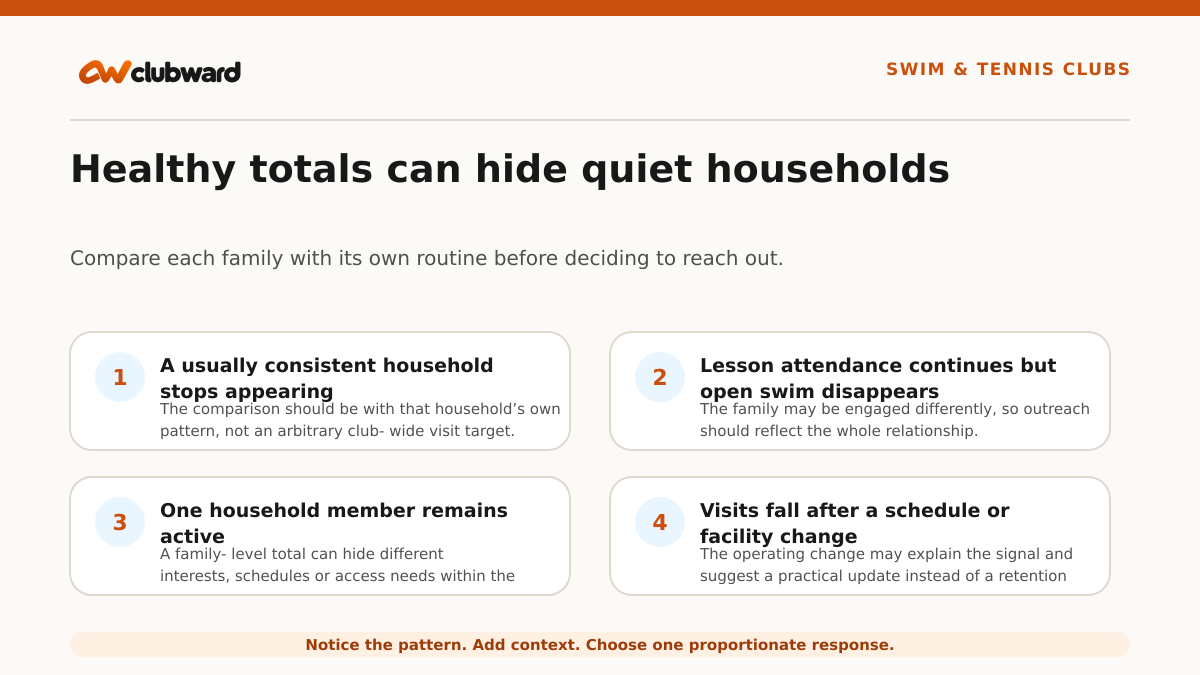
- A usually consistent household stops appearing: The comparison should be with that household’s own pattern, not an arbitrary club-wide visit target.
- Lesson attendance continues but open swim disappears: The family may be engaged differently, so outreach should reflect the whole relationship.
- One household member remains active: A family-level total can hide different interests, schedules or access needs within the account.
- Visits fall after a schedule or facility change: The operating change may explain the signal and suggest a practical update instead of a retention message.
- Staff remember visits that are missing from the record: Check-in consistency or credential use may be the real issue.
Ask the questions that change the next decision
A useful review is short enough to repeat and specific enough to change what the team does next. Put the relevant record, instruction and operating context together. Avoid turning the meeting into a search for someone to blame. The point is to find the first place where information, ownership or capacity stopped matching the work.
- What was the family’s normal rhythm?: Use a relevant prior period and comparable part of the season rather than a generic expectation.
- Are arrivals being recorded consistently?: A new gate, staff habit or alternate entrance can produce a data gap that looks like disengagement.
- What other activity remains visible?: Review lessons, tennis, events, reservations and account interactions before deciding the family has gone quiet.
- Did the club change something relevant?: Hours, weather closures, program times and facility availability can explain a change in routine.
- Would contact be welcome and useful?: Choose a channel, person and message that fit the relationship; sometimes no action is the right decision.
- What next step can the team actually deliver?: Offer current information or a genuine invitation, not a generic message with no practical value.
Record the answer that is known, the question that remains and the person who can resolve it. If the team cannot support a conclusion, keep the item open rather than filling the gap with a story. A transparent “needs review” state is more useful than a confident but unsupported explanation.
Turn the pattern into one practical next step
The best first response is usually smaller than a policy rewrite or new staffing model. Choose a reversible step that tests the leading explanation: clarify a message, expose a status, change a cutoff, assign an owner, update a role guide or review a narrow audience. Keep the original pattern visible so the team can tell whether the change helped.
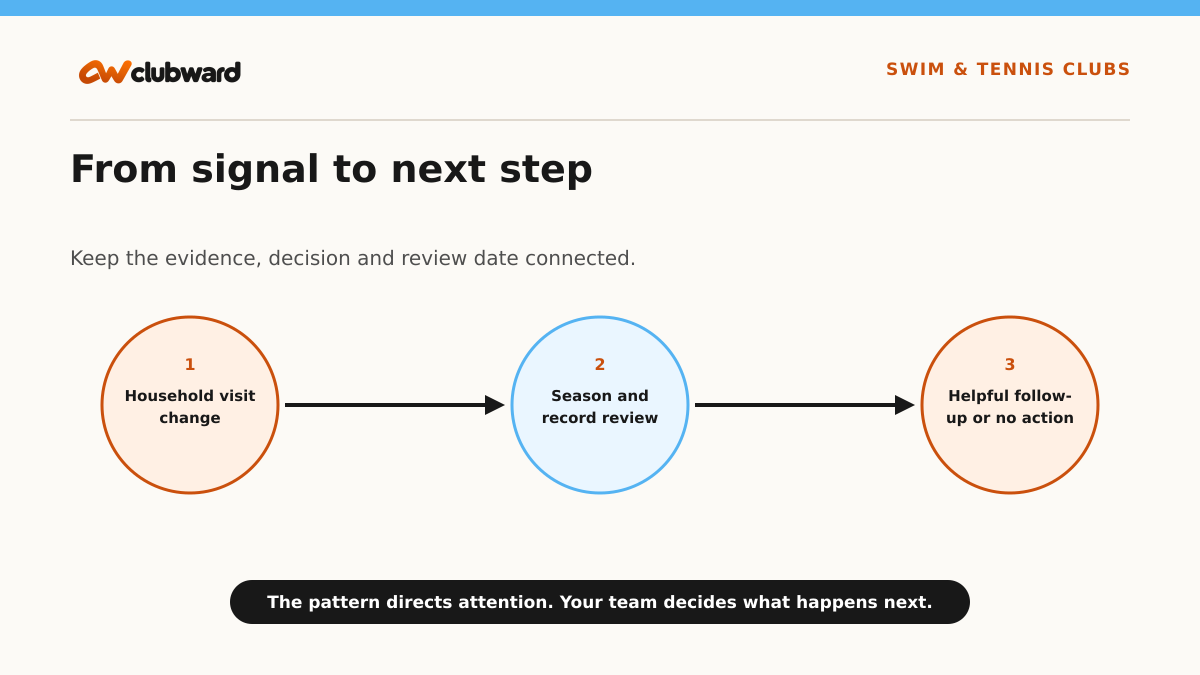
1. Define a meaningful change
Choose a comparison that fits seasonal operations and recorded household behavior. Avoid labeling every low-frequency family as inactive.
2. Validate the record
Check credential, gate and staff-entry consistency before treating the pattern as a member-behavior signal.
3. Add program and household context
Review relevant bookings, lessons, events and household members while protecting information staff do not need.
4. Let people review the signal
A manager or membership lead should consider known context before any message is approved.
5. Choose one proportionate action
Correct the record, share a schedule update, make a warm personal contact or take no action and revisit later.
6. Record the decision and learn
Note why the response was chosen and whether it produced useful information, without turning the member relationship into a score.
Work through a realistic example
A family normally checks in twice each weekend during the early summer. Their recorded visits stop for four weeks, but one child is still attending weekday swim practice. The club has also shifted open-swim hours because of meets. The signal deserves context, not an automatic “we miss you” campaign.
The membership lead confirms that check-ins are being recorded, sees the practice attendance and notes the schedule change. A staff member who knows the family remembers that weekend hours were important to them. The useful next step is a short personal note with the updated weekend calendar and an invitation to reply if the new hours create an access question.
If the family responds that they are traveling, no retention sequence is needed. If they did not know about the schedule change, the club has found a communication gap. If the record is wrong, the operational fix belongs at check-in. The same signal can lead to different answers because the review preserves context and human judgment.
Keep the response proportionate and human
Patterns describe recorded activity, not motivation or character. A household that stops visiting, a participant who misses class or a volunteer who cannot cover a shift may have context the organization does not know and does not need to investigate. Use the signal only to improve the relevant service or offer a respectful next step.
Before contacting anyone, ask whether the message provides value. Useful outreach can clarify an updated schedule, offer an appropriate option, check whether help is needed or invite a reply. Avoid language that makes people feel monitored or assumes a personal reason. Let the team edit, approve or decline any suggested response.
Protect access to the underlying information. Front-desk staff need the answer for the current interaction; managers may need the pattern; a board or client may need an aggregate decision summary. Not every role needs every detail. Define who reviews, who acts and what can be shared.
Decide what the evidence can support
Write the decision in three layers. First, state the observation without interpretation: what changed, during which period and in which workflow. Second, list the context the team verified, including data quality, schedule changes, facility conditions and known process differences. Third, record the action the evidence supports today. Keeping those layers separate prevents a reasonable observation from turning into an unsupported claim about people or future results.
Use a threshold that is practical for the decision, not one chosen because it looks precise. A pattern that affects access, participant safety, money handling or a critical role may deserve attention after one well-documented case. A participation or communication pattern usually needs several comparable observations. State the reason for the threshold and revise it when the team learns that it produces too much noise or misses important work.
Also name what the review cannot answer. The record may show that attendance changed, but not why a person stayed home. It may show that evening requests take longer, but not prove another employee is required. It may show that a rule generates questions, but not determine the board’s preferred policy. This boundary does not weaken the review. It keeps the next conversation honest and directs the unresolved decision to the right owner.
When several actions are possible, compare them by usefulness, effort, reversibility and risk. A message or instruction update is easier to test than a permanent schedule change. A temporary coverage adjustment can show whether capacity is the real constraint. Choose the smallest action that can produce meaningful evidence, and set an end date so a trial does not quietly become permanent.
Measure the operating result, not the story
Choose measures that show whether the process became clearer or the next step became more useful. Do not promise that one message will retain a member, fill a class or solve coverage. The first goal is better judgment: cleaner records, fewer avoidable handoffs, earlier visibility and an action the team can explain.
- Validated-signal rate: Track how many changes remain meaningful after checking record consistency and seasonal context.
- Response appropriateness: Review whether the chosen action matched the relationship and known situation.
- Useful-information rate: Count follow-ups that reveal an actionable schedule, access, program or communication issue.
- No-action decisions: Preserve cases where the team correctly decides that outreach would not help.
- Recurring operational cause: Watch for several households affected by the same hours, access or communication change.
Review the same measures after a reasonable operating period. If the signal changes, check whether the underlying recording practice changed too. If nothing improves, reconsider the explanation before escalating the response. Learning that the first idea was wrong is a useful result when the test was small and respectful.
Run a 20-minute signal review
Spend the first five minutes confirming the signal and comparison period. Put the relevant records on screen and remove unrelated events. Spend the next five minutes checking the operating context: schedule, facility, role, access rule, communication and known data limitations.
Use the third five-minute block to choose one next step, one owner and one effective date. Write down what result would make the team keep, revise or stop the change. In the final five minutes, decide when to review the next sample and which role needs the updated instruction.
Close the review with a plain-language summary: what changed, what the team believes may explain it, what action will be tested and when the result will be reviewed. That summary is more useful than a dashboard screenshot with no decision attached.
Leave a decision record the next person can use
A decision record should fit on one screen. Include the signal, comparison period, context checked, affected workflow, chosen action, owner, effective date and review date. Add the current status—proposed, approved, in progress, complete or stopped—so another shift or leader can understand whether they are reading an idea or an active instruction.
Link the record to the source workflow rather than copying sensitive details into a broad note. The person carrying out the change should see the approved instruction and the information needed for that role. The person reviewing the outcome should be able to return to the same period and definition. This makes continuity possible without relying on the original reviewer’s inbox or memory.
At the review date, close the loop even when the result is inconclusive. Keep the change, revise it, end it or extend the test with a stated reason. Record one lesson that will improve the next review. A closed decision trail helps boards, managers and program leaders distinguish deliberate operating changes from temporary workarounds.
Where a connected club management platform helps
Clubward connects household memberships, renewals, check-in, programs, guest access and on-site operations for seasonal and year-round swim clubs. Its current swim-club workflow describes using LookForward to review attendance and participation patterns, then letting the team approve an appropriate response. Bring a real household pattern to a demo and confirm the plan, modules, data quality and team-review controls required for your club.
Use this decision checklist
Before the team acts on the pattern, confirm:
- Comparable season period
- Household baseline
- Current check-in pattern
- Record consistency checked
- Other household members
- Lessons and programs
- Reservations and events
- Relevant schedule changes
- Staff context
- Chosen response
- Response owner
- Review date
The value of an operational trend is not that it makes the decision for you. It gives your team a better place to look, a shared record to discuss and a way to connect the next action with the people and work it affects.
See how Clubward can help your team review attendance changes and choose an appropriate next step.
From Clubward Team
More from Clubward