Swim & Tennis Clubs
The Renewal List Looks Ready. Did You Check the Household Records?
Run a household-record check before renewal opens so families receive the right message, staff can resolve routine corrections, and exceptions reach the right owner.

A renewal list can look complete while the household records behind it still need work. One parent is no longer the best contact. A child belongs to the wrong household. A membership package changed during the season. A waiver is missing, but no one has decided whether it belongs in the renewal path or the arrival checklist.
The best time to find those issues is before the first reminder reaches the family. A short household-record review helps staff correct routine details, route genuine policy questions, and explain the next step without turning every reply into a new investigation.
This checklist is designed for swim and tennis clubs preparing a renewal cycle. It focuses on records and operating handoffs, not on changing membership terms or deciding exceptions without the club’s authorized approval.
Start with the household, not the mailing list
A mailing list tells you where a message will go. A household record tells you who the club is serving, which people are connected, what membership applies, and what the team will need when the family returns. Review those relationships first, then build the renewal audience from the corrected records.
If you’re exploring Clubward for your swim club, start with one household’s journey through renewal, waivers, payment, and arrival. Bring your membership rules to the walkthrough so we can confirm how the records, selected modules, and setup would support your club throughout the season.
Choose a review date and name the person who owns the list. That person does not need authority to decide every exception. They need authority to coordinate the review, assign questions, and confirm when the record is ready for the message.
Define what “ready for renewal” means
Write a short completion definition before the team starts. A household may be ready when its primary contacts are current, people are connected correctly, the active or most recent membership is understood, required documents are identified, and any exception has an owner.
Do not require every future action to be complete before sending a renewal message. The point is to prevent known record problems from creating avoidable confusion. A family may still need to sign a new waiver or choose a package during renewal. The record should make that next step clear.
Separate a data correction from a policy decision. Correcting a misspelled name is routine. Deciding whether an adult child remains eligible on a household plan may depend on the club’s approved membership terms. The checklist should make the difference visible.
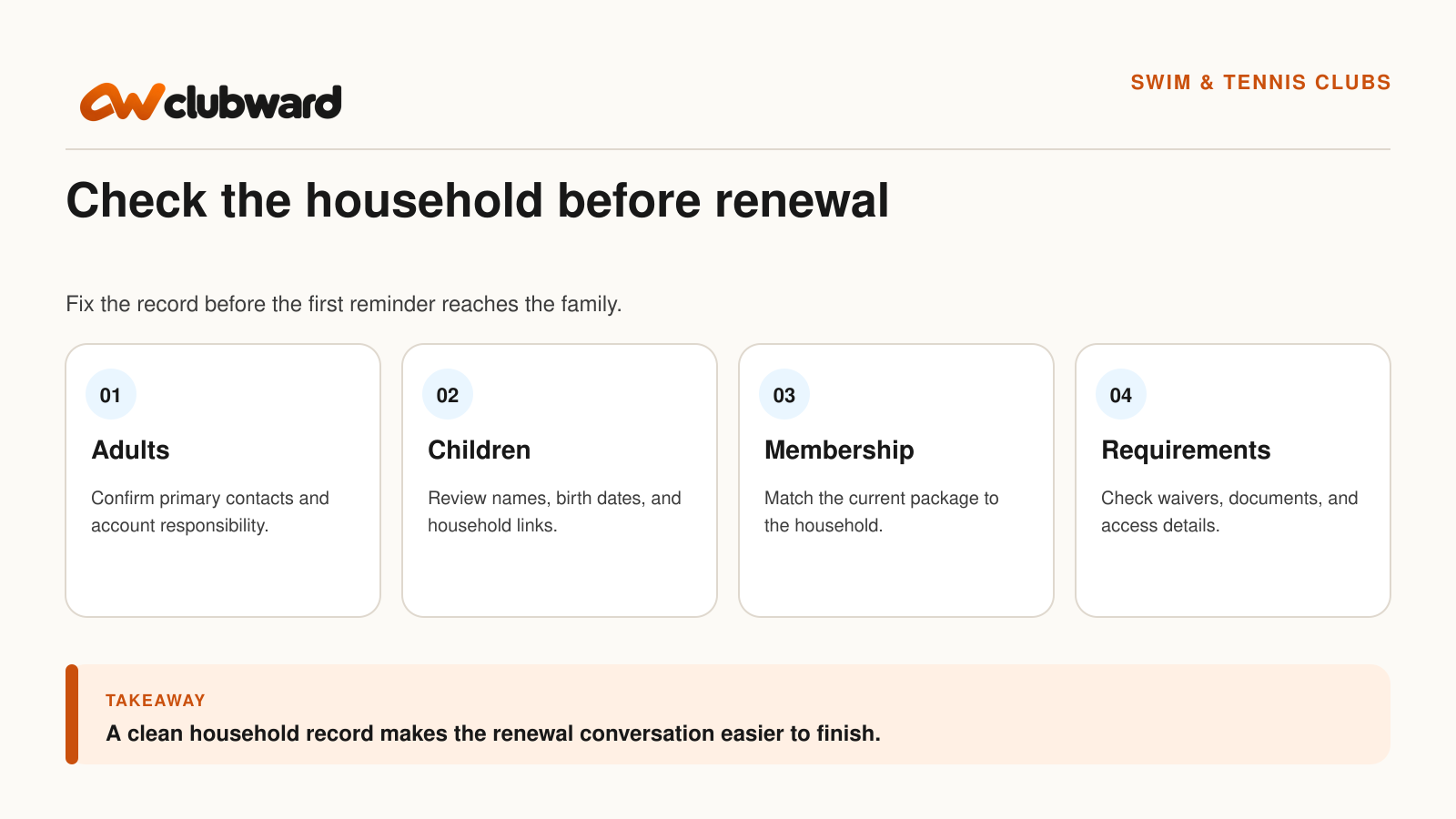
Check the adults and account responsibilities
Confirm the primary contacts, preferred email addresses, phone numbers used for urgent club communication, and any account responsibility the club records. Ask staff to flag addresses that repeatedly bounce or messages that have required manual forwarding.
Look for duplicate adult records and outdated contacts. Do not merge records simply because names look similar. Verify the relationship first, preserve the history the club needs, and follow the system’s supported merge or correction process.
If the household has more than one adult, decide how renewal notices should be delivered. The club may send to every authorized adult, one billing contact, or another agreed audience. Apply the established rule consistently and keep the reason visible to staff.
Review children and household relationships
Check names, birth dates if the club maintains them, and the household connection used for membership eligibility or program registration. A child duplicated across households can create confusing renewal choices and inconsistent arrival information.
Do not infer a family relationship from an address or last name. Use the club’s normal verification process. When guardianship, caregiving, or household circumstances require additional care, limit the review to the information staff need for membership and club operations.
Note age-based changes that may affect the next season, but do not automatically change a package unless the approved terms call for it. A useful flag says what needs review, which rule applies, and who has authority to confirm the result.
Match the current membership to the household
Identify the active or most recent membership, its term, and the household members associated with it. If the club offers family, individual, senior, weekday, seasonal, or activity-specific options, make sure staff can explain which one the household currently has.
Check for a known status that could change the renewal path: resignation, approved hold, transfer, waitlist position, unpaid balance review, or a membership-type change already authorized. Do not treat those labels as self-explanatory. Record the current decision and the next action.
Keep the renewal offer separate from a guarantee of access or program availability. A renewed membership may still require documents, payment completion, guest products, class registration, or facility-specific steps under the club’s rules.
Confirm documents, waivers, and access details
List the documents the club expects during or after renewal and identify which ones can carry forward under the club’s approved policy. Staff should know whether a missing item blocks renewal, blocks check-in, or simply requires follow-up before a particular activity.
Review guest-pass and access information that could surprise the family on the first busy day. If guest products expire, reset, or require a new purchase, put that information in the appropriate renewal or arrival communication. Do not bury it in an internal note that the member never sees.
Check front-desk readiness as part of the record review. Walk a renewed household through Clubward’s check-in and guest-access workflow to see how staff find membership eligibility, household details, and guest information when the family arrives.
Use a clear route for exceptions
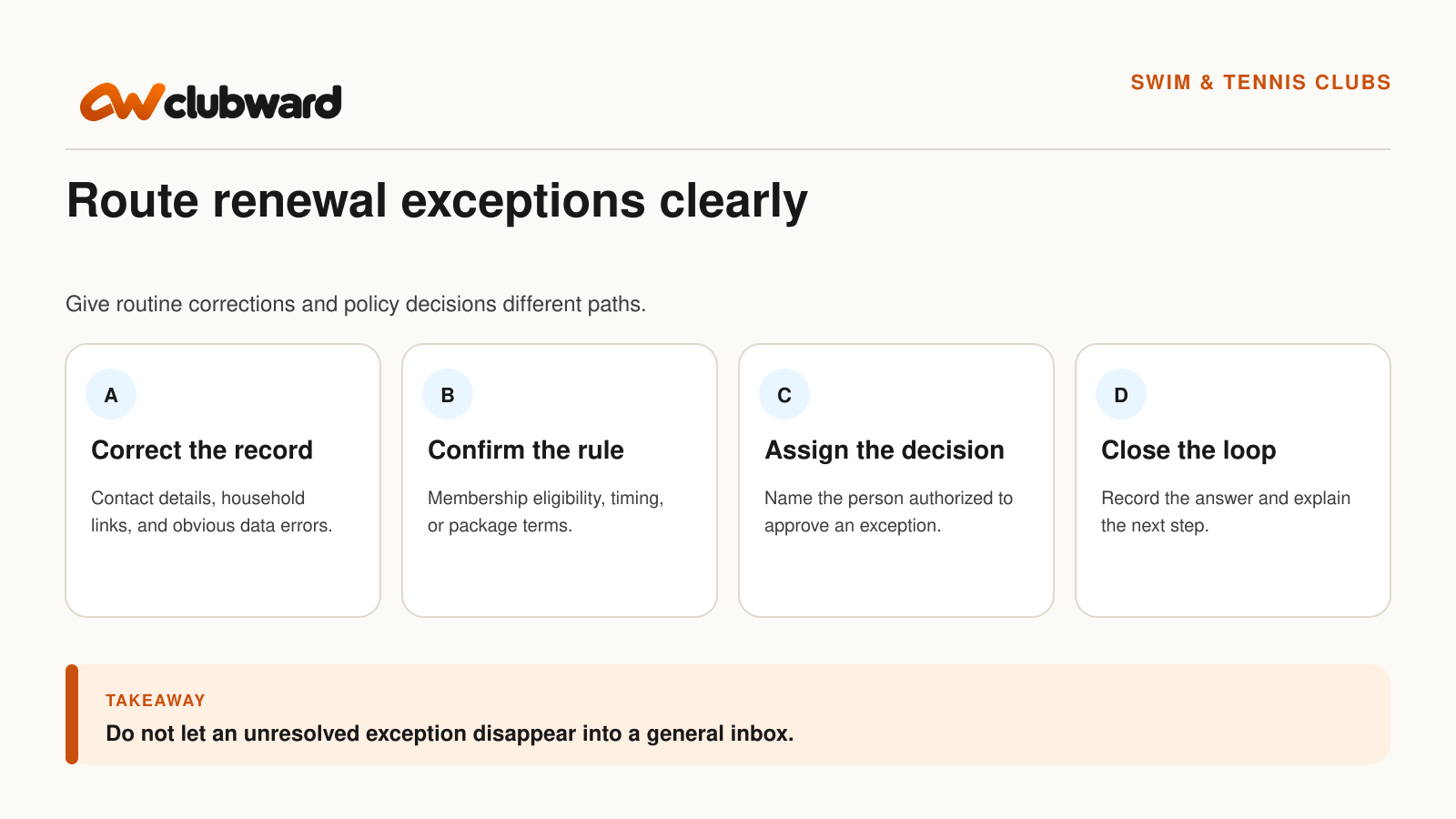
Create two paths. Routine corrections go to the person responsible for member records. Policy questions go to the manager, committee, board, or other authorized owner named by the club. The same inbox can receive both, but the resolution authority should be explicit.
For every exception, record the question, the relevant rule, the decision owner, the member-facing message, and the date the record was updated. Avoid notes such as “manager approved” without the approved action or effective period.
If the club cannot decide before renewal opens, send the family a precise status. Explain what is being reviewed, who will respond, and whether they should wait or complete another step. Silence encourages duplicate emails and inconsistent answers.
Run a small sample before reviewing every household
Select a varied sample: a straightforward returning family, a household with a membership change, a record with multiple adults, a family with a missing document, and an approved exception. Walk each one through the checklist.
Notice where the team hesitates. The problem may be a missing field, an unclear definition, a rule that has never been translated into staff instructions, or a decision that lives only in someone’s memory. Fix the review method before scaling it to the full list.
Have a second person review several completed records. The goal is not to recheck every keystroke. It is to confirm that two staff members interpret “ready” the same way.
Prepare the renewal message from the record
A renewal message should tell the family what is available to them, what information to review, what steps to complete, and where to ask a question. Use the current household record to personalize the practical details without exposing information that does not belong in email.
Make the primary action easy to identify. If the family should review household members before selecting a membership, say that first. If they should complete payment and then sign a waiver, present the order. Avoid sending several equal calls to action that leave the reader guessing where to begin.
Give staff a matching response guide. A family may reply with a name correction, a membership question, or a request for an exception. The team should know which answers they can provide and which require another owner.
Protect the opening-day handoff
Renewal is not complete merely because a message was sent or a payment was recorded. Confirm which record tells the front desk the membership is current, which requirements remain open, and how a staff member should handle a discrepancy.
Test three arrival scenarios: the household completed everything, the family renewed but a document is outstanding, and the family believes they renewed but the record does not show completion. Write the staff action for each one in plain language.
Keep exceptional member information limited to the people who need it. The front desk may need an eligibility status and next action, not the private history behind the decision.
Measure the quality of the process
After the first renewal wave, review the questions that came back. Group them by contact corrections, household relationships, membership choices, documents, payment steps, and exceptions. Do not use the total alone as a success score.
Ask whether a question revealed an avoidable record problem, an unclear message, or a legitimate choice the family needed help making. Update the checklist only when the change would make the next review more reliable. A larger checklist is not automatically a better one.
Record the next review date and owner. The household record changes during the year, so the process should include a lightweight way to keep important details current rather than waiting for the next renewal deadline.
Avoid five common renewal-record mistakes
Do not treat the email address as the household. A message can be delivered while the people, relationships, and membership behind it remain wrong. Review the record that the front desk and membership team will use later.
Do not “clean” uncertain relationships by guessing. Similar names, shared addresses, and past memberships can point to several explanations. Flag the question, verify it through the club’s approved process, and preserve the history required for a safe correction.
Do not let notes substitute for a status. A long note may explain an exception, but staff still need the current decision, effective period, owner, and next action in a place they can use consistently.
Do not send an exception to everyone. One authorized owner should decide, while the record coordinator tracks the question and communicates the result. A general inbox can receive the request, but it should not become the decision maker.
Do not stop at the renewal confirmation. Follow the household into the arrival workflow. Verify that the membership, documents, guest details, and access status will make sense to the staff member greeting the family.
Give the team a review rhythm
Divide the list into manageable groups and assign a completion date for each. Start with households already known to have changes, then review a representative portion of straightforward records before moving through the rest.
Hold a short daily or twice-weekly exception review during the preparation window. Bring only the questions that need authority or cross-team coordination. Routine corrections should continue without waiting for the meeting.
Close each review by recording the decision, updating the household, and confirming the member-facing message. The work is not finished when the manager gives an answer; it is finished when the record and the communication agree.
Before the first message goes out, run a final audience check. Compare the number of households selected with the number expected for the membership groups in scope. Inspect several included and excluded records, verify the sender and reply path, and open the message on a phone. A sound household review can still be undermined by the wrong filter, an outdated link, or a reply address no one owns.
After sending, monitor delivery problems and member replies as operating signals. Correct the household when a response reveals a real data issue, route policy questions to the named owner, and keep a record of the answer that staff can use later. This turns the first wave into a controlled check of the process rather than a rush of unrelated inbox work.
Bring a household scenario to a Clubward demo
Choose a household with a membership change, a document requirement, and a guest or check-in question. Book a personalized Clubward demo and ask the team to show the renewal-to-arrival workflow, confirm the modules and setup involved, and identify any club-specific rule that your team must define.
From Katelyn Pauley
More from Clubward