Swim & Tennis Clubs
Reload, Purchase, Adjustment: Trace One Prepaid Balance
Trace a prepaid balance through reloads, purchases, and approved adjustments, then give staff a clear explanation and review route.

When a prepaid balance looks wrong, follow one account from its opening amount through each reload, purchase, and adjustment. Compare the account activity with the relevant receipt or approved correction. Do not change the balance simply to make it agree with a number on a separate sheet. First identify which event explains the difference and who can decide what happens next.
A swim or tennis club can use a small reconciliation worksheet to make that review understandable. The worksheet should show the order of events, the amount added or deducted, the supporting record, and the running balance. A staff member should be able to explain the closing amount without relying on a colleague's memory of a busy afternoon.
The sample below follows a household's prepaid spending balance. It does not describe membership credit, a refundable reservation deposit, or a customer result. Keep those purposes separate in your own review. Use your club's actual account terms and approval procedure to decide whether a transaction or correction is permitted.
Choose one account and one review period
Start with the household and the balance being questioned. Confirm the account identifier, the type of balance, and the period under review. “The Morgan household snack bar balance between Monday opening and Friday close” is specific enough to trace. “The club's money does not match” is not.
Identify the opening amount from the appropriate account record. State its date and whether the figure represents the beginning or end of that day. A review that mixes an opening amount with later transactions can create a difference before anyone has made an error.
Gather the relevant account activity, purchase receipts, reload records, and adjustment approvals through authorized access. Keep payment credentials and unnecessary personal information out of the working explanation. A transaction reference is usually more useful to the reviewer than a copied collection of private household details.
Name the person coordinating the review and the person authorized to approve a correction. Those responsibilities may differ. A seasonal employee can help locate a receipt without being permitted to change a household balance or promise a refund.
Distinguish the three kinds of balance changes
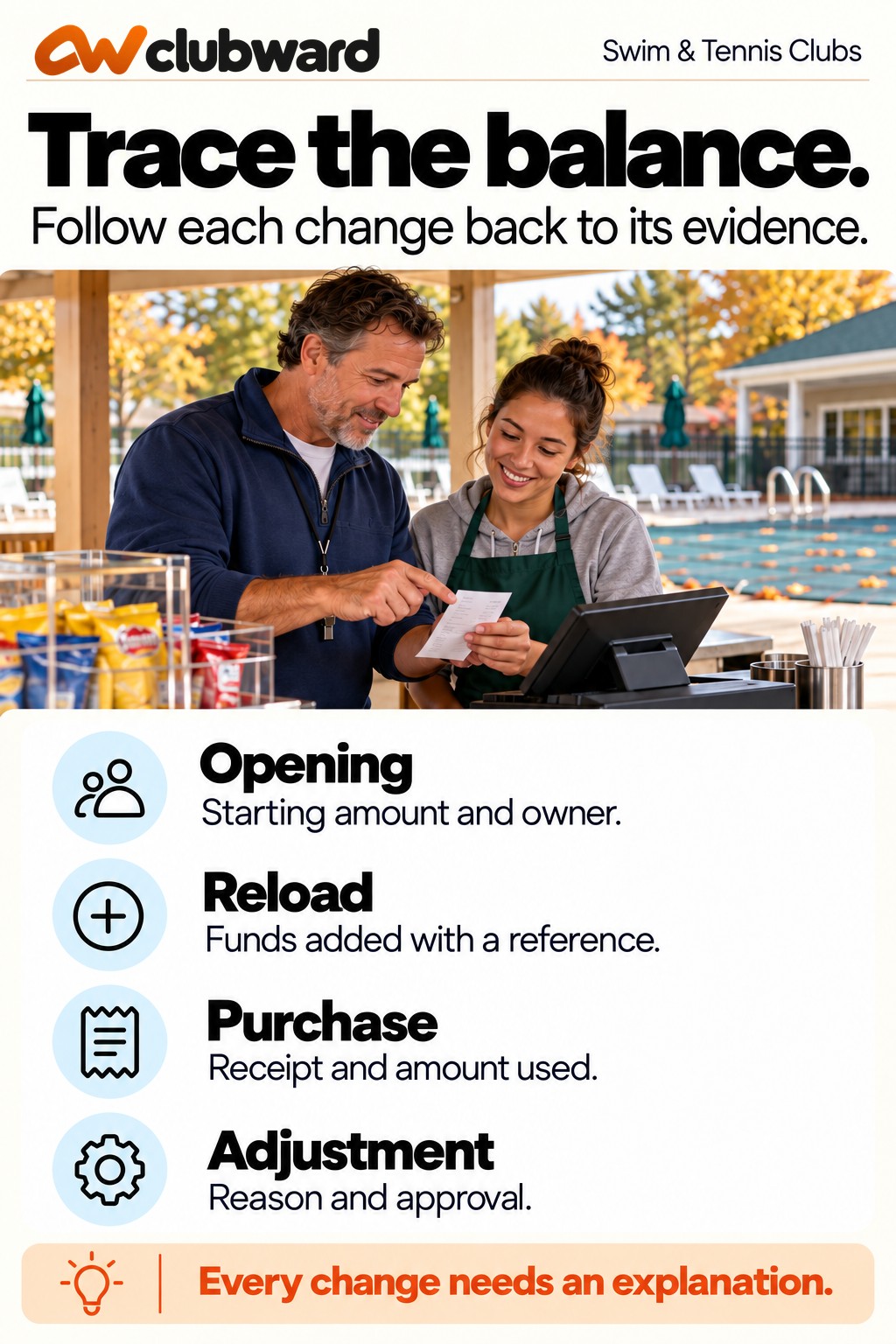
A reload adds approved funds to the prepaid spending balance. A purchase deducts the amount charged for the goods or service. An adjustment changes the account through a correction or other authorized action. These labels should describe what happened, not merely whether the number became larger or smaller.
For a reload, identify the supporting payment or funding record and the account that received the value. For a purchase, identify the receipt and the amount actually applied to this balance. For an adjustment, identify its reason, supporting evidence, and approval under the club's procedure.
Do not label a purchase reversal as a new reload just because it increases the available amount. The explanation matters when staff answer a member's question later. “A cancelled purchase was corrected” describes a different event from “You added more funds.”
Keep membership charges, deposits, and spending balances in their proper context. If a household asks whether a membership credit can fund snack bar purchases, refer the question to the applicable terms and authorized owner. The reconciliation worksheet can show where a value sits; it does not create permission to transfer it.
Build the worksheet around a running balance
Use one row for each event in the review period. Sort the events using the account's recorded sequence and preserve their references. When two records use different times, investigate the timing rather than silently rearranging them to produce the desired closing figure.
- Event date and reference: Which recorded event is this row describing?
- Type: Is it a reload, purchase, or approved adjustment?
- Added amount: How much entered this particular balance?
- Deducted amount: How much left this particular balance?
- Running balance: What remains after this event?
- Supporting record: Which receipt, payment, or approval explains the change?
- Review state: Is the row matched, awaiting evidence, or assigned for a decision?
Keep additions and deductions in separate columns when that makes the sequence easier for staff to read. Use consistent currency and rounding conventions from your actual records. Do not combine several purchases into one unexplained deduction if the question concerns a specific receipt.
Put the account balance at the end beside the worksheet's calculated closing amount. Agreement is a useful check, but it is not the only check. Two offsetting mistakes could still produce the expected total, so inspect the purpose and evidence for each event.
Follow a sample balance through five events
Suppose a household begins with a prepaid balance of $25. It adds $40, makes an $18 purchase, makes a $7 purchase, and later receives an approved $5 correction for an item charged incorrectly. The ending amount is $45. The arithmetic is $25 plus $40, minus $18, minus $7, plus $5.
The worksheet begins with $25 as the opening balance. The reload row adds $40 and produces $65. The first purchase deducts $18 and produces $47. The second deducts $7 and produces $40. The approved correction adds $5 and produces $45.
Each movement needs its own explanation. The $40 reload points to its funding record. The two purchases point to separate receipts. The $5 adjustment points to the original item, the correction reason, and the authorized approval. A note saying “balance fixed” would not preserve that history.
If the member remembers adding $40 and spending only $18, the $7 purchase is the next event to inspect. Locate its receipt and confirm that it belongs to this account. Do not erase it because the member did not initially mention it, and do not dismiss the question because the final arithmetic works.
Match the reload before treating funds as available
Review a reload against the appropriate funding and account records. Confirm the amount, household, date, and recorded result. A member's intention to add funds is not the same as the value appearing in the correct spending balance.
If the funding record and balance activity disagree, record the difference and identify the owner who can investigate it. Avoid taking a second payment or adding a manual amount merely because the first result is unclear. Follow the club's established process for uncertain or incomplete transactions.
Check whether the reload happened outside the chosen review period. A receipt from Sunday cannot automatically explain a Monday movement without checking the recorded timing. Mark the relationship you can establish and leave an unresolved timing question visible.
When a reload went to the wrong household or balance type, keep the correction within the authorized process. The worksheet should identify the affected records and the decision needed. It should not become an informal transfer instruction that bypasses account controls.
Trace the purchase to the account deduction
Compare the receipt with the amount applied to the prepaid balance. Confirm that the household and purchase reference match. If a purchase used more than one payment method, identify the portion charged to this balance rather than treating the receipt total as the account deduction.
For example, a $12 purchase might use $8 from prepaid funds and $4 through another approved payment method. The worksheet for the prepaid balance records an $8 deduction. Recording $12 would create an apparent shortage even though the purchase total itself is correct.
Review the item detail when the question concerns a price or quantity. A running balance can tell you where the difference occurred, but it cannot decide whether the underlying charge was correct. Assign that question to the person authorized to review the receipt and applicable club policy.
Keep the explanation specific. “Receipt 1042 applied $8 to this spending balance” is more useful than “snack bar activity.” It gives the next reviewer a record to find and helps the member understand which part of the purchase affected the account.
Explain an adjustment with its reason and authority
An adjustment row should answer why the account changed. Identify the original event where relevant, the amount of the correction, the supporting record, and the person who approved it under your procedure. Preserve enough context for someone who was not present to understand the action.
In the sample case, the $5 correction relates to an incorrectly charged item. The reviewer should be able to connect the increase to that item and the approved correction. It is not additional spending money supplied by the household, and the explanation should not describe it that way.
If an adjustment has no clear reason, mark it for review. Do not invent a purpose from the amount or assume that a staff member must have had approval. Locate the evidence and ask the appropriate owner to confirm the event.
When a proposed correction remains undecided, keep it separate from completed account activity. A worksheet can show a pending question and the possible effect without presenting that amount as already available. The member-facing answer should reflect the actual recorded state.
Investigate a difference in a useful order
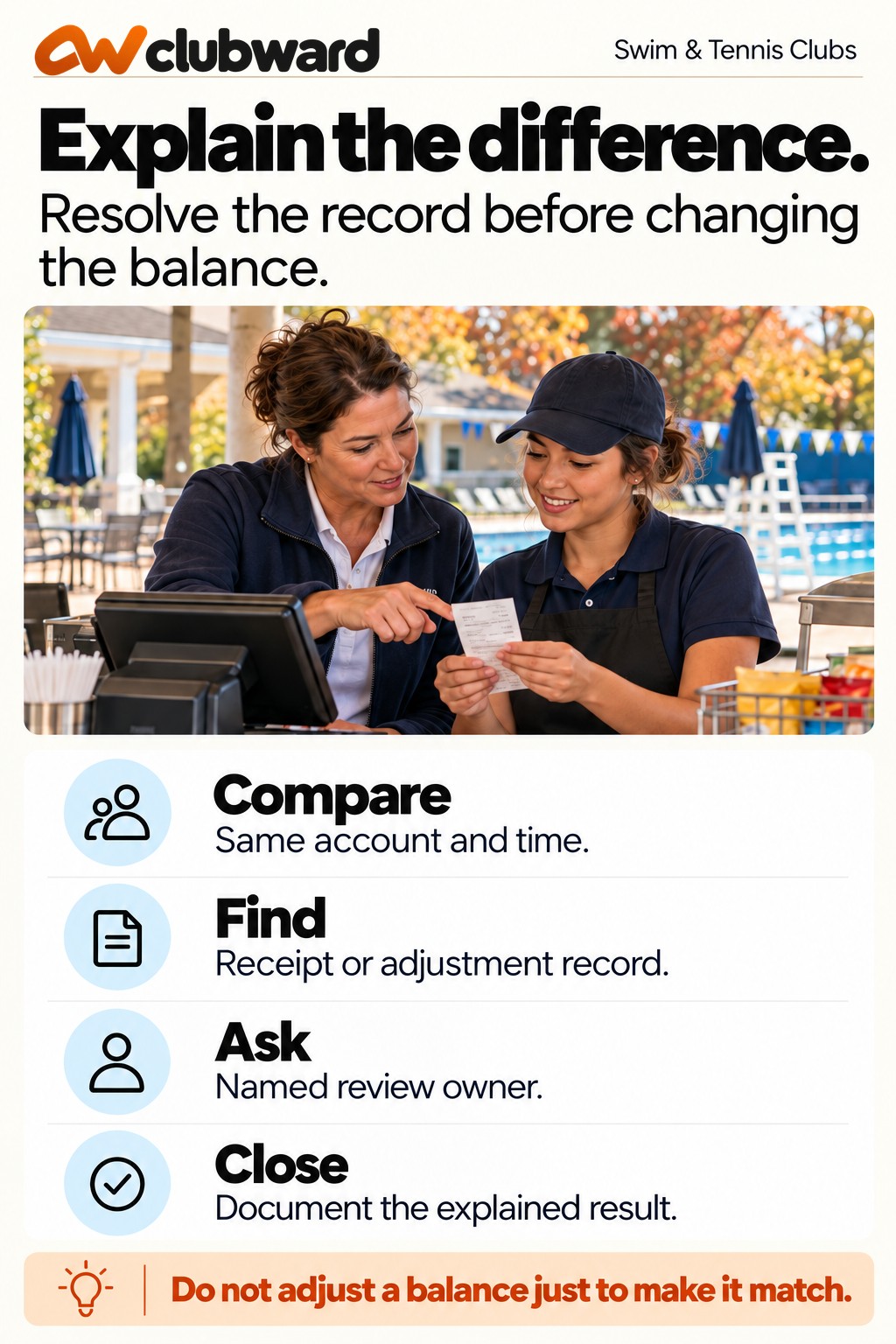
Begin by checking that both records describe the same household, balance type, and period. Then compare opening amounts. Only after those match should you inspect the event sequence. This avoids spending time searching receipts for a difference caused by mismatched scope.
Next, identify the first point where the running balance diverges from the account activity. That point narrows the question. Look for a missing event, a duplicate entry, an amount applied to another payment method, or an adjustment whose evidence has not been located.
Write down the competing figures and their sources. “Worksheet shows $47 after receipt 1041; account activity shows $40 before receipt 1042” gives the investigator something concrete. “The register seems wrong” gives them a broad suspicion without a starting point.
Assign the next action to an owner who can obtain the relevant evidence. The cashier may locate a receipt; the account administrator may inspect an account event; an authorized manager may decide a correction. Give each person a bounded question rather than forwarding the entire problem without context.
Handle a purchase reversal as its own event
A cancelled sale or void can affect several records. Follow the original receipt, the cancellation or correction record, and the account activity through your actual procedure. Do not assume that a receipt marked void proves the prepaid account has already been restored.
Check the recorded effect separately. If the original purchase deducted $10 and an approved reversal restored $10, show both events with their relationship. The sequence explains why the balance moved twice and preserves the original purchase history.
If a reversal is still awaiting an authorized action, state that clearly in the internal review and member update. Avoid describing the expected balance as the current balance. The person who can complete the correction should receive the references needed to do so.
Retain the review trail after the issue is closed. The next employee should be able to tell that the increase was linked to a reversed purchase, rather than mistaking it for a reload or performing the same correction again.
Prepare a member-facing explanation that follows the sequence
Lead with the amount currently recorded and the events that explain it. For the sample household, a concise explanation is: “Your account began with $25. The $40 reload brought it to $65. Purchases of $18 and $7 reduced it to $40. The approved $5 item correction brought it to $45.”
Offer the relevant transaction detail through your authorized communication route. Keep other households, staff private notes, and payment credentials out of the message. Explain the member's own activity rather than sending a broad export that includes unrelated information.
If one event is unresolved, identify the question and next action. “We are checking which account received the reload and will update you through the membership office” is more accurate than promising a balance correction before the evidence is reviewed.
Avoid framing the explanation as proof that the member was mistaken. They may have identified a real gap in the record or a confusing description. Your job is to make the sequence understandable, investigate the specific issue, and communicate the actual outcome.
Give seasonal staff a practical boundary
Write down which questions seasonal staff may answer from visible account activity and which actions require an authorized reviewer. A staff member may be able to explain a recorded deduction while lacking permission to reverse it. The desk guide should preserve that difference.
Give employees a short escalation handoff: account reference, questioned event, observed amount, supporting receipt, and the member's question. Add the named review owner and approved contact route. This is enough to continue the investigation without an informal promise.
Practice the sample sequence during a briefing. Ask the employee to explain the $45 balance and then introduce a missing $7 receipt. They should recognize when the arithmetic is complete but the evidence remains incomplete.
Check that the replacement shift can find the worksheet and current review state through the approved records. An explanation kept only in a departing employee's message leaves the next person guessing whether a correction has already been completed.
Close the review without erasing the question
A completed review should identify the matched closing amount, the evidence inspected, any authorized correction, and the communication sent to the household. Record who verified the result and when. Keep unresolved items open with an owner rather than hiding them behind a completed total.
If the balance was already correct but the activity description was unclear, record that distinction. The next improvement may be a better desk explanation or receipt reference. A corrected account description and a financial adjustment are different outcomes.
When several reviews reveal the same question, examine the process that produces it. Staff may be combining payment methods incorrectly in their explanation, or correction reasons may be too vague. Choose one practical change and test it with the next relevant case.
Keep the worksheet reusable, but do not copy a previous household's answer into the next review. The structure can stay the same while the opening amount, events, evidence, and decision differ.
Check the review boundary before comparing totals
A balance check needs a clear cutoff. If the account view includes a purchase made after your worksheet period ended, its current amount can differ from your closing amount without either record being wrong. State the period and the cutoff beside the total you are explaining.
For the sample household, the worksheet closes Friday with $45. A Saturday purchase of $6 would bring the later account amount to $39. Do not change Friday's review to $39 unless you deliberately extend the period and include the Saturday event. The two figures answer different questions.
Use the account's recorded timing when identifying events, and note any uncertainty that affects the comparison. A receipt time, a posting time, and the time someone exported a report may describe different moments. Ask the appropriate owner to confirm their relationship when it matters.
Tell the member which amount your explanation covers. “The Friday closing balance was $45; the later $6 purchase brought the current recorded balance to $39” connects the two periods. It avoids forcing the household to infer why an earlier explanation differs from the amount they now see.
Keep the cutoff in the completed worksheet so another reviewer does not repeat the same investigation using a different window. A total without its date and scope can become a new source of confusion after an otherwise careful reconciliation.
Prepare a review request for an unresolved event
When one row cannot be explained, give the investigator a bounded request. Identify the account reference, the event, the amount, the supporting record already inspected, and the specific question. Ask for the evidence or authorized decision needed to move that row forward.
For example: “Please check the $7 deduction associated with receipt 1042. The account activity shows the deduction, but the receipt available to the desk names a different household. We need to confirm the account relationship before giving the member a final explanation.” This describes the observed conflict without deciding which record is wrong.
Assign the request to the person who can inspect the relevant records. If they cannot decide a correction, name the approval owner separately. Do not leave the task addressed to an unnamed group that assumes someone else will answer.
Keep the current account state in the handoff. If no correction has been made, say so. If a correction has been approved but remains incomplete, identify the next action. The reviewer should not need to guess whether another employee has already changed the balance.
After a response arrives, compare it with the original question. An explanation of the total may still leave the household mismatch unresolved. Close the row only when the evidence or authorized outcome addresses the actual issue, then update the member through the approved communication route.
Record the final transaction reference when a correction occurs. That reference helps the next reviewer connect the change to this investigation and avoid performing a second adjustment for the same question. Retain the useful context with the account review rather than leaving it only in a message thread.
Give the seasonal desk a short closing note with the confirmed amount, the period reviewed, and the help contact for further questions. Explain any remaining issue separately. A clear note lets the next employee answer from the reviewed sequence and recognize a new question, without repeating the entire investigation or assuming that every later balance difference relates to the correction you have just completed and documented.
Bring one balance sequence to Clubward
Clubward connects member records with payments and account activity. Bring one sample prepaid sequence to a walkthrough and ask how the relevant records and staff responsibilities support your club's actual process.
Use an opening balance, a reload, two purchases, and an approved adjustment. Include one unanswered question so the walkthrough covers evidence, ownership, and the member's next update. Keep transfers, refunds, and corrections within your established approval boundaries.
Book a personalized Clubward demo around that sequence. The practical goal is a balance your staff can trace and explain, with a clear route for any event that still needs a decision.
From Clubward Editorial Team
More from Clubward