Swim & Tennis Clubs
Snack Bar Refunds Keep Returning: Find the Policy Gap Before Renewal
Trace recurring snack bar refund questions from purchase through approval, account correction and closeout before changing renewal instructions.

When snack bar refund questions keep returning, review the decision behind the correction before adding another reminder at the register. Trace one request from its original sale through approval, the account change and closing review. Then group similar requests by the question staff could not answer. The useful next step is a clearer rule or handoff, grounded in the transactions your club actually handled.
A member may say a drink was charged twice, a balance looks different or an item was unavailable after payment. Those situations need different investigations. Calling each one a refund problem hides whether the uncertainty concerns the sale, the account, the approved remedy or the person authorized to act.
For a swim and tennis club preparing renewals, keep snack bar corrections separate from membership credits and deposits. A counter purchase question should not silently change the renewal amount. Use the review below to explain what happened, choose one process correction and carry unresolved account questions to a named owner before families receive their next instructions.
Choose the question you need to answer
Start with one recurring situation rather than every counter exception. You might examine duplicate-charge questions, unavailable items, returns or requests to move a purchase between household accounts. Name the situation in the words staff and members use. Then write the operating question: what evidence does the counter team need, and who decides the next action?
Select a period with comparable operations. If the snack bar opened only on weekends, use those operating days rather than a month containing several closed weeks. Note changes in staff, products, payment setup or club instructions. These details help you understand the reviewed records without treating every difference as a policy failure.
Include straightforward corrections alongside cases that required several conversations. A useful contrast may show that one cashier located the transaction reference while another received only a household name. That finding points toward the information handoff. It does not establish that one colleague performed poorly or that every sale is difficult to trace.
Keep the original sale visible
For each reviewed case, locate the sale reference, date, items, amount and payment route through the records your staff are authorized to access. Add the household or account reference only where it is needed to investigate. Keep private details in their proper record rather than copying them into a general board report.
Do not replace the original sale with a summary of what someone remembers. Preserve the transaction context and connect later actions to it. A note saying “fixed balance” leaves the next reviewer guessing what changed. A note linking the approved correction to the original purchase gives them a starting point.
Where the member’s description and the sale record differ, record the precise difference. They may remember two drinks while the receipt shows three, or they may be looking at an earlier balance. Ask a neutral follow-up that helps locate the purchase. Do not decide the outcome merely because either account sounds more confident.
Separate the request, approval and correction
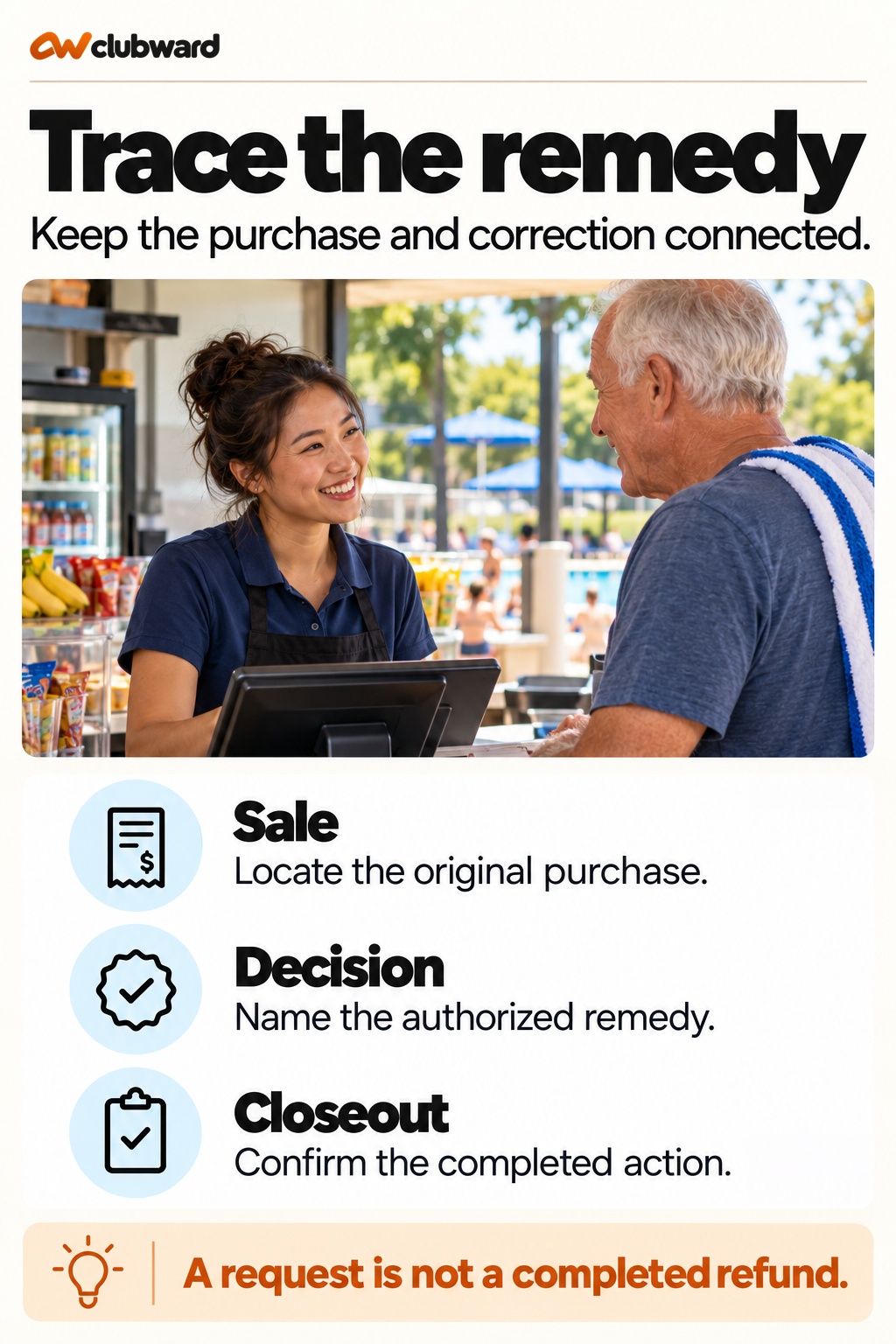
Create three distinct spaces in the review sheet. The request explains what the member reported. The approval records the authorized decision. The correction records the action completed afterward. Keeping these stages separate prevents a request for help from being counted as an approved refund or a verbal approval from being treated as a completed account change.
Record the owner at each stage. The cashier may collect the reference while the manager decides the remedy and the closing colleague checks the account activity. In a small club one person may handle all three tasks. Still identify the tasks so a covering colleague knows what remains.
Use the club’s established rules and supported payment process. This review does not create new refund eligibility, deadlines or staff authority. If those instructions cannot answer the selected situation, give the policy owner the exact question. Keep the member informed about the next step without promising a remedy that has not been approved.
Classify why the question returned
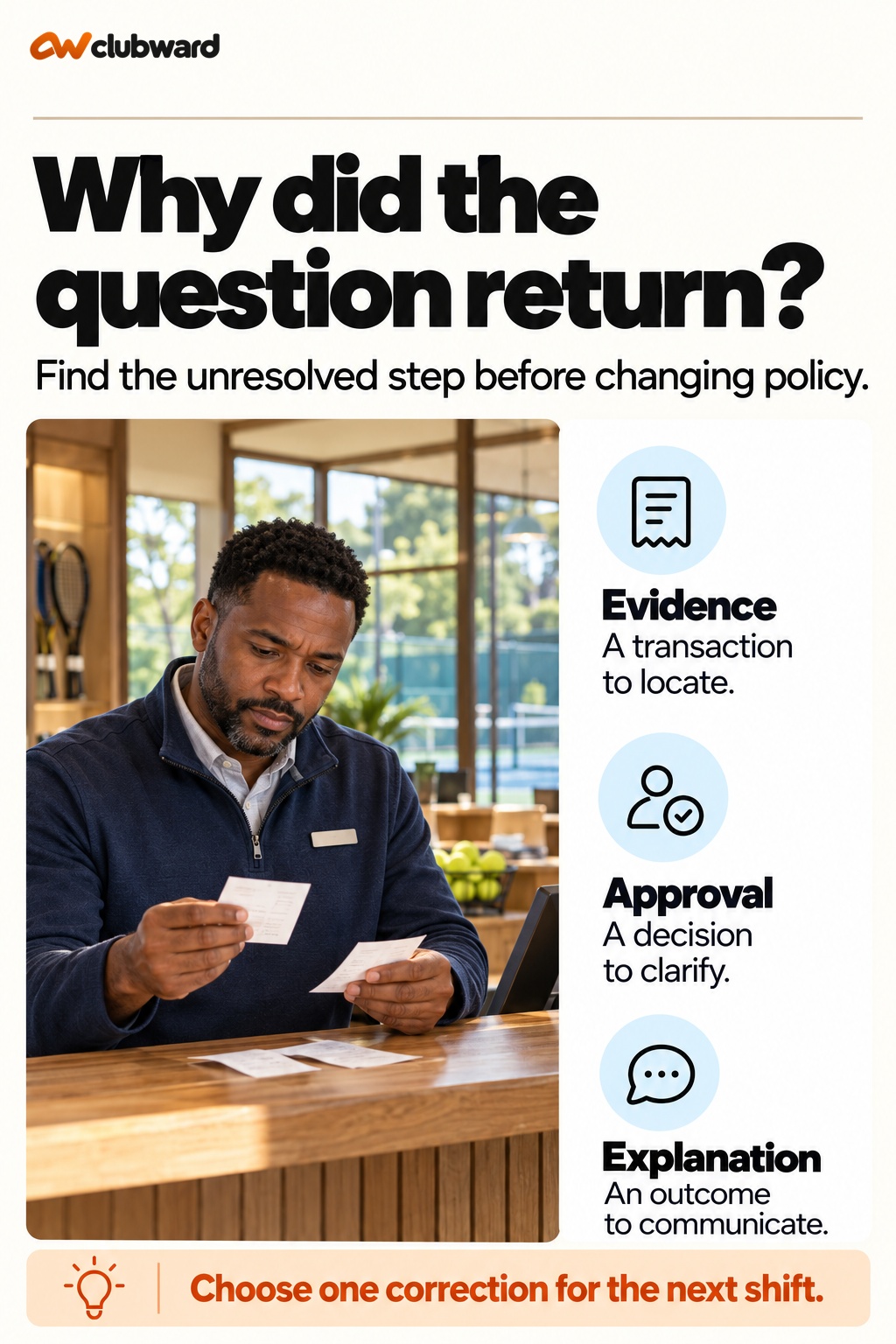
For each repeat conversation, identify the unresolved step. Did staff lack a sale reference? Was the remedy unclear? Did an approved correction remain incomplete? Did the member receive no explanation of the outcome? A repeat message is a signal to investigate, rather than proof that the same underlying error happened again.
- Evidence gap: the team cannot locate the purchase or account activity needed.
- Decision gap: the applicable rule or approval owner is unclear.
- Execution gap: an approved action has not been confirmed as complete.
- Explanation gap: the member does not understand what changed or what happens next.
- New information: the latest conversation adds a different question or transaction.
Allow more than one classification when the record supports it. A missing reference and an unclear approval route can coexist. Keep the actual question beside the label, so the team can choose a correction that addresses the work rather than designing around an abstract category.
Walk through an unavailable item
Imagine a household pays for a sandwich that the counter cannot supply. Staff offer an available alternative, but the member prefers the approved refund route. Begin with the original purchase and the club’s instruction for this situation. Confirm which item is affected and which part of the sale remains valid.
The authorized person decides the remedy under that instruction. The colleague completing it then records the action against the sale context. If the purchase involved prepaid value, establish what account change the supported process makes. If it used another payment route, follow that route’s approved procedure instead of assuming the same account action applies.
At closing, ask the reviewer to explain the sequence from the records alone. They should be able to identify the original item, the approved decision and the completed change. If they need to call the cashier for missing context, note exactly what the record failed to provide.
The member-facing explanation should answer the question they brought. State which purchase was reviewed, what action was completed and where to ask about a remaining difference. Avoid exposing internal staff discussion or private account information in an open message. Keep the explanation connected to confirmed evidence.
Trace a duplicate-charge concern carefully
A member reports that the same purchase appears twice. Locate both entries they are describing before deciding whether the case is a duplicate sale, an incomplete account explanation or a different transaction. Ask for the useful reference through the authorized support route rather than requesting a broad account history.
Compare the dates, amounts and transaction context. Two identical totals do not by themselves identify the same purchase. Conversely, slightly different amounts do not rule out a related question. The task is to locate the entries and establish what they represent using the records available.
If the evidence remains incomplete, give the investigation to a named owner with the specific missing information. Record the member’s next contact route and the internal review point. Do not complete an additional adjustment merely to make the visible total match while the original sequence is unexplained.
Once the decision is confirmed, check the resulting account and register activity through the supported workflow. Explain the outcome in plain language. Where another party or payment process owns part of the action, keep that responsibility visible and distinguish a request submitted from a completed remedy.
Use a small closeout worksheet
Build a worksheet with the case reference, original sale, reported question, approval owner, authorized action, completed activity and remaining question. Add the closing reviewer and review date. Each field should support a task someone actually performs. Leave detailed account information in the authorized source records.
For the unavailable sandwich example, the reported question concerns one item. The authorized action and completed activity should identify that item’s remedy without implying that the entire sale was cancelled. The remaining-question field might be empty, or it might note an account display that requires further review.
Use a separate status for “awaiting decision” and “approved, completion not confirmed.” That distinction gives the next shift a useful task. It also prevents the closing team from treating every open case as a cashier error when some cases depend on a manager’s decision or another supported process.
Review the worksheet with the people who close the counter. Ask whether they can find the referenced activity and identify the next owner. Remove fields nobody uses. Add a missing reference only when it makes the case traceable, rather than collecting more information as a substitute for clear responsibility.
Compare repeat questions with the current instruction
Gather the instruction the cashier uses, the manager’s approval reference and the closing checklist. Compare their descriptions of the same situation. If one says “ask the manager” while another names a different role, record the mismatch. Ask the owner to clarify the applicable instruction before changing the template.
Look for words that conceal decisions. “Refund when appropriate” does not explain who decides or what evidence is needed. “Adjust the account” does not identify the supported action. Replace vague wording with the club’s approved decision path and the information needed to follow it.
Keep genuine judgment visible. Some cases may require an authorized person to consider circumstances rather than apply a simple rule. Write the escalation route for those cases. Do not turn a nuanced decision into an automatic checkbox merely because the counter guide needs to be short.
After a clarification is approved, update every operating copy that depends on it. Give the change an effective date and identify which unresolved cases need review. Preserve earlier instructions where your record practices require them, while making the current version easy for staff to find.
Choose one correction before renewal
Rank the findings by the consequence for the next operating day and the evidence you located. A missing approval owner may matter more than a frequently asked wording question. Explain the choice using a specific case, with personal details removed. Frequency helps describe the work but does not decide the remedy alone.
Your first trial could require a sale reference on every correction request, clarify the role that approves an unavailable-item remedy or add a completed-action check to closing. Choose one bounded change. If you change the rule, register setup and member message together, you may not know which change addressed the question.
Define the trial’s scope and review point. A seasonal club could use its remaining staffed counter days; a year-round club could use a comparable weekend period. Assign an owner to retain unresolved questions and a reviewer to compare the records after staff have used the revised instruction.
Keep the renewal handoff separate. If the review finds an unresolved household balance question, give it a case reference and owner. Do not merge it into a membership discount or renewal credit without the applicable decision. Families need an explanation of each amount’s purpose and the route for questions.
Rehearse the next shift
Use an authorized practice scenario with no live account changes. Ask a cashier to locate the original purchase, identify the decision owner and explain what they would record. Then ask a covering colleague to continue from the resulting note. The rehearsal tests the instruction and handoff, not the colleague’s speed.
Include one ordinary case and one case outside the usual rule. In the ordinary case, staff should identify the supported steps. In the exception, they should know where to stop and who can decide. A confident guess is not a successful handoff when the instruction requires escalation.
After the exercise, ask which reference was difficult to find and which label was ambiguous. Correct the approved guide and repeat the relevant part. Keep the required evidence proportionate to the task. Staff should be able to use the guide during counter work without reading a long management report.
Give the shift lead a short reminder of what changed and why it matters for the next action. Ask the closing reviewer to retain examples of any remaining uncertainty. That gives the post-trial review concrete material beyond a general impression that staff seemed comfortable.
Review the trial without inventing savings
At the agreed review point, inspect the selected cases using the same definitions as before. Count requests, approved remedies, confirmed completions and unresolved questions separately. Keep the number of reviewed cases beside any finding. A small sample can identify a useful correction without establishing a club-wide performance rate.
Combine the records with staff observations. Ask whether the decision owner was clear, whether the sale context was available and whether a covering colleague could finish the task. A lower number of messages alone may conceal cases that were never followed through. Check completion as well as conversation volume.
Record changes in operating hours, sale volume and staff coverage that affect the comparison. If you did not measure handling time, describe the steps rather than presenting time savings. If several changes occurred together, avoid assigning every difference to the revised instruction.
Choose the next action from the remaining question. Retain the useful correction, clarify an unresolved approval or investigate a separate account issue. The review should end with an owner and a specific task, rather than a statement that the refund process is permanently solved.
Distinguish a void, refund and account correction
Use the terms your supported register and payment process actually use. Before a trial, ask the operating owner to explain when a sale is cancelled before completion, when an approved remedy follows a completed purchase and when account information needs correction. Keep the instruction specific to the action available in your setup. Do not assume these labels produce interchangeable records.
A cashier might discover an incorrect item before the purchase finishes. Another case might involve an item already paid for and later unavailable. A third might involve a correct purchase connected to the wrong account. Present these as separate practice situations. Ask the owner to identify the supported route and the evidence the closing team should expect.
Give staff a clear stopping point when the available action does not match the approved decision. They should contact the authorized owner rather than improvise an offsetting purchase or create a second correction. Record the unresolved step so the person receiving the question can continue the investigation without starting again.
Follow a partial remedy through the record
Suppose a practice purchase totals twelve dollars: an eight-dollar meal and a four-dollar drink. Only the meal is unavailable. The club’s authorized owner approves the applicable remedy for that item. Start the review with the twelve-dollar purchase, then identify the eight-dollar portion affected. Keep the drink’s completed sale visible.
Write the expected record sequence before examining the outcome. The original transaction should remain understandable, and the later activity should show the approved change through the supported process. If the member used eligible prepaid value, ask the reviewer to explain the resulting balance with the account activity. If another payment route applies, use its confirmed evidence.
Now ask a covering colleague what they would tell the member about the remaining four dollars. Their answer should follow the original purchase and approved remedy, without guessing that the entire sale was reversed. If the record cannot support that explanation, identify the missing reference or clarification and give it to the operating owner.
Check the member message against the same sequence. It should identify the affected item and the completed outcome while leaving unrelated purchases alone. A short, precise explanation helps the member understand the decision. It also gives the next colleague a clear boundary if another question arrives about the drink.
Prepare an unresolved-case handoff
At the end of a shift, list only the open cases requiring another action. For each, provide the sale reference, the unresolved question, the named owner and the next review point. Distinguish a missing decision from a completion awaiting evidence. Avoid copying the full member conversation into the shift summary when a secure reference is sufficient.
Ask the incoming lead to explain which task they will complete first and where they will find the supporting record. If they cannot access the necessary information, resolve that requirement through the club’s normal permissions process. A handoff note is useful only when the recipient can perform the assigned action.
Keep a member-facing update separate from the internal queue. The member needs a useful next step and an accurate explanation of the current state. They do not need staff speculation about what may have gone wrong. When the investigation finishes, connect the confirmed outcome to the same case rather than leaving two competing summaries.
Before the renewal window opens, review the remaining cases that affect household account questions. Give each one an accountable owner and a clear contact route. Keep the unresolved question visible until the evidence supports closure.
For a case crossing shifts, make the next check concrete: locate the completed action in the available activity and compare it with the approved remedy. If they disagree, keep the case open and route it to the responsible manager. Do not ask the next cashier to reconstruct the decision from memory. Give them the original reference, the current question and the owner’s contact, with access limited to what their role needs to perform the check.
Bring the counter-to-closeout journey to Clubward
Clubward’s Snackbar & POS supports staff-operated counter sales, member tabs, eligible prepaid value and register activity for reconciliation. Bring one ordinary purchase and one correction question to a walkthrough. Ask the team to demonstrate the supported steps for your payment setup, accounts, equipment and closing responsibilities.
Use your worksheet as the demonstration sequence: locate the sale, identify the account context, establish the authorized remedy, follow the supported action and review the available activity. Keep staff approval decisions in the scenario. A connected register still needs clear instructions about who may decide and what the next colleague should check.
Begin with the recurring question your team can trace today. Locate its purchase, separate the request from the decision and check the completed action. Then choose one practical correction for the next shift. To explore that journey, book a personalized snack bar workflow demo and bring your club’s counter and closeout requirements.
From Clubward Editorial Team
More from Clubward