Swim & Tennis Clubs
A Sale Was Voided. Can Staff Trace the Account Correction?
Compare the original receipt, approved correction and actual account activity before confirming a voided snack bar sale's outcome.

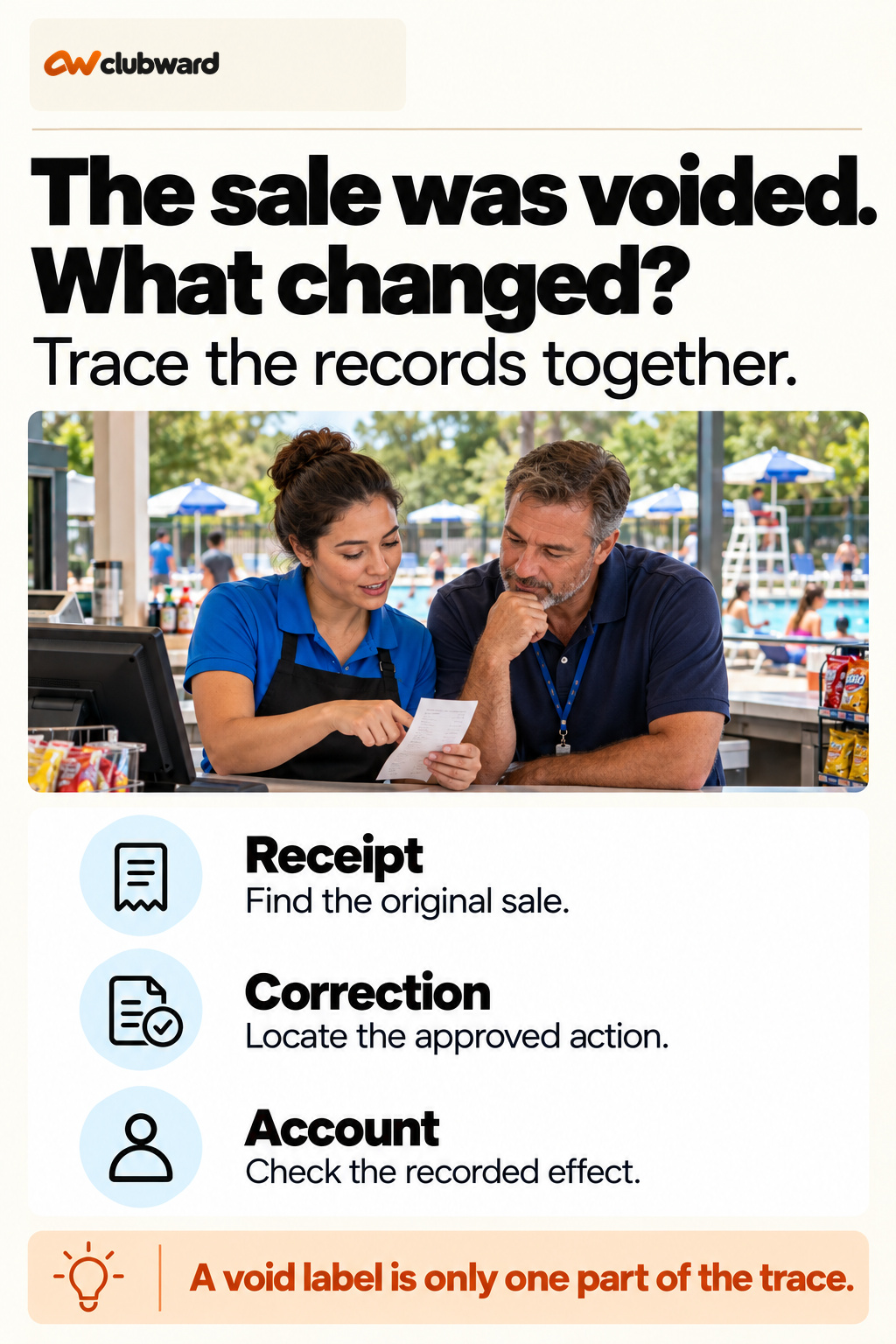
To trace a voided snack bar sale, connect the original receipt, the approved void or correction record and the actual member account activity. Check the payment method and the recorded effect before telling the member their balance has been restored. If the state is uncertain, give the investigation a named owner and verify what already happened before attempting another correction.
This evaluation is for swim and tennis club managers, counter supervisors and membership administrators preparing staff to handle a sale that did not proceed as expected. Use an authorized practice transaction or controlled example. Keep live account changes within your club's approved authority and payment procedures.
The test ends when another authorized reviewer can follow the sale through its correction and explain the result. A receipt marked void is useful evidence, but the account question needs its own answer. Your deliverable is a linked record of what was sold, what action was approved and what the relevant account now shows.
Choose one sale and one correction question
Start with a single counter sale that has an identifiable receipt and payment route. Ask a concrete question, such as whether the original prepaid deduction was reversed. Keep the scope small enough to trace every relevant event.
Do not begin with a general suspicion about register totals. That can become a separate closeout review. This test follows one purchase and the action intended to correct it, with the actual account effect checked afterward.
Record the state known at the start. The sale may be cancelled before completion, marked void after recording or awaiting an authorized correction. Use your system's supported terms and procedure rather than treating those situations as interchangeable.
Agree who can inspect the records and who can perform any live correction. A rehearsal should not give a new cashier authority to change balances. Use practice data when the permitted review would otherwise expose unnecessary member information.
Locate the original receipt
Find the receipt through the normal register or transaction history. Match the reference, date and relevant sale details. If a member presents a printout, compare it with the controlled record before drawing conclusions about the transaction's current state.
Check which items and amounts belong to the sale being reviewed. A later purchase by the same household is a different event. Do not search by a familiar name and assume the first matching receipt is the one that needs attention.
Record the original payment route. A prepaid deduction, charge to an account and external payment can require different evidence to explain the result. The correction test should follow the actual route used for this sale.
Keep the receipt reference in the evaluation record. Link to the authorized source where your process permits it rather than copying a full member account into a training folder. The next reviewer needs a reliable starting point with proportionate information.
Establish what completed before the void
Ask which part of the sale actually completed. The receipt status, account activity and other approved evidence may show different parts of the journey. Identify what you can confirm and what remains uncertain.
A cashier's recollection can help locate the moment of interruption, but it should not replace the transaction record. Record the question that needs investigation, such as whether a deduction was posted, without presenting an expected amount as an actual event.
Use the supported record and procedure for your setup. Do not infer a payment outcome solely from a screen closing or a printed label. If the needed evidence is unavailable, route the case to the authorized owner.
Keep the original record intact through the approved review process. The evaluator should be able to distinguish the purchase from the later corrective action. Replacing the history with a single unexplained balance can make the next review harder.
Identify the approved corrective action
Locate the action intended to address the sale. The record should identify the original transaction and the authorized correction, using the terms supported by your club's procedure. Do not substitute a general account adjustment simply because it is available.
Check the action's reason and owner. The reviewer needs enough context to understand why the correction occurred and who was permitted to make it. Keep the explanation focused on the transaction rather than a broad judgment about the cashier.
Ask whether the correction is completed, pending or still only requested. An approval to act and a recorded completed action are different evidence. The member-facing answer should reflect the actual state your reviewer can confirm.
If the correction reference is missing, assign that gap before attempting another action. The absence of a located record does not prove that nothing happened. Your next step is to establish the current state through the supported review route.
Follow the payment method
For a prepaid purchase, inspect the relevant stored-value activity and the original deduction. For a charge to an account, inspect the relevant account entry. For another payment route, use the evidence and owner your approved procedure requires.
Keep different kinds of value separate in the test. A membership credit, deposit and prepaid spending balance should not be assumed to represent the same funds. Use the actual account labels and explain the route in staff instructions.
Ask what the corrective action was supposed to affect. An item cancellation, an account entry and a payment reversal can involve different records. Trace the specific action rather than assuming one label describes every part of the outcome.
Use the member and household reference authorized for the task. Do not move a correction to another person's balance merely to make the totals agree. Any ownership or allocation question belongs with the responsible account administrator.
Use a simple prepaid example
Imagine a practice prepaid balance starts at forty dollars. A ten-dollar purchase is recorded, leaving thirty. The club's approved correction restores that ten dollars after the sale is voided. The resulting balance returns to forty if those are the only events.
The reviewer should be able to locate both the original deduction and the completed restoration. Showing only the final forty does not explain which action produced it. Keep the purchase and correction references connected in the evaluation record.
Now imagine another five-dollar purchase occurred afterward. With the same completed restoration, the final balance would be thirty five. A reviewer expecting forty could mistakenly treat the later purchase as evidence that the void failed.
This is why the test follows the sequence and scope of the account activity. Identify the comparison point, then explain subsequent events separately. Do not repeat a correction because the balance differs from a remembered amount.
Check the recorded account effect
Open the actual account activity through the authorized route. Find the event related to the corrective action and compare it with the original sale. Check the amount, direction and account scope using your current procedure.
Record the effect you can see, not just the outcome you expected. If a restoration is pending, show that as an unresolved state. The evaluation should expose the remaining action without describing the value as already available.
Ask another authorized reviewer to follow the same references. They should reach the same transaction question and understand which evidence supports the result. This checks whether the trace can survive a shift change.
Keep the account check separate from the receipt label. Both may be needed to explain the sale. A successful evaluation shows how they relate rather than selecting one as a substitute for the other.
Check whether a later adjustment belongs to this sale
An account may contain several changes close together. Match the correction to the original transaction through the supported references and context. Similar amounts or nearby timestamps can help locate a candidate, but they do not establish the relationship alone.
Ask the responsible owner how your setup records the link. Follow that method in the staff guide. Avoid inventing a field or label that the actual register or account history does not provide.
If the relationship is unclear, write the competing possibilities and the evidence needed to distinguish them. A focused question gives the investigator a practical next action. “The balance is wrong” leaves too much scope undefined.
Do not combine unrelated adjustments into the void explanation. A reload, approved credit or later purchase can explain a different balance movement. Preserve those events in the sequence while keeping the reviewed correction identifiable.

Stop before repeating an uncertain action
Include a scenario where the cashier cannot tell whether the correction completed. Ask them to identify the current record and help route before clicking or submitting another action. The rehearsal should make the supported stopping point clear.
The next owner needs the original receipt, attempted correction reference and known state. Provide those details through the approved channel. Do not ask the cashier to assemble a broad account history when the bounded question is enough.
Check what the member is told while the review is pending. A statement that the team is checking the account effect is more accurate than promising restored value before the evidence is confirmed. Give the follow-up to a named role.
After the investigator resolves the state, record the result and any permitted next action. If a second correction is required, it should follow the authorized procedure with the existing evidence visible. The test does not authorize an improvised retry.
Test a partial correction if your procedure supports it
If the club's actual workflow supports correcting part of a sale, choose an appropriate practice case. Identify the item or amount involved and ask which records change. Do not assume that every setup supports the same operation.
Compare the original sale, the approved partial action and the resulting account effect. The remaining sale should still be understandable through the supported records. Ask the reviewer to explain which part was corrected and which part remains.
Keep the member explanation consistent with the actual outcome. “The entire purchase was cancelled” would be inaccurate if only one item was addressed. Staff should use the terms and scope the record supports.
If partial correction is outside your procedure or authority, leave it out of the live rehearsal. Record the evaluation question for the appropriate manager or vendor walkthrough. A test can identify a requirement without pretending the operation is available.
Keep inventory and account questions distinct
If your approved process includes an inventory check after a void, give it its own evidence and owner. The account effect and the item-handling outcome may require separate follow-up even when they concern the same sale.
Ask what physically happened to the item. A prepared snack, returned merchandise and an unfilled order can involve different operating questions. Use your club's actual handling instructions rather than assuming every void returns an item to stock.
Do not change inventory merely to make a training example symmetrical. Keep the rehearsal within the supported procedure and authorized practice environment. The purpose is to locate the real handoff, not manufacture a clean result.
Record any unresolved item question separately in the test sheet. This keeps the balance explanation focused while ensuring the counter supervisor can follow the physical outcome through the appropriate process.
Prepare a useful shift handoff
Give the next supervisor the original receipt reference, corrective-action state, account effect checked and remaining question. Name the person responsible for completing the review. Avoid a note that simply says “refund issue” without a next action.
Identify whether the member has already received an update. A covering colleague should not need to infer the conversation from the account history. Record the operational fact through the approved channel without unnecessary personal detail.
Check the next follow-up point. If the responsible administrator is unavailable, use the club's existing covering route. Do not promise a specific resolution time unless the owner can support it through the actual process.
Ask the covering supervisor to explain what they would check before acting. This makes the handoff part of the evaluation. A case is ready for another shift when the person can distinguish completed work from an unresolved investigation.
Explain the outcome to the member
Use the actual verified result to prepare the response. Identify the sale or receipt in the way your normal communication allows, state what was corrected and explain the relevant account effect without exposing another member's information.
Keep pending and completed states distinct. If a review is still open, say what the team is checking and who will follow up. Do not use a reassuring balance figure unsupported by the current evidence.
If another purchase explains the remaining balance, separate that event from the void. A short sequence can make the answer understandable without sending a full internal investigation note. Share only the relevant account context through authorized channels.
Confirm the next help route if the member still has a question. The counter staff can provide the approved contact and reference without making a new promise about adjustment authority. Keep the responsibility for a further decision clear.
Give the manager an evidence-based finding
Prepare a short evaluation note naming the sale route, correction tested and observed account effect. Include what the reviewer could follow and where the trace stopped. Keep a proposed improvement separate from a confirmed result.
Classify the gap by the action it needs. A missing reference may require better staff recording. An uncertain completed state may require supported transaction review. An unclear approval route may require a manager to clarify responsibility.
Avoid interpreting one test as evidence of widespread cashier error or financial loss. The observation concerns a bounded workflow. Choose broader review only when the available evidence supports that next question.
Assign the correction to an owner and repeat the same trace after the change. The manager should be able to see whether the next reviewer can now connect the sale, approved action and account outcome.
Prepare staff with the actual procedure
Use the evaluated case to improve the register guide. Show where to find the original receipt, how to identify the supported corrective action and when to seek help. Keep access and approval boundaries beside the step that requires them.
Practice with a person who did not write the guide. Ask them to follow the records and explain the result without coaching first. Observe the instruction that helps or the missing detail that interrupts their next action.
Use the screen names and record routes in your actual setup. A generic training card should not promise a button or automatic effect that the register does not support. Keep the guide synchronized with the procedure owner.
Retain a controlled example for returning seasonal staff. It can help rehearse the trace before the counter gets busy again. Review it after relevant workflow changes so the example does not quietly teach an outdated correction route.
Check a second payment route separately
After the first evaluation works, select another payment route that your club actually uses. A prepaid deduction and an account charge need their own trace. Do not treat success in one as proof of the other.
Use the same broad questions while changing the relevant evidence: what completed, what correction was approved and what recorded effect followed? Keep the account scope and authorized reviewer clear for the second case.
Record the scope of each completed evaluation. The manager should know which routes were tested and which remain questions. A small set of clear findings is more useful than a broad statement that the register has been checked.
Give remaining requirements to the appropriate owner or walkthrough team. This turns the evaluation into a practical next step while preserving the distinction between observed behavior and a process you would like to have.
Compare a tab charge with restored prepaid value
Imagine the same ten-dollar snack purchase was recorded as a charge to a member tab instead of a deduction from prepaid funds. The correction question now concerns that charge and its supported account treatment. A reviewer should not expect a prepaid balance to increase when the original purchase did not deduct from it.
Ask the cashier to identify the payment route from the original record before selecting the evidence to review. This is an important part of the rehearsal: the amount can look familiar while the account effect belongs somewhere else. Use the actual account labels in your setup.
Then ask the account administrator to explain the completed correction using the linked records. They should be able to distinguish a removed or corrected charge from restored spending value under your approved procedure. Do not ask them to force a particular ledger shape merely because the practice example used one.
Add the distinction to the staff guide beside the first account check. A useful instruction tells the cashier which reference to find and when to route the question. It need not teach the person to perform every kind of account correction.
Finally, review the proposed member response. It should describe the effect supported by the record, with any separate balance activity kept distinct. This avoids an explanation that sounds reassuring but assigns the correction to funds that were never used for the sale.
Give the covering cashier that payment-route distinction before the next practice case. Ask them to identify the original method, locate the appropriate record and explain what they can confirm. Any remaining account question should reach its authorized owner before another corrective action is attempted.
Bring the trace to a Clubward walkthrough
Clubward's Snackbar and POS features support staff-operated counter sales, member tabs, prepaid balances and connected register reporting. Bring the original sale and the correction question to a walkthrough to discuss the record journey your club needs.
Ask the team to demonstrate the specific supported correction route, the approval boundary and the account evidence in your proposed setup. Assess those details against your evaluation rather than assuming every void automatically completes every related action.
Before the next counter shift, follow one sale from receipt through the approved correction to the actual account effect. Keep the uncertain state visible until its owner resolves it. To explore that journey in a club management platform, book a personalized snack bar and account-workflow demo.
From Clubward Editorial Team
More from Clubward