HOA & Condo Communities
How HOA Boards Can Prioritize Competing Clubhouse Requests
Two households want one clubhouse date. A clear priority rule, complete requests and a recorded decision make the answer easier to explain.

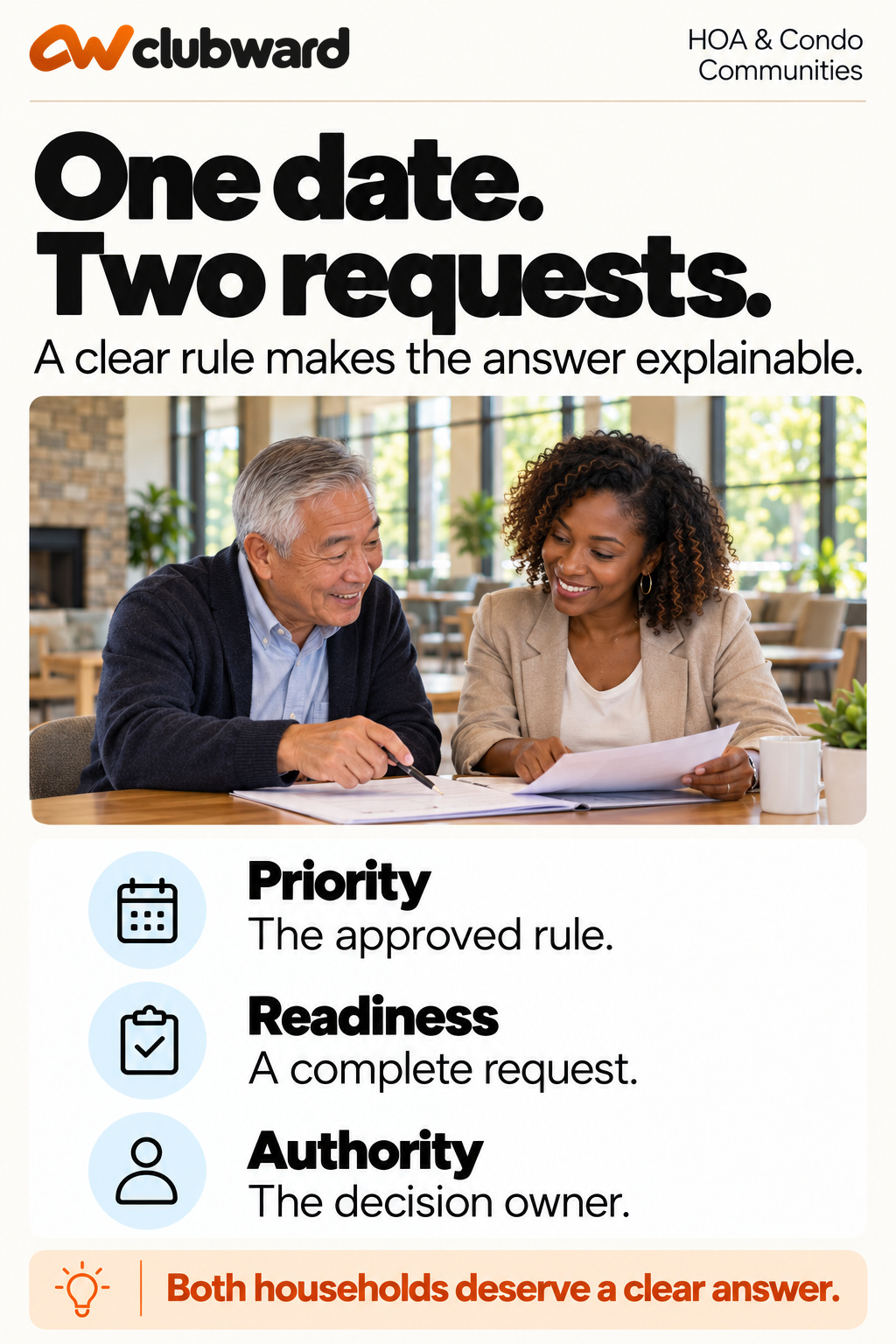
Two households want the clubhouse on the same Saturday. Both are eligible to use it. Both have a good reason for choosing that date. The calendar can show the conflict, but it cannot explain which request your association should approve.
A clear decision needs three things: an approved priority rule, a consistent definition of a complete request, and someone authorized to apply the rule. When those pieces are visible, the community manager can give both households an understandable answer. The board can review the process without becoming the referee for every weekend booking.
The useful question is therefore bigger than who asked first. It is whether your association can explain how the same situation would be handled for another household next month. That explanation should hold up at the office, in the reservation form, and at the clubhouse door.
The decision starts before the first request
Reservation priority belongs in the association's approved amenity policy or operating procedure. An employee answering a phone should not have to invent it while two residents are waiting. If the policy does not settle the conflict, the request needs a decision through the association's established approval process.
The Community Associations Institute distinguishes the board's policy role from the community manager's implementation role. Its overview of community manager responsibilities is useful when deciding who approves a priority rule and who applies it. Your association's governing arrangements and management agreement provide the specific boundaries.
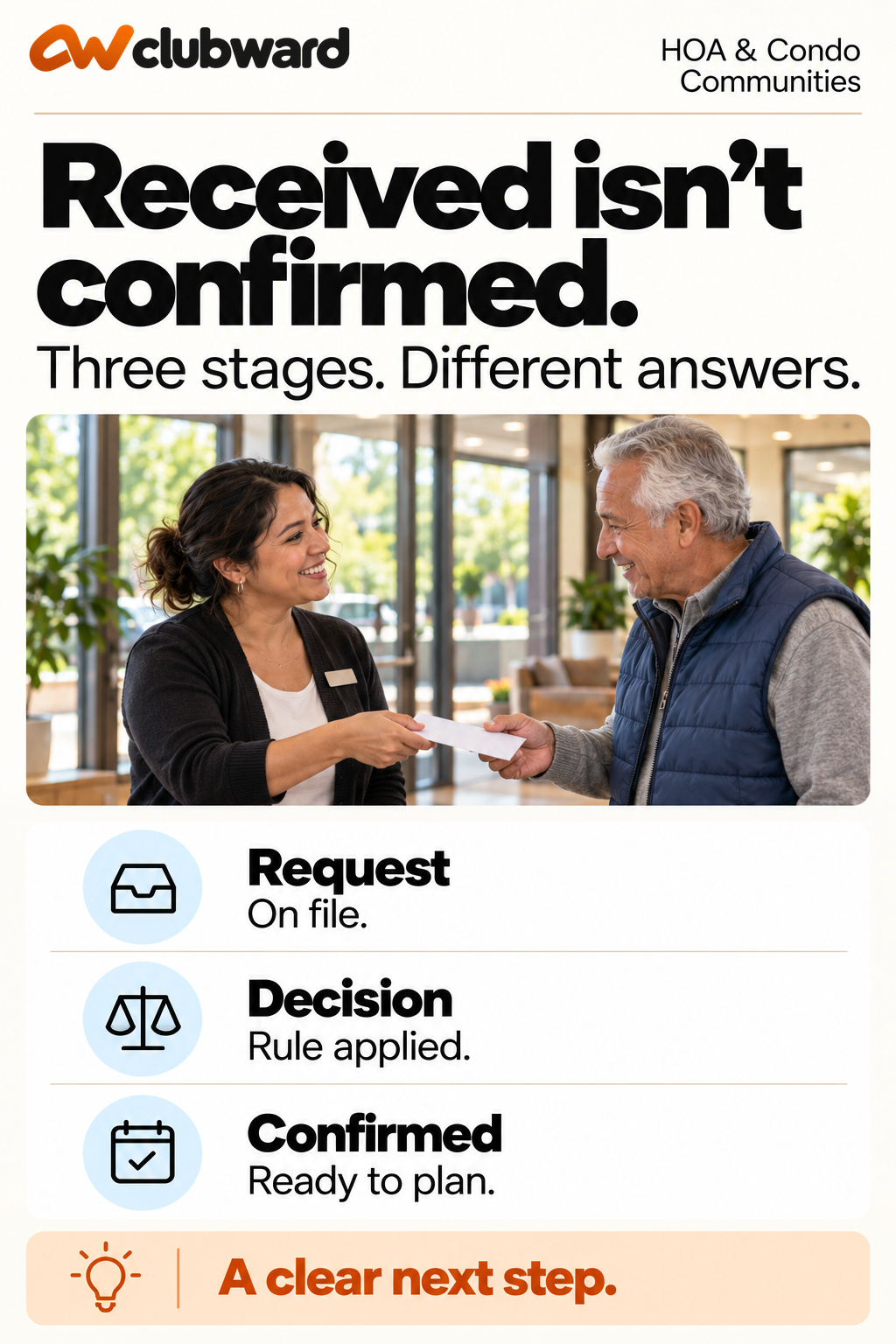
A practical rule explains what counts as an eligible request, which information makes it complete, how competing requests are ranked, and who handles situations outside the normal path. It also explains when a reservation becomes confirmed. A request received by the office and a confirmed booking are different answers to the resident's question.
That distinction makes the conversation easier. A resident can understand, “We have your request and will confirm the outcome after the application window closes.” It is harder to understand a message that sounds like approval, followed by a later explanation that another household had priority.
Different priority rules create different expectations
There is no single operational approach that suits every community. The board's choice should reflect how the clubhouse is used, how residents submit requests, and which commitments the association has already made. These four approaches illustrate the tradeoffs.
First complete request
Priority follows the time a request meets the published requirements. This gives the manager a clear comparison, provided everyone knows what complete means. A missing contact number and an unpaid required deposit cannot be treated casually for one household and strictly for another. The association also needs a consistent way to record completion times.
First request received
Priority begins when an eligible resident expresses interest through the approved channel, with a defined period for supplying missing details. This can accommodate residents who need help completing a form. It also creates a holding period that must end clearly, or an unfinished request can prevent other households from using the space.
A shared application window
Requests received during a published window are considered together under an approved selection method. This changes the resident's expectation: submitting early within the window does not necessarily secure the date. The opening and closing times, decision method, notification date, and handling of incomplete applications all need to be understandable before the window opens.
A defined community priority
The association may reserve certain dates or give specified community activities priority under its approved rules. Residents need to know which dates are unavailable for private bookings and when that information becomes reliable. An unpublished preference applied after a household has planned an event creates a different experience from a clearly stated calendar restriction.
The point is not to add complexity. It is to make the chosen approach explainable. If the office cannot tell a resident what determines priority in one plain paragraph, the process probably needs clarification before the next conflict.
An incomplete request needs a visible next step
Incomplete does not have to mean rejected. It means the association cannot yet treat the request as complete under its chosen procedure. The resident should know what is missing, where to provide it, and whether the date is being held while they respond.
Imagine a booking form that requires the household contact, requested time, intended use, and acknowledgment of the applicable conditions. A resident submits the date and contact details but leaves the intended use blank. The manager now needs a response that matches the priority rule, rather than an improvised promise about the calendar.
Under a first complete request approach, the manager might explain that priority is established once the required information is received. Under a first received approach, the procedure might allow a limited hold while the resident completes the request. Either approach can be communicated clearly; the confusion comes from mixing them.
A useful message identifies the missing information and the next decision point. “We need the event type before we can complete your request. Please reply through the booking form. The date remains unconfirmed until you receive the approval message” tells the resident what the current answer means.
Help ownership matters too. If a resident cannot use the form, the office needs an approved assistance route that preserves the same information and priority record. An accessibility or support question should not disappear into an employee's personal inbox. A recorded hold should show its end time and its responsible manager.
One Saturday, two different requests
Suppose the association uses first complete request priority. The Patel household submits a request for Saturday afternoon at nine in the morning. It includes the date and contact details but omits the event type. The Reed household submits the required information for the same period at ten. Both households meet the association's eligibility conditions.
Under this example rule, the Reed request becomes complete first. The manager records that comparison and checks the remaining approval requirements. The Patel household receives a request for the missing information and an explanation of the date's current position. The earlier arrival of its unfinished form is retained in the record, but it does not establish priority under this particular procedure.
Now change one condition. Suppose the association instead uses first received priority with a published completion period. The Patel request may hold its place while the household supplies the missing information within that period. The Reed household needs a truthful pending answer and a date for the next update.
Neither outcome should depend on which resident calls most often or which employee answers. The approved rule determines the comparison. If the manager encounters a situation the rule does not cover, the record should show what needs a decision and who will make it.
This example also reveals a communication test. Could someone on the next shift explain the outcome using the request record alone? If they need the manager to reconstruct an earlier phone call, part of the decision still lives outside the shared process.
A booked date is more than a start time
Two requests can appear compatible while still requiring the same room at the same moment. One household may ask for an event ending at three, while another plans to begin at three. Their event times touch; their setup and reset needs may overlap.
The request therefore needs the period during which the space is unavailable to someone else, using the association's established booking conditions. That might include approved setup, the event itself, and the agreed return of the room. A resident should not discover after approval that their decorating time belongs to another reservation.
A clear record keeps those periods understandable without turning the form into a facilities manual. The office can explain which time the resident requests, which time the association reserves, and which arrangements still need confirmation. Those are related details, but they are not interchangeable.
If the association permits compatible uses in different parts of a building, that needs an equally clear boundary. Sharing should follow the approved space arrangement and operating requirements. It should not be offered simply because two applicants are disappointed with the same answer.
A decision record both shifts can read
A short comparison record is more useful than a long message thread. It gives the next employee the facts behind the answer and gives the board a reviewable explanation if the process is questioned.
| Record detail | What it explains |
|---|---|
| Requested space and period | Which actual use conflicts, including the approved booking period. |
| Eligibility and completeness | Whether each request meets the conditions used for this decision. |
| Priority reference | The approved rule and the relevant comparison. |
| Decision and decision owner | Who applied the rule or resolved the unanswered question. |
| Resident communication | What each household was told and what remains pending. |
| Next action | The remaining information, alternative date, or review still needed. |
The record does not need private explanations for why one family wants a celebration more than another. It needs the information relevant to the approved decision. Personal context can make a conversation more considerate without becoming an unofficial scoring system.
Changes belong in the same trail. If a household revises its time, the manager should be able to distinguish the original request from the approved revision. That makes the final confirmation intelligible to someone who was not involved in the earlier discussion.
The resident reply should answer the real question
A resident asking about the clubhouse usually wants to know whether they can make plans. A status label by itself may not answer that question. “Pending” could mean missing information, an unresolved conflict, or a request waiting for an authorized decision.
A helpful reply explains the current answer, the relevant reason, and one next step. It can be brief and friendly: “The afternoon period is already assigned under our first complete request procedure. Your request is still on file. We can help you consider the morning period or another available date.”
When a decision is still outstanding, the reply needs a different shape: “Two requests cover the same period. The community manager is reviewing them under the published procedure. We expect to update you on Thursday. Your booking is not confirmed yet.” That gives the household a realistic planning boundary without promising an outcome.
The UK Government Service Manual's guidance on connected service channels includes keeping frontline staff informed about changes. For this workflow, the practical application is one compatible answer across the form, office reply, confirmation, and desk conversation.
Residents do not need the association's editing history. They need the answer that applies to their request and a person who can help with the remaining question.
When the two requests look equal
A priority rule also needs an answer for a genuine tie. Two complete requests may arrive within the same recorded period, or the available record may not establish which came first. The manager should be able to distinguish an actual tie from a missing detail that can still be clarified.
The first comparison is the association's own definition of received or complete. An email arrival, an office conversation, and a submitted form should not quietly become three different tests of priority. If those channels are accepted, the procedure needs to explain how their requests enter the same comparison.
After the relevant records have been checked, an unresolved tie belongs with the approved tie handling method or the authorized decision owner. A staff member's preference for one event is not a useful substitute. Neither is choosing the household that happened to call again while the office was reviewing the conflict.
The resident update can acknowledge the uncertainty without sharing another household's private information: “The requests meet the same priority condition, so the designated reviewer is applying our tie procedure. We will confirm the outcome through your booking contact.” The message explains the next action while leaving the decision with the appropriate person.
If the association has no tie procedure, that gap is a specific policy question. The board can settle how future comparable requests will be handled and provide an approved instruction for the current unresolved situation through its established process. The manager then records the result and the relevant reference.
A completed comparison should leave enough context for a later review: what was equal, which records were considered, who decided, and what each household was told. That is a stronger starting point than a note saying only “manager resolved.” It also helps the next employee recognize the same kind of question without repeating the discussion.
Exceptions need a different route
A request for an exception is different from a request that meets the normal conditions. The distinction protects the resident from a vague promise and protects staff from being pushed into a decision beyond their authority.
The exception route should identify the authorized reviewer, the information needed, and how the resident will receive an answer. The ordinary priority record should remain visible while that review happens. An exception request does not automatically erase another household's approved reservation.
Consider a community activity proposed after private requests have already been confirmed. The manager needs to know whether the approved policy addresses that situation. If it does not, the matter belongs with the appropriate decision owner. The office can communicate that review without suggesting that the current booking has already changed.
Repeated exceptions can reveal a policy question for a later board discussion. They should not gradually become a different priority system applied through private conversations. A useful review asks which circumstance keeps recurring and whether the written process needs an approved change.
A cancellation opens another decision
When an approved household cancels, the date becomes a new opportunity only after the cancellation and availability are confirmed through the association's process. An old approval message should not remain the basis for staff decisions about the space.
The next offer depends on the chosen procedure. An association may have a recorded order of eligible requests, a new application window, or another approved method. The manager needs that answer before telling a waiting household the room is theirs.
A clear offer includes the space, period, response deadline where applicable, remaining requirements, and route for accepting. It also explains when acceptance becomes a confirmed reservation. A household saying it is interested should not be confused with completing the required booking steps.
If the first household declines, the record should show that result before the next offer is made. This is less about adding another status and more about leaving the next employee with a reliable answer to, “Who has the room now?”
Recurring use changes the size of the question
A one afternoon reservation and a request for every Saturday create different effects on the shared calendar. The board may need a separate approved approach for recurring use, rather than treating it as a series of unrelated requests.
The association can consider the period being reserved, the space remaining available to other residents, the review date, and what happens when the recurring activity changes. These are choices to settle through its own policy process. The booking team then needs instructions it can apply consistently.
A recurring approval should be easy to distinguish from a single event. Its start and end dates, authorized pattern, and any conditions belong in the operating record. The office should not have to infer continuing permission from a reservation that happened months ago.
For a resident, the useful explanation is concrete: which dates are unavailable, how they can request an alternative, and when the recurring arrangement will next be reviewed. That is more helpful than an unexplained calendar block.
A short test can reveal an unclear rule
A useful test gives an employee two requests and asks them to explain the next action using the written procedure. The goal is to discover missing information, not to see who remembers the board discussion.
NIST's usability testing overview describes representative users performing representative tasks, with observations about completion, errors, and feedback. Applied here, an employee unfamiliar with the decision can reveal where the instruction needs a clearer definition or a more accessible reference.
The first test can use two complete requests for the same period. The second can introduce an incomplete earlier request. A third can change the booking period or add a cancellation. Each variation should produce an understandable result under the approved approach.
A pause is useful information. Perhaps the completion time is unclear, the help route is missing, or the employee cannot tell whether a hold is still active. Improving that particular detail is more useful than adding another general reminder to follow the policy.
What belongs in the board's review
The board's review can focus on the process rather than individual personalities. Were competing requests resolved under the approved rule? Could the office explain pending decisions? Did cancellations make the space available through a clear next step?
A concise review includes unresolved policy questions, repeated points of confusion, and the operating change proposed for each. It can also distinguish a communication fix from a change to reservation priority. Shortening a confusing sentence and changing who gets the room are different decisions.
The review is useful when it ends with a bounded next action and an appropriate owner. Residents should experience the result as a clearer booking conversation, rather than another document they must interpret before asking about the clubhouse.
Making the booking context easier to see
Clubward connects households, amenity access, reservations, and communication for HOA operations. That shared context can support the people applying your association's approved process. The priority choice and the authority to resolve exceptions still belong with the appropriate people in your organization.
A useful walkthrough follows both competing requests, not just an empty calendar. It includes the missing information, the decision, the resident's reply, and the final confirmed booking. The person covering the next shift should be able to explain the answer from the same record.
Book a Clubward amenity workflow demo around one booking conflict your association wants to handle more clearly. Bring the question that is difficult to answer today, and use it to explore how the people, space, and decision fit together.
From Clubward Editorial Team
More from Clubward