HOA & Condo Communities
Your Incoming Board Can Open the Files. Can It Explain One Amenity Exception?
Evaluate one amenity exception from ordinary rule through approval and staff instruction, then give missing decision context a named owner.

An incoming HOA board should be able to explain one amenity exception from the decision through the current operating instruction. Ask a new board member to find what was approved, why it was limited, who carries it out and what must happen next. A successful login is only the starting point. The handover test ends when the person can distinguish a past decision from permission that applies today.
Choose a routine exception with a clear record, such as a temporary clubhouse setup window. Keep sensitive resident circumstances out of the exercise. Use the actual approved documents within the association's normal access rules, or use a blank case if an appropriate record is unavailable.
This evaluation helps boards, committee leaders and association managers check decision continuity. It does not ask an incoming volunteer to reopen an approval or improvise a new policy. The useful result is a short list of missing context, unresolved authority and handoff steps assigned to people who can clarify them.
Choose an exception that tests understanding
Select a case that crosses a real operating boundary. A booking approved by the board but carried out by an association manager and front desk makes a useful example. The incoming person must connect the decision to the instruction used by someone else.
Prefer a bounded exception with an identifiable beginning and ending. A permanent change to the amenity rules can become a different discussion. A case with unresolved sensitive circumstances may need a restricted review rather than a general board orientation exercise.
Write the question in ordinary language: “Can the organizing resident enter the clubhouse early for this event, and who confirms the setup window?” This gives the reviewer a concrete task. “Review amenity governance” does not reveal what the person needs to explain.
Agree what the exercise covers before it starts. Finding the decision, explaining its limits and naming the next owner are appropriate checks. Making a new exception, changing access or contacting the resident should remain outside the rehearsal unless separately authorized through the association's normal process.
Establish the ordinary rule first
Ask the outgoing owner or manager to locate the current ordinary rule. The incoming board needs that baseline to understand what the exception changed. Record the relevant section and its effective date using the association's established document system.
Identify which part of the rule was varied. An earlier setup window may leave occupancy, cleanup and guest requirements intact. Do not summarize the approval as “special access” when the actual decision covered only entry at a particular time.
Check whether the operating guide expresses the same baseline. A desk instruction may use shorter language than the policy, but it should lead to the same ordinary decision. Mark any disagreement for the responsible owner to resolve.
Keep the baseline and exception together in the exercise packet. Otherwise, an incoming member may understand the exceptional instruction but treat it as the normal rule for the next request. The comparison is what makes the decision understandable.
Find the actual decision record
Ask the incoming member to follow the normal route to the approval. That might be the association's approved minutes, decision register or another authorized record. Do not rely on a private explanation that only the outgoing chair can supply.
Check that the record identifies the case and the action approved. A discussion note can show that a topic arose without showing a final decision. A forwarded email may contain an instruction without the evidence needed to explain its authority.
Record where the approval is found and who maintains that location. Use a case reference in the orientation sheet rather than duplicating resident details into another file. The next board should know how to retrieve the controlled record.
If the record cannot be located, stop the interpretation exercise at that point. Assign the missing evidence to the person responsible for the decision history. An incoming board member should not be expected to reconstruct an approval from conflicting memories.
Separate context from permission
Decision context explains the problem the board considered. Permission explains what the authorized action allows. Keep both visible, but do not let a sympathetic account of the original request expand the actual approval.
Imagine a resident group asked for extra setup time because tables needed rearranging before a community workshop. That reason helps explain the decision. It does not automatically authorize later events, additional guests or a longer reservation.
Ask the incoming member to state the approved action without using the request's whole narrative. Then ask what context helps interpret a condition. This separates the evidence that supports understanding from the terms that govern the work.
Where the rationale is absent, record that limitation internally and ask the authorized owner whether clarification is needed. Do not add a plausible reason to the decision record. A tidy story invented during handover is still an invented history.

Identify the boundary of the approval
Give the incoming reviewer five questions: which amenity, which occasion, which person or group, which time window and which conditions? Adapt the questions to the case without collecting unnecessary personal information.
A one-time booking exception should have an identifiable occasion. If the record says “next workshop,” ask which booking or event reference makes that phrase unambiguous. Relative wording can become difficult to interpret after the original meeting.
Check the end condition separately. The approval may end at a specified time, after the event or after a required review. Use the actual terms rather than assuming that the next board's arrival cancels or extends the decision.
Ask what remains unchanged. Cleanup requirements, ordinary guest eligibility and the manager's operating responsibilities may still apply. Record the distinction in the handover sheet so the exception does not become a broad waiver in the next person's explanation.
Name the people who decide and act
Distinguish the role that approved the exception from the role that implements it. A board decision may require a manager to coordinate the booking and a desk employee to check the arrival instruction. Each person needs an appropriate part of the record.
Ask who can clarify an ambiguous condition. The incoming member should know the association's established decision route rather than selecting the colleague most likely to answer quickly. A convenient contact is not necessarily the authorized owner.
Identify a backup for ordinary follow-up when the usual manager is away. Keep that backup within existing responsibilities. The exercise should expose a missing covering arrangement without granting a new volunteer authority to change access or policy.
For board-manager responsibilities, the Community Associations Institute's explanation of a community manager's role distinguishes board policy from management implementation. Use your association's own approved authority and responsibilities when deciding who handles this particular case.
Follow the instruction to the point of use
Find the instruction a front-desk employee or amenity coordinator would actually encounter. This may be a booking note, a controlled desk guide or an approved communication. The board packet alone does not show what the operator will do.
Ask the incoming member to compare the instruction with the decision. Does it show the same occasion, time and conditions? Can the operator identify when the ordinary rule resumes? Mark a discrepancy rather than quietly choosing whichever version seems easier.
Check how staff recognize the current instruction. An old printout, a forwarded message and a current booking note can all look credible. The handover should identify the operating location and the person responsible for maintaining it.
Keep the operational instruction proportionate. Staff may need the booking reference, approved window and help route without the resident's private circumstances. Share the information needed for the allowed action through the association's normal channels.
Work through the setup-window example
Imagine the ordinary clubhouse booking starts at six. A recorded approval allows the organizing resident to enter at five thirty for setup on one specified evening. The manager is responsible for confirming the arrangement with the desk.
Ask the incoming member to explain what happens at five fifteen, five forty five and on the following evening. These three moments test the boundary without adding a complicated scenario. The answer should follow the recorded window and occasion.
Then ask which instruction the desk uses at arrival. If the booking note only shows the six o'clock event start, the exercise has found an implementation gap. The incoming member should assign the clarification through the approved owner.
Finally, ask what evidence closes the handover. A statement that the folder was shared does not show that the desk received the current instruction. Identify the actual confirmation your process requires and who records it.
Ask for an explanation before offering help
Let the incoming member work through the case using the normal documents. Ask them to explain their reasoning in plain language. Avoid supplying the missing context before you know which part of the handover needs improvement.
Observe whether they can distinguish the ordinary rule, the approved variation and the next operating action. Record the point where they hesitate. The purpose is to improve the handover, not to rank volunteers by speed or memory.
Offer help when needed, especially if the exercise reaches a restricted record or an unresolved authority question. Note what explanation enabled the next step. That information may belong in the orientation guide or a controlled decision reference.
Afterward, ask which document or instruction they would use tomorrow. This checks whether the rehearsal left them with a reliable route to the answer rather than a conversation they would need to repeat with the outgoing chair.
Test a changed circumstance carefully
Add one change that should require a fresh decision, such as a request to use the same early setup window for another event. Ask the incoming member what they can explain and what they must refer to the authorized owner.
Keep the original approval intact. A new request does not alter its history, and a past exception does not by itself approve a repeat. The exercise should reveal how the next board separates precedent from current permission.
Ask which information the decision owner needs. The new booking reference, requested variation and applicable ordinary rule may be enough to begin. Avoid turning the rehearsal into a request for detailed resident circumstances without a defined purpose.
Record the next step as a referral or review, not an assumed approval. The incoming board should be able to tell a resident what happens next without promising the outcome before the authorized process has taken place.
Check the handover when the outgoing chair is absent
Repeat the document route without relying on the person who made the original explanation. A covering board member or manager should be able to locate the evidence and identify the unresolved question through the agreed system.
Check whether any essential link depends on a personal inbox or an unshared file. Handle access changes through the association's normal process. The evaluation does not authorize copying private correspondence into a broadly accessible orientation folder.
Ask the covering person to identify the next owner and backup. If the only answer is “ask the former chair,” record a continuity gap. Assign someone to establish a supported route before the case becomes a live desk question.
Keep the correction specific. The association may need a document location, a named receiving role or a clearer note about the approval's end. A general instruction to communicate better will not close the identified gap.
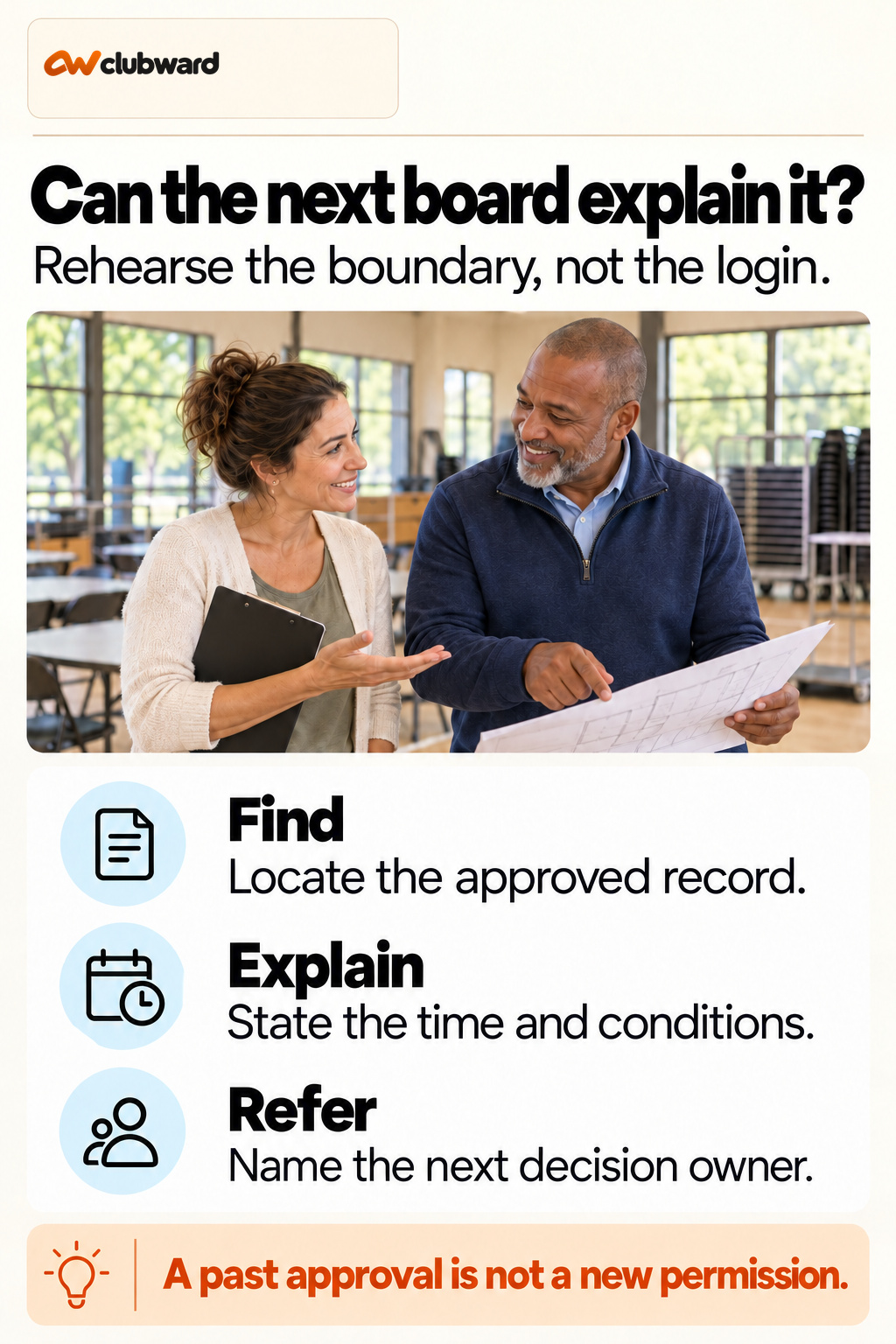
Use a decision-context handover sheet
Create a short sheet with the ordinary rule, the decision reference, the approved variation, its boundary, the implementing role and the next review or closing action. Link to controlled records rather than reproducing the whole case.
Add a space for the incoming member's unanswered question. This keeps uncertainty visible and gives the outgoing owner something concrete to clarify. An empty field is more useful than a confident summary unsupported by the record.
Show which instruction the operator uses and who confirms that it matches the decision. This links board understanding to the actual amenity work. The sheet should describe the handoff, not become a second competing permission record.
Use a review date appropriate to the case. A completed one-time event and an ongoing conditional approval need different follow-up. Let the responsible owner decide the review action within the association's existing process.
Classify the gaps you find
Separate a missing record from a hard-to-find record. The first needs evidence located or clarified by its owner; the second may need a better index or route. Both interrupt the handover, but they require different corrections.
Separate unclear authority from unclear wording. A simpler sentence cannot resolve a disagreement about who may decide. Send the authority question to the appropriate owner before polishing an instruction that assumes the answer.
Separate a board explanation from an operating mismatch. The incoming member may understand the approval while the desk still sees an older note. Assign the operating correction to the person responsible for the point of use.
Keep an unresolved category when the evidence is incomplete. The evaluation should narrow the next question rather than force every case into a tidy label. Record what you observed, who can investigate and when the board expects an update.
Give each correction a useful completion check
For a missing decision reference, completion means the authorized record has been located and linked through the approved route. For an operating mismatch, completion means the current instruction has been checked against the decision and confirmed by its owner.
Assign one person to coordinate each correction. Several colleagues can contribute, but the incoming board needs a clear person to ask about progress. Give that owner the actual discrepancy rather than forwarding the entire handover packet without explanation.
Include a date or operating trigger for review. If the next event occurs before the normal board meeting, the instruction may need clarification sooner. Use proportionate follow-up without inventing an urgent deadline unrelated to the work.
Recheck the original question after the correction. Can the incoming member now explain what applies and what happens next? Closing an administrative task does not necessarily show that the handover answer became understandable.
Discuss the result without reopening every decision
Bring the evaluation's findings to the appropriate board or manager discussion. State the case reviewed, the documents used, the uncertainty found and the agreed next action. Keep the distinction between the existing approval and a proposed process improvement clear.
Do not present the rehearsal as a legal review or proof that every amenity decision is sound. It checks a bounded operational handover. Matters requiring specialized advice should follow the association's established route rather than being settled by an orientation exercise.
Use the case to choose a manageable improvement. A clearer decision index, a current desk instruction or a named reopening owner may resolve the immediate gap. Avoid expanding the project into a complete document redesign unless the findings support that work.
Tell the incoming board where the corrected answer now lives. Preserve the decision history and update the approved operating reference through its owner. The handover should leave the next team with a usable route rather than another separate summary.
Repeat the test with a different operating boundary
After the first case works, choose a different exception that crosses another handoff. A guest allowance, a temporary room restriction or a conditional booking can test a different part of the amenity process.
Use the same evaluation questions while adapting the example. Do not assume that a successful clubhouse case proves a pool access case is ready. The relevant records, decision owners and operating instructions may differ.
Keep the number of cases manageable for volunteers. One thoroughly explained case can reveal a practical gap. Add cases because they test a different boundary, not because a long orientation packet looks more complete.
Record which parts of the handover were actually tested. Future board members can then see the scope of the exercise and choose an appropriate next case. Avoid claiming that every decision has been checked from a small rehearsal.
Compare two plausible explanations
Ask the incoming reviewer to compare these answers to the setup-window question: “The resident group has early access” and “The recorded approval allows this booking's organizing resident to enter at five thirty for setup on the specified evening.” The second answer identifies the action and boundary. The first leaves the next operator to guess which people, dates and purposes are included.
Now ask what each answer would lead the desk to do at five forty five. Both might appear sufficient for the original evening. Test them against a different evening and the difference becomes visible: the broad wording can be carried into a new occasion without another decision.
Keep the comparison beside the actual case, not as a replacement for its terms. Your approval may use different conditions. The exercise asks whether the incoming board can preserve those conditions in a practical explanation.
If the reviewer gives the broader answer, locate the missing detail together. It may be absent from the handover summary while clearly recorded in the approval. Correct the summary through its owner, then ask a covering operator to interpret it. This checks whether the improved explanation reaches the people who need it rather than remaining an orientation conversation.
Keep the clarification connected to the case so another reviewer can follow it.
Bring one decision to a workflow walkthrough
Clubward's programs and shared spaces connect program planning and shared-space reservations. Bring the ordinary rule, one approved exception and its operating instruction to a walkthrough to discuss how your association would keep the booking context accessible to the right people.
Ask the team to demonstrate the particular record and responsibility handoff your association needs. Assess it against the case you rehearsed. Record any configuration questions without assuming that a platform makes board decisions or interprets an exception independently.
For your next board handover, choose one amenity decision the incoming team should explain. Follow it from approval to the point of use, clarify the missing context and check the answer again. To explore that workflow in a club management platform, book a personalized amenity and board-handoff demo.
From Clubward Editorial Team
More from Clubward