HOA & Condo Communities
How HOA Boards Can Hand Off a Pool Closure Without Losing the Details
A pool closure is a decision, a message and an operating change. This guide helps HOA boards hand all three to the people who must carry them out.

A pool closes at 2:15 p.m. The board president knows why. The community manager knows who made the call. The maintenance vendor knows what has to happen next. Yet the attendant at the gate has only heard that “something is wrong,” and residents are already asking whether the clubhouse, courts and evening event are affected.
The problem is not necessarily the closure decision. It is the handoff. A useful pool-closure process must move one approved decision from the board or manager to the people handling access, resident questions, facility work and reopening. If any of those people receive a different version, the community ends up with mixed messages, avoidable escalations and a second round of work.
The practical answer is to treat every closure as a small operational packet: scope, effective time, reason that can be shared, decision owner, resident message, staff answer, next review and reopening authority. The packet should be brief enough to use during a busy shift and complete enough that the next person does not have to reconstruct the story.
Why a simple change becomes a complicated shift
- The decision has no operational boundary: “The pool is closed” does not say whether the deck, restrooms, lessons, clubhouse or adjacent spaces are included. Staff need a precise boundary, not a general warning.
- The effective time is implied: A notice written at 2:15 may be intended to take effect immediately, after the current class or at the next scheduled break. State the time and time zone.
- Only residents receive the notice: A resident email does not automatically prepare the front desk, maintenance contact, program leader or next shift. Each group needs the part that changes its work.
- Reopening is treated as automatic: A repair may be complete while the approved reopening check is still outstanding. Name the person who can reopen the facility and the evidence they need.
- Old answers remain visible: A printed sign, scheduled message or staff note can outlive the closure. Include the places that must be updated again when status changes.
Build a handoff packet people can actually use
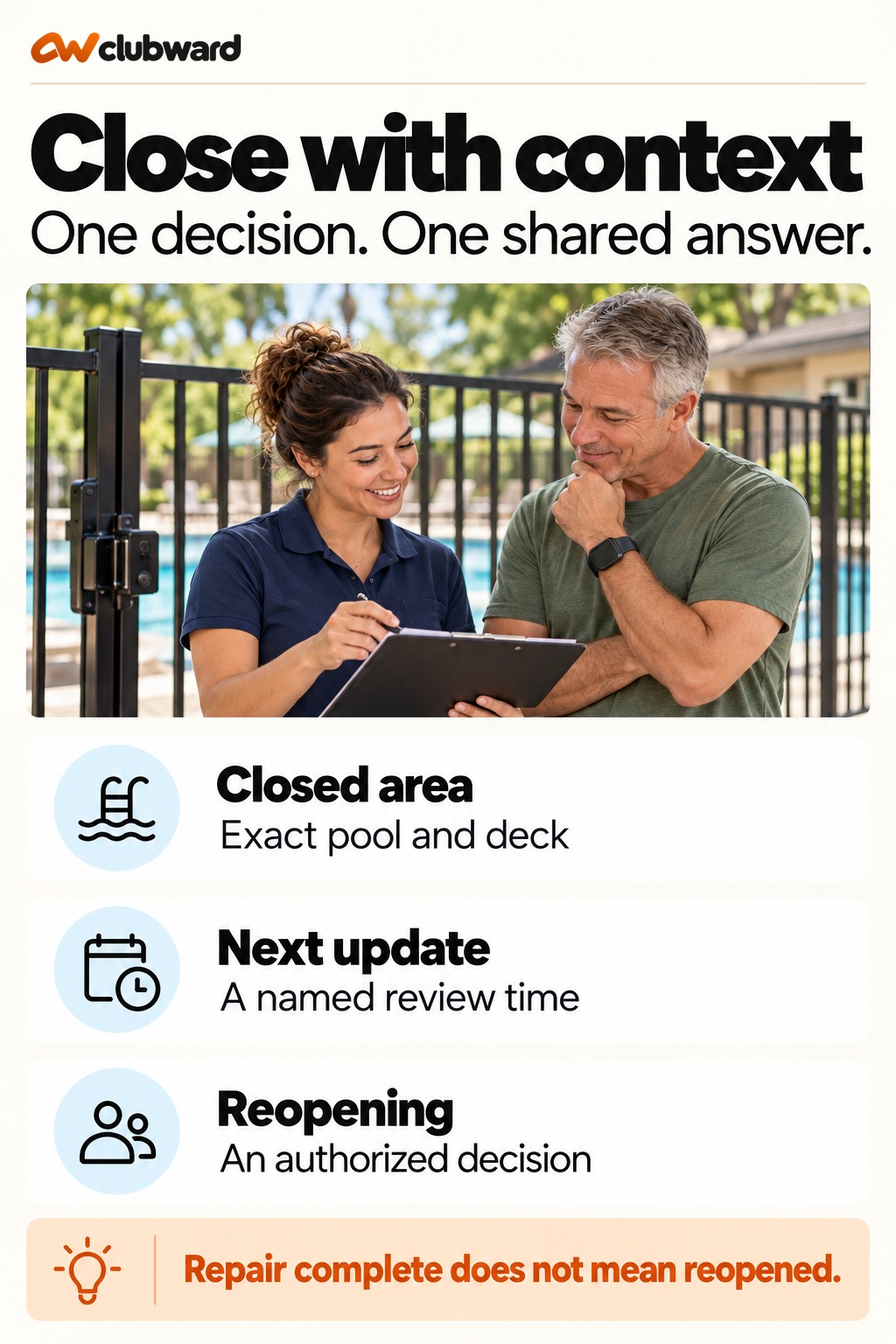
- Facility and boundary: Name the exact pool, gate or area and list the nearby spaces that remain open.
- Status and effective time: Use a clear status such as closed, restricted or delayed, followed by the effective date and time.
- Shareable reason: Give staff a short factual explanation that protects private information and avoids speculation.
- Decision owner: Identify who approved the closure and who can answer operational questions.
- Next review: Set the next decision point even when the repair or inspection time is uncertain.
- Reopening authority: Name the role that can change the status and how the team will record that approval.
Move the decision from one role to the next
1. Confirm the decision before broadcasting it
The person receiving the initial report should repeat back the facility, scope, timing and decision owner. This two-minute confirmation prevents a vague maintenance message from becoming an unofficial community-wide closure.
2. Write one source message
Draft a short master update. From that source, create the resident notice, staff brief and vendor instruction. The wording can change by audience, but the underlying status and timing should not.
3. Brief the people answering questions
Give attendants and the front desk an approved sentence, the next review time and an escalation contact. They should not have to interpret board minutes or a long email chain while a line forms.
4. Resolve affected reservations and programs
List every booking, class or event that touches the closed space. Decide whether it is cancelled, relocated, delayed or still proceeding, and assign one owner for participant follow-up.
5. Record the reopening check
When work is complete, confirm the required check rather than assuming the facility is ready. Add the approver, time and any remaining restriction to the same operational record.
6. Close the communication loop
Update signs, staff notes, resident notices and affected bookings. A reopening is not complete until the people who received the closure also receive the current status.
A worked handoff example
Imagine an outdoor pool closes because a circulation problem is reported during open swim. The manager confirms that the pool and deck close immediately, while the clubhouse restrooms and tennis courts remain open. The board’s designated operations contact approves the status. A maintenance visit is expected later that afternoon, but the next formal review is set for 5:00 p.m.
The resident message says what is closed, what remains open, which programs are affected and when another update will be provided. The staff brief adds an approved answer for walk-up questions and the manager’s escalation number. The program coordinator moves an indoor meeting but cancels swim practice. The evening attendant sees the same status before starting the shift.
At 4:40 p.m., the vendor completes the repair. That does not silently reopen the pool. The designated approver records the reopening check at 5:05, staff replace the entrance sign, the resident update goes out and the next shift begins with a current answer. No one needs to guess whether “fixed” and “open” mean the same thing.
Measure whether the handoff works
- Time to first complete brief: Measure from the decision time to the moment staff have scope, answer and next review—not merely to the first email.
- Unanswered escalation count: Track questions that reached the board only because the front desk lacked an approved answer.
- Affected booking completion: Confirm that every impacted program or reservation has a recorded outcome and owner.
- Reopening confirmation time: Record when the authorized person approved reopening and when public and staff messages were updated.
- Repeat confusion: Review whether the same boundary or ownership question appears in later closures; that points to an instruction that needs improvement.
Rehearse the closure before a real interruption
Choose a quiet week and run a tabletop exercise with the board’s operations contact, the community manager and one attendant. Use a believable scenario: the main pool closes at 3:30 p.m., tennis remains open, an evening practice is scheduled and the maintenance vendor cannot arrive for two hours. Give the group ten minutes to produce the operational packet and the first resident update.
Then change one fact. The repair is complete, but the person authorized to reopen the pool is unavailable. Ask the attendant what status they would show, what they would tell a resident and whom they would contact. This reveals whether the process separates completed work from an approved reopening. It also tests whether the backup authority is clear.
Finish by comparing every output. The resident notice, sign, booking decision and staff brief should agree on scope and timing. If one says the “amenity area” is closed while another says only the pool is closed, fix the source language. If the next review time is missing, add it as a required field. A short rehearsal makes the next real closure calmer because the team has already practiced the decision path.
Where a connected club management platform helps
Clubward connects household records, access rules, reservations, facilities and community communication for the resident-facing amenity side of association operations. Its HOA software is scoped to those amenity workflows rather than general-ledger accounting, violation enforcement or architectural review. That boundary is useful here: a closure handoff belongs with the people, facilities, bookings and notices it affects, while the association can keep separate governance or property systems for work outside that scope.
For a closure scenario, the useful evaluation is concrete. Ask whether the team can identify the affected facility, show which reservations touch it, prepare a targeted notice, leave the front desk an approved answer and preserve a record for the next shift. If equipment or camera compatibility matters, confirm the supported setup during evaluation rather than assuming every device connects.
Write the first notice before you know the reopening time
A closure notice can be useful even when the next decision is uncertain. Separate confirmed facts from unresolved work. The confirmed facts might be that the main pool and deck are closed, the clubhouse remains open, and the operations manager owns the next review. The unresolved work might be the repair duration. Residents need both, expressed plainly, so they can decide whether to change their plans.
For the circulation example, a first message could read: “The main pool and deck are closed from 2:15 p.m. today while the circulation issue is assessed. Tennis courts and clubhouse restrooms remain open. This afternoon’s pool practice is cancelled. We will post the next status update at 5:00 p.m., including if the closure continues.” State the next update time separately from reopening, so residents know when to check confirmed status.
The update promise belongs to a person, not to the repair schedule. Assign the community manager to publish the 5:00 message even if the vendor has no new estimate. “The pool remains closed; the next update is tomorrow at 9:00 a.m.” is more useful than silence after an earlier promised review. Avoid giving the attendant an estimated reopening time that the designated approver has not accepted.
Choose channels based on the people affected. A resident notice addresses plans. An entrance sign addresses arrivals. A staff brief addresses questions and permitted actions. A message to the swim organizer addresses the cancelled practice. Use one source status for all four, then tailor the action. You do not need to send a maintenance discussion to every household to give residents a clear answer.
Give the attendant a usable answer and a boundary
An approved answer should fit a normal conversation. Ask an attendant to read it aloud before using it. If it sounds like a board resolution, shorten it while preserving scope and timing. A useful gate answer is: “The pool and deck are closed. The courts are open. The next update is at five. I can contact the manager if your reservation needs a separate decision.”
Pair that answer with three boundaries. The attendant can explain the saved status, identify unaffected amenities and route an unresolved booking. The attendant cannot promise a reopening, approve entry to a closed area or invent compensation. Those boundaries make escalation purposeful. They also keep the resident from receiving a different decision simply because they ask a different person.
Keep the help route practical for the shift. “Contact management” is incomplete when the office is closed. Name an on-duty role and a backup, and specify which questions require immediate contact. A request for next week’s clubhouse availability can wait for ordinary reservation support. A person trying to enter the closed pool requires the community’s existing immediate response procedure. Staff should know the distinction before the first question arrives.
At shift change, use a short read-back. Ask the incoming attendant which spaces are closed, what remains open, when the next update is due and who can reopen the pool. This is a check of the brief, not a memory contest. If the attendant cannot find an answer quickly, improve the record rather than expecting them to memorize the afternoon’s conversations.
Follow one affected reservation to a finished outcome
Take the evening practice from the example and follow it separately from the closure. Record the organizer, time, affected area and approved outcome. A cancelled program needs an owner for participant communication and any further decision under the association’s existing rules. Marking the pool unavailable does not prove that the organizer has received the cancellation or that families know not to travel.
For a nearby clubhouse meeting, ask a different question: does the closure actually affect its room, route or required setup? Do not cancel it simply because the booking is on the same property. If the meeting can proceed, state that outcome in the operational packet. If its entrance crosses the closed deck, assign someone to confirm an approved alternative route before telling the organizer that everything is unchanged.
Use a small affected-booking list with columns for activity, impact, decision, owner and completion. The list may contain only two entries. Its value is the separation between the facility status and the promise made to each organizer. Leave an unresolved item visible with its decision deadline. Do not write “handled” when the actual state is “organizer called, awaiting a decision.”
When the next shift receives the list, it should be able to answer whether participants were notified, whether a replacement space was approved and whether any payment question still belongs to management. The attendant does not need private participant details or an organizer’s full email history. They need enough context to route the next question without reopening settled decisions.
Make reopening an explicit handoff
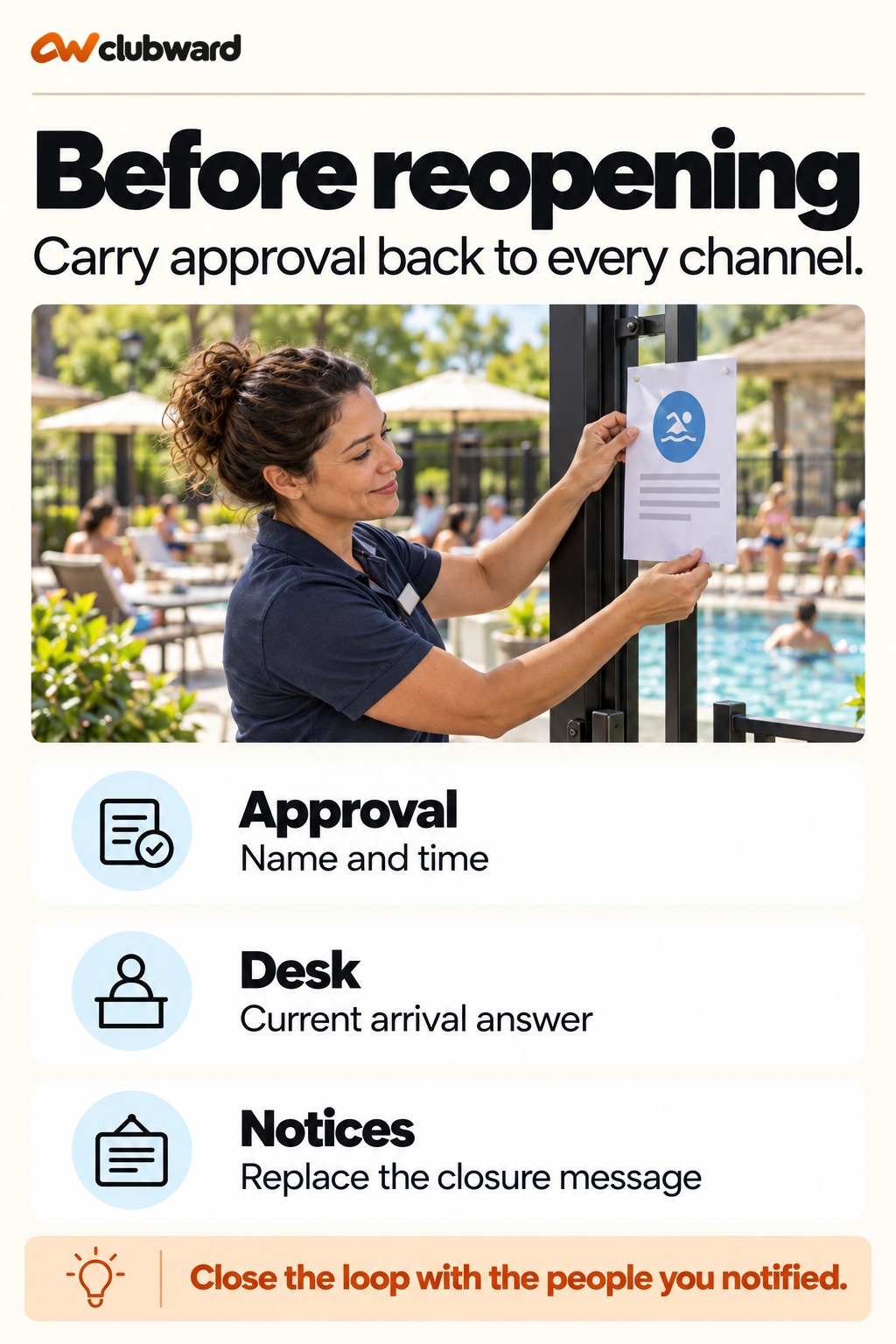
Reopening reverses several actions at once. The maintenance contact may report that the repair is finished. The designated approver must decide whether the community’s required reopening checks are satisfied. The manager then updates the operating status. The attendant updates the entrance information, and program owners resolve the next scheduled activity. Put those responsibilities into the closure packet at the beginning.
Record the approval as a decision with a time and scope. “Approved to reopen the main pool at 5:05 p.m.; normal access resumes” is different from “equipment repaired at 4:40.” If one area remains restricted, include it in the approval and the public update. A partial reopening should not become a full reopening through shortened wording on a sign.
The backup approver needs defined authority before the primary person becomes unavailable. A list of telephone numbers does not settle who may make the decision. Agree on the backup role through the association’s normal governance and operating process. Confirm required technical checks and authorized decision roles through your community’s existing pool operating procedures before approving and communicating a reopening.
After the approval, check the channels that were changed at closure. Replace the entrance sign, update the staff note, send the resident status and review any delayed booking. Also check messages queued for later delivery. A closure reminder sent after reopening can create a second wave of confusion even when the physical entrance is correct.
Manage an unresolved closure across overnight shifts
An overnight closure should carry a next review, not an abandoned estimate. Before leaving, the manager records the last confirmed status, completed maintenance work, outstanding check, morning owner and first update time. The record should distinguish a vendor appointment from a decision deadline. The appointment may move; someone still owns the next resident update.
Suppose the vendor will return at 8:30 a.m., while a morning practice begins at 9:00. The program owner must decide when participants need an answer to avoid an unnecessary trip. Waiting until the vendor arrives may be too late for that program. Set a separate communication decision: for example, the organizer will receive a cancellation or postponement decision by the association’s chosen early-morning cutoff.
The incoming attendant should see the closure before opening the gate. Include the exact area, current sign, approved answer and morning contact. If a resident says that someone promised the pool would be open, the attendant checks the saved approval rather than weighing competing recollections. The response can acknowledge the inconvenience while keeping the current decision intact.
Keep an open-items list for work that extends beyond reopening. A cancelled lesson, damaged sign or unresolved organizer question may need follow-up after the pool is available again. The closure record can be operationally resolved while a separately owned follow-up remains open. That distinction prevents the manager from hiding unfinished work or leaving the entire closure indefinitely incomplete.
Review the decision trail with the board
At the next operations review, bring a brief chronology rather than the full message thread. Show the closure decision, first complete staff brief, affected-booking outcomes, review updates and reopening approval. Ask where the receiving role lacked a fact or authority. A timeline is useful because it separates a late repair from a late message; the improvement needed for each is different.
Choose one change that can be tested during the next interruption. If attendants repeatedly ask whether restrooms remain open, add nearby-space boundaries to the source notice. If a program owner learns the news late, add that role to the acknowledgment list. If reopening is delayed because the approver cannot be reached, review the backup arrangement through the appropriate decision process.
Retain the decision context for the next board and manager. They should be able to tell why the area stayed closed after repair, which role approved reopening and which communication problem the team corrected. That record is more useful than a folder of notices with no connection between them. It also lets an incoming leader distinguish a one-time judgment from a permanent operating rule.
Check the difference between notice delivery and staff readiness
For the next closure rehearsal, give the resident notice to one person and the staff brief to another. Ask each to identify the next decision. The resident should know when to expect an update and what to do about an affected activity. The attendant should know which questions they can answer and which require the authorized owner. If both receive identical text but only one can act, the handoff needs a clearer role instruction.
Record acknowledgment from the role that receives the work. An email delivery marker does not tell the manager whether the evening attendant found the current answer. A brief read-back before the shift is a more direct operational check. Keep that confirmation with the closure record so the morning owner can see which shifts were prepared.
Also test a resident who arrives at an unaffected amenity. The staff answer should preserve access to the open area while explaining the closure boundary. That case checks whether a broad warning unintentionally became a wider restriction than the specific authorized pool closure decision.
Final checklist
Before marking the handoff complete, confirm the following items in the saved record:
- Exact facility and boundary
- Effective date and time
- Approved shareable reason
- Decision owner and escalation contact
- Resident notice
- Front-desk answer
- Affected programs and reservations
- Vendor or maintenance action
- Next review time
- Reopening authority
- Updated signs and scheduled messages
- Final completion note
From Clubward team
More from Clubward