HOA & Condo Communities
Your Amenity Exceptions Keep Coming Back. Is the Approval Actually Expiring?
Check the scope, authority, conditions, ending and closure of temporary amenity approvals before the same question reaches your board again.

Before you answer another question about a temporary amenity exception, check the last one your association approved. Can someone other than the original decision-maker tell when it ends, what it covers, and what should happen afterward? If the answer is unclear, start there. Another reminder about the general rules will not resolve an unfinished approval.
Consider a clubhouse booking that received permission for an earlier setup time. The event is over, but the email remains in a resident’s inbox and a note remains on the reservation. At the next booking, the resident expects the same arrangement. Your team now needs to establish whether the earlier decision applied to one event or changed the standing process.
Use the review below to diagnose that uncertainty without reopening every association rule. It focuses on the life of a temporary decision: its authority, scope, ending condition, communication, and closure. The intended result is a short list of specific corrections your board or manager can consider through the normal approval process.
Choose one kind of exception to examine
Start with a narrow situation, such as clubhouse setup times, temporary access arrangements, or a reservation rescheduled after maintenance. Choose something your team has actually handled recently. Avoid combining unrelated decisions simply because staff used the word “exception” in each record.
Set a review period that gives you a manageable collection of cases. For a seasonal amenity, use the latest operating period rather than an arbitrary month with no activity. For a year-round clubhouse, choose a recent stretch that includes ordinary bookings as well as a busy weekend.
Write the review question before opening the records: “Can we determine which setup-time permissions are still active?” Keep that question beside your notes. You are testing whether approvals can be interpreted and closed, not scoring residents or judging whether a particular request was reasonable.
Include both straightforward cases and cases that needed clarification. Record how you selected them. If you only examine the most memorable dispute, present the finding as a problem in that case, not a conclusion about every amenity decision your association makes.
Separate policy authority from operational follow-through
The Community Associations Institute describes the manager’s role as implementing board policy and assisting board decisions, while identifying policy-setting as a board responsibility. That distinction is a useful starting point for this review. See CAI’s explanation of community manager responsibilities.
For your association, locate the actual authorization that applied when the exception was made. Identify the approved rule, any delegated decision-making authority, and the person or body that approved this particular departure. Refer questions about authority to the association’s established advisers and approval process.
Then identify the operational owner. Approval and implementation are separate tasks in this worksheet. A board may approve an arrangement while a manager updates a reservation and an attendant receives the instruction. Record each responsibility without assuming the approver personally completed every follow-up.
If the authority is unclear, mark the case for clarification. Do not silently convert an informal email into a standing policy, and do not erase an existing arrangement as a shortcut. The audit should produce a question for the right decision-maker, with the relevant record attached.
Look for five parts of a complete temporary decision
Read each approval against five questions. Keep the original wording available so another reviewer can check your interpretation. Where a detail is missing, write “not located” rather than guessing from what staff remember happening.
- Scope: which event, amenity, household, or approved activity does this cover?
- Authority: who approved it, and where is that decision recorded?
- Conditions: what must be true for the arrangement to apply?
- Ending: does it expire at a date, after an event, or after a specified review?
- Closure: who checks the result and updates the operating record?
Use these as review prompts rather than new eligibility rules. An association may need different fields for different arrangements. The test is whether the person using the record has enough information to apply the approved decision without expanding its meaning.
Take extra care with open-ended phrases such as “for now,” “this season,” and “until resolved.” Ask what event or date those words referred to. If the underlying decision never defined that boundary, send it back for clarification instead of adding a deadline after the fact.
Distinguish an expiry date from a review date
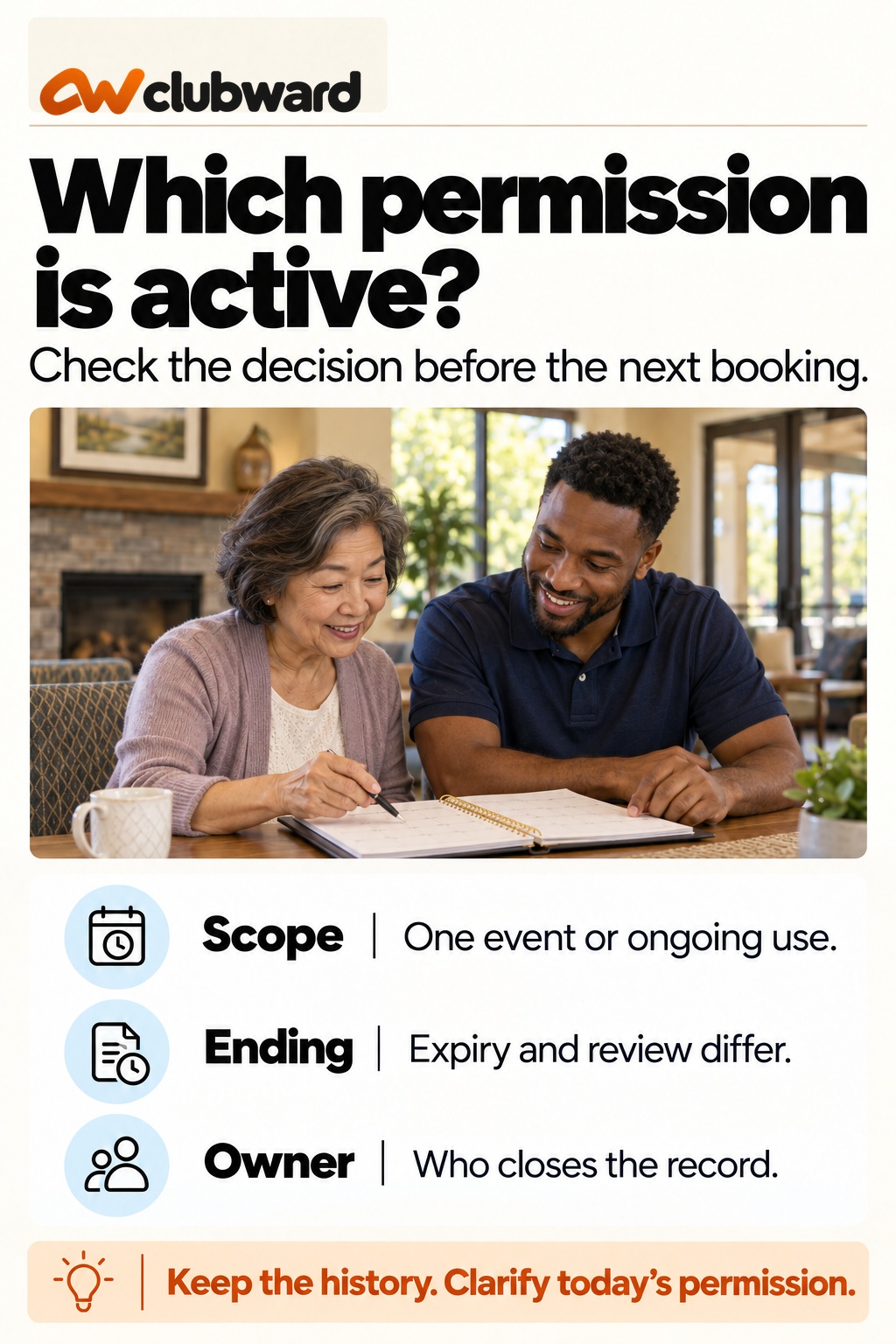
On your worksheet, give these concepts separate spaces. An expiry date describes the end of the approved arrangement. A review date tells someone when to examine it. Do not treat a reminder to review an arrangement as proof that the permission automatically ends at that moment.
Imagine a clubhouse access route temporarily changes while a doorway is repaired. Your review might find a date to check the repair, but no recorded decision about how staff will confirm the normal entrance is usable again. The missing piece is a completion check, not necessarily another calendar reminder.
Ask the authorized owner to state what happens if the review is delayed. Staff need an approved instruction for that situation. Avoid writing a general default that could change someone’s access merely because the administrative follow-up is late.
Keep the distinction visible in communications too. “We will review this arrangement on Friday” and “this approval applies only to Saturday’s event” convey different decisions. Match the message to the approval instead of using the same template for every temporary arrangement.
Follow one approval through every place it appears
Choose a case and trace the information from the original decision to the people implementing it. Look at the reservation, staff instructions, resident confirmation, and any shared calendar note that your team actually uses. Avoid creating a new list of systems nobody consults.
Record the purpose of each location. The decision record might contain the full approval. The attendant’s view might need only the permitted setup time and an escalation contact. The resident message might explain the agreed arrival arrangement and what to do if plans change.
Compare the versions for scope and timing. If one says “early setup approved” while another names a single date, note the exact mismatch. Recommend correcting the incomplete version by reference to the approval, not by inventing a broader interpretation.
Check where outdated copies remain discoverable. An old message does not need to be destroyed for the current instruction to be clear. Preserve appropriate records while making the active decision and its applicable date easy for authorized staff to identify.
Work through an early-setup example
Suppose a community approves setup at 8:30 for a gathering whose reservation begins at 9:00. The approval applies to that Saturday, requires the room to be available, and names the facilities coordinator as the operating contact. Use this as a practice case for your worksheet.
The first check is scope. Does the reservation note identify the Saturday gathering, or does it simply say the household has early access? The second check is delivery. Has the person opening the building received the same time and conditions the resident received?
The third check is closure. After the gathering, ask the coordinator to confirm that the event-specific note is no longer presented as an active instruction for future bookings. Keep the approval attached to its historical event according to your association’s record practices.
If the resident asks for early setup again, staff should be able to locate the previous decision without treating it as automatic permission. Route the new request through the applicable process. If repeated requests suggest a policy issue, collect the evidence for a separate review.
Ask staff to interpret the record without coaching
Give an authorized colleague the current record and a practical question: “The resident is booking another event next month. What would you do?” Ask them to show where they found the answer. Keep the exercise private and focused on the information available to them.
Observe where they pause, which record they trust, and which person they would contact. Do not supply the missing context immediately. First note what the record fails to explain; then clarify the approved instruction so the exercise does not leave a live question unresolved.
Compare interpretations without turning the review into a staff performance contest. If two people reach different answers, quote the ambiguous wording and identify the decision that needs clarification. The useful finding is the gap in the instruction, not a label attached to either colleague.
Repeat the exercise after the correction. Use the same practical question and check whether the person can now identify scope, end condition, and next action. Treat that result as evidence about this instruction, not proof that every exception process is solved.
Give unresolved cases a controlled next step
Create a short queue for the cases you cannot close during the review. Each entry needs the question, its owner, the supporting record, and a next-check date. Use a neutral description such as “confirm whether approval applies to repeat bookings.”
Separate a missing record from a disputed interpretation. The first may require locating a decision. The second may require the authorized decision-maker to explain or reconsider it. Sending both to the same generic “admin cleanup” bucket hides the different work involved.
Where an upcoming event depends on the answer, include its date and the team awaiting guidance. Ask the owner to provide an approved interim instruction if needed. Do not make front-line staff choose between competing messages while the review remains open.
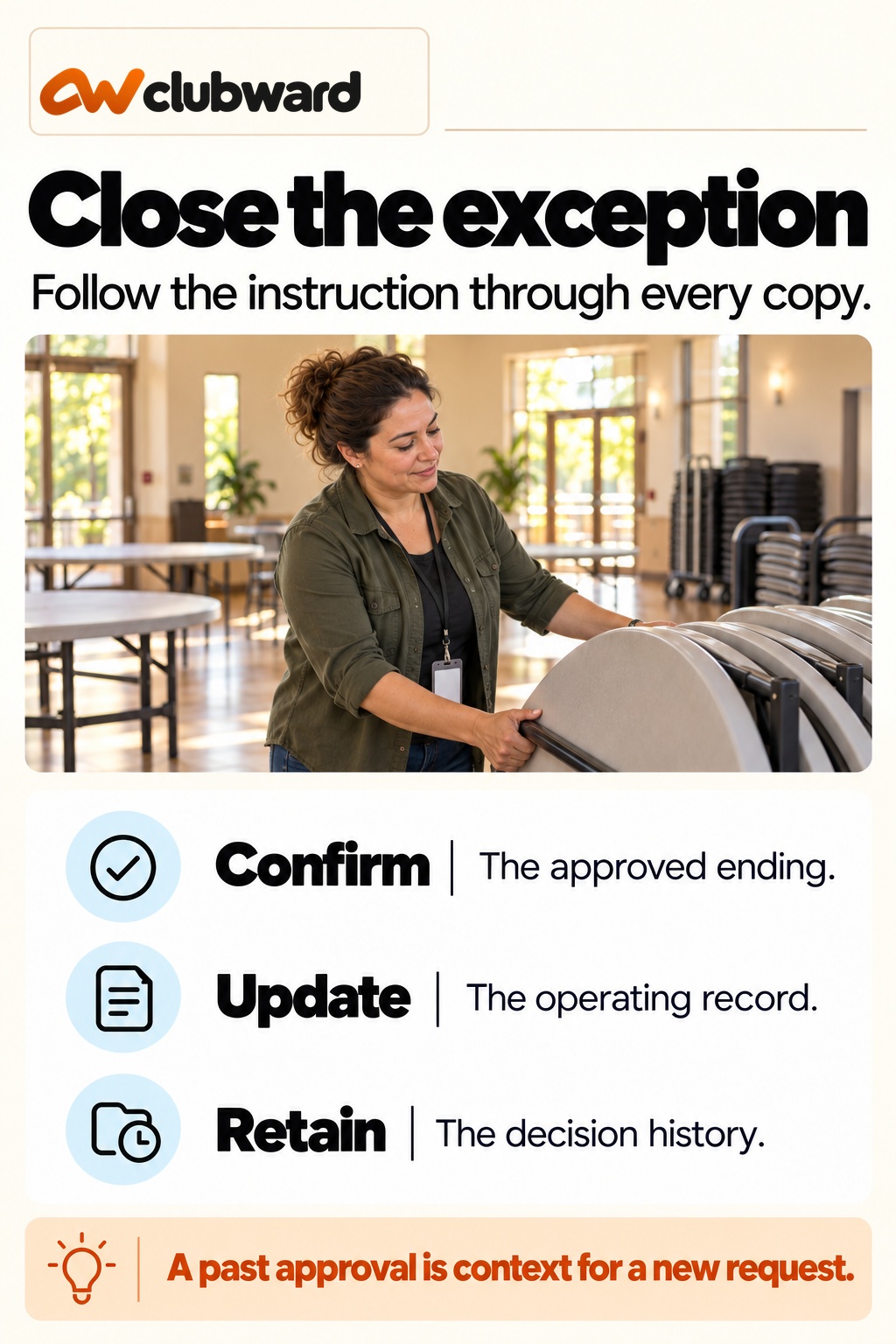
Close the entry only when the answer has reached the places that need it. A reply to the reviewer is not the end of the task if the reservation or staff guide still contains the old wording. Record what was updated and who checked it.
Turn the findings into a board decision
Prepare a concise summary with the number of cases reviewed, the selection period, and the specific gaps found. Separate missing end conditions, missing operating owners, and inconsistent copies. Include anonymized examples where they help explain the requested correction.
A useful recommendation might be to require an event reference and closure owner on future setup-time exceptions. Another might be to clarify who can approve an arrangement under an existing policy. State the decision needed without presenting your preferred outcome as already approved.
If you report a count, keep the denominator beside it. “Three of the eight reviewed approvals lacked a located end condition” is a bounded observation. Do not turn that sample into an estimated association-wide failure rate or a prediction of resident dissatisfaction.
Keep individual case resolution separate from policy improvement. Your board can discuss a clearer future process while the manager continues to handle current bookings under the applicable instructions. Give both work streams owners so neither disappears into the meeting minutes.
Test the next arrangement from approval to closure
Apply the revised process to one suitable upcoming request after the necessary approval. Ask the resident-facing contact and the operating owner to check the same scope and timing. Then schedule the closure check at the point the approved arrangement actually ends.
Watch for unnecessary duplication. If a field already exists in the reservation record, link to that record rather than copying it into several worksheets. If a colleague cannot access the record they need, resolve that access requirement through your normal permissions process.
When considering a club management platform, bring this complete scenario into the evaluation. Ask how your team would record the decision, find the current instruction, restrict sensitive details, and distinguish a historical exception from a current permission. Request a demonstration of each step.
Compare what is shown with your actual operating requirements. Record configuration needs and unanswered questions. The goal is an understandable approval lifecycle your team can follow, whether the final arrangement uses your existing tools or a different platform.
Check the boundary of a repeat request
Before treating several similar requests as one issue, compare the approved scope in each case. Two early-setup requests may involve different room schedules, conditions, or decision-makers. Put those differences beside the recommendation so the board can see what is genuinely repeated.
For the next review, choose one concrete question: should future setup requests record both event time and setup time? Identify who would use each answer and who verifies availability. If the board approves a change, test that field on a suitable request without assuming earlier approvals have changed. Keep a record of the new instruction’s effective date and the cases it covers.
Build a current permission sheet from the decision
For the arrangement you selected, prepare a single working sheet with an event reference at the top. Under it, place the original approval wording, the applicable date or ending condition, and the operating owner. Add the current question in a separate line. This makes it harder to confuse what was approved with what someone is asking now.
Next, record the locations where staff will encounter the instruction. For an early setup, that could be the room reservation, the opening checklist and the resident confirmation. Beside each location, name the person who checks it. Mark whether the wording matches, needs correction or cannot yet be confirmed. Keep this sheet restricted to colleagues who need the case details.
Use a final line for the closure evidence. The coordinator might confirm that the gathering ended and the event note is now historical. Another arrangement could depend on a maintenance completion check. Describe the evidence required for that particular decision rather than adding a universal closed checkbox that hides different meanings.
Handle a delayed review without inventing an expiry
Consider an access arrangement approved while a doorway is repaired. The team expected to review it on Thursday, but the repair inspection moves to Monday. The review date passing tells you that follow-up is late. It does not, by itself, tell you whether the arrangement ended or which entrance a resident should use tomorrow.
Give the authorized owner the original wording, the delayed inspection information and the next arrival date. Ask for the instruction staff should apply until the uncertainty is resolved. Carry that answer to the opening team and the resident-facing contact. Record the answer as a current clarification, with its own scope and date, rather than rewriting the earlier approval.
If the owner is unavailable, use the association’s established escalation route. State the unresolved question precisely: “The scheduled review did not occur; which approved access instruction applies for Saturday?” That is more useful than a general urgent message. The person receiving it can see the decision needed and the event depending on it.
After the inspection, finish the original closure work. Confirm the usable route, communicate the approved next instruction and retire the temporary operating note when appropriate. Keep the record of why the review moved. A later board should be able to understand the sequence without mistaking the delay for a new standing permission.
Separate an extension from a repeat request
An extension keeps an existing arrangement active beyond its previously approved boundary. A repeat request asks for another arrangement on a different occasion. Give these separate labels in your case notes. Otherwise, a familiar household or identical event type can make a new decision look like routine administration.
Suppose the Saturday gathering moves to Sunday because of a building problem. Ask whether the original approval covers the revised date and conditions. Do not simply copy the early setup note. The new time could affect another booking or require a different opening colleague. Show the approver the changed facts and carry the confirmed decision through the same operating locations.
For a gathering next month, begin with the current request and use the earlier approval only as relevant history. Record which facts remain the same and which differ. A previous decision can help the authorized person understand the request; it cannot supply a missing answer about the next event’s availability or conditions.
When repeated requests accumulate, preserve their individual outcomes while preparing a separate policy question. Ask whether a standing setup arrangement deserves consideration, which situations it would cover and who would apply it. Keep that recommendation distinct from permission for the event already approaching.
Write a closure message that answers the next question
A useful internal closure message identifies the event, the approved ending and the records checked. For example: “The Saturday setup arrangement is complete. The reservation retains the decision history. The opening guide now shows the normal instructions for future bookings.” Adapt the wording to the evidence your coordinator actually confirmed.
The resident-facing message may need less detail. Explain the arrangement that applied to their event and the route for another request. Avoid administrative labels that leave them unsure whether an existing booking changed. Where a future reservation is affected, state that separately and provide the relevant approved details.
Ask a colleague to read the message with one question in mind: “If this resident books again, do we know what to do?” If the answer depends on a conversation only the writer remembers, add the missing reference or next step before closing the case.
Keep the next event visible
Put the next affected booking beside the unresolved question, including the confirmed event date and time and the colleague waiting for an answer. This connects administrative follow-up to an actual operating need. If the booking changes, update that reference and tell the decision owner. Do not leave an old event date driving the escalation after the resident has moved their plans. At the weekly review, ask which cases need a decision before the next opening shift and which simply need their historical records completed. Assign those tasks separately so staff can finish the right work first.
Start with the approval your team keeps revisiting
Choose one recurring amenity question, locate its original decision, and check its scope, authority, conditions, ending, and closure. Give any missing answer to a named owner. That is a useful first step before rewriting rules or sending another general announcement.
To explore the same scenario with Clubward, request an amenity-workflow demo. Bring one anonymized temporary arrangement and ask the team to walk through how your association would handle it from the initial approval to the final follow-through.
From Clubward Editorial Team
More from Clubward