Community & Recreation Centers
They Want to Return Next Season. Does Your Recreation Center Have the Staff?
A recreation staffing plan needs more than positive replies. Understand availability, role readiness, session assignments and the gaps still needing a decision.

“I’d love to come back next term” is a welcome answer from a recreation employee. It is not yet a staffing plan. The coordinator still needs the person’s available dates, the program role they would like to discuss and the decisions that remain open. Familiar names provide a starting point, rather than a completed schedule.
Interest, availability, role approval and assignment describe different answers. A returning instructor can provide useful planning information before a particular session is agreed. The coordinator compares that information with the center’s program needs, while the appropriate people complete the organization’s staffing decisions and confirmation process.
The first return conversation can establish a picture without settling the next-season schedule or defining every responsibility. A current answer, a route for changes and a named follow-up owner let the coordinator distinguish possible coverage from agreed assignments. That distinction gives the next planning conversation a specific question to resolve.
The planned work gives the conversation context
The planned work gives the return conversation context. Opening and closing, reception, instruction and activity setup can have different time windows and responsibilities. Approved programs need to be distinguishable from ideas still under discussion. A person cannot give a meaningful commitment around a timetable the center has not yet settled.
A role description makes the time question more useful. Someone available on Saturday may want to teach rather than cover reception. Someone interested in setup may not be prepared to lead the activity. Keeping those distinctions visible prevents a positive return response from quietly becoming a promise of interchangeable coverage.
The responsible manager identifies role requirements and follows the center’s process for assessing readiness and authorization. Availability alone does not establish permission to perform every task. The planning list is useful when it distinguishes the reported time window from the review and agreement still required for a particular assignment.
Questions people can answer now
The first contact can ask about interest, known dates, preferred roles and recurring limits. It also needs room for an unfinished answer. A timetable, another job or family arrangement may still be unsettled. The coordinator needs the relevant availability, rather than a private explanation for every unavailable date.
An early response can describe what is known now and when another part may become clearer. “Interested; next term’s timetable pending until March” is useful with a follow-up point. Repeatedly requesting a final weekly answer before that information exists does not make the staffing plan more certain.
The first message explains its purpose and the next conversation. An invitation to discuss returning is different from an approved employment arrangement or session assignment. The responsible lead can use the appropriate wording, so a friendly interest survey is not the only record of a decision it was not designed to make.
Four states with different meanings
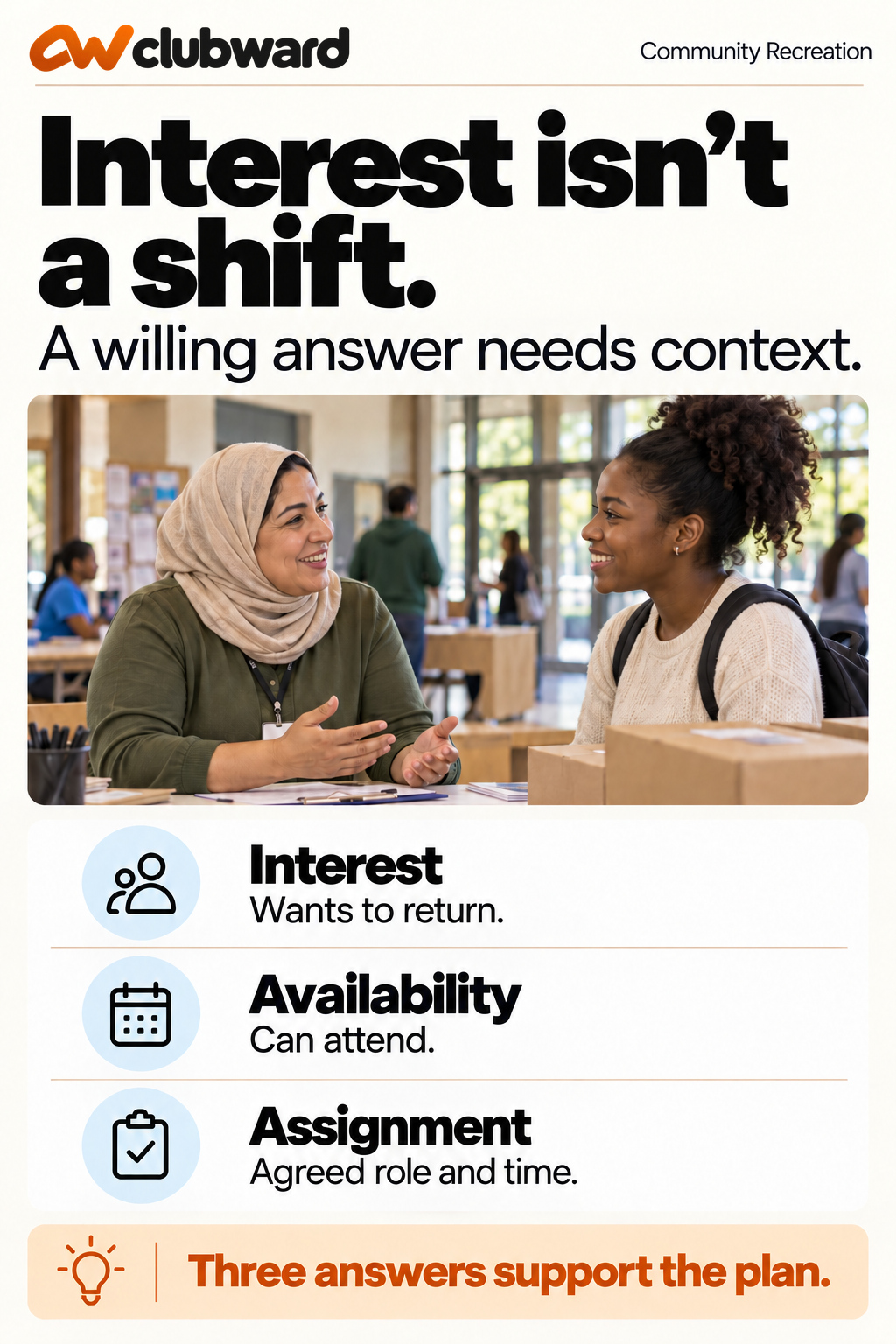
Four plain states can describe the planning position. Interested means another conversation is welcome. Availability received identifies the supplied dates and uncertainties. Approved records the relevant role decision. Assigned identifies the agreed responsibility and time. Those labels carry the process’s answers rather than replacing the human decisions behind them.
Not returning and no response are different states. One supplies an answer; the other leaves a question open. The manager can follow up or consider another coverage route without inventing the person’s intention from silence. That keeps the list considerate toward people and useful to the program coordinator.
The latest response date gives each state context. An autumn answer may need refreshing before a winter or spring program is finalized. The state describes which kind of answer was supplied; the date explains when it was current. A covering colleague needs both to understand which conversation comes next.
A return message with a human tone
Try an opening such as: “We're starting next season's staffing plan and would like to know whether you're interested in returning. Please tell us the roles you'd like to discuss and any dates you already know you cannot work. It's fine if some plans are still undecided.”
The message can identify the coordinator and expected next update. A named contact gives the employee a route for questions or changed information. The first request should be answerable on a phone without finding an old roster or translating internal role codes before expressing interest in returning.
Ask for necessary planning information through the approved channel. Do not request private explanations for every unavailable day in a general survey. If a personal circumstance needs a confidential discussion, provide the appropriate contact rather than leaving it in a roster shared with the whole team.
The coverage picture behind the headcount
Group the club's needs into meaningful windows, such as weekday mornings, weekday evenings, and weekend opening. Use the actual operating plan for the club. Count people who have reported relevant availability, but label the result as planning information until the required checks and assignments are complete.
Several positive responses may concern the same window. Three people could be interested in Saturday mornings while Sunday closing remains open. The names remain useful, but their overlap limits the conclusion. Roles, dates and known restrictions need to be considered together before next season is described as covered.
A responsibility concentrated in one person raises another planning question. If only one returning employee can explain the opening arrangement, another appropriate person may need practice and support. General availability does not settle that task-specific gap. The relevant preparation and review belong with the designated people before assignment.
A small example reveals the planning choices
Say the club needs a desk supervisor for Saturday opening and Sunday closing. Three former supervisors express interest. One is available only on weekdays, one can consider Saturday mornings, and one has not confirmed their weekend commitments. The return list contains three names, but the two weekend needs are not yet covered.
The manager records a Saturday conversation with the second person, a follow-up date for the third, and an open Sunday requirement. The weekday-only response stays useful for another part of the plan. Nobody is counted as assigned simply because they replied positively to the first message.
That picture gives the board a practical decision. It can authorize recruitment for the unresolved need, discuss a different operating plan, or wait until a specific follow-up date. It does not need a prediction dressed up as a confirmed roster.
Use the same approach for programs. An instructor's interest in returning does not confirm the exact class times the club wants to advertise. Check those details before registration materials promise a particular schedule or person. Keep pending staffing decisions visible to whoever prepares the program announcement.
An uncertain answer can have a next step
A useful follow-up note identifies the unanswered question, contact owner and next discussion point. If the employee expects a timetable in March, the conversation can follow that information. “Ask again later” supplies less help to a covering colleague than a specific question with a reason for its timing.
Set a planning checkpoint for the club too. Decide when unresolved positions must move into recruitment or another approved response. That date should follow the club's actual hiring and preparation needs, not a generic deadline copied from another organization.
Earlier responses remain useful context when the latest answer is clearly identified. Changed availability may affect a proposed shift, practice session or class announcement. The coordinator needs to know which other arrangement used the older answer, instead of assuming that editing one list updates every conversation already underway.
The response form needs a clear meaning
Ask a staff member to complete the return form using a practice response. Can they indicate an uncertain date, distinguish preferred roles from confirmed availability, and find the contact for questions? Watch where they hesitate instead of explaining every field before they try it.
NIST’s usability testing overview describes using representative tasks to reveal difficulties. Applied narrowly here, an employee unfamiliar with the form can show whether it allows the planning answer the coordinator needs. The useful finding is a specific point of confusion, rather than a score for the form’s appearance.
If a field confuses the tester, revise it before distribution. “Available from” may mean the first date they can discuss work, the first training date, or the first day they can accept a shift. Use the wording that matches the question. Keep a date example near the field if it helps.
A planning list and agreed schedule
The return list supports conversations before it becomes a schedule. Proposed arrangements need to be recognizable as proposals, with a clear response route. Employees should know which question they are answering and how the organization records a settled responsibility for the relevant program and time window.
The manager follows the organization’s approval process before finalizing coverage. Role, date, hours, supervisor arrangements and outstanding preparation all contribute to that review. The current availability response supplies the relevant context, rather than a screenshot from an earlier conversation that happened to be easiest to find.
After publishing, use the established route for changes. A staff member updating general availability should not assume an already assigned shift has automatically disappeared. Explain how they raise a conflict and who confirms the result. Keep that instruction beside the schedule communication.
The board needs a staffing decision with appropriate context
Report the operating needs, the confirmed position of the plan, the unresolved gaps, and the decisions required. The board usually does not need every personal detail behind an availability restriction to decide whether recruitment should start or program hours should change.
Show uncertainty plainly. “Two opening supervisors approved; Sunday closer still under review” says more than “three supervisors returning.” Include the next checkpoint and the manager responsible for the open work. That makes the report easy to revisit at the following meeting.
Separate money and staffing assumptions. If a proposed budget assumes a certain role or service level, make that link visible. Have the people responsible for compensation and employment terms handle those decisions through the approved process. A return-interest survey should not create unreviewed pay or hours commitments.
A Clubward walkthrough follows the role pattern
Clubward’s staff workspace includes scheduling and coverage, while its program workspace connects registrations with shared spaces. A practical walkthrough can follow those records alongside the center’s role decisions. A visible name on a schedule still needs the appropriate agreement and preparation behind it.
Bring one returning employee with a known date limit and one unresolved role. Ask how the manager keeps a proposed assignment separate from a published shift, how staff see the result, and how changes are reviewed. Follow the process using the access each person will actually have.
The readiness conversation needs its own record owner. The coordinator can identify which role explanation, supervised practice or review remains outstanding before an assignment is finalized. Those decisions follow the center’s procedure. The schedule provides context without being treated as automatic proof that a person is prepared for the task.
Useful knowledge survives when someone does not return
Thank people for a clear answer even when they are moving on. Ask the manager which procedures need a handover, and arrange that through the club's normal process. Focus on the knowledge the next employee needs: where instructions live, which recurring task is awkward, and what should be explained during training.
Continuity belongs in the center’s approved records and access arrangements. The next coordinator needs a route to current procedures and unresolved questions, rather than a former employee’s personal account. A change of people is easier to manage when the departing colleague does not become an unofficial continuing support contact.
Turn one useful observation into an improvement before the next intake. If several staff found the same closing task unclear, rewrite that instruction and have a new person try it. A return conversation can improve next season even when the person giving the feedback will not be there.
A recreation center needs coverage for programs, not just open hours
A center may be open from morning until evening and still be unable to run an advertised class. The doors are unlocked, the desk is staffed, and the room is available, but nobody has confirmed the person responsible for leading the program. That is why a returning-staff survey is only one piece of a recreation staffing plan. The real planning unit is an activity with its dates, space, responsible roles, preparation and closeout.
Start with the center's likely operating calendar. Note regular public hours, classes requiring a qualified instructor, program registration periods, events that add front-desk traffic, and shared-space changes that may need setup coverage. Separate year-round services from seasonal offerings, and identify which proposed programs still depend on enrollment or budget decisions. A center should not imply a class is fully staffed merely because the usual instructor says they hope to return.
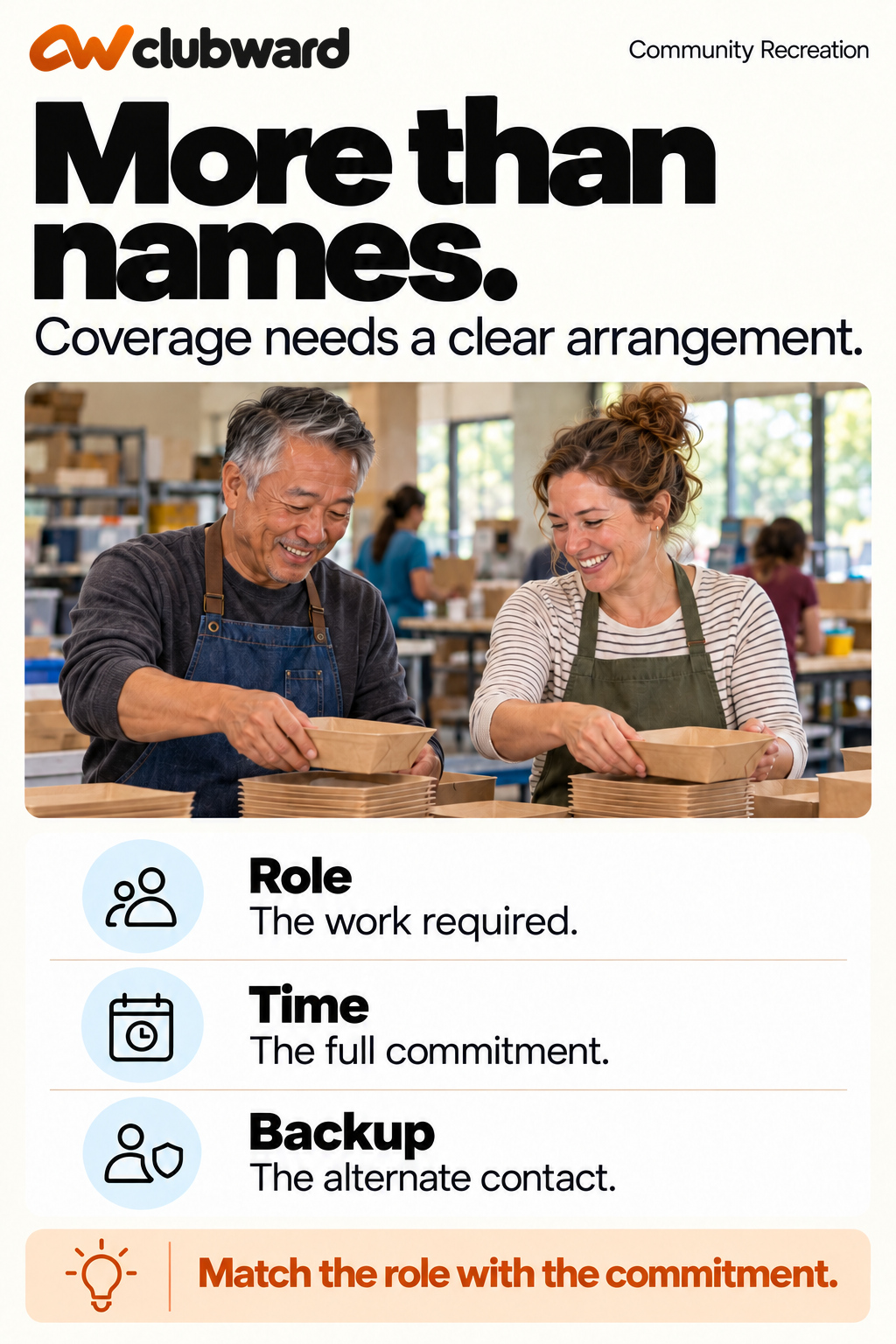
For each program, describe the distinct work that makes it possible. A teacher may lead the session while another employee handles arrivals, equipment, room preparation or participant questions. The same name might cover more than one role on a quiet afternoon, but that depends on the organization's approved responsibilities and real timetable. Recording the roles explicitly makes hidden assumptions easier to challenge before the season begins.
Interest and a schedule another coordinator can trust
Imagine the coordinator asking five instructors about next quarter. Three say they are interested, one gives a definite weekly window, and one has not replied. The program calendar tells a different story if the interested people are all unavailable on the day when two classes need to run.
Build a view organized by program, date or recurring time, role and planning state. For example, the Wednesday after-school class may require an instructor from 3:30 to 5:00, plus opening setup and a receiving desk employee who knows when families arrive. Mark the instructor's availability as received, the assignment as pending approval, and the desk coverage separately. If only the instructor's name appears on the plan, the center has not yet checked the full workflow.
The dates when the usual coverage pattern breaks
A calendar can include weeks with different coverage questions. A school holiday, community occasion, facility interruption or newly planned program may change the relevant role or time window. Returning employees can describe the dates they already know about, while other conflicts remain questions for the center’s later scheduling and review process.
Use an exception review before a busy period. Which sessions have a named instructor but no confirmed backup? Which rooms need extra setup time? Which people are scheduled for overlapping duties at separate facilities? Which arrival desk will answer a participant whose class was moved? The point is to find a specific decision that a coordinator can make while there is still time, not to produce a perfect spreadsheet months early.
If an absence is confirmed, follow the center's established substitution process. Check the permitted role, time window, relevant staff instructions and the person authorized to approve a replacement. If coverage cannot be confirmed, route a change or cancellation decision to the appropriate owner and make sure the message to enrolled participants agrees with the schedule. Avoid relying on an informal text thread as the only record of that change.
The center's hiring and operations teams need the same definitions
The manager reviewing return interest and the coordinator publishing classes may work from separate lists. One says an instructor is available, another says the class is on the calendar, and a third assumes the facility will be ready. Give them a shared vocabulary: interested, availability received, approved for the role, assigned to a session, and informed of a change.
Write down who changes each state. The person collecting return-interest responses can update availability without claiming a hiring decision. The designated manager can record the organization's approval. The scheduling coordinator can record an actual session assignment after confirming the required role and space. The front desk needs the current published answer, not every note from the planning conversation.
A short weekly handoff can keep the plan current. Ask what changed since the last review, which dates are still uncertain, what decisions are due before the schedule is published, and whether a participant-facing message needs to change. This provides calm continuity when a manager changes shifts or a part-time coordinator takes over.
One recreation-center scenario before the season begins
Choose one ordinary program and walk through it from advertised registration to arrival. Confirm the program's time and room, then identify its instructor, setup duties, front-desk information and closeout. Change one condition, such as an instructor becoming unavailable or a room moving. Ask the team to show who decides what happens, who updates the records, and what staff and enrolled families will see.
This test exposes gaps that a return-interest survey cannot. You may discover that schedule changes are recorded in one place while the desk uses an older printout, or that a substitute has no documented contact for a question outside their role. Give each finding a specific owner and follow-up date. Preserve the scenario so the team can run it again before publishing the next program cycle.
The program and shared-space records in Clubward provide activity context for a staffing walkthrough. A coordinator can follow one session’s room, enrollment, setup duties, named instructor contact information and coverage together, with the center’s approved role and preparation decisions clear to the people responsible for the schedule.
A short planning handover
- Confirm which operating needs are approved and which remain proposed.
- Send a short return-interest request with an owner and a next step.
- Record dates, role preferences, uncertainties, and the latest response date.
- Keep interest, availability, approval, and assignment distinct.
- Review gaps by role and time window, not just total names.
- Assign follow-ups and set the club's next staffing decision point.
- Test the form and the handoff before using them more widely.
Book a Clubward coverage workflow demo around one role pattern your recreation center needs to plan. Following the availability response, role review and agreed session gives the coordinator a practical way to explore how the records stay understandable as people and plans change.
From Clubward Editorial Team
More from Clubward