Community & Recreation Centers
Cancelled Sessions Keep Clustering on One Day. What Should You Check?
Separate staffing, room and enrollment evidence behind repeated session cancellations, then choose one approved trial with a named review owner.

If cancelled sessions keep appearing on the same day, compare the sessions that were supposed to run before deciding that the day itself is the problem. Separate staffing coverage, room availability and enrollment decisions. Then trace one cancelled session alongside one that ran. That comparison gives you a concrete question to investigate and a proportionate change to test.
A Tuesday cancellation can mean an instructor was unavailable, a room conflict remained unresolved or the program did not meet its approved enrollment condition. The participant may receive a similar notice in each case, but the operating correction differs. A single cancellation total cannot tell your recreation team which part of the plan needs attention.
Use this review for one center and a defined set of comparable sessions. Your goal is a decision note: the located pattern, the evidence supporting it, what remains unknown and one next-session trial. Keep changes to program conditions, staffing authority and participant remedies within your organization’s normal approval process.
Count the sessions that were planned
Begin with the planned calendar, not only the cancellation list. Record which sessions were scheduled on each day during the selected period. A day with more planned programs has more opportunities for a cancellation. Keep that denominator beside any count so the review does not confuse volume with reliability.
Choose a consistent definition of a session. A six-week course may have six individual meetings and one enrollment record. Decide whether you are examining cancelled meetings or entire programs, and keep those units separate. A course withdrawn before opening and one meeting cancelled after launch require different follow-up.
Include sessions that ran, moved or used an approved substitute. They help explain which arrangements supported delivery. A cancellation-only sheet omits those contrasts. Record a changed room or instructor without calling it a cancellation when the session still took place under the approved plan.
Use a recent operating period that your team can inspect directly. Note holidays, facility closures and changes in opening hours. If Tuesday had fewer available rooms during maintenance, keep that context visible. Do not combine the affected period with ordinary weeks without explaining the difference.
Build a session-level record
For each selected session, collect the program name, date, intended time, room, required roles, assigned coverage, enrollment state and recorded outcome. Add the decision time and reason where available. Use case references in the working review, keeping participant and staff personal information in authorized records.
Distinguish the stated reason from what the reviewer can confirm. “Instructor unavailable” may be the message participants received. The internal record might show that the assigned person was absent and no approved substitute was located. Record both without speculating about the person’s circumstances.
If a reason is missing, mark it as not located and name who will check. Do not assign every unexplained cancellation to staffing merely because that is a familiar challenge. A gap in the record can become its own improvement task: ensure the next authorized decision has a usable operational reason.
Keep the calendar state and the final outcome separate. A program may still appear on an old printed timetable after cancellation. That mismatch matters for communication, but it is different from the original cause. Give each issue the evidence and owner appropriate to the work.
Compare staffing requirements with coverage
Write the roles needed for the session before looking at the names assigned. The plan might require an instructor, a setup colleague and a front-desk contact. Check the required preparation and authority for each role through your existing procedures. A full headcount does not necessarily cover the actual duties.
Trace how an absence became a decision. Who noticed the gap, who could approve a substitute and who confirmed that the replacement could carry out the session? Record the sequence rather than treating an absence notice as the whole explanation. The interruption may have occurred in the response route.
Compare a session that ran with an approved substitute. Ask which instruction, contact or preparation made that possible. Keep the comparison bounded to the cases reviewed. A successful substitution in one program does not establish that the same person can cover every activity or participant group.
For future planning, identify the unresolved duty rather than simply recommending more staff. The useful next step could be naming a substitute approver, preparing an accessible session guide or checking availability earlier. Use the evidence to decide which task belongs in the trial.
Follow the room beyond its booking time
Locate the room booking and the actual preparation requirements. The activity may need setup before participants arrive and cleanup after they leave. Compare those intervals with other uses of the room. A calendar showing no overlap during class time may still conceal a setup conflict.
Ask who confirmed the room’s readiness. That may involve equipment, arrangement or an approved alternative space. Use the facility team’s current instructions rather than assuming any empty room is suitable. Keep questions about suitability with the authorized person who can decide them.
Trace one room conflict from discovery to outcome. Did someone identify an alternative, seek approval and tell the instructor and desk? Or did the record stop after noting that the room was unavailable? These are different situations even when both began with the same booking overlap.
Compare a session that moved successfully. Identify how the final room reached the people preparing, delivering and attending it. Carry that practical handoff into the next trial if it addresses the observed problem. Do not change all room allocations before understanding the step that failed.
Read enrollment as a decision input
Locate the program’s approved enrollment conditions and the date they were checked. Keep registered participants, confirmed places and actual attendance distinct. A cancellation based on an enrollment condition concerns the planned session; an attendance observation after delivery concerns a different stage.
Record who could decide whether the program would run, change or be cancelled. If the condition was met but the decision arrived late, investigate that handoff. If the condition was not met, examine the information and timing used. Avoid treating every cancellation as proof that participants lacked interest.
Compare registration windows and program formats before comparing weekdays. A Tuesday workshop announced recently and a Thursday series open for months are not equivalent opportunities. Note these differences so the decision-maker can see the limits of the pattern you observed.
Where the reason is uncertain, gather the located information and ask the program owner a precise question. Do not infer a family’s preference from a missing registration or invent demand for another time. A proposed alternative can be tested as a question before it becomes a promised program.
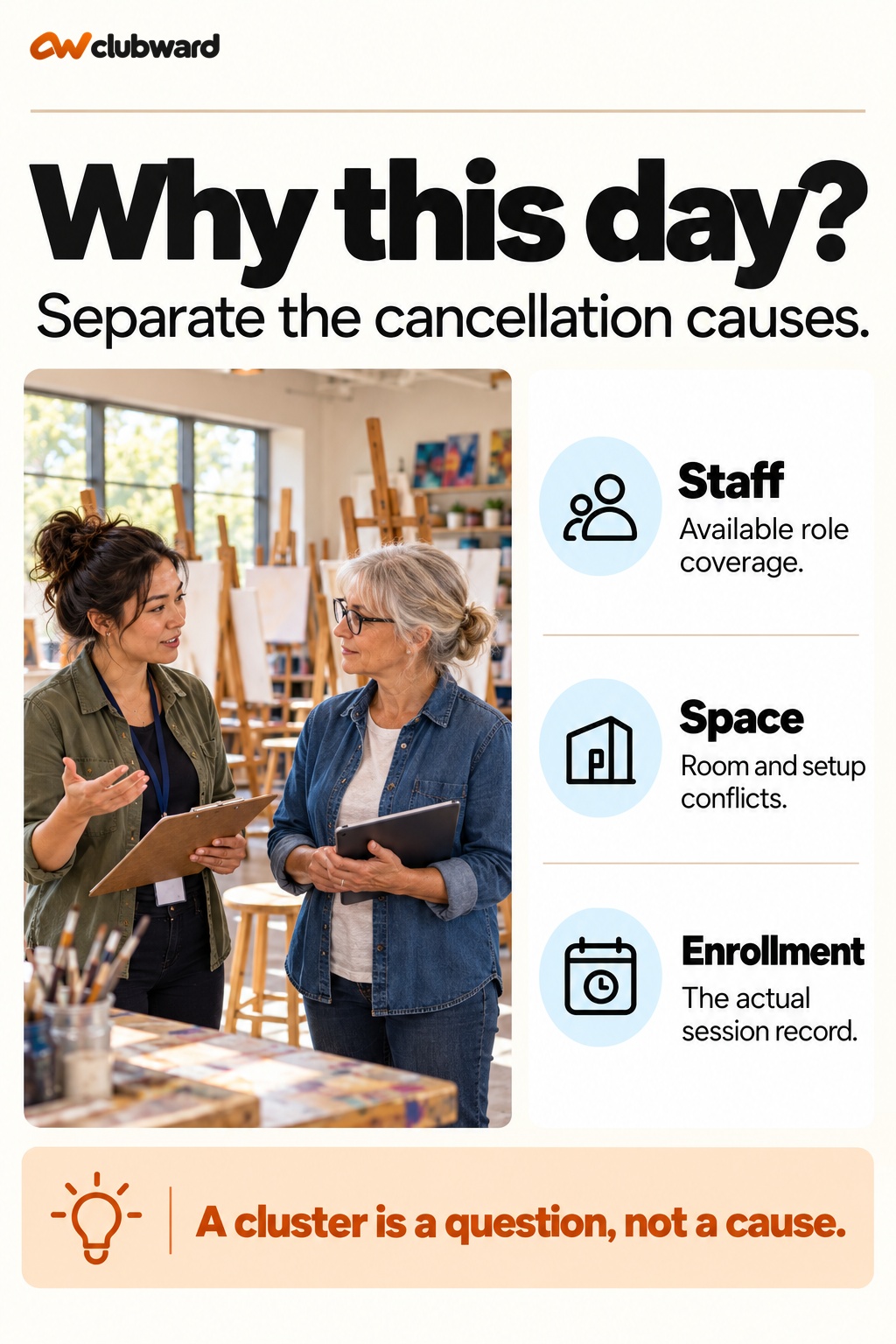
Use a Tuesday review example
Imagine a practice review of twelve Tuesday sessions and eight Thursday sessions. Three Tuesday meetings were cancelled: one lacked an approved instructor replacement, one had a setup conflict and one did not meet its approved enrollment condition. One Thursday meeting was cancelled because its room was unavailable. These sample numbers demonstrate the review structure rather than describe a center’s results.
The Tuesday count looks larger, but the cases do not share one cause. Put the planned-session counts beside the cancellation counts and retain the individual explanations. Then choose the next question by the operational consequence and the evidence available, rather than using the weekday as a complete diagnosis.
For the instructor case, check the replacement decision route. For the setup conflict, compare the room intervals. For enrollment, inspect the condition and decision date. Each investigation can produce a distinct owner. A single instruction to move programs away from Tuesday would leave the underlying questions unresolved.
Now add two Tuesday sessions that ran with changed arrangements. One used an approved substitute who received a session guide. Another moved rooms after a clear facility handoff. These cases help the team identify processes worth testing while keeping their limitations visible.
Separate cause from participant follow-through
Once a session is cancelled, participants need an approved explanation and next step. Check the notice, front-desk answer and any account or rescheduling follow-up your process requires. Keep that work separate from the review of why the session could not run.
A staffing correction does not complete an unanswered participant question. Likewise, a clear cancellation notice does not resolve the missing substitute route. Give both work streams an owner, and record which tasks remain open. This prevents the review meeting from hiding unfinished service work behind a future improvement plan.
Use the actual decision when reviewing messages. Do not add a new refund promise, alternative class or reopening date while making wording clearer. If the responsible owner has not decided the remedy, explain the supported next step rather than presenting an unconfirmed outcome as settled.
Ask a covering desk colleague to locate the current answer for one selected session. They should identify the affected program, the approved decision and the help route. If they need a private conversation to reconstruct the answer, note the missing operating reference and assign its correction.
Locate when the interruption became visible
Record major points in the sequence: the first known issue, the decision request, the authorized decision and the participant message. These timestamps can reveal where follow-through paused. Keep elapsed calendar time separate from staff effort, and note service hours or a scheduled decision meeting where relevant.
Ask whether earlier information would have changed the available choices. An instructor absence known before the session guide was prepared differs from a late interruption. A room conflict identified before registration opened differs from a same-day change. Keep the distinction specific rather than assuming earlier is always operationally possible.
Where timestamps are incomplete, describe the sequence you can confirm. Ask the people responsible for the missing stage to clarify it. Avoid inventing handling hours or delay estimates. The review can still identify a decision owner or missing handoff without a precise time calculation.
For the next trial, choose the point where information can realistically be checked. That could be the weekly room review, the coverage confirmation or the enrollment decision date. Assign the check to someone with the information and authority needed to act on what they find.
Choose a trial that addresses one cause
Write the trial question before choosing the change. “Can the approved substitute begin from the current session guide?” points to a readiness test. “Do room bookings include the required setup interval?” points to a calendar check. “Does the enrollment decision reach the desk on the agreed date?” points to a decision handoff.
Keep the selected trial small enough to explain. Use one program type, one room sequence or one set of comparable sessions. State the approved change, the owner, the affected dates and the evidence you will collect. Name a supported route for cases outside the trial.
Record other changes occurring at the same time. A different instructor, new room or revised registration window can affect the outcome. You do not need to freeze the whole center to learn something useful, but you should keep those differences visible when interpreting the result.
Define what would make the trial useful even if no session is cancelled. The team might confirm setup intervals consistently or locate substitute instructions without extra calls. Observe those intermediate tasks. A short period with no cancellations alone does not establish that every underlying problem is solved.
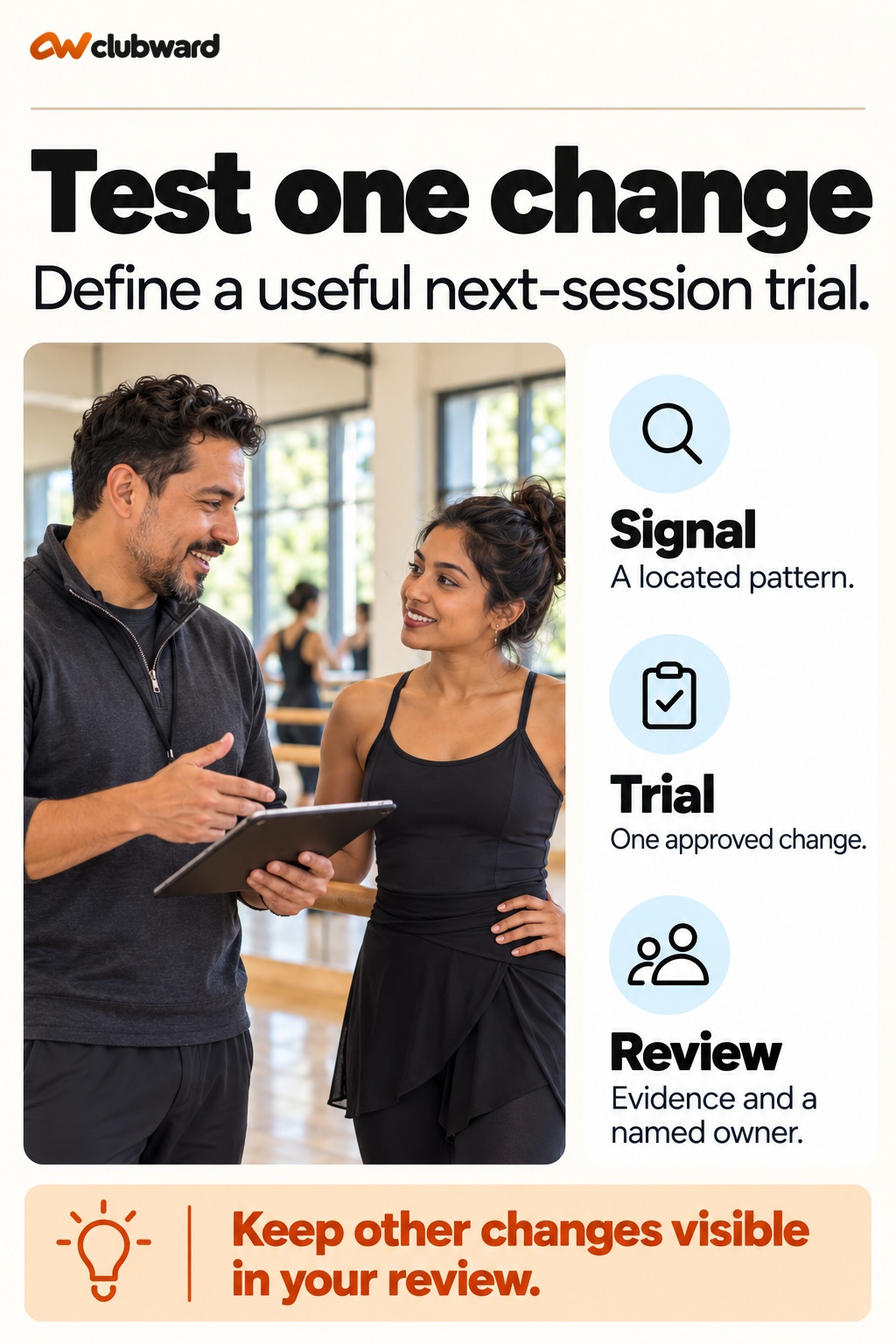
Prepare a decision note for the director
Begin the note with the question reviewed and the period covered. State the planned-session counts and the located outcomes using consistent units. Then explain the specific cause selected for a trial. Separate confirmed observations, remaining questions and the recommendation so the director can assess each clearly.
Use one anonymized sequence to show the handoff that needs attention. For example, the instructor absence was recorded but no role owned substitute approval before the participant notice. That description gives the director a practical decision. A broad statement that Tuesdays are unreliable would obscure the necessary action.
List any approval the trial requires. Changes to program conditions, staffing responsibilities or room arrangements should follow the established process. Keep the recommendation visible until that decision is made. Do not tell participants about a proposed alternative as though it were already an available session.
Finish the internal note with an owner, a review date and the evidence expected. The next meeting should be able to discuss whether the agreed task happened and what it showed. Avoid asking the team to return with a general report on whether everything felt smoother.
Review the next comparable sessions
After the trial, examine the selected sessions with the same definitions. Record whether they ran, changed or were cancelled, and retain the located reason. Compare the operating task the trial addressed, not only the final outcome. A class can run despite an unresolved preparation problem.
Ask the delivering and support teams what changed in their work. Could they locate the approved room? Did the substitute receive the current guide? Was the desk ready with the participant answer? Keep their observations linked to a specific session and instruction rather than treating them as a center-wide satisfaction measure.
If the same cause remains, inspect the step again before expanding the trial. The owner may lack the information needed, the check may occur too late or the instruction may be ambiguous. Choose the next correction from that evidence. Do not make a larger schedule change simply because the first trial was small.
Retain the useful process and prepare the next question separately. A room check that works can stay in place while you investigate coverage. Keeping the work streams distinct helps the director understand which decisions are supported and which require more information.
Check the comparison before changing Tuesday
A useful comparison is another session with similar operating requirements. An art workshop requiring room setup, materials and a particular instructor role may not be comparable with an informal drop-in activity. Choose the comparison for the decision you are considering. If you want to test room buffers, look at sessions with similar setup and teardown work rather than every activity on the calendar.
Write down the meaningful differences before interpreting the outcome. One session may run during school dismissal, another during an evening rental. One instructor may need a particular piece of equipment; another may bring their own materials. Those differences do not invalidate the review. They identify what the proposed change needs to address and what it cannot explain.
Suppose the Tuesday craft session was cancelled when the earlier booking overran its room block. A Thursday craft session used the same room without an earlier booking and ran as planned. That comparison supports inspecting the transition between bookings. It does not establish that Tuesday participants were less interested, that every Tuesday class needs a different room or that a new registration process would prevent the conflict.
Locate the setup requirement for both sessions. Ask the delivering instructor what had to be ready before participants arrived. Compare that requirement with the room booking and the available preparation time. If the requirement was known but absent from the room plan, give the room-plan owner a specific correction. If nobody had confirmed it, establish who must ask before the next schedule is finalized.
Check whether the proposed buffer changes someone else’s work. Moving setup earlier may conflict with the previous group’s teardown. Moving the class later may affect the instructor’s next session. Give each affected owner the proposed arrangement and request a practical response before treating the trial as approved. Keep unresolved conflicts visible in the decision note.
Do the same with staffing. A substitute listed as available may have another duty during setup, or may need information before accepting the session. Compare the coverage requirement with the whole working period, including preparation and the participant handoff. Ask who can confirm the arrangement rather than assuming an open calendar means the assignment is ready.
For enrollment questions, compare the decision dates and the information available at those dates. A session reviewed before the registration deadline differs from one reviewed after it. Record whether the decision maker had the current count, the approved criteria and any relevant participant changes. Investigate missing information separately from an instruction that was followed correctly.
Give the director a bounded recommendation. Explain the sessions compared, the difference that matters and the smallest approved change that addresses it. Name the person checking the next session and the evidence they will retain. If the review is inconclusive, say which record or decision is missing and assign the next check. An honest unresolved question is more useful than a confident explanation built from unlike sessions.
After the trial, compare the same requirements again. Check the room transition, preparation period and staffing arrangement that motivated the change. Keep other changes in view. If the session ran with both a new room and a new instructor, do not attribute the outcome solely to the buffer. Record what worked, what remains uncertain and what should be checked at the next comparable session.
Keep the comparison note with the trial decision so a covering coordinator can understand the reason for the change. Include the original session references and the review owner. That context helps the next person check the same question without restarting the investigation.
Bring the connected session to a walkthrough
Clubward’s programs and shared spaces workflows connect programs, registrations and the spaces they use. Its staff operations include scheduling and coverage. Bring a planned session, its room requirements and the staffing decision your center needs to handle.
Ask for a walkthrough from the planned calendar through a changed instructor or room and the current operating information. Have the people delivering the session and answering participant questions assess the sequence. Record configuration needs and unanswered requirements without treating a demonstration as proof of a future result.
Start with one cancellation your team can explain and one comparable session that ran. Separate coverage, space and enrollment evidence, then choose a practical trial. To explore the same journey in a club management platform, book a personalized program, room and staffing demo with your center’s actual operating question.
From Clubward Editorial Team
More from Clubward