Sports & Social Clubs
A Member Brings Two Guests to a Full Club Event. What Happens Next?
A member’s invitation and a confirmed guest place are different answers. Follow eligibility, available capacity and party changes through to a clear welcome.

A member signs up for Friday's social evening and asks a perfectly ordinary question: “Can I bring two friends?” The event page says registration is open. The volunteer at the desk says the room is almost full. Someone on the organizing committee remembers that guests were allowed last year, but nobody can find the current limit. Meanwhile the member has already told both friends to come.
The awkward part is not the question. Clubs want members to share good experiences with people they care about. The problem begins when a friendly invitation quietly becomes a promise the organizer cannot support. A useful guest-registration process answers who is eligible, which places are actually confirmed, and who gets the next decision when capacity is tight.
Before changing the form or buying another tool, follow one invitation from the member's first question to the guest's arrival. The answer needs to agree in the policy, event record, confirmation message, and door list. This guide shows how to build that agreement while keeping the welcome personal.
An RSVP is not automatically a confirmed place
At some clubs, tapping “I'm interested” simply helps the organizer estimate attendance. At others, a submitted RSVP holds a place immediately. A third event might require a staff approval or payment before a reservation is final. All of those approaches can work when the distinction is explicit. Trouble starts when the member reads “Thanks for your RSVP” as a guarantee and the organizer intended it only as an acknowledgment.
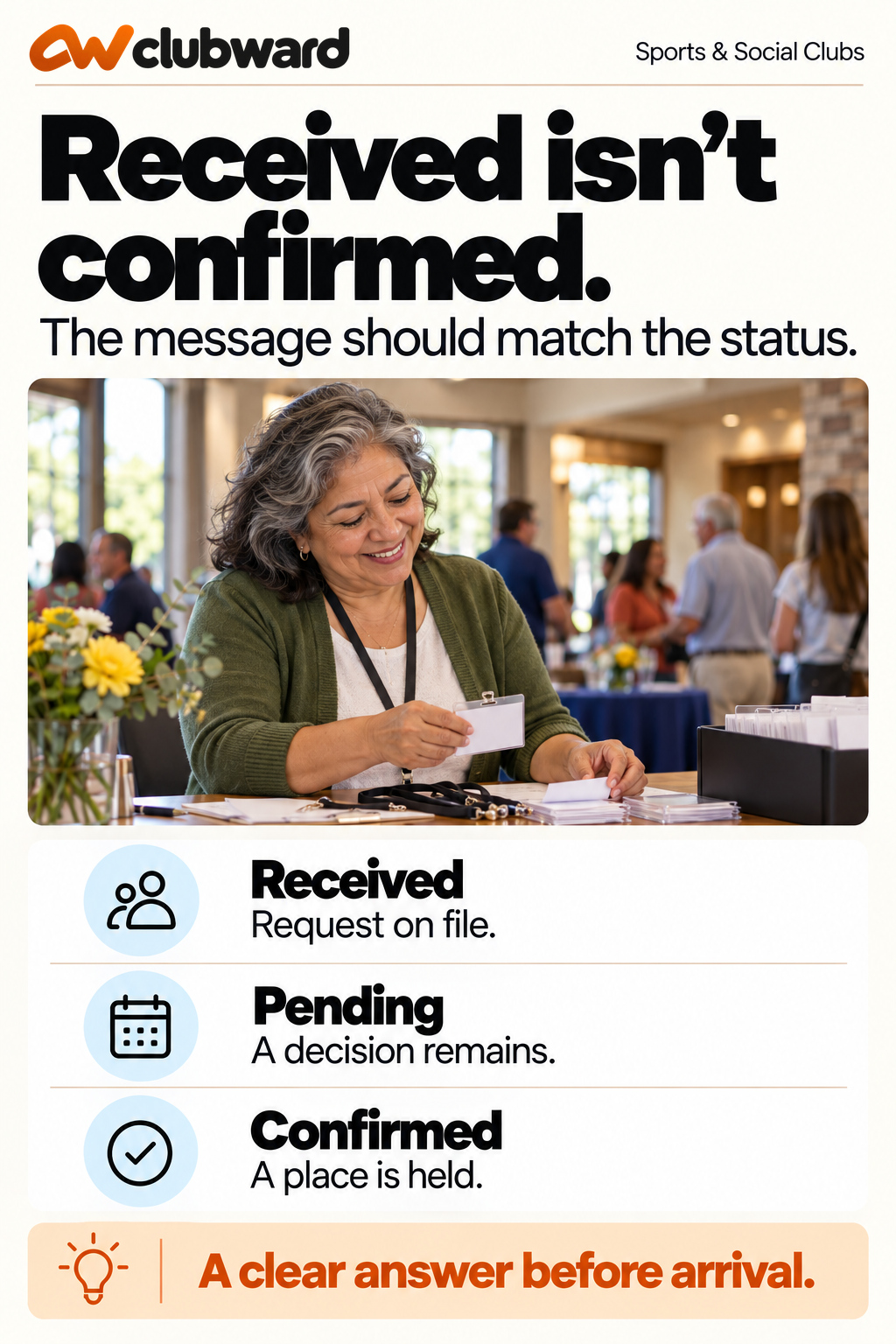
Plain event states make the answer easier to explain. Received means the request exists. Pending identifies a remaining condition or review. Confirmed means a place has been committed under the club’s rules. Waitlisted means no place is currently held, while the request remains eligible for an offer. Cancellation and attendance describe later outcomes, rather than another way of saying the request was received.
Members do not need to see an elaborate workflow diagram. They need a plain answer at each transition. A received message should say whether any action is outstanding. A confirmed message should name the event, date, party size and relevant instructions. A waitlist message should make clear that showing up without an offer would not create a seat.
This distinction is especially important for a sponsoring member. If the member has one confirmed place and two guests still pending, the group does not have three confirmed places. Show that plainly rather than putting all three names on one undifferentiated RSVP line.
The unit behind the capacity decision
For this social event, the practical capacity question is how many attendees the planned arrangement accommodates, rather than how many registration records exist. A couple using one household expects two chairs. A sponsoring member and guest need their appropriate places too. Another activity may use teams, tables or a different defined resource; the event’s approved plan establishes the useful counting unit.
The operating plan gives the coordinator a total and a clear record of places already committed. Organizers, working volunteers or performers also need appropriate provision where the arrangement requires their presence. The space’s general availability and the event’s chosen registration target are different answers. A particular dinner setup or service arrangement may support fewer confirmed attendees than another use of the room.
If seating has several types, separate them. A member ticket, a guest ticket, a child registration and a volunteer working position may use different eligibility or pricing rules. They still need to be counted appropriately when making a capacity decision. Do not assume one generic guest toggle captures all of those differences.
When a limit changes, record who authorized the change and why. “We added ten places” may sound like an ordinary event adjustment, but it affects people already waiting, messages already sent and the receiving team's expectations. A short approval note is enough to preserve the decision without turning it into bureaucracy.
Guest eligibility before the invitation
Some events welcome any guest accompanied by a member. Others allow a limited number of guests per household, require an age-appropriate registration, restrict a particular area, or reserve initial access for members before opening remaining places. The right answer comes from the club's approved event and membership policies, not a form designer's default settings.
The invitation should explain the guest rule before a member forwards it to a friend. The relevant questions include accompaniment by the sponsor, the number of guests permitted and whether each guest needs a confirmation. Any approved charge or cancellation arrangement needs its own clear meaning. A short explanation lets the member understand the invitation without translating a form’s settings.
A routine facility visit and a registered social occasion may follow different approved procedures. Clubward’s household membership records provide member context, while its program and shared-space workspace connects registrations and reservations. The event’s own rules determine who is eligible and when a requested place becomes confirmed. The sponsor’s ordinary membership status is one part of that decision.
An exception request needs a recognizable route and decision owner. The desk should understand which ordinary questions it can answer and which need approval. A recorded exception identifies the occasion, scope and authorized decision. The next shift can then apply the actual answer without turning a single event arrangement into an unwritten standing policy.

The member and guests share a context
A guest list without sponsor context may be enough for name tags, but it is not always enough to resolve an invitation question. If a guest calls to change their arrival time, the organizer may need to know which member invited them and whether the original party size still fits the reservation. Connect the guests to the relevant member or household without making that relationship public to unrelated attendees.
Useful registration information follows the event’s needs. Names may help the door team; a contact route may support a changed start time. Meal choices or access arrangements can have their appropriately limited handling route. The form’s ability to ask another question does not establish that the information is useful to this occasion or needed by every helper.
A party summary can show the member’s own status, confirmed guest count, pending requests and cancellation route together. The member should not have to reconstruct the group from several unrelated receipts. When one person withdraws, the relevant place follows the approved cancellation process, while the remaining confirmations retain their own meaning.
At check-in, staff should be able to find either the guest or sponsor and see the appropriate current status. A guest whose request is still pending needs a different conversation from a guest who has a confirmed place but arrived before the member. Clear context helps staff respond kindly without improvising an exception at the door.
Work through a social evening with limited seats
Picture a sports and social club planning a dinner for eighty attendees. The approved setup includes places for the members and guests attending, with separate working arrangements for the people organizing and serving. At the start of the afternoon, seventy-seven places are confirmed and three remain. Member Elena has one confirmed place and asks to add two guests. Her friends would bring the attendance count to seventy-nine, so there is room if both guests meet the event's rules and the organizer approves the additions.
The seventy-seven confirmed places already include Elena’s own place. Her two guests are two additional attendees, not three more people to add to the total. That leaves one available place after their confirmation. If the coordinator starts from a different snapshot, the answer may change. A later request therefore needs the current committed count and any separately recorded active holds before another promise is made. The arithmetic is straightforward; the important context is which people were already included when the count was taken.
Before sending the confirmation, the event coordinator checks the party's eligibility, any event charges and the actual available capacity. The additions are recorded under the same member context, and Elena receives a message naming all three confirmed attendees. The door list now expects three people, not one member with an informal note to “bring friends.”
Later another member asks for four guest places. The event has only one uncommitted place. The coordinator should not describe a four-person request as confirmed simply because the RSVP form accepted it. The response explains what can be offered under the event's policy: a smaller group, a pending request, a waitlist entry or another option approved by the organizer. The choice should be communicated before the member makes plans for friends.
Now suppose Elena cancels one guest. That releases one place after the cancellation is processed. It does not automatically confirm every waiting person, and it does not erase the registration for Elena or her other guest. The event's established offer order and response window determine who can take the opening and when the list should be updated.
The cancellation changes available places, rather than every attendee’s status. The organizer still needs an approved next offer and updated confirmation. A colleague at the door should be able to identify the current party from the record without recreating its original invitation conversation.
A waitlist and a held place are different answers
A waiting list should represent a real opportunity to be offered a place, not a second set of supposed registrations. Define its ordering rule and what happens when space becomes available. For an event with individual seats, one opening may help a solo attendee but not a party that requested three seats together. Decide in advance whether partial offers are permitted or whether groups should remain intact.
A reply window gives the waiting member a realistic decision point. An opening on Thursday afternoon for Friday evening needs a clear offer: available places, applicable conditions and the reply deadline. A declined or expired offer then follows the approved release process. The next eligible request can receive a truthful answer about the places that are actually available.
Staff also need a way to identify stale requests. A guest who is no longer coming should not occupy an apparent future place indefinitely. Likewise, a member who accepted an offer should not remain in the waiting pool and receive a second invitation. Keep each transition attached to the actual event record and the responsible organizer.
When the offer process feels unfair, review the published rule and the recorded decisions before assuming a problem with someone's behavior. Members can disagree with a policy even when staff applied it consistently. The board or event committee may need to change the rule for a future occasion, but the desk should not invent a new priority order halfway through a full event.
Before doors open, give one volunteer a practice case. The member is confirmed, one guest is confirmed, and another is still waiting. Ask the volunteer to find the party, explain which seats exist, identify who can authorize an exception, and record the final decision. Then change the scenario: the confirmed guest cancels while two other requests are pending. If staff cannot reach the same answer from the event record, fix the handoff before guests arrive.
The door team needs an arrival-ready answer
The welcome desk needs a current list with confirmed attendees, relevant party relationships and the few event conditions staff are authorized to apply. It does not need every planning conversation or committee email. Keep one clear operating view so a volunteer starting ten minutes before doors open can answer ordinary questions without calling the event chair for each name.
Separate checked-in attendance from confirmation. A person may be confirmed and late, confirmed and absent, or present after the organizer approved a late change. If attendance is recorded, the list should distinguish these outcomes. Otherwise a final headcount can accidentally become a count of everyone who ever registered, making the next event harder to plan.
A short exception route supports the welcome desk when the record does not settle the answer. An unregistered guest may need a capacity review; a missing confirmation may need a lookup by the coordinator. Staff need to know who can resolve each question and when to pause, rather than feel pushed toward an uncomfortable rejection or an unauthorized admission.
When doors get busy, warm wording helps. “I can see your member registration, but the two guest requests haven't been confirmed yet. Let me check with the event coordinator before I tell you there's room” is more useful than “You're not on the list.” The operational answer and the welcome can both be clear.
Three messages with different purposes
Registration communications often become longer than the event itself. Most members need three simple types of information: a receipt or acknowledgment, a clear confirmation or waiting status, and an update when the plan changes. A message should lead with the result, then provide the date, location, party size and one next action. Save internal workflow notes for the organizers.
A received message might say: “We have your request for Friday's member social, including two guests. The guest places are still being reviewed. We'll send a separate confirmation before you make arrival plans.” A confirmed version can say: “Your party of three is confirmed for Friday at 6:30. Please check in together at the clubhouse entrance.” These are examples of plain communication, not promises that every event uses the same rule.
A waitlist update needs equally clear wording: “Your request is on the waiting list; no places are reserved yet. If an opening fits your group, we'll send an offer with a reply deadline.” Avoid implying that a visible waiting-list position guarantees admission. Different group sizes and event conditions may affect the next eligible offer.
A changed room or cancellation needs to reach the affected people and receiving team. A general event newsletter may not answer a pending guest’s particular question. The Government Service Manual’s connected-channel guidance includes keeping frontline staff informed of service changes. Here, that means the door list and guest message give compatible answers about the same occasion.
Registration changes and money decisions
A guest cancellation may have financial consequences, but those decisions belong to the organization's approved event terms. A reserved place, completed payment, refund approval and processed refund are different states. Staff should not promise a refund because a person disappeared from the door list, or treat payment as proof that an otherwise pending guest request has been accepted.
The approved event terms establish what happens when the organizer cancels, a guest withdraws or a late offer cannot be accepted. An unusual case needs a decision owner. A shared explanation gives the treasurer, event chair and reception team the same starting answer, while leaving exceptions with the appropriate reviewer.
If the event has separate guest and member prices, attach the right amount to the confirmed attendee type rather than using an unexplained household total. When a party changes, record the approved adjustment and the updated confirmation. That creates a usable trail for the finance reviewer without making the attendee decode internal transaction entries.
Appropriate information for each role
Guests should be able to attend a social evening without becoming a new marketing contact by accident. Collect information for the purposes the club has actually approved and explain how event-related updates will be delivered. A private contact route for event changes is not an invitation to expose a guest's phone number to an entire member list.
Limit the door list to what the receiving staff need. The event chair may have additional context about special arrangements, but not every helper needs that detail. If a participant needs an accommodation or a sensitive exception, route it discreetly through the appropriate person instead of putting it in a conspicuous public note.
After the event, follow the club's record retention and access practices. Keep the attendance and relevant operational decisions needed for the organization's work, and avoid circulating old spreadsheets simply because they are easy to forward. A clear record can support a follow-up without making private guest information everyone's business.
Review the event for decisions, not vanity numbers
After the last guest leaves, compare the registration states with what actually happened. How many places were confirmed? How many people arrived? How many guests were added late, withdrew or remained waiting? Were there questions at the door that the published instructions should have answered? These are practical questions that help the event committee adjust its next invitation.
Look at where the handoff failed, not merely whether the evening felt busy. Perhaps the event was full but the door list was stale. Perhaps a guest was told to pay twice because the original confirmation was hard to find. Perhaps a generous member invitation contradicted a written limit. Each finding suggests a different improvement: clearer wording, a better status transition, or a policy decision for the next event.
One or two specific findings can guide the next event’s preparation. A clearer registration sentence, revised status handoff or late-guest rehearsal each addresses a different difficulty. A named owner can carry that change forward. The aim is a less confusing welcome for members and guests, rather than rebuilding the entire process after every minor inconvenience.
Use one real guest invitation to evaluate Clubward
Clubward connects household membership and payment records, while its program workspace includes registrations and shared-space reservations. Those records provide context for a conversation about your event. The people running the occasion still need a clear approved guest rule, capacity decision and confirmation process that match the member’s invitation.
A useful walkthrough follows a sponsoring member, requested guests, limited remaining places and a later cancellation. The confirmed list and the messages need to stay understandable as those conditions change. The organizers can then consider how their policy and approval steps fit the workflow, rather than evaluate only a smooth single-person request.
Book a personal Clubward walkthrough around the next sports or social event your club wants to run. Bring the guest question that usually sends a staff member searching through messages. A more useful event experience starts when everyone can give the same clear answer before people reach the door.
From Clubward Editorial Team
More from Clubward