Sports & Social Clubs
A Busy Club Calendar Can Hide the Members Who Never Get a Place
Trace requests, waiting-list offers and member experiences to distinguish booking friction from limited interest before changing your activity plan.

A full event calendar tells you what the club offered. To understand who had a useful chance to participate, examine who requested a place, who received one, and which members could not find an option that worked. Start with the booking journey before interpreting absence as a lack of interest.
Imagine a social club whose Friday gatherings fill quickly. The attendance sheet looks healthy, yet a member tells the membership director that they have stopped trying to book. That comment is a question to investigate. It is not enough, by itself, to prove the booking rules are unfair or that the member intends to leave.
This diagnostic helps sports and social club managers review access to popular activities. It separates demand, booking outcomes, timing, and member preferences. The useful result is a specific next step: clarify the booking process, test an alternative session, improve a waiting-list handoff, or gather better evidence before changing anything.
Choose one activity with a clear booking journey
Begin with a recurring activity rather than the entire club calendar. Choose a dinner series, social tournament, workshop, or member gathering with comparable sessions. Write down who it is intended for and how a member is supposed to find and request a place.
Use a recent period during which the booking rules were stable. If the rules, format, or capacity changed, note the change and avoid combining the periods without explanation. You want to understand a particular opportunity to participate, not produce a single impressive total.
Describe the question you are investigating. “Can interested members find and complete the booking process?” is different from “Do members want another Friday session?” Keep both questions separate if they arise, because they require different evidence.
Include the person who manages bookings and the person who delivers the activity. Ask each to describe the same member journey. Note where their descriptions differ, especially around waiting lists, cancellations, invitations, and when a place is considered confirmed.
Keep people, bookings, and attendance separate
Set up a working sheet that distinguishes requests, confirmed places, cancellations, attendance, and distinct participants. A person can make more than one request, attend multiple sessions, or cancel one booking and attend another. Choose the unit that matches your review question.
For example, if you are asking how many members experienced the dinner series, count distinct participants using the records your team is authorized to access. If you are asking how well places were used, examine session-level bookings and attendance separately.
Do not label someone disengaged because they do not appear in this activity’s attendance sheet. They may use another part of the club, prefer a different format, or have circumstances you have not asked about. Keep unknown reasons marked as unknown until you have evidence.
Record gaps in the data. If staff do not record unsuccessful booking attempts, say that the review cannot measure them from the reservation list. A complete-looking spreadsheet is not a reason to invent demand or infer that everyone who wanted a place received one.
Walk through the moment booking opens
Inspect the member-facing route using a test scenario and authorized access. Find the activity, read the eligibility and timing information, and identify the action that requests a place. Check what happens when the activity is full.
Record the announcement channel and opening time. Then ask whether the instructions explain those details before members need to act. Avoid assuming that receiving a general newsletter means someone understood when this particular booking would become available.
Look at the distinction between selecting a place and receiving confirmation. Can a member tell whether they have completed the process? Is there a clear next step when information or approval is still required? Note the exact message rather than describing the whole interface as confusing.
Review the experience for members who use the supported assisted route. Ask how an office request is recorded and when it joins the same decision process. Do not assume a digital-only route is the complete service if your team also handles bookings in person.
Inspect the waiting list as a separate journey
Choose a recent session that used a waiting list, if one exists. Trace a single place from cancellation through the next offer and final confirmation. Use your club’s approved rules for ordering, response windows, and eligibility.
Identify who notices an opening, who contacts the next person, and how the result is recorded. Check whether the member can tell the difference between joining a list and holding an offered place. Those should be distinct questions in your review.
Where the record stops, ask the staff member who handled the case what happened. Preserve uncertainty if the outcome cannot be verified. Do not turn an unanswered message into a no-show or count someone as rejecting an activity when no offer reached them.
Look for an owner when the usual coordinator is absent. The test is not whether another person can improvise a solution. Ask whether an authorized colleague can locate the current list, apply the existing rules, and record the next action consistently.
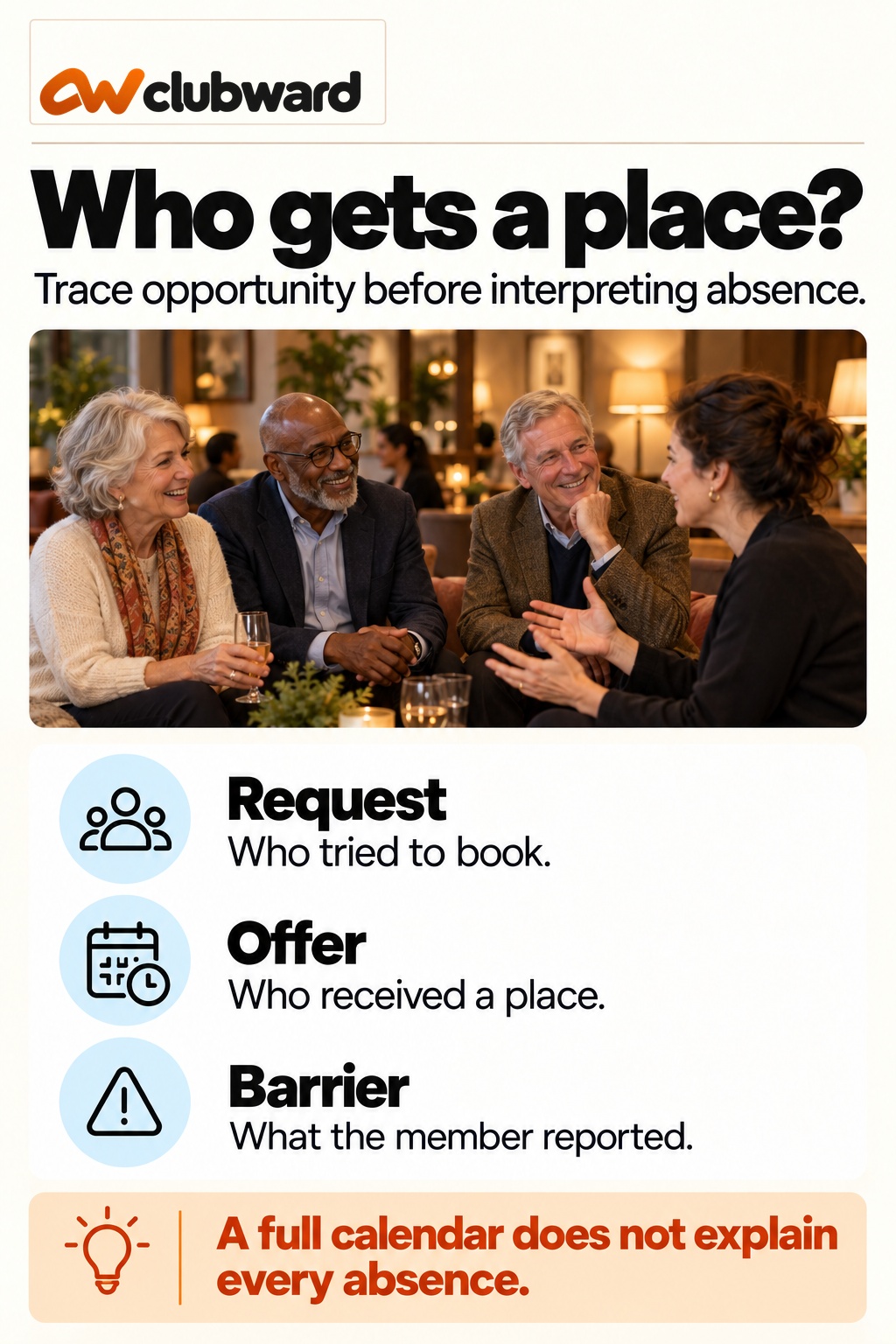
Talk to members about a specific attempt
Invite a small range of members to describe their most recent attempt to join the activity. Include someone who booked successfully, someone who waited, and someone who says they stopped trying, where those people are willing to participate.
GOV.UK’s user-research guidance recommends open, neutral interview questions and discussion of real examples rather than only how a service should work. Use that approach to ask what happened at this club, without steering members toward a predetermined explanation. Read the interview guidance.
Ask where they learned about the activity, what they tried next, and where they became uncertain. Follow up on a particular step. Avoid opening with “Is our booking system frustrating?” because you are trying to understand the experience, not collect agreement with a diagnosis.
Explain how you will use their feedback and respect their choice not to participate. Keep notes limited to the relevant process. Do not put private personal circumstances into a general committee report when a broader description of the scheduling need would serve the review.
Use a worked example to keep conclusions bounded
Suppose your practice review covers four supper-club evenings. The reservation records identify confirmed places and attendance, but they do not record people who looked at a full session and left. Start by acknowledging that limitation in your working notes.
A member says they learned about the booking window after it opened. Another joined the waiting list but did not know whether a response was needed. A regular attendee says the current time works well. Treat these as three observations, not a vote for one sweeping change.
You could test a clearer advance announcement for the next session and a more explicit waiting-list message. You could separately ask interested members about an alternative evening. Each action addresses a different question raised by the review.
Do not promise that those changes will increase renewals or fill an additional event. Define what you will observe: whether members can identify the opening time, whether offers receive a recorded outcome, and whether enough people express interest to justify further planning.
Distinguish limited opportunity from limited interest
Use three provisional categories for the questions you hear: could not find a suitable opportunity, could not complete the booking journey, and did not want this activity. Keep a separate category for insufficient information instead of forcing every comment into one explanation.
For limited opportunity, investigate timing, format, and availability. For a booking problem, inspect the step that failed or remained unclear. For limited interest, ask what the member hoped to do at the club rather than treating attendance at this event as the only useful outcome.
A member can belong to more than one category. They may prefer a different evening and also find the waiting-list message unclear. Record both observations while choosing a manageable first correction. Do not require a single cause simply because the report format has one column.
Look for evidence that would challenge your preferred explanation. If a booking process works well for several participants but a particular message confuses others, test that message. Avoid replacing the whole process before establishing which part needs attention.
Review allocation rules through the right process
If your findings raise questions about repeat bookings, guest places, or priority windows, take those questions to the authorized decision-maker. An operations review should not quietly change who is entitled to a place.
Present the current rule, the observed situation, and the decision needed. Explain which members or sessions your evidence covers. If the team is considering a trial, ask how the change will be communicated and how existing confirmed bookings will be treated.
Keep service clarity separate from policy preference. You can recommend explaining an existing priority window more clearly without endorsing or rejecting the policy itself. If the policy is under review, make that a distinct discussion with its own owner.
Check that any approved change reaches the booking instructions, staff reference, and member messages together. Use the same effective date and terminology. Preserve the earlier record so staff can understand bookings made under the previous arrangement.

Choose one test and define what you will watch
Write a short trial plan: the question, the change, the sessions included, the owner, and the evidence you will collect. Keep the change small enough that you can explain what was different when members encountered it.
For a clearer booking announcement, ask whether participants can identify the opening date and the route to request a place. For waiting-list follow-through, check whether every offer has a recorded next action. For a timing question, gather interest in specific alternatives.
Set a review point after the relevant activity rather than declaring success on launch day. Include comments from the person administering the bookings and the person running the session. Their observations may reveal work that the member-facing message does not show.
If you compare numbers, use comparable definitions and explain differences in capacity, format, or season. Do not call a higher attendance count an improvement in access without checking who had the opportunity to participate and what changed.
Turn participation information into a careful next step
Prepare a short decision note for the membership director or committee. State what the records show, what member conversations add, and what remains unknown. Keep observed facts separate from your interpretation and proposed action.
A useful note might recommend testing an additional booking reminder while gathering more information about another session time. It might instead recommend fixing the waiting-list handoff before considering more capacity. Tie the choice to the evidence you collected.
When evaluating a club management platform, bring this diagnostic into the conversation. Ask which participation records are available, how requests and attendance are distinguished, and how staff can investigate a proposed next step. Request a demonstration using the scenario you reviewed.
Keep an alternative session separate from an expansion promise
If members suggest another time, ask about a specific proposed day and format before treating the comments as committed demand. Record whether people are expressing interest, requesting a place, or confirming a booking. These are different stages in your planning exercise.
Check the staffing, venue, and operating requirements through the club’s normal planning process. Present the committee with the evidence gathered and the questions still open. If you decide to test one additional session, define the scope and review point. Avoid turning an exploratory conversation into a promise that the club will permanently add capacity or change existing members’ bookings.
Follow a member who never reaches the roster
The attendance record begins too late to answer every opportunity question. Walk through a member’s attempt before they receive a place: learning about the activity, understanding eligibility, opening the booking route, finding capacity and completing the supported request. A gap at any point can leave no attendance entry to investigate later.
Ask the member about a particular occasion. “What happened when you tried to book the last dinner?” invites a sequence. Follow with “What did you see next?” or “What did you expect that message to mean?” Keep their explanation distinct from your team’s interpretation, especially when the member did not save the original message.
Then compare the account with the records you can locate. You might confirm that the session was full while remaining unable to determine exactly when the member tried. Write both parts. An incomplete record still supports a useful question; it does not justify assigning a reason that nobody observed.
If the member used an assisted route, trace how that request reached the booking owner. Identify whether the office recorded an inquiry, a request or a confirmed place. These labels matter when you compare outcomes. A friendly conversation at reception may be useful service without creating a booking.
Build an opportunity review with clear units
Use one sheet for sessions and another for member journeys if needed. The session sheet records the activity date, capacity, confirmed places, cancellations and final attendance. The journey sheet records a case reference, the attempted route, the outcome known and any member-reported barrier. Link them only where the information supports the connection.
Consider a member who books two sessions, cancels one and attends the other. That is one participant, two confirmed bookings, one cancellation and one attendance. Now consider a member who joins two waiting lists and receives no located offer. That is one person with two waiting-list entries, not two confirmed participants.
Choose the comparison that matches your question. To examine whether places were used, review session outcomes. To examine whether more members had a chance to attend, compare distinct people with confirmed places. To understand an unsuccessful journey, use the member account and the relevant request evidence. Avoid blending these measures into one participation score.
Keep missing information visible. If you cannot locate whether an offer was delivered, mark delivery unresolved. If the member says they could not attend the time offered, record that reason without inferring dissatisfaction with the whole club. The smaller, accurate description gives your team something it can act on.
Test a clearer opening announcement
Suppose the review identifies uncertainty about when booking opens. Draft a message naming the activity, the opening date and time, the supported route and the action required for confirmation. Use the club’s approved eligibility and allocation rules. Include a help contact for members who use the assisted route.
Ask a member or colleague unfamiliar with the draft to find three answers: when to act, where to act and how they will know they have a place. Observe the answer they find rather than reading the message aloud for them. If they cannot locate one of the answers, revise that part before the next announcement.
During the trial, keep the session format and rules stable where possible. Record other changes, such as a different room or capacity, so the review does not attribute every outcome to the message. Ask the booking team whether the same opening-time questions continue and retain the examples needed to understand them.
Review the trial after members have had an opportunity to use it. A message sent successfully is delivery evidence, not evidence that everyone understood it. Compare the questions received and the recorded booking stages. Decide whether to retain the wording, improve the assisted route or investigate a separate barrier.
Handle an offer that did not become a place
Trace one waiting-list offer through its actual outcome. Identify the opening, the eligible recipient under the current rule, the offer message, the response deadline if applicable and the completed response. Keep an offered place separate from a confirmed booking until your process records the acceptance.
If the member declines, record the reason only as they state it and only where it helps the operational review. A timing conflict can support a question about another session; it does not establish that the club needs permanent expansion. Follow the existing rule for releasing the place to another person.
If no response is located, check the delivery and the instruction before describing the outcome. The message may have lacked a clear action, or the available records may simply be incomplete. Give the coordinator one specific follow-up task rather than putting the member into a disengaged category.
At the next review, distinguish offers, accepted places and attendance. That separation helps the committee decide whether the next trial belongs in allocation, communication, confirmation or the activity itself. Keep the chosen trial small enough that staff can explain it and members can understand their next step.
Keep the invitation separate from the evidence
After listening to a member, offer one relevant next step without treating their feedback as permission for a broader campaign. They may want help booking a future session, information about another format or simply acknowledgment that their experience was heard. Record the action they agreed to and name its owner. When you return to the committee, use the operational finding rather than personal details. For example, describe confusion about the waiting-list response instead of circulating the member’s circumstances. This keeps the review useful while letting the member choose whether to participate in the next activity. Record the contact preference alongside the agreed action for the covering colleague. Check that the agreed follow-up was completed before adding another invitation.
Start with one member journey
Choose a popular activity and trace one successful booking, one waiting-list case, and one member’s account of an unsuccessful attempt. Write down what you know about each and what still needs checking. Use those differences to select a practical next action.
Your calendar can remain busy while you ask better questions about participation. The useful shift is to examine the opportunity and the journey, then act on an identified issue. Avoid turning a full room or an empty attendance record into a complete story about your members.
To examine that workflow with Clubward, request a participation-focused demo. Bring one activity, its booking rules, and the decision you want to make. Ask for a walkthrough that connects the available records to the next action your team would actually take.
From Clubward Editorial Team
More from Clubward