Sports & Social Clubs
Someone Declines a Waitlist Offer. Can the Next Person Accept?
Trace one declined offer through release, the approved next recipient and completed acceptance so the operating team knows who holds the place.

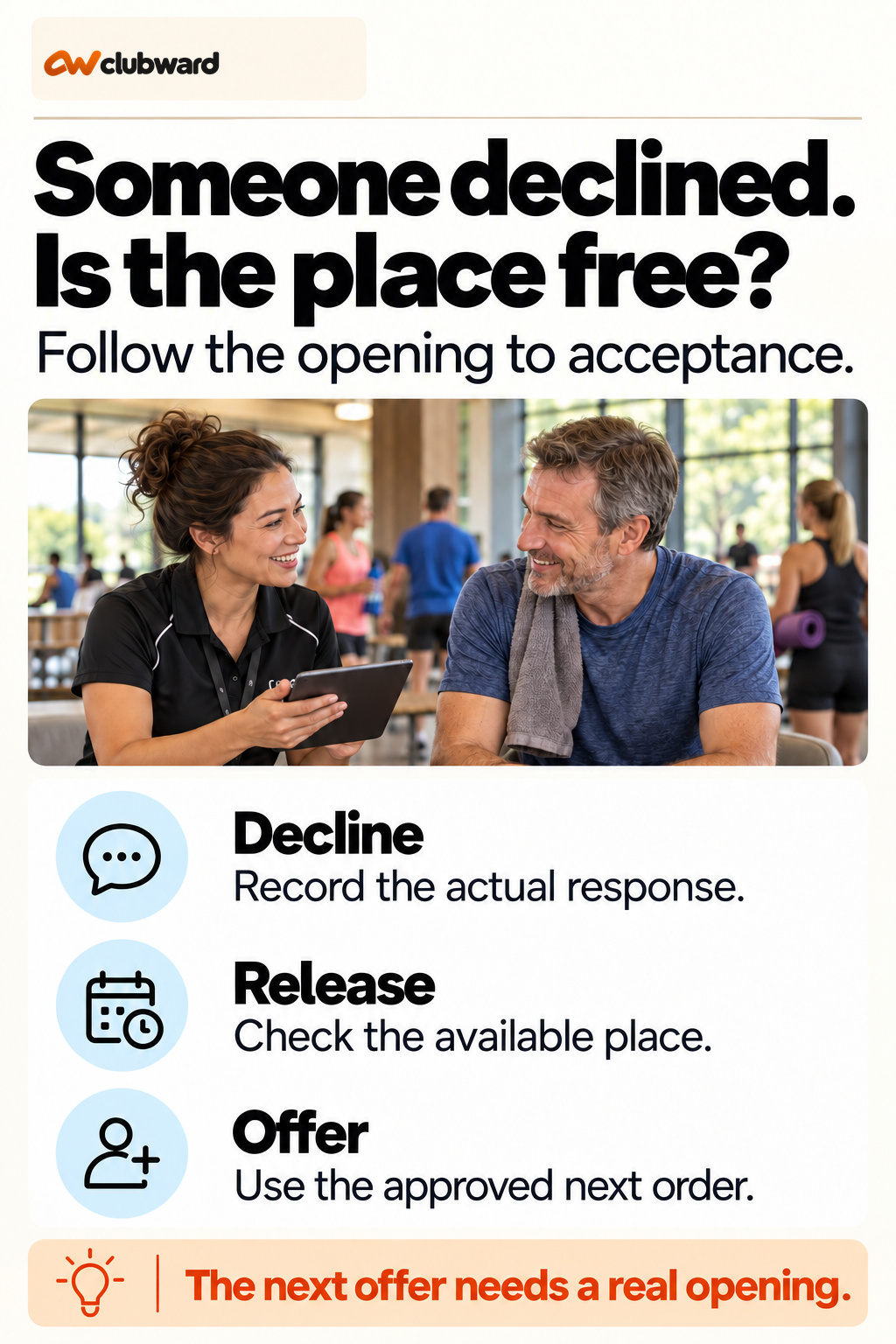
Test a declined waitlist offer by following the place through the actual decline, release, next offer and completed acceptance. Ask a covering colleague to explain who holds the place at each point and what evidence supports that answer. The next person should receive an offer for a real opening, with an acceptance route they can complete.
This evaluation is for sports and social club managers, membership directors and program coordinators. It checks a specific transition after someone declines. Keep your existing eligibility, priority and offer rules intact. A rehearsal is not an opportunity to move a preferred member ahead of the approved order.
Use a practice event or authorized example and avoid sending live offers merely to test the process. Your deliverable is a four-state trace showing the opening, the responsible owner and the completed next action. The practical question is whether your process can finish one declined offer without leaving two people uncertain about the same place.
Begin with the approved offer rule
Locate the current eligibility and priority rules for the activity. The evaluator needs that reference to understand which next person should be considered. Do not redesign the policy while checking the handoff between offers.
Confirm what counts as a decline and what counts as an expired offer. An explicit response and a missed deadline can require different evidence. Use the definitions your club has approved and keep the states distinguishable in the record.
Find the conditions for acceptance. A reply, registration step or other required action may form part of completion in your actual process. The test should follow the current rule rather than assuming a positive message always finishes the booking.
If you need to establish those rules first, use the fair waitlist offer process for sports and social clubs. This evaluation starts with the existing process and checks whether one decline reaches a usable next acceptance.
Choose one opening to follow
Select a single identifiable place in a program or event. State which session, date and participant category the opening concerns. A general total of vacancies can hide the particular place being transferred between offers.
Use the capacity and availability definitions in your actual process. A place held for one offer should not automatically be described as available for anyone to accept. Record who can determine the current opening state.
Keep the scenario manageable. One place and two successive offers can expose the important handoffs. Add more places or categories later only when they test a different operating condition.
Agree how the practice case avoids live consequences. A walkthrough can use sample names and draft messages without notifying members. If a real case is reviewed, inspect the record through authorized access without changing its order or status.
Establish the first offer's current state
Locate the original offer, recipient reference, response window and acceptance route. Confirm that the record describes the particular opening chosen for the test. The covering owner should be able to find it without relying on the first coordinator's memory.
Record what was sent and what remains active. A prepared message and a delivered offer are different states. Use available evidence rather than assuming that a draft or notification preview reached the member.
Check what the offer says about declining or asking a question. The person should have a supported response route. A member reply sent elsewhere should not vanish simply because it did not use the easiest route for the coordinator.
Keep the offer's conditions visible. The next reviewer needs to understand the held place, deadline and required completion steps before interpreting the response. A single offered label may not provide all that context.
Read the decline as it was received
Find the actual response through the supported channel. An explicit “I cannot attend this session” is different from a question about changing the date or a failed attempt to accept. Keep the member's stated meaning intact.
Do not turn silence into a decline before the approved deadline and expiry procedure applies. Likewise, do not treat an unclear message as permission to release the place without following your club's clarification route.
Record the response reference and the owner responsible for processing it. Use proportionate information in the evaluation sheet rather than copying the person's whole communication history. The next reviewer needs the decision-relevant response.
If the message is ambiguous, assign clarification before completing the transition. The test should reveal a pending question honestly. A tidy four-state record is not useful if the first state rests on an assumption.
Check what happens to the declined place
Follow the supported release action after the decline is confirmed. Ask which record shows that the place is no longer held for the first recipient and who is authorized to complete that action.
Keep the member's waitlist status separate from the opening's status. Your policy may specify whether declining this session affects future offers. The evaluator should check the actual rule rather than assuming a decline removes every future opportunity.
Locate the release evidence in the normal workflow. A note that someone declined can explain the response without showing that the capacity or held place was updated. Inspect both parts where your process requires them.
Record an unresolved release as pending. Do not prepare a confident next offer for a place whose current availability is still unclear. Assign the question to the owner who can confirm the opening through the supported route.
Select the next person from the existing order
Once the opening is confirmed, follow the approved eligibility and priority sequence. Use the current record for the activity and check any conditions that legitimately apply before making the next offer.
Keep reasons for a skipped entry visible within the authorized process. A person may be ineligible for this session or have a pending question that your policy addresses. Do not silently reorder the list to make the next offer easier.
Check that duplicate communications or household entries do not create competing review paths. Follow your existing duplicate-handling procedure without changing someone's priority merely because the record needs cleanup.
Ask a covering colleague to explain why the selected person is next. They should be able to use the rule and relevant record. This verifies the transition's continuity without turning the rehearsal into a new policy decision.
Prepare the second offer with complete context
Use the approved offer format for the actual activity. Include the relevant session details, response window, acceptance method and help route. The next member should understand the specific place being held and the action needed to accept it.
Check the message against the current opening. A copied earlier offer can carry the wrong date, deadline or registration reference. Review the details that change between recipients before considering the draft ready.
Keep the terms consistent with comparable offers under the club's rule. A rehearsal should not invent a shorter deadline to speed up the test. Use the approved window and identify the owner of an exceptional timing decision.
Separate a prepared second offer from one actually issued. Your evaluation can test a draft message without sending it. Record that scope so another manager does not mistake the rehearsal for a completed member communication.
Work through an evening activity example
Imagine a club has one opening in a Thursday beginner pickleball session. The first eligible member receives an offer for that particular session and responds that they cannot attend. The coordinator locates the response and processes the decline through the approved route.
The evaluator then checks the held-place record. It should show whatever release state your process requires before the next person is offered the opening. A recorded decline alone is not assumed to finish that step.
The next eligible member receives the offer through the existing order. Their acceptance follows the required registration and confirmation steps. The test records which action establishes the completed state rather than relying only on a friendly yes.
Finally, the covering session colleague checks the current roster or arrival instruction. They should see the confirmed participant according to the actual process. The transition is useful only when the place becomes understandable to the people running the activity.
Follow the next member's acceptance route
Use the route the offer actually provides. That may be a supported registration link or a staffed completion process. Do not choose an internal shortcut that the member would not know exists.
Ask whether the recipient can identify the activity and held place before completing the required action. Check the date and any relevant conditions at the point of acceptance. A correct email does not prove that its linked destination is correct.
Use authorized practice data for a rehearsal. Do not make payments, sign agreements or submit private information simply to test the journey. A controlled walkthrough can show the supported steps and identify remaining questions.
Record the point at which the process considers acceptance complete. The evaluator needs that evidence to distinguish an interested reply from a confirmed place. Keep any unfinished required step visible rather than describing it as done.

Compare the accepted state with the roster
Find the normal record used by the program or event team. Check whether the confirmed next member appears in the appropriate roster or arrival instruction after the supported acceptance process is complete.
Compare the session, person reference and status. A registration for another date or activity is a different outcome. The evaluator should follow the specific offered place all the way to the operating record.
Ask the session colleague what they would do when the member arrives. Their answer should follow the current instruction and permitted actions. If they must ask the original coordinator to identify the accepted place, the handoff needs clarification.
Keep the record's privacy and access rules intact. The evaluator can check whether the right role can use the arrival instruction without exporting a full membership list into the rehearsal sheet.
Test an acceptance that does not finish
Include a practice situation where the next person replies positively but a required completion step remains unfinished. Ask how staff distinguish that state from confirmed acceptance under the existing offer rule.
Check whether the place remains held and which deadline applies. Use the current process to answer. Do not invent an extension because the evaluator wants the scenario to conclude neatly.
Identify who follows up and how the member receives help. A failed link or unclear instruction needs a different response from a person simply deciding later. Record the observed obstacle without assuming the member lost interest.
Follow the case through its eventual completed or expired state in the authorized practice route. The result should preserve the distinction between attempted acceptance and a confirmed place, with the next action owned.
Check the old offer after the new one proceeds
Ask what happens if the first recipient later attempts to use the original acceptance route. The evaluator should inspect the supported behavior and approved staff response rather than assuming the old invitation cannot still create confusion.
A changed mind may become a new request under the existing policy. Keep it separate from the completed decline and next offer. The first recipient's previous opportunity does not automatically establish a current place.
Check who resolves an unexpected late response. The desk or program colleague may need to route the question to the authorized coordinator. Give them the relevant case reference and current state.
Record any ambiguity as an evaluation finding. Do not send competing live offers or alter member priority to probe the system. A controlled walkthrough is enough to identify a requirement for the owner to investigate.
Handle two replies without improvising priority
Use a practice case where two communications arrive close together. One concerns the earlier declined offer and one concerns the current recipient. Ask the owner to identify the current held place and the approved rule before acting.
Follow the actual references and recorded states. The earliest visible email in an individual inbox may not describe the active offer. The evaluator should check the controlled record instead of relying on message order alone.
Keep member-facing explanations consistent with the verified outcome. Staff can acknowledge a question without promising a place that is held or confirmed elsewhere. The decision owner should handle any exception through the existing process.
Record what the covering colleague needs to resolve the question. A current offer reference, held-place state and escalation contact may close the handoff. Avoid collecting extra personal history when the operational context is sufficient.
Inspect the instructions on a phone
Open the practice offer and acceptance destination in the format members are expected to use. Check the essential date, action and deadline as displayed. The evaluation concerns the actual route, not an ideal message viewed only at a desktop.
Keep the next step in readable text. A graphic can help explain the journey, but the member should not need to decode small image labels to understand how to accept or obtain help.
Check whether the help route remains available at the point of difficulty. An unreachable contact or hidden instruction can leave a willing recipient unable to finish. Record the exact obstacle and responsible owner.
Ask a colleague unfamiliar with the draft to explain what they would do next. This gives you a practical observation about the instruction's usefulness. It does not establish a broad satisfaction rate or conversion result.
Make the shift handoff explain every state
Prepare a handoff containing the opening reference, original response, release evidence, current offer and acceptance state. Give unfinished work a named owner and a review point appropriate to the activity.
Ask the covering colleague to explain which place is available, held or confirmed. They should be able to connect that answer to the relevant evidence. A long message history should not be the only way to reconstruct the case.
Identify which member communication has already occurred. A prepared message and a sent response need distinct labels in the operational record. This helps the next owner avoid sending a duplicate or contradictory answer.
Keep the handoff within the club's existing channels and access rules. It should enable the permitted next action without becoming a separate uncontrolled waitlist or exposing unnecessary member information.
Choose an improvement from the observed gap
If the release cannot be confirmed, investigate that action and its owner. If the next offer carries old details, improve the review step. If acceptance stops before confirmation, address the specific instruction or supported route that failed.
Separate evidence from the proposed correction. “The reviewer could not locate the release state” is a finding. “The platform should automate every offer” is a requirement to evaluate, not a behavior demonstrated by the test.
Assign one coordinating owner and repeat the same transition after the correction. The repeated check should show how the declined place reaches a completed next acceptance through the approved rule.
Retain the test's scope for future evaluation. One session and one opening can reveal useful friction, but it does not prove every event, membership offer or participant category follows the same route.
Distinguish a decline from an expired offer
Run a second practice transition in which the first recipient does not respond within the approved window. Keep it separate from the explicit-decline case. The same opening may eventually move to the next person, but the evidence and permitted timing differ.
For the decline, locate the actual response and the supported release action. For expiry, locate the relevant deadline, any required review and the recorded expired state. Ask the covering coordinator to explain which case they are viewing before proceeding to the next offer.
This distinction matters when an unanswered question is present. Imagine the recipient contacted the club about a broken acceptance route before the deadline. Follow the policy for that situation and route the issue to its owner. Do not call it a voluntary decline because the person has not completed registration.
Compare the messages prepared for the two outcomes. The club can acknowledge an explicit decline through its normal process. An expired offer needs language that reflects the actual state and any supported next choice. Keep the member's intent separate from the process outcome when you do not have evidence of it.
Ask whether the next owner can locate the deadline without opening a chain of copied messages. Use the controlled record and the time zone stated in the applicable offer. A covering colleague should not have to infer which local clock governs the response window.
Finally, inspect the opening after each practice outcome. The release state and next-recipient selection should follow the approved rule. Record any difference between the intended process and the observed route, especially if an offer still appears active after the team believes it ended.
Give a specific correction to the owner responsible for that gap. It may require clearer status wording, an accessible deadline reference or a supported review step. Repeat the affected transition before describing the next offer as ready. The evaluation should make the declined and expired histories understandable while keeping both tied to one actual place.
Keep each practice result tied to its own response and deadline evidence. A covering colleague should be able to explain why the first offer ended and which next action is permitted. If that explanation remains uncertain, assign the missing reference to its owner before preparing another complete and accurate member communication for the same opening.
Explore the opening-to-acceptance journey
Clubward's waitlist and program features support keeping demand visible and following up when places open. Bring one declined offer and its next-recipient journey to a walkthrough to discuss the records and responsibilities your club needs.
Ask the team to demonstrate the specific release, next offer and acceptance behavior in your proposed setup. Compare the evidence with your evaluation. Keep questions about timing or automation as requirements until the relevant behavior is shown.
Before your next activity, trace one decline through release to a confirmed next place and its arrival instruction. Give uncertainty an owner rather than offering the same opening twice. To explore that process in a club management platform, book a personalized waitlist and registration-workflow demo.
From Clubward Editorial Team
More from Clubward