Sports & Social Clubs
A Fair Waitlist Offer Process for Sports and Social Clubs
A clear waitlist workflow that separates eligibility from priority, defines each opening, sets offer deadlines, and records every outcome.

A waitlist offer should answer three questions without negotiation: why this person received the opportunity, how long the offer remains open, and what happens next if they decline or do not respond.
Sports and social clubs often create a waitlist when a court clinic, league, outing, dining event, or member program fills. The list appears orderly. The difficult work begins when a place opens. Staff may have to interpret household priority, membership status, registration time, skill grouping, team balance, age band, or an accommodation. If those rules are not explicit, two employees can make different decisions while both believe they are being fair.
A practical waitlist process separates eligibility from priority, records the rule before places open, creates a time-limited offer, defines acceptance and expiration, and leaves a visible decision trail. The goal is not to promise that every outcome will feel equal. It is to make the club’s method consistent, explainable, and workable for members and staff.
Begin with the reason for the waitlist
Different constraints require different allocation rules. A court clinic may be limited by court space and instructor ratio. A team program may need age or skill groupings. A social event may have a room-capacity limit. A dining reservation may depend on seating configuration. A popular trip may include transportation seats.
Write the constraint in operational language:
- “Twenty-four places are available because the program uses four courts with six participants per court.”
- “The room is limited to eighty registered attendees for this setup.”
- “The trip has forty available transportation seats.”
Only use verified limits. Do not invent a capacity to make a process seem objective. If the limit is flexible, name who can change it and what must be checked first.
The constraint determines what happens when a place opens. If any eligible person can use the place, chronological priority may work. If the opening is specific to a division, date, or role, the next eligible person within that group may need the offer. The method should be settled before staff are looking at names.
Separate eligibility from priority
Eligibility asks, “Can this person take this place?” Priority asks, “Which eligible person should receive the offer first?” Keeping those questions separate makes the process easier to explain.
Eligibility
Eligibility conditions may include active membership, household relationship, age band, registration prerequisites, program dates, division, accessibility or support requirements, and any current restriction that legitimately applies to the activity.
Use only conditions the club has actually adopted and can verify. Avoid adding an informal condition because a staff member knows a participant or believes one person is “more committed.” If a condition matters, put it in the program rules before allocation begins.
Priority
Choose a primary priority method and document any limited tie-breaker. Examples include:
- registration timestamp among eligible participants;
- rotating priority across a recurring series;
- household or member category defined in the program rules;
- division-specific sequence;
- lottery completed at a stated time;
- a published combination, such as division first and timestamp second.
Do not call the method “first come, first served” if staff can reorder the list. If legitimate exceptions exist, describe the decision path honestly.
For programs with legal, safety, accessibility, or governing-document implications, the club should have the appropriate authorized people review the rule. Record the specific approved instruction and the role responsible for handling uncertain cases.
Publish the rule before demand exceeds capacity
Members should be able to understand the process when they register, not only when they ask why someone else received a place.
Explain:
- when a waitlist begins;
- how a member joins it;
- whether the position is visible or approximate;
- which eligibility conditions are checked when a place opens;
- how priority is determined;
- how the club contacts the next person;
- how long an offer remains open;
- what counts as acceptance;
- what happens after expiration or decline;
- how members should report a changed email or phone number;
- where a genuine error can be reviewed.
Use plain terms. “Offer window” is useful if you define it. “Subject to operational considerations” is not useful unless the considerations are named.
If a member’s apparent position can change because the next opening belongs to a different division or time, explain that a single numbered position may not predict the next offer. It is better to provide a truthful status than a precise-looking number that the process cannot honor.
Create one record for each waitlist entry
The record should contain the information needed to evaluate and contact the person without exposing unnecessary private details to staff who do not need them.
Include:
- member or household identifier;
- program, event, or reservation option;
- date and time joined;
- relevant eligibility group;
- contact route selected or authorized;
- current status;
- offer history;
- decision notes when an exception or correction occurs.
Use clear statuses such as:
- Waiting
- Eligibility check needed
- Offer sent
- Accepted
- Declined
- Expired
- Removed at member request
- Closed because the program ended
Avoid vague statuses such as “pending,” which can mean the member is waiting, staff are checking, or an offer is awaiting response. A status should tell the next employee what action remains.
Keep a timestamp when status changes. That creates a reliable sequence without requiring staff to reconstruct events from email threads.
Define the opening before choosing the person
When a place becomes available, record what kind of opening it is:
- program and session;
- date and time;
- division, age band, role, or other applicable group;
- any access or support condition associated with the place;
- response deadline;
- latest time the place can be reassigned.
This prevents the team from starting with a name and then justifying the fit. The place is defined first; the priority rule then selects from eligible entries.
For a simple event, the opening may be unrestricted. For a doubles ladder, it may belong to a specific level or pairing need. For a trip, it may include one transportation seat. For a recurring clinic, the opening may apply to only one session rather than the entire series.
If staff cannot describe the opening, they are not ready to make the offer.
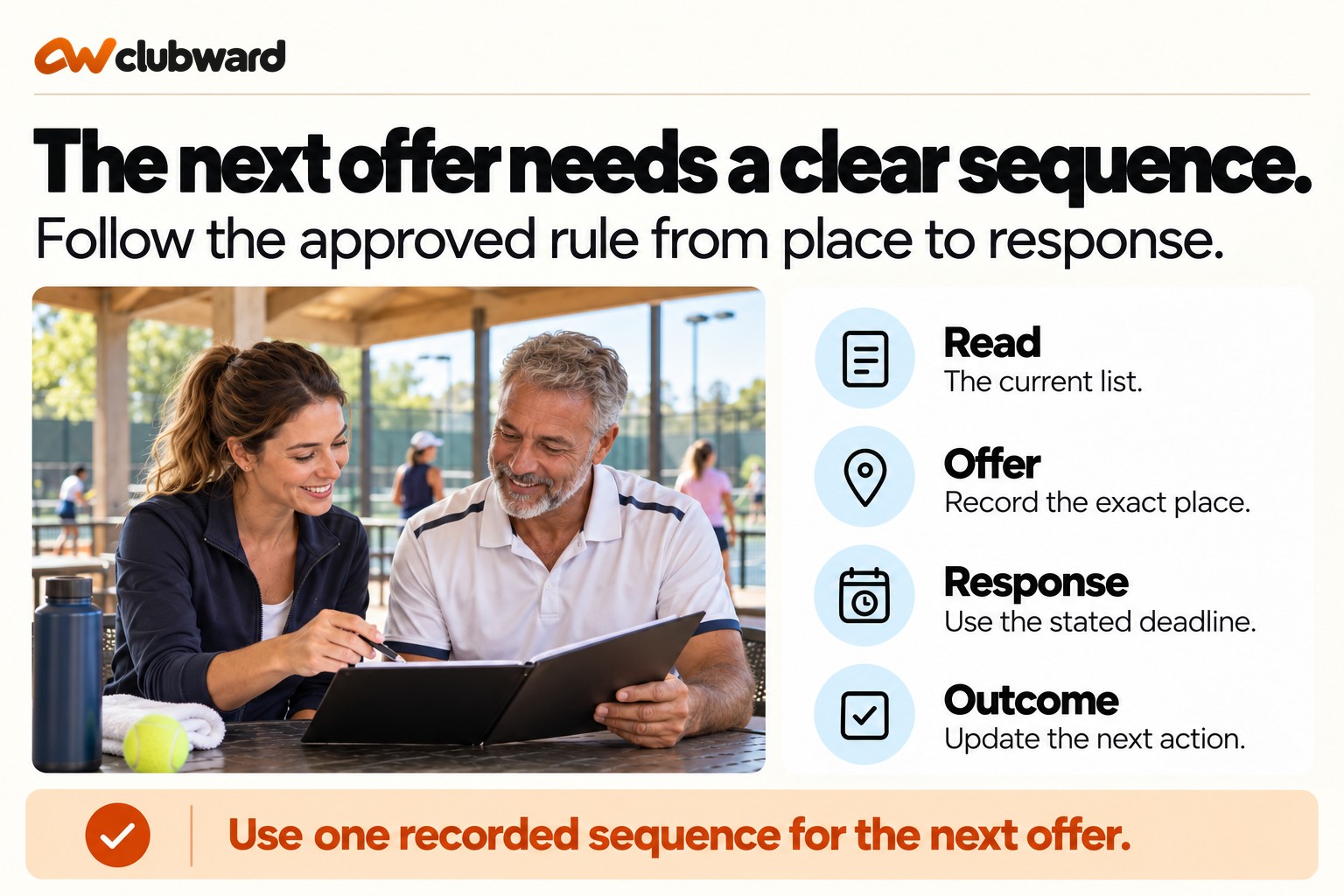
Use a repeatable selection sequence
A fair operating sequence can be short:
- Confirm the opening and its constraints.
- Filter the waitlist to entries that meet the published eligibility conditions.
- Apply the published priority method.
- Check that contact information and member status are current enough to proceed.
- Create the offer with a deadline.
- Record who was selected and which rule produced the selection.
If the first person is not eligible, record the reason in a controlled, respectful way and continue. Do not delete the entry to hide the decision. If the eligibility issue can be corrected, move the entry to the appropriate status and follow the club’s stated review process.
If the selection requires a judgment—such as placing a player into an appropriate level—name the authorized role and the evidence used. A waitlist coordinator should not have to invent a technical assessment at the moment a place opens.
Make the offer specific and time-limited
The offer should identify the exact opportunity and the action required to accept it.
Include:
- program or event;
- date, time, and location;
- price or fee only if verified and applicable;
- what is included;
- response deadline with time zone when members may travel;
- acceptance method;
- payment or confirmation step if required;
- what happens if the offer expires;
- one contact route for a question or accessibility need.
Avoid messages such as “A spot may be available—let us know if you’re interested.” That creates uncertainty about whether the place is being held and whether a reply completes registration.
A stronger message is:
“A place is available in the Thursday 6:00 p.m. beginner clinic on October 8. We are holding it for you until Wednesday at noon Central. Use the registration link in this message to accept. If it is not completed by the deadline, the offer will expire and the place will move to the next eligible member.”
The window should reflect the activity and how soon it begins. A high-demand event months away may support a longer response time than a clinic tomorrow. Apply the same window to comparable offers unless a published condition explains the difference.
Define acceptance as a completed state
A member can say “yes” while a registration, payment, waiver, or roster step remains incomplete. Decide what constitutes acceptance.
It might be:
- completing registration;
- confirming through the member portal;
- paying a verified required fee;
- signing a current acknowledgement;
- responding through a staffed channel that completes the registration.
Do not make members guess whether an email reply holds the place. State the action and show a confirmation when it succeeds.
If a required step fails because of a system or staff issue, route it for review before expiring the offer. The decision record should distinguish “member did not respond” from “member attempted to accept but could not complete the process.”
Expire, decline, and reoffer without improvising
At the deadline, the offer needs a clear outcome.
If accepted, update the roster and close the corresponding waitlist entry. If declined, record the decline and offer the defined opening to the next eligible person. If expired, record the deadline and move forward according to the published rule.
Avoid holding a place indefinitely because staff know the member or expect a late reply. That changes the process for everyone behind them. If the club allows a grace period, publish it and apply it consistently.
When the activity is close, the club may use a shorter response window or simultaneous limited offers, but only if the method is explicit. Simultaneous offers can create disappointment if more people accept than places exist, so the message and confirmation process must make the allocation method unmistakable.
For recurring programs, decide whether declining one offer keeps the member on the list for future dates. There is no universal answer; the important part is to state the rule before the member decides.
Work through a club example
Suppose a sports club runs a six-week social pickleball series with twenty-four places. Registration fills, and eleven eligible members join the waitlist. The published rule uses registration timestamp within the appropriate experience group.
Two days before the first session, a beginner participant withdraws. Staff define the opening: beginner group, full six-week series, Tuesday at 7:00 p.m., response due the next day at noon. The waitlist is filtered to eligible beginner entries. The earliest entry receives a specific offer and a registration link.
That member declines because of a schedule conflict. The decline is recorded, and the next eligible beginner receives the same offer window. The second member completes registration and receives a confirmation. The roster updates, and the waitlist entry closes as accepted.
Now consider a different opening: an experienced-group participant withdraws. The first overall name on the waitlist is a beginner. The offer goes to the earliest eligible experienced player because the opening was defined before selection and the published rule accounts for group fit. If the club displayed a single queue number, it would need to explain why positions do not always predict the next group-specific offer.
The process is explainable because staff can show the constraint, eligibility group, priority rule, offer window, and outcome without relying on private conversations or personal preference.
Connect reservations, participation, and communication carefully
Waitlist work connects program capacity, member records, communications, and the eventual roster or reservation. When evaluating Clubward’s Programs & Spaces workflows, bring your allocation rules and walk through a place becoming available, an offer going out, and a member completing registration.
For sports and social clubs, the handoff also needs to work at the front desk. Staff should be able to confirm who received the place, which activity it covers, and whether anything remains before the member can participate.
The evaluation question is not simply “Does the system have a waitlist?” Trace the full opening-to-acceptance path:
- Can staff define the available place precisely?
- Can the list be filtered by the club’s legitimate eligibility rule?
- Is the priority method visible and repeatable?
- Does the offer have a clear deadline and acceptance action?
- Does the roster or reservation update after acceptance?
- Can another staff member understand why the selection occurred?
- Can managers see repeated decline or expiration patterns without inventing conclusions about members?
Use the completed offer history to identify patterns that deserve a closer operational review before changing the next cycle. A trend can suggest a question—whether an offer window is too short, a time slot is difficult, or a group is repeatedly constrained—but it does not explain motivation on its own.
Review the process after each cycle
After a program or event closes, review the workflow rather than judging individual members.
Ask:
- Were eligibility rules clear before registration?
- Did staff apply the same priority method?
- How many offers expired without a completed action?
- Did members encounter a broken acceptance step?
- Did a particular group face repeated capacity constraints?
- Were staff able to explain selections from the record?
- Did a rule create an outcome the program owner did not intend?
Treat the answers as signals for the next cycle. If many offers expire, examine the message, deadline, timing, and acceptance path before assuming members were uninterested. If one division repeatedly has more demand, consider scheduling or capacity options without promising expansion. If staff keep overriding the list, clarify whether the priority rule is wrong or the team is bypassing it.
Make a decline release the actual place
A member declining an offer should trigger a clear change in the operating record. Close that offer, confirm that its place is available again, and apply the same eligibility and priority rules to the next candidate. Avoid leaving the first offer active while another employee contacts the next person. Two invitations can create two expectations even when only one place exists.
Separate declining this event from leaving the waitlist. A member might be unavailable for one date while still wanting a future opportunity. Ask only the question your policy needs: whether to close this offer, whether to retain an eligible future request, or whether to withdraw completely. Record the choice in the appropriate place instead of interpreting a short reply as permission for every change.
A useful response is: “Thank you for letting us know. We have closed your offer for Saturday's workshop and will offer that place to the next eligible member. Your request for the November session remains unchanged.” Adapt the final sentence to the member's actual request. A confirmation should describe what staff did, without promising another invitation.
Handle simultaneous replies with a named decision owner
Consider a dining event with one opening. One employee sends a timed offer while another receives a telephone enquiry from a different member. The second employee should check the current offer state before making a commitment. A place held by an open offer is different from a place ready for a new invitation.
If conflicting commitments have already been made, pause new offers and involve the authorized event owner. Preserve the relevant timestamps, messages, and stated rules. The owner should resolve the case using the club's approved process and communicate the outcome directly to affected members. Quietly deleting an invitation makes the record tidier while leaving the member's expectation unresolved.
Use the incident to improve the next handoff. Determine whether staff lacked a current offer view, misunderstood a deadline, or relied on separate notes. Correct that specific weakness. Adding an extra approval for every routine invitation may create unnecessary delay if the actual problem was one missing status field or an unclear ownership rule.
Give the next shift enough context to finish the offer
The outgoing employee should identify the activity, the open place, the current recipient, the response deadline, and the action due next. Include the approved contact route and the person who can authorize exceptions. Keep the handoff focused on unfinished work rather than requiring the next employee to read the entire registration history.
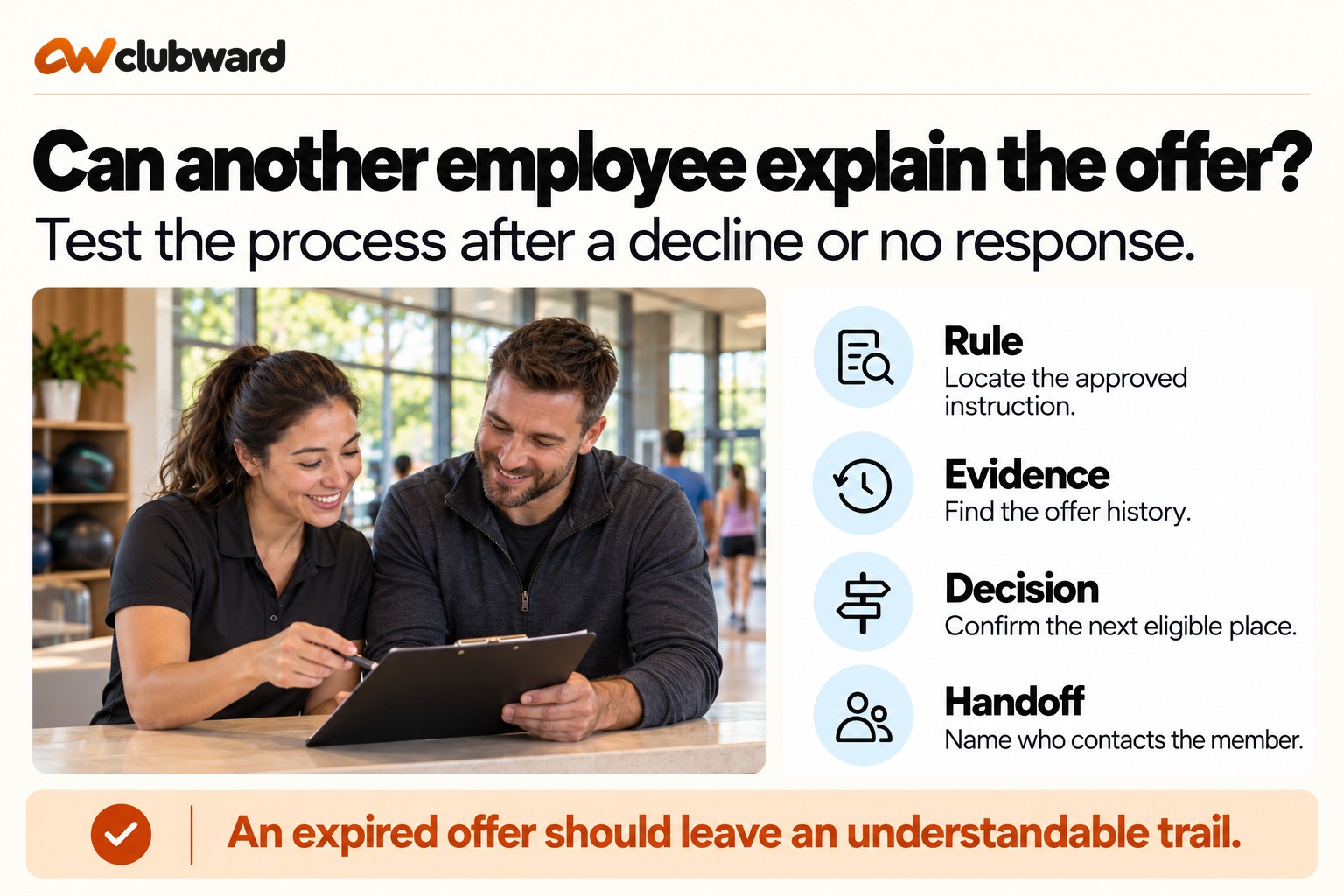
Ask the incoming employee to explain what happens if the member accepts, declines, or does not reply. Acceptance should lead to the club's defined confirmation process. Decline should close the offer and release the place. Expiry should follow the published response rule. Any ambiguous reply needs a named reviewer instead of an improvised decision at the desk.
For the first event using the procedure, review one completed offer with the membership or event lead. Check the original eligibility decision, the invitation, the reply, and the final roster entry. A member should be able to receive a concise explanation of the outcome without staff inventing a different rule after the event.
Bring one unfinished invitation to your next staff handoff review. Ask an employee who did not send it to identify the member, the available place, the deadline, and the next permitted action. Then introduce a decline and follow the place through the next offer to final confirmation. Record any point where staff need a private message or separate spreadsheet to understand the current state. Assign that dependency before the next event, and repeat the test using the corrected procedure with the incoming shift lead. Confirm every transition.
The reusable waitlist-offer workflow
Use this sequence:
- Identify the real capacity constraint.
- Publish eligibility and priority rules before demand exceeds capacity.
- Create one structured record per waitlist entry.
- Define each opening before looking at names.
- Filter for eligibility, then apply priority.
- Send a specific offer with a clear deadline and action.
- Treat acceptance as a completed, confirmed state.
- Record declines, expirations, corrections, and exceptions.
- Reoffer the same defined place using the same rule.
- Review patterns and improve the next cycle without inventing member motives.
A trustworthy waitlist is less about the length of the queue than the quality of the handoff from an open place to a confirmed participant. When the method is clear, staff can act faster, members know what to expect, and the club can improve capacity decisions using an accurate history.
Verify completion.
Bring one full program and one difficult allocation rule to your evaluation. Book a personalized Clubward demo to walk through the waitlist offer from capacity and eligibility to communication and confirmed participation.
From Clubward Editorial Team
More from Clubward