Sports & Social Clubs
An Event Guest Wants to Join: Build a Clear Membership Handoff
A warm guest conversation can disappear between the event team and membership office. This process preserves context without turning hospitality into pressure.

A guest has a great evening at the club and asks the event host how membership works. The host says someone will follow up. By Monday, the membership team has a first name, no context and no clear permission to contact the guest. The moment that felt welcoming on event night turns into either silence or an awkward generic message.
The missed opportunity is a handoff problem, not a sales-volume problem. Event staff and member hosts are closest to the conversation. The membership team is best equipped to explain options and next steps. A respectful process connects those roles without turning every guest interaction into a lead-capture exercise.
A strong handoff records only what is useful: who the guest is, which event or activity created the interest, what they asked about, whether they want follow-up, how they prefer to be contacted, when contact would be welcome and who owns the response. The goal is not pressure. It is continuity—letting the next person pick up the conversation with enough context to be genuinely helpful.
Why a simple change becomes a complicated shift
- Interest is recorded without permission: A staff note that someone “seemed interested” is not the same as a request for contact. Ask plainly before sharing details.
- The handoff contains no context: A name and email force the membership team to begin with a generic pitch. The event, activity and question make the response relevant.
- Everyone assumes someone else will follow up: The member host, event chair and membership director each expect another person to act. Assign one owner and due time.
- The response ignores timing: A guest who asked for information next week should not receive three messages the next morning. Record their preferred timing.
- No outcome returns to the event team: Without a simple outcome, organizers cannot learn which events create genuine interest or improve the guest experience.
Build a handoff packet people can actually use
- Guest identity: Capture the minimum reliable contact information the guest agrees to share.
- Event context: Name the event, activity, introducing member or part of the experience that prompted the question.
- Stated interest: Use the guest’s actual question, such as family membership, tennis access or future social events.
- Permission and preference: Record whether follow-up is welcome, by which channel and on what timeline.
- Membership owner: Assign one person who can answer the question and preserve the tone of the introduction.
- Outcome: Record the next step—information sent, tour arranged, no action requested or future follow-up date.
Move the decision from one role to the next
1. Recognize a real request
Listen for an explicit question or ask the guest whether they would like information. Do not turn ordinary friendliness into assumed interest.
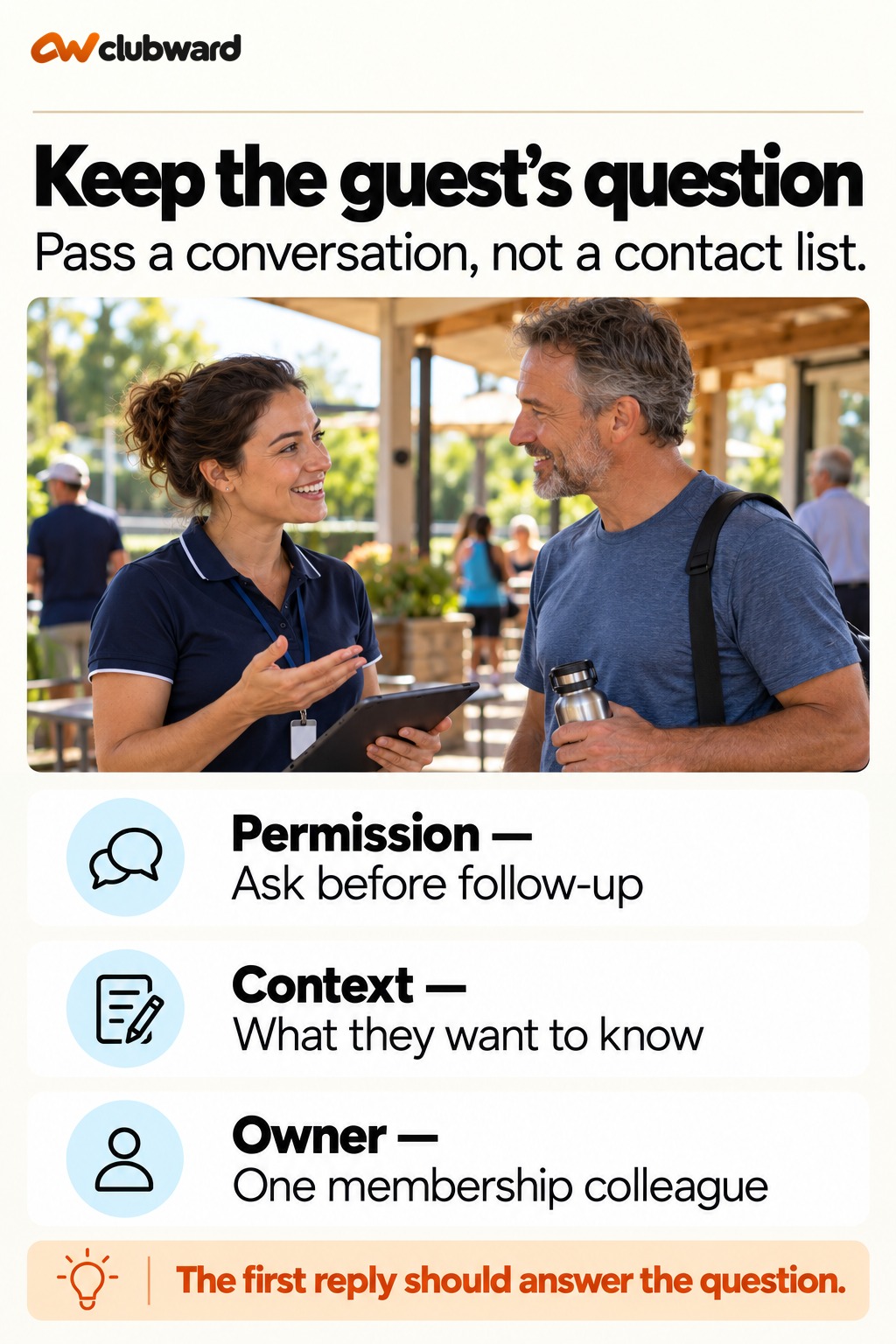
2. Ask permission in the moment
A simple “Would you like our membership director to send you the details?” is clear and respectful. Confirm the channel and timing.
3. Preserve useful context
Add the event, activity, introducing member and specific question. Avoid subjective labels such as “hot lead” that do not help the next conversation.
4. Assign one owner
Route the handoff to the person best able to answer. Give them a due time that matches the guest’s preference, not an arbitrary urgency rule.
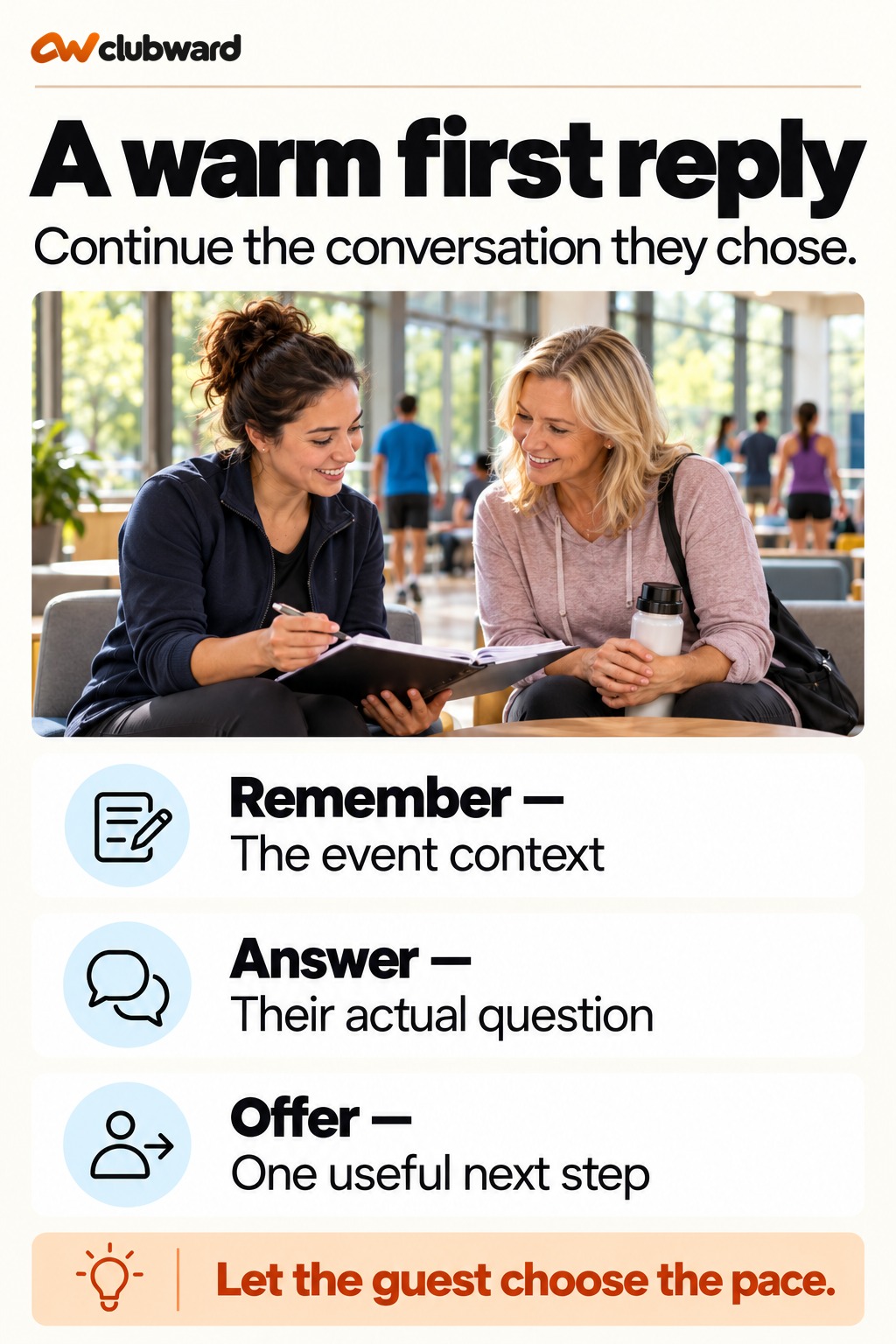
5. Make the first response specific
Reference the event and answer the question that was asked before describing every option. Offer one appropriate next step.
6. Close the loop without oversharing
Record the operational outcome so the team knows the handoff was handled. Protect private conversation details and honor a request for no further contact.
A worked handoff example
Suppose a guest attends a mixed-doubles social event with a current member. After the final match, the guest asks whether a family membership includes junior court time. The host does not guess. They ask whether the guest would like the membership director to send the relevant options the following week. The guest agrees and prefers email.
The handoff note includes the event, introducing member, family-membership question, email permission and “next week” timing. The membership director is assigned as owner. On Tuesday, the director sends a brief message that references the event, answers the junior-access question within the club’s actual rules and offers one next step: a short conversation or visit.
The outcome is recorded as “information sent; guest invited to choose whether to continue.” The host can see that the promise was kept without receiving private details. If the guest declines, the team records that choice and stops. The process protects the welcoming tone that created the interest in the first place.
Measure whether the handoff works
- Permission completeness: Review whether handoffs include clear contact permission and preferred channel.
- Owner acceptance: Measure whether the assigned membership contact acknowledges the handoff.
- Response matched to timing: Check whether follow-up occurs within the guest’s requested window.
- Question-first quality: Sample whether the first response addresses the specific interest before offering broader information.
- Outcome visibility: Track whether the handoff reaches a simple closed or next-step status without unnecessary personal detail.
Practice a warm handoff without turning it into a script
Role-play three event conversations with hosts and membership staff. In the first, a guest directly asks about membership. In the second, a guest compliments the club but asks for nothing. In the third, a current member offers a friend’s contact information. The team should identify when permission exists, when a gentle question is appropriate and when no handoff should be created.
For the direct request, practice asking for the preferred channel and timing. Capture the event context and actual question in one or two sentences. Then give the note to a membership colleague who was not present. Their first response should answer the question, acknowledge the event and offer one next step. If they still need to ask why the guest was contacted, the handoff needs more context.
Review the tone as carefully as the fields. Hospitality is damaged when an interested guest receives an urgent sequence of generic messages. Set a reasonable response expectation and honor a request to wait. Define a closed state for information sent, no further contact requested and future follow-up chosen by the guest. The practice should help event staff keep a promise without asking them to become salespeople, and help the membership team continue a real conversation instead of starting over.
Member hosts need a boundary too. They may introduce a guest and share the membership team’s public contact route, but they should not promise acceptance, pricing, availability or benefits outside the club’s approved information. A clear boundary lets members remain warm ambassadors without carrying responsibility for the membership decision. Include that expectation in host or event-lead guidance.
Where a connected club management platform helps
Clubward connects memberships, reservations and everyday operations for sports and social clubs. Member and household records share a workspace, and clubs can manage courts, rooms, activities and reservations.
That product fit should be tested with the full guest journey, not a generic contact form. Bring an event-guest scenario to a demo and ask how permission, event context, membership ownership and follow-up outcome stay connected. If your club has specific privacy, communication or membership-approval requirements, include them in the workflow review.
Distinguish interest from a request to be contacted
An event guest can enjoy an evening without asking for membership follow-up. They might compliment the setting, ask a casual question or tell their host they had a good time. Those comments are useful hospitality feedback, but the event team should not treat them as permission to begin a contact sequence. Look for a specific question and ask what the guest would like next.
Consider three conversations. One guest says, “This was lovely,” while leaving with friends. Thank them and let the conversation end. Another asks where membership information can be found. Give the public route and ask whether they would like a colleague to help. A third asks, “Could someone explain whether I can attend weekday activities?” That is a concrete question suitable for a permission-based handoff.
Use a natural invitation: “Would you like our membership colleague to reply about weekday participation? Which contact method and timing would suit you?” The wording can vary, but the scope should remain clear. Do not ask for contact details before explaining what the contact is for. A guest can choose to take the public information instead, without entering a follow-up process.
Record the answer in the club’s approved workflow. Include the question, permission, preferred channel and any requested timing. Avoid collecting extra personal details simply because a form has space for them. The membership owner needs enough information to keep the promise made at the event, not a profile assembled from assumptions about the guest’s life.
Preserve context that improves the first reply
Write one or two sentences about the event and the actual question. “Attended Thursday’s social doubles evening; asked whether a weekday membership covers afternoon activities; requested an email next week” gives the membership colleague a useful start. It does not claim the guest is ready to join or that a particular package is suitable before the question is answered.
Keep observations separate from the guest’s stated interest. “Played two matches” is event context if appropriate to the handoff. “Will be a strong long-term member” is a prediction the event team cannot establish from that visit. Avoid labels such as hot lead or perfect fit in the note. Describe what the guest asked and what was promised.
If a member introduced the guest, record that connection only when useful and appropriate. The membership colleague may need to acknowledge the event host, but the introducing member does not automatically need the guest’s private follow-up outcome. The event team can confirm that a promised handoff was received without sharing later questions, account decisions or personal reasons.
Use the guest’s own terms for the question. If they said weekday activities, do not turn that into a request for the highest membership tier. If they asked about attending with a partner, do not assume a particular household arrangement. The first reply should clarify the real question with approved information, then offer the next step that follows from the answer.
Give the handoff a named owner and a realistic time
One membership colleague should own the first response. A shared inbox may be the intake point, but the operational record still needs a responsible person or role assignment. Otherwise, several colleagues may send similar replies or everyone may assume someone else has responded. The event lead should be able to tell whether the promised conversation has an owner.
Set the response time around the guest’s preference and the club’s actual capacity. If the guest requests next week, record that timing and honor it. If the club normally needs two working days, give an honest expectation at the event. Do not create artificial urgency because the evening went well or because a generic follow-up template uses a countdown.
Define the backup when the assigned colleague is away. The backup should receive the question, permission and current status, not just the contact detail. They should know whether a reply has already been drafted or sent. A controlled reassignment protects the guest from repeating the event story and protects the club from making the same promise twice.
At the end of the event, review only the handoffs actually requested. Confirm which have owners and which need clarification. Do not turn the full guest attendance list into a membership outreach list. The event record and the follow-up record have different purposes. A well-run evening should be welcoming for guests who choose to remain guests.
Make the first reply answer something useful
For the weekday-participation example, open with the event context and the question. A sample beginning is: “It was good to hear you enjoyed Thursday’s doubles evening. You asked which weekday activities a membership would cover. I can help you compare the relevant options and the participation rules that matter to your usual visiting time.” Then use the club’s current approved information to answer.
Do not bury the answer beneath a general account of the club’s history or benefits. The guest chose one conversation. Address it early, explain any genuine decision they need to make and offer one next step. That step might be a short conversation about their preferred activities or a useful membership information page, depending on the request.
If the answer requires a decision that is not yet confirmed, say what remains open and who will resolve it. A membership colleague should not promise availability, acceptance, pricing or benefits beyond current approved information. A useful reply can explain the known options and provide a clear follow-up time without filling the gap with an optimistic assumption.
Keep the tone warm and proportionate. Refer to the shared activity without pretending to know the guest personally. Avoid suggesting that they owe the club a response because someone spent time with them. The purpose is to continue a conversation the guest requested. An unanswered first reply is an outcome to handle respectfully, not evidence that more pressure is needed.
Set clear outcomes for the next conversation
Choose a small set of states that reflect the work: requested, assigned, information sent, guest chose a next step, waiting until the requested date, and closed. Define what each means in your workflow. “Information sent” should not be counted as a membership decision. “Next step chosen” should name the action the guest accepted rather than imply a completed application.
When the guest replies, record their stated preference. If they want a conversation next month, assign that timing according to the club’s approved contact process. If they request no further contact, close the follow-up and apply that preference where appropriate. If they choose to apply, hand the question to the membership process without treating the event conversation as approval.
For a guest who does not reply, use the club’s proportionate follow-up approach and the original permission scope. Do not expand a single requested answer into an indefinite campaign. The membership owner should be able to explain why another contact is appropriate, what it offers and when the conversation will close. A useful follow-up adds help, not a repeated demand for attention.
Keep operational outcomes distinct from success claims. A clear first reply, honored timing and resolved question are meaningful service results. They do not prove that the event increased renewals or that the guest will become a member. Review actual membership outcomes through your established reporting process, and avoid attributing a later decision to one conversation without supporting evidence.
Recover a missed promise without starting over
Suppose the guest was told a colleague would reply on Monday, but the assignment was missed. The event lead flags the overdue handoff to the membership owner. The owner checks whether a reply was already sent before contacting the guest. This prevents a recovery effort from creating duplicate messages because one response was recorded elsewhere.
If the promise was missed, acknowledge it briefly and answer the original question. “We said we would follow up Monday and missed that timing. Here is the information about weekday participation you asked for” is direct and useful. Avoid a long internal explanation that makes the guest responsible for understanding the club’s staffing or recordkeeping problem.
Review why the handoff failed after the guest receives help. A missing owner suggests an assignment problem. A vague question suggests a context problem. A requested date hidden in a note suggests a timing problem. Fix the specific point rather than adding a longer generic script for every event. Keep the change small enough for event staff to use naturally.
Evaluate the handoff with hospitality in view
Invite one event host and one membership colleague to rehearse the three conversations: a compliment, a request for public information and a direct request for a reply. Check whether the host respects each guest’s choice. Check whether the membership colleague can continue the direct request using only the saved question and context.
Then test a reassignment and a no-contact preference. The receiving colleague should know what was already sent and what the guest asked to happen next. A handoff passes when it preserves the guest’s intent, gives the next person a useful question and leaves the guest free to choose the pace. That is the operating standard to carry into the next club event.
Check the handoff when the guest asks a different question
A guest may reply to membership information with a new question about an event, room booking or visiting again as a guest. Treat the new question according to its actual purpose. Do not continue pushing a membership next step if the guest has chosen a different conversation. Assign the appropriate owner and carry only the context they need.
For example, a guest who asks about bringing a friend to another social evening needs the current event and guest rules. The membership colleague can route that question to the event owner without implying that the guest applied to join. Record the changed next action so the event team does not receive a vague contact note and repeat the original membership pitch.
When the original membership conversation closes, keep its outcome accurate. Information supplied, question routed and no further membership follow-up requested are useful states. They should not be combined into a claim of membership interest or conversion. A respectful handoff follows the guest’s stated choice and lets the next colleague provide the help requested.
If the guest returns to the membership question later, begin from their new request. Check the current information and preferred next step again, rather than treating the old event conversation as continuing permission for a different contact or a broader ongoing membership discussion.
Final checklist
Before marking the handoff complete, confirm the following items in the saved record:
- Guest’s full name
- Reliable contact detail
- Explicit follow-up permission
- Preferred contact channel
- Preferred timing
- Event or activity context
- Introducing member if relevant
- Guest’s actual question
- Assigned membership owner
- Response due time
- One useful next step
- Outcome recorded
See how Clubward can connect events, guest context and membership follow-up for your club.
From Clubward team
More from Clubward