Sports & Social Clubs
The Renewal Reply Is 'Not This Year.' What Should You Ask Next?
A respectful nonrenewal follow-up that records the member's stated reason, clarifies a useful question, and agrees on a proportionate next action.

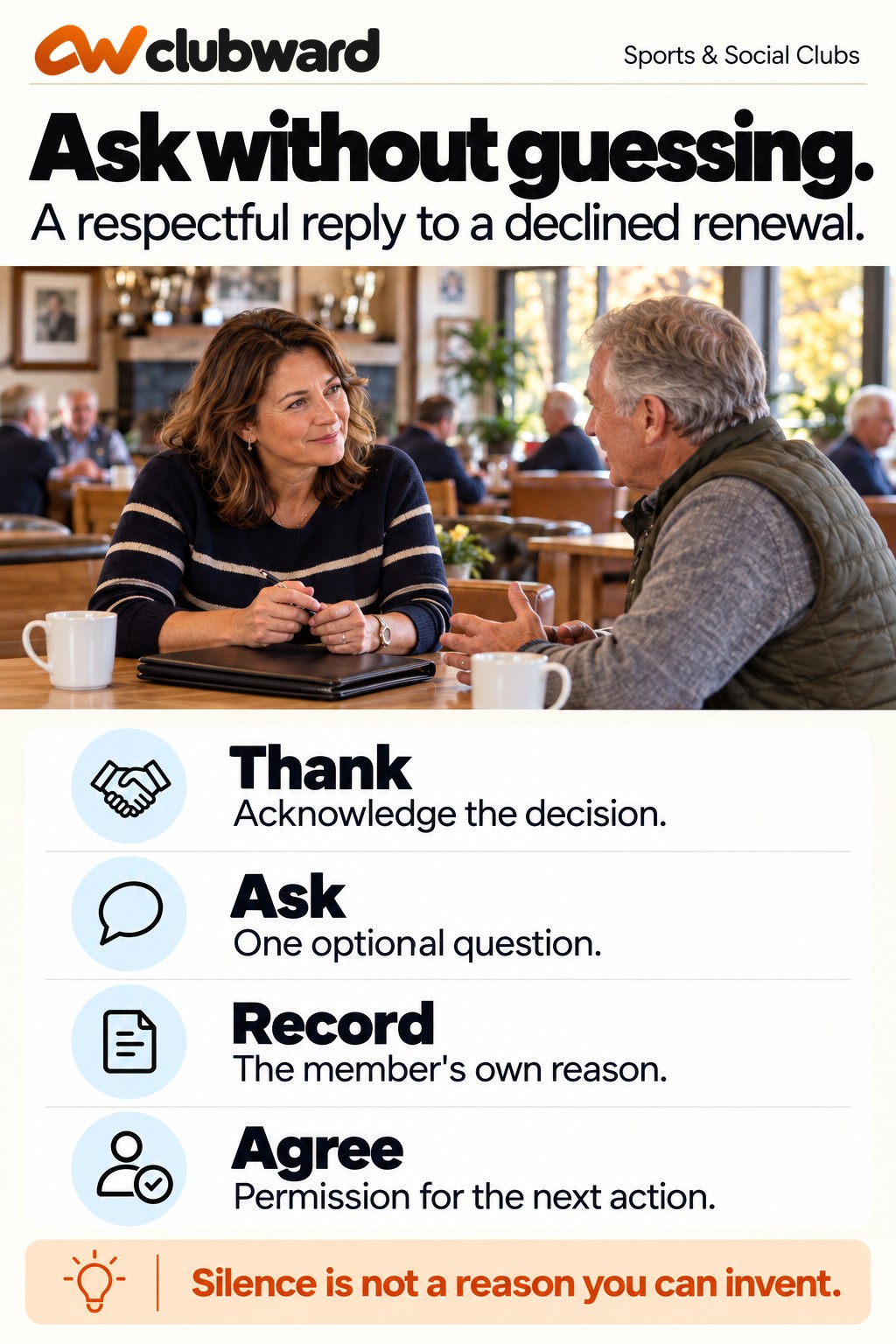
When a member replies “Not this year” to a renewal invitation, thank them, ask one optional question about their decision, and record the reason they choose to share. Then agree on an appropriate next step. Do not turn a short reply into a guessed explanation about price, dissatisfaction, or the member's personal circumstances.
A useful follow-up respects the decision while helping your sports or social club learn what the member actually meant. Their answer may point to timing, program fit, a specific experience, or a simple preference not to continue. Those answers require different actions. Some require no further contact.
Use the templates and review sheet below to keep the conversation specific. The aim is an accurate member-stated reason and a proportionate response, not a script that pressures every person to reconsider. Follow the club's established communication preferences and renewal procedures.
Separate the renewal decision from the explanation
The member has told you they are not renewing this year. That is a decision you should acknowledge. They have not necessarily told you why, whether they want to hear about alternatives, or whether they might return later.
Keep those questions separate in the record. A field labeled “declined renewal” can describe the stated decision. A reason field should contain the explanation the member actually provides, or indicate that no reason was given. Do not fill the gap with an assumption based on attendance.
A member who attended few events may have faced inconvenient times, limited places, changed interests, or an unrelated circumstance. The attendance record can identify a question worth considering internally. It cannot tell you which explanation belongs to this person.
Give the reply a named owner. The membership director may handle the conversation while another team reviews a program concern. The member should not receive several competing follow-ups because different staff interpret the same response independently.
Start with an acknowledgment that accepts the answer
A practical first line is: “Thank you for letting us know. We will record that you are not renewing for the coming year.” Adapt it to the actual state and procedure. Do not say a cancellation is complete if the reply still needs an authorized administrative step.
Then make any request for explanation optional. “If you are comfortable sharing, what most influenced your decision?” asks a useful question without demanding personal details. It lets the member choose the reason and the level of detail.
Keep the message short enough that the member can answer easily. A long list of potential reasons can lead them toward your categories before you hear their own explanation. Start with the open question and clarify only when the response leaves an operational point unclear.
If the member has already explained the decision, do not ask them to repeat it. Acknowledge the specific point they raised and decide whether a clarification or an agreed next action is useful. The template should support the conversation, not restart it mechanically.
Use a respectful first follow-up template
Here is a message structure a membership team can adapt:
“Thank you for letting us know you will not be renewing this year. If you are comfortable sharing, what most influenced your decision? We would like to understand your experience and plan more thoughtfully. There is no need to provide personal details. If you prefer not to discuss it, we understand.”
If the renewal response needs an administrative action, add the actual next step separately. “The membership office will confirm the account update” should appear only when that is your procedure. Keep the request for feedback from implying that the member must answer before their decision is respected.
Send the message through the appropriate existing communication route. Do not add the person to a new campaign simply because they replied to a renewal invitation. Record any preference they state about future contact and follow the club's established process for applying it.
Review the tone before sending. Remove urgency, guilt, and promises the team cannot support. “We would hate for you to miss out” may shift the message from understanding the decision to pushing another sale before you know whether that is welcome.
Record the reason in the member's terms
Keep a short, faithful account of what the member says. “Most activities I want are on weekday mornings, when I work” is more useful than a broad label such as “low engagement.” The specific reason identifies a participation barrier that staff can understand.
Use a category for internal comparison only after retaining the meaning. Timing, program fit, experience, and reason not provided can be useful starting groups. They should not replace the member's explanation or force a mixed response into a single misleading label.
Distinguish a member's report from a verified operating fact. If they say they could never get a place in a particular program, record that experience accurately. Review the relevant booking opportunity separately before claiming a club-wide capacity problem.
Keep sensitive personal detail out of a broad feedback summary. If a member offers private circumstances, record only what is needed in the authorized location. A planning meeting may need to know that timing was a barrier without seeing the person's full explanation.
Build a five-field follow-up sheet
Use a small record that connects the reply to the next action. It should help an incoming membership colleague understand the conversation without reading an unrelated history of the household.
- Stated decision: What did the member say about the coming renewal?
- Member-stated reason: What explanation did they choose to provide, or was none given?
- Clarification needed: Which specific point would change the appropriate response?
- Agreed next step: What action or contact, if any, did the member welcome?
- Owner and review: Who completes the next step and checks that the record reflects the actual outcome?
Include the relevant membership reference and communication date through your normal records. Keep the sheet tied to the approved account procedure. It is a conversation aid, not a substitute for completing the actual renewal or nonrenewal action.
Use “no further action requested” when that accurately describes the outcome. A completed follow-up does not always create a sales opportunity. Sometimes the useful result is a clear decision, a respected preference, and one planning question for the club.
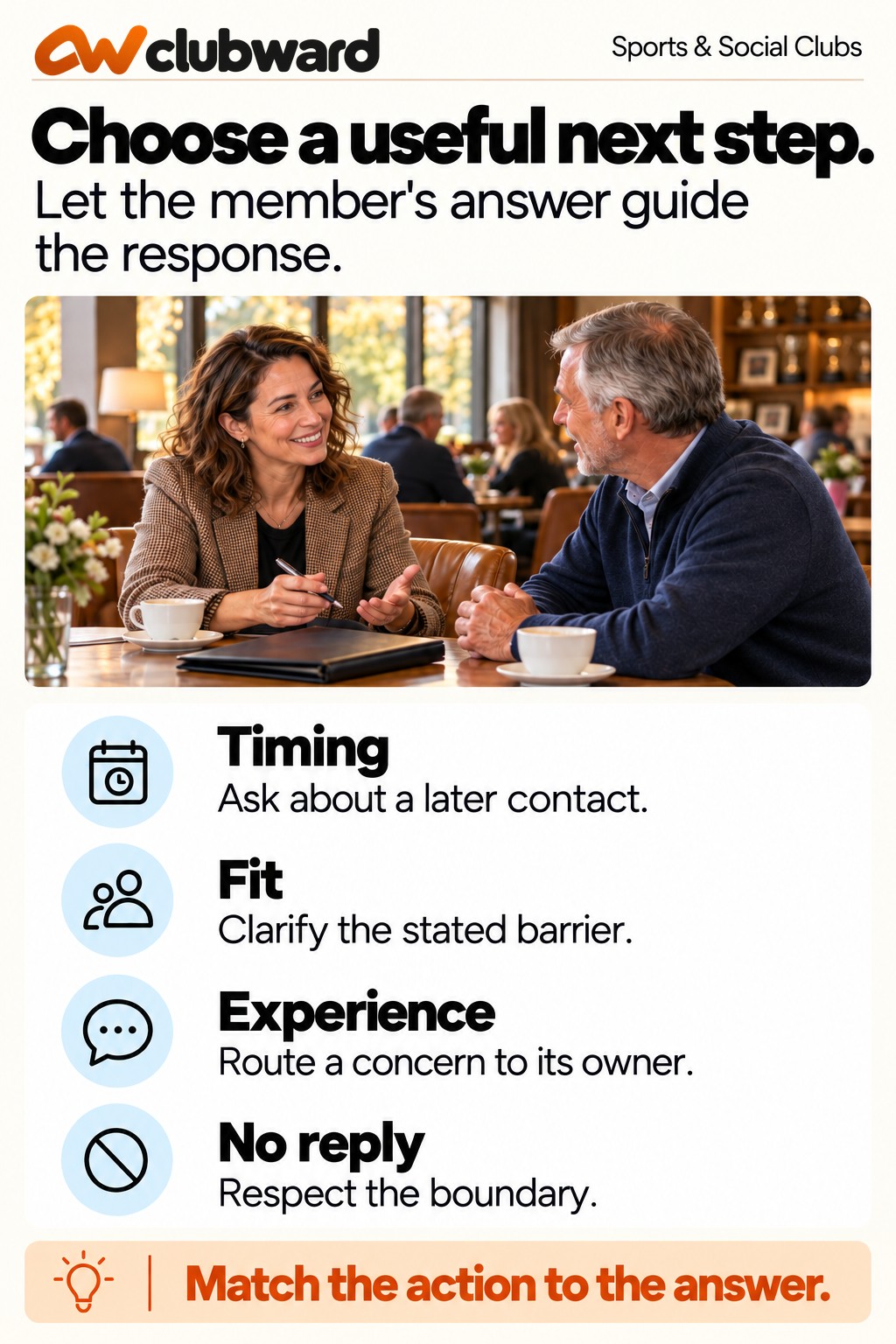
When the reason is timing, ask about the specific barrier
Suppose a member says their preferred activities happen while they are working. Thank them for the detail and ask a focused clarification only if it would help: “Was the weekday morning timing the main barrier, or was it difficult to find an available place at other times?”
That distinction matters. A timing problem suggests reviewing when the relevant activity is offered. An availability problem suggests reviewing how members reach a place. Do not promise a new evening program or priority booking before an authorized owner evaluates the idea.
If the member welcomes information about an existing relevant option, offer only the option you have verified. Explain its actual dates and next step. Avoid sending the entire calendar and asking the member to solve the mismatch themselves.
Record the response to that option separately from the original reason. “Timing barrier; member interested in hearing about an existing weekend session” preserves both. “Retained” would be inaccurate until the member has actually made and completed the relevant decision.
When the reason is fit, understand what was missing
A member may say the club no longer offers activities they want. Ask which activity or experience they were hoping for, if they are comfortable explaining. Keep the question specific enough to produce an actionable answer without inviting a lengthy survey they did not agree to complete.
Do not interpret the answer as a commitment to return if the club adds that activity. Interest and renewal intent are different. Record the stated preference and any permission for a later update, rather than placing the member on an assumed waiting list.
Review the idea with the program owner alongside actual demand, staffing, space, and participation evidence. One member's explanation can raise a useful question. It does not establish that a new activity will succeed or that everyone who declined renewal shares the same preference.
When a current option genuinely fits, ask whether the member would like its details. If they decline, acknowledge the answer and close the conversation appropriately. The purpose of clarification is to understand and respond proportionately, not to keep finding another objection to overcome.
When the reason is an experience, name the response owner
A member may describe an unanswered question, an unwelcoming arrival, or a booking disappointment. Thank them for explaining and identify what action they want, if any. They may want the club to understand the issue without seeking another conversation about it.
For an actionable concern, give the relevant owner the member's actual account through the approved internal route. Include the event or program reference if available. Avoid transforming their report into a verified allegation or dismissing it because another record tells only part of the story.
Tell the member what will happen next using the actual procedure. Do not promise a refund, policy change, disciplinary outcome, or new place before the authorized owner decides. A named contact and a clear next action are useful without an unsupported outcome promise.
Keep the renewal conversation and the concern review connected but distinct. The member does not need to reconsider renewal for their concern to be taken seriously. A resolved concern does not automatically mean the membership decision changed.
When no reason is provided, leave the gap visible
If the member declines to explain or does not reply, record that no reason was provided. Do not assign a reason from their last visit, household changes, or the tone of a brief message. The absence of feedback is an information limit, not a member characteristic.
Follow the club's approved contact procedure and any preference the person has stated. Avoid repeated personal follow-ups merely to complete a reason field. An internal report should distinguish known reasons from unclassified decisions.
Check whether the administrative nonrenewal step still needs completion. The membership owner should handle that through the actual procedure, independently of whether the person offers feedback. A missing survey answer should not leave the account in an unclear state.
For future planning, use the responses you have with their limitations. A small set of voluntary explanations can identify questions to investigate. It should not be presented as a representative finding about all departing members.
Work through a timing reply and an agreed next step
Consider a social club member who replies, “Not this year. I could rarely attend because the photography group met on Tuesday mornings.” The membership director thanks them and asks whether the main issue was that particular meeting time.
The member confirms the timing issue and says they would welcome information if an evening group becomes available. The director records the member-stated barrier, their interest, and the permission for that specific update. They do not promise an evening group or record a future renewal.
The program owner checks existing activity plans and participant interest. If an appropriate option is approved later, the membership director can send the agreed update through the club's process. If no option is available, the record still contains an accurate explanation and a bounded next step.
Compare that case with a member who says, “I am taking a break and do not want further messages.” The appropriate response is an acknowledgment and the approved contact-preference action. Both conversations can be handled well even though only one leads to a possible future invitation.
Use the feedback without overstating what it proves
Review member-stated reasons in a small, clearly scoped group. Describe the period, the replies received, and the questions those replies raise. Keep members who gave no reason visible in the summary so the known explanations are not mistaken for the entire picture.
Group similar operational questions, such as activity timing or access to places. Retain enough specific context to distinguish them. “Participation barrier” alone is too broad to tell a program owner what to inspect.
Choose one investigation or trial tied to the evidence. If several people independently mention weekday timing, review the relevant schedule and actual participation before proposing a new session. If the issue is obtaining a place, inspect opportunity rather than simply adding more invitations.
Do not report invented retention results. A member accepting information is not a renewal. A program trial is not proof that the club solved the barrier. Record the actual actions and review the actual outcomes when they become available.
Give the next owner a complete handoff
A handoff should contain the stated decision, the member's explanation, the next action they welcomed, and the assigned owner. Include the relevant date and communication reference through your authorized record. The receiving colleague should not have to guess whether another reply is expected.
For the photography example, the program owner receives the timing question without unnecessary household detail. The membership director retains responsibility for the agreed future update. This separates planning from personal follow-up while keeping their connection clear.
If the owner changes, review open actions before the handoff is considered complete. Confirm that any contact preference and promised next step are visible to the replacement. Do not leave a personal reminder as the only record of what the member agreed to receive.
Close an action with the actual result: information sent, clarification received, preference applied, or no further action requested. Avoid vague labels such as “handled” that hide whether the club completed the step or merely discussed it.
Choose a clarification that changes the next action
Before asking another question, decide what the answer would help you do. “Was the difficulty finding a suitable time or obtaining a place?” can separate two operational barriers. “Would a discount make you stay?” moves straight to an offer that may be irrelevant and unauthorized.
If the member gives a broad answer such as “It did not work for me,” ask whether they want to share one specific part of the experience. Accept a brief response. The conversation should not become an interview simply because the membership team wants a more complete classification.
Keep clarification proportional to the member's interest. Someone who writes a detailed concern may welcome a discussion with the responsible owner. Someone who sends a short refusal may prefer a simple acknowledgment. Use their stated preference rather than treating message length as evidence of a personality or motive.
When you can answer a practical question immediately, do so accurately. If you need an authorized decision or current program detail, identify the owner and next step. Avoid using the follow-up as a reason to promise an option the club has not approved.
Record the clarification beside the original explanation. That preserves the sequence and helps the next colleague understand how the agreed next step arose. It also prevents an internal category from replacing the more useful words the member chose.
Review the message before it leaves the membership desk
Read the complete response as the member would receive it. It should acknowledge the decision, make any feedback question optional, and explain the actual administrative next step where needed. Remove sentences that imply the person owes the club another opportunity to persuade them.
Check every offer against current information. If you mention a session, confirm its existence and the route to details. If you offer a conversation, name the person responsible for following through. Do not send an invitation whose owner does not know it was promised.
Check the account state before describing it. A reply received, a pending administrative update, and a completed nonrenewal are different. Use the state that has been confirmed through the club's procedure and ask the responsible colleague to complete any outstanding step.
Inspect the recipient and context carefully. A template for one household should not retain another member's program reference or private explanation. Send only the information relevant to this conversation through the approved channel.
Ask a colleague to check a new template using the two sample cases. The first member welcomes an update; the second wants no further messages. A useful template should accommodate both without turning either response into an exception to a sales script.
Turn one reason into a bounded planning question
Bring the program owner a question they can investigate: “Several replies mention that the photography activity's weekday timing prevented participation. Can we review the relevant attendance and available scheduling options?” Keep the scope and source of that observation clear.
The owner can inspect actual program constraints and decide whether a trial is appropriate. Record the proposed action, its responsible person, and the review point. Do not announce a future activity to former members until the club has made the relevant decision.
After a trial, review what happened using available participation evidence and any feedback received. Keep the member's renewal decision separate from the program result. This gives the club a useful learning loop without claiming that one conversation or schedule change produced a membership outcome you have not observed.
Keep the original member-stated barrier available to the responsible planning owner in an appropriately limited summary. If a later proposal addresses something different, make that distinction visible. A broader calendar change may still be useful, but it should not be described as solving the specific timing question until the relevant option and member experience support that conclusion through a completed review of the actual program outcome.
Bring one renewal reply to Clubward
Clubward supports member records and renewal workflows. Bring one nonrenewal reply and its follow-up sheet to a walkthrough. Ask how the current decision, relevant context, responsible owner, and next action fit your membership procedure.
Use two cases: a member who welcomes one specific update and a member who wants no further discussion. Keep their decisions and preferences clear. Your useful test is whether the team can respond accurately without guessing the reason or repeating an unwanted conversation.
Book a personalized Clubward demo around those cases. A thoughtful follow-up starts with what the member actually said and ends with a next step they understand.
From Clubward Editorial Team
More from Clubward