Sports & Social Clubs
Membership Renewal Email Templates for Every Stage
Six membership renewal email templates, with clear recipient conditions, payment-pending language, confirmation details and a practical review before each send.

A member replies to your renewal reminder with a perfectly reasonable question: “I paid yesterday. Is something missing?” The message sounded friendly, the link worked, and the deadline was correct. The problem was the audience. Your club sent a request to renew to someone whose renewal needed a different answer.
A useful renewal email starts with the member's current situation. An invitation, an unfinished application, a pending payment and a confirmed renewal are different conversations. The templates below give each conversation a clear purpose, an understandable next step and a person who can help. They work best when the record behind the message has been reviewed first.
For a sports or social club, that might mean following an individual membership, a couple's account or a household through the next term. The wording should reflect the membership your club actually offers. A warm message can still be precise about dates, money and remaining requirements, without turning the reader's inbox into another place to untangle the club's administration.
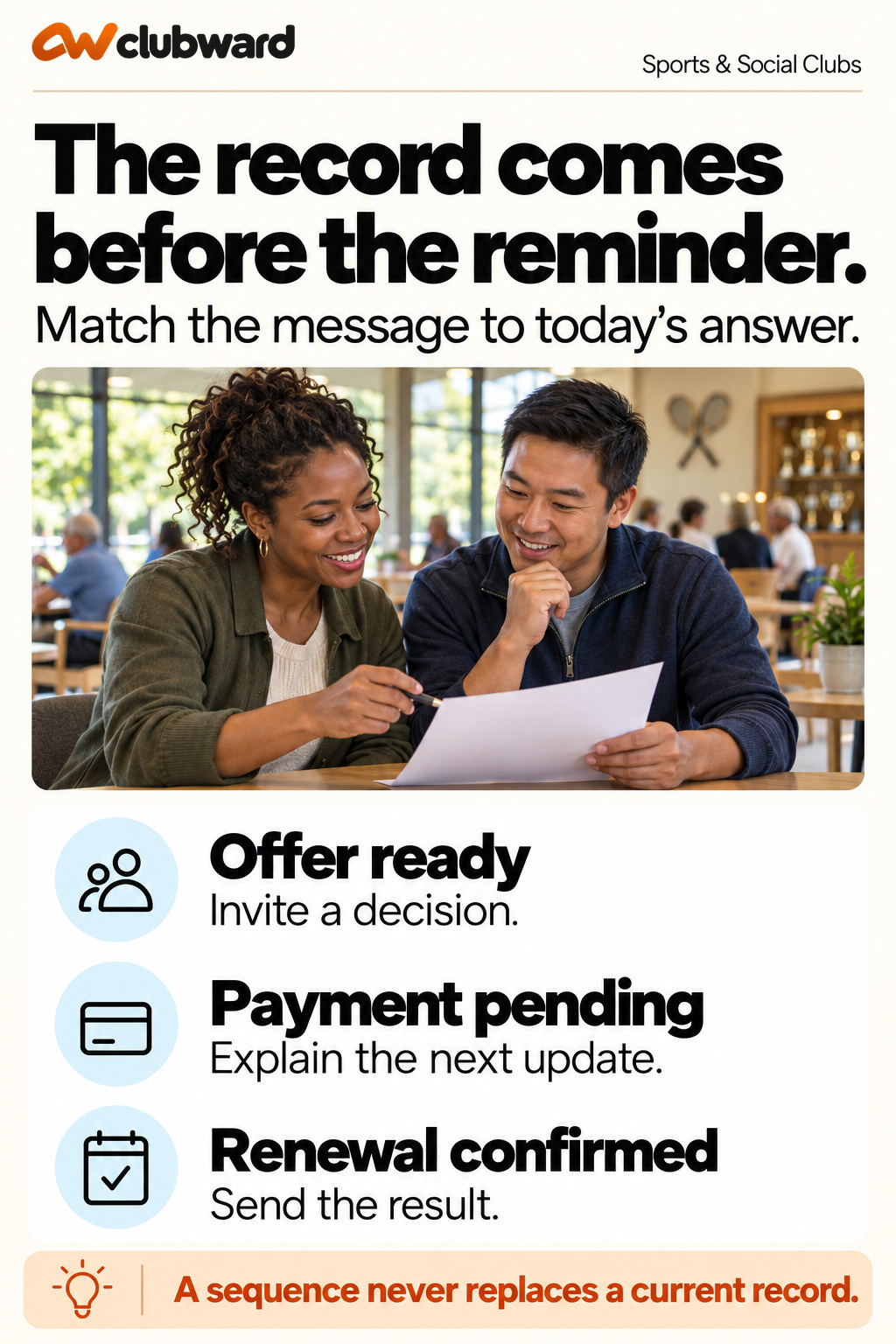
The record comes before the reminder
Before choosing a template, establish which question the message needs to answer. Is the member eligible for an available renewal offer? Have they started but stopped at a particular requirement? Has a payment been submitted without a final result? Has the renewal already been confirmed? These distinctions make the wording useful to the person receiving it.
The same review should identify who receives the message. A household membership may have an agreed account contact, while another adult attends most events. The most familiar name is not automatically the right recipient for account information. Your existing contact permissions and communication preferences provide the starting point for that decision.
A small preparation record can contain the membership term, recipient, current state, verified amount where relevant, next action and help owner. It can also record the time those details were checked. That gives the next colleague a way to understand why this message was appropriate, rather than relying on the name of an old mailing list.
One template, one member question
The bracketed fields in these templates are places for your club's approved details. A field should become a truthful answer before the message is sent. If the answer is still unknown, the right message may be an acknowledgment with a named follow-up, rather than an invitation that makes the unfinished decision sound settled.
Each example includes a subject, greeting, short explanation, one main action and a help route. Your normal signature and applicable sending details belong alongside the message. An account-specific link should lead to the intended account experience without exposing private information in a general announcement or shared document.
The timing belongs to your club's renewal calendar. These templates do not prescribe a universal number of days before expiry or a fixed number of reminders. A defined response point is more useful than an escalating sequence that continues after the person has completed the task, asked for help or declined the offer.
Template one: the renewal invitation
This invitation suits a member whose next-term offer is available and ready to review. The offer should identify the membership, covered people where relevant, term and approved amount. If those details are still being decided, a general heads-up can explain when information will become available without asking the member to act on an incomplete offer.
Subject: Your [term] membership is ready to renew
Hi [name],
We'd love to welcome you back to [club] for [term]. Your renewal offer is for [membership], covering [people or membership scope], from [start date] to [end date]. The amount shown for this offer is [verified amount].
You can review the details and renew at [account link] by [approved deadline]. If something looks different from what you expected, [help contact] can help before you continue.
Thank you for being part of [club].
The invitation's amount and scope should match the destination. If the email names one package while the account opens another, the member has to decide which explanation to trust. Reviewing the whole journey with one sample account can reveal that mismatch before the invitation reaches the wider renewal audience.
Template two: an unstarted renewal
A reminder can acknowledge that the offer remains available without guessing why someone has not acted. Silence might mean the member has not decided, has not seen the invitation or needs an answer first. The message can offer that answer without inventing urgency or implying that continued membership has already been agreed.
Subject: A reminder about your [term] renewal
Hi [name],
Your [membership] renewal offer is still available for [term]. Our records do not yet show a completed renewal. The current offer can be reviewed at [account link], with a response due by [approved deadline].
If you have a question about [relevant membership detail], please contact [help contact]. We're happy to help you understand the available options before you decide.
Thank you, [sender name]
This version deliberately avoids saying that the member forgot or needs a final push. The useful information is the current offer and response point. Someone who has already submitted a renewal or payment belongs in a different review, even if the original mailing list still labels their account as outstanding.
Template three: one unfinished requirement
An unfinished renewal deserves a message about the actual remaining step. A household detail, an unanswered selection and a document requirement create different questions. The member needs to recognize where they stopped and understand how to continue, without receiving a second invitation that makes their earlier effort appear to have disappeared.
Subject: One remaining step for your [term] renewal
Hi [name],
We have your renewal request for [membership]. The remaining step in our record is [specific requirement]. You can continue at [appropriate account link], where [brief explanation of the next screen or action].
Your renewal is currently [truthful status]. [Help contact] can help if the requirement is unclear or your circumstances have changed. Please use [approved response route] by [applicable deadline].
Thank you for working through this with us.
The explanation should stay within the recipient's appropriate account context. A general email does not need copies of sensitive documents or a detailed description of another household member's circumstances. The club can identify the remaining task and provide an authorized route for resolving it without spreading unnecessary information.
Template four: payment submitted, result pending
A pending result needs a different message from an unpaid offer. The club's responsible payment reviewer should confirm the situation and the instruction that applies. Where the approved instruction is to wait rather than submit again, the message should say so clearly and give the member a realistic follow-up point.
Subject: An update on your renewal payment
Hi [name],
We can see that your payment for [term] was submitted. Its result is still pending in our records. Under the instruction for your account, you do not need to submit another payment while [responsible team] checks the result.
[Named contact or team] will update you by [accepted follow-up time]. If you have a question before then, please use [help route] and quote [safe reference].
Thank you for your patience.
The follow-up time should be something the responsible person has accepted. A reassuring sentence becomes less helpful when nobody owns the promised update. The account should also be excluded from messages asking for a new payment while the pending result is being reviewed under the club's process.
Template five: the renewal is confirmed
Confirmation should describe the result the club has actually established. A payment receipt and a completed membership renewal may represent different stages in your process. If a requirement remains open, the message needs to explain that truthfully rather than use a broad confirmation that leaves staff and the member with different expectations.
Subject: Your [term] membership renewal is confirmed
Hi [name],
Your [membership] renewal is confirmed for [start date] through [end date], covering [membership scope]. Thank you for continuing with [club].
[Accurate first-visit information or explanation of any separate remaining arrangement.] Your membership details are available at [account link]. If you have a question about the confirmation, [help contact] can help.
We're looking forward to seeing you at [club].
The next communication should follow the confirmed state. A completed member should not remain in the same unfinished-renewal audience merely because an earlier export still contains their name. The confirmation record and the reminder audience need a shared review point before the next batch is sent.
Template six: the membership has expired
An expiry message should explain the current account position and the approved return path. The club's actual rules determine whether an offer remains available, a new application is needed or a person must speak with the membership team. A template cannot create a grace period, guarantee a place or authorize continued access.
Subject: Your membership ended on [date]
Hi [name],
Your [membership] term ended on [date]. Our current record shows [accurate account status]. If you'd like to return, the available next step is [approved renewal, application or contact route].
[Clear explanation of the relevant effect on bookings or visits, where applicable.] If you believe your record is incomplete, please contact [help contact] so we can review it with you.
Thank you for the time you've spent with [club].
This message leaves room for a record question without assuming the person wants to return. Someone who has explicitly declined should follow the club's agreed response to that decision. A useful conversation can end with acknowledgment; it does not always need another offer or a request to explain personal circumstances.
When the member says they are leaving
A reply saying “not this year” changes the conversation. The club now has a stated decision, rather than an unanswered invitation. A brief acknowledgment can thank the person and clarify any account question they have raised. Optional feedback belongs in a separate, respectful exchange that the person can decline.
The related guide to responding when a member decides not to renew develops that conversation with examples and a member-stated reason record. It is useful when your team needs to distinguish learning from the member's answer from repeatedly trying to reverse their decision.
The renewal pack can therefore stop at the appropriate point. The record might say the person declined, asked to hear about a later term or requested no further promotional contact. Each outcome deserves its own accurate handling under the club's procedures, instead of becoming another entry in a general list labeled “needs follow-up.”
A single household, three different messages
Imagine a household receives its renewal invitation on Monday. On Tuesday, the account contact selects the next term and submits payment. The result is still pending when a volunteer prepares Wednesday's reminder list. An old export describes the renewal as unfinished, while the current account needs a payment-result review.
The useful Wednesday message is the pending acknowledgment after the responsible reviewer confirms that instruction. It explains what the club knows and who will update the household. It does not ask the contact to start the same process again. The volunteer records the review point and removes the account from that payment-request batch.
On Thursday, suppose the result is confirmed and all membership requirements are met. The confirmation template now fits. If a household detail remains unresolved instead, the unfinished-requirement template explains that particular task. The message follows the current evidence rather than the order of a prewritten sequence.
This example also shows why a sent message is not the final account answer. A colleague covering reception needs the current record when the family arrives. The email can explain the result to the member, while the operating record helps staff give the same answer about the applicable term and remaining arrangements.
The small review before each batch
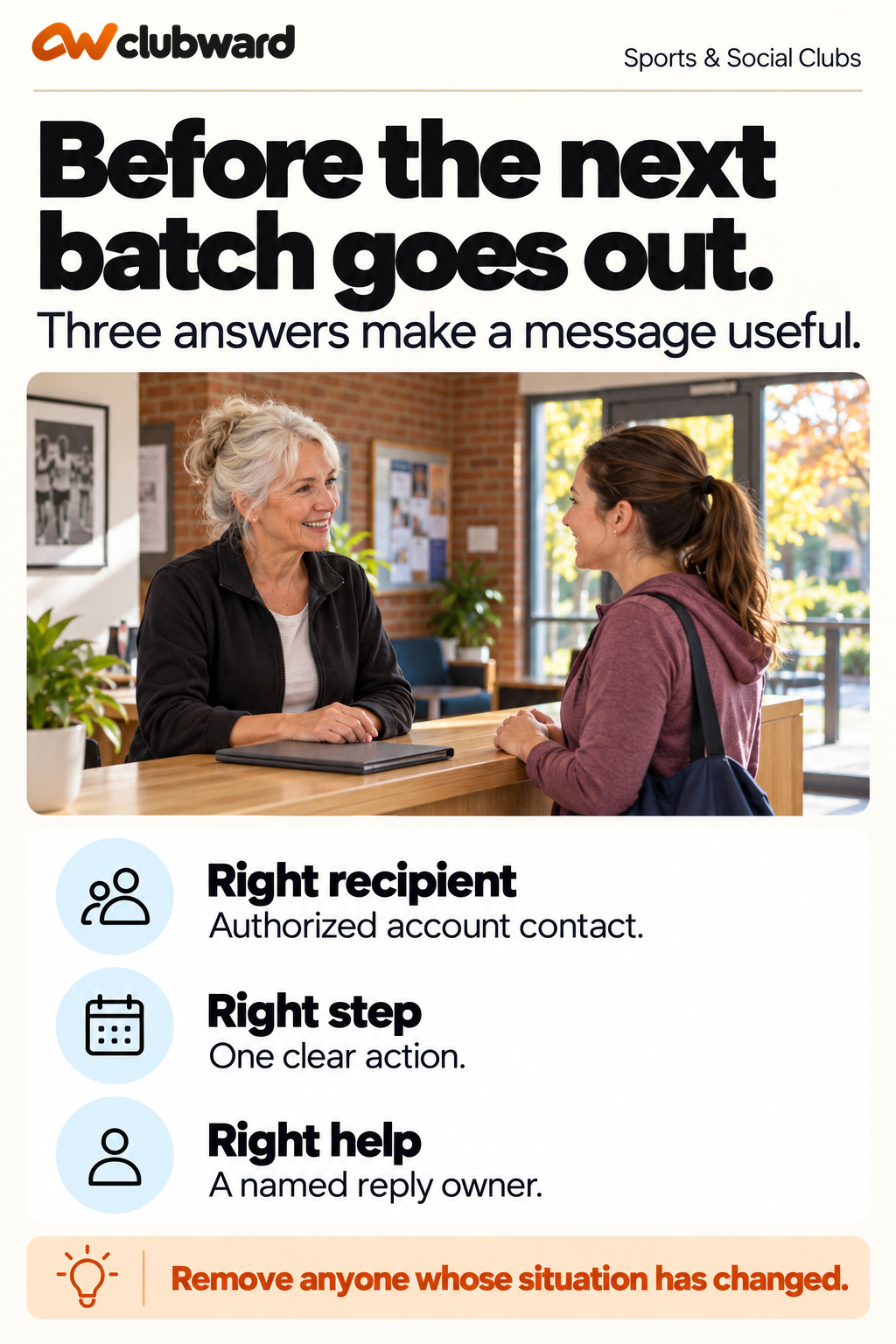
A batch review can focus on the conditions that would make the proposed message wrong. Has anyone completed renewal since the list was prepared? Is a payment pending? Has a member asked for help, changed their offer or declined? The useful review is tied to the proposed send, rather than a monthly assurance that the list was once accurate.
For each template, a short companion row can identify the recipient condition, removal condition, source record and person responsible for exceptions. An invitation row might require an available offer and remove confirmed renewals. A pending-payment row needs a reviewed pending result and a named follow-up owner. These are proposed operating definitions to adapt to your club.
The sending colleague should be able to explain a sample recipient using that row. If the explanation requires an unrecorded conversation, the preparation needs another step. A small sample does not prove that every account is correct, but it can reveal an unclear definition before the team relies on it for a larger batch.
Membership emails still need a purpose review
For United States email, the FTC's CAN-SPAM business guidance distinguishes commercial messages from narrowly defined transactional or relationship messages by their primary purpose. An existing membership alone does not make every message transactional. The guidance also addresses messages that mix account information with promotion.
That resource helps the person responsible for your email process review the finished message, including its subject and promotional content. Calling a template an account update is not a substitute for that review. Your club's applicable requirements and sending procedures should determine the appropriate handling before the message enters a live campaign.
For these templates, the practical editorial choice is to keep the account explanation focused. A pending-payment update does not need an unrelated event promotion. A renewal invitation should describe the actual offer. Combining several different purposes can make the reader's next step harder to understand even before the club considers how the message should be classified.
Useful examples without borrowed assumptions
Soroptimist's member retention resources include a dues invoicing kit with example letters and follow-up scripts. The collection offers a useful comparison for organizing a club's own materials. Its organizational dates and processes should not become your club's renewal rules simply because a sample is convenient.
A template review can separate reusable communication structure from details that belong to the organization providing the example. Greeting, purpose, next step and contact route can inform your approach. Eligibility, amounts, deadlines, benefits and return options need your own approved answers. The examples in this pack provide original wording for that adaptation.
When the renewal offer changes
A changed offer needs a clearer explanation than a replacement amount in an otherwise familiar email. Suppose an individual member asks to move to a household membership for the next term. The membership coordinator needs to confirm which people are covered, when the change applies and which approved charge the member is being asked to accept.
The original invitation can remain part of the record, but the current message should identify the revised offer. A useful opening is, “Following your request, your renewal offer now covers [scope] for [term]. The revised amount is [amount]. You can review the updated details at [link].” The member can then recognize the change without comparing two unexplained totals.
If a payment was already submitted against the earlier offer, the payment reviewer needs to settle the next instruction before another payment request is sent. The message might acknowledge the request and explain when the account contact will receive an answer. A changed membership selection alone does not establish how an existing payment should be handled.
The reply needs somewhere to land
The help route is part of the template's usefulness. A reply asking about an amount should reach someone who can inspect the relevant record or arrange the right review. A general inbox can serve that purpose when its coverage and handoff are clear. Naming a friendly contact is less useful if nobody covers their absence.
A covering colleague needs the message version, account reference, question received and promised response point. They do not need to reconstruct the whole renewal campaign before acknowledging the member. A short note can distinguish an unanswered offer question from a payment result already under review, keeping the next action with the appropriate person.
Consider a member replying, “The amount is different from last year.” The first answer can explain which offer and term are shown, then route any unresolved amount question to its owner. It should not assume the member objects to the price or offer an unapproved reduction. The question asks for an explanation before it establishes a decision.
A second reply might say, “Please send this to my partner.” That request needs the club's contact and permissions process before account details are forwarded. The helpful outcome is an accurate authorized recipient, rather than a quick transfer that leaves the original account arrangement unclear for the next message.
These replies can improve the next template revision. If several people ask where to find the term dates, the invitation may need a clearer date sentence. If one account has an unusual charge, that remains an account question. The distinction helps the coordinator improve shared wording without turning an individual exception into a promise to every member.
The saved template should also identify its owner and review date. A changed membership rule can then lead to a deliberate wording update before the next team member reuses an outdated version.
A renewal conversation your team can follow
Clubward brings member and household records, renewals and payment history together. That context can help a team understand the account behind a renewal question. Capabilities depend on the selected plan and modules; the wording and review decisions still need to match your club's actual process.
A useful discussion follows one invitation, one pending result and one confirmation. Your team can identify where each answer comes from, how the recipient is selected and what removes someone from an outdated reminder audience. That is a concrete way to assess the connection between membership work and the messages members receive.
Plan a Clubward membership walkthrough around the renewal question your team finds hardest to answer. Bring the situation behind the email, so the conversation can follow the member's next step and the colleague responsible for helping them finish.
From Clubward Editorial Team
More from Clubward