Community Nonprofits & Volunteers
Audit Volunteer Arrival Instructions Before Your Next Community Program
Test the reporting time, entrance, receiving contact and backup plan so your next volunteer intake begins with clear, usable arrival instructions.

Before your next volunteer intake, ask someone unfamiliar with the venue to explain how they would arrive, enter, find the right person, and get started using only the instructions you send. Note every question they need to ask. That is the starting point for an arrival audit.
This review happens before role training. A volunteer may know the purpose of the program and still need to find the correct entrance, understand an arrival time, or reach a contact when a door is locked. Keep those questions separate from the detailed procedures they will learn once they are inside.
For a community nonprofit coordinator, the aim is a dependable first handoff: from accepting a volunteer assignment to reaching the person who receives them. Use one upcoming program, one venue, and one set of instructions. The result should be a clearer arrival message and an explicit receiving responsibility.
Define where the arrival handoff ends
Choose a concrete endpoint for the review. For example: the volunteer has reached the designated receiving person, confirmed their assignment, and knows where to wait or begin the approved orientation. Do not treat merely entering the building as the end if no one knows they have arrived.
Write down where the journey starts. It may begin with an assignment confirmation, a coordinator’s email, or a message from a team leader. Identify the version a new volunteer actually receives rather than the internal guide your experienced team uses.
List the responsibilities involved: preparing the message, checking venue details, being available for arrival questions, and receiving the volunteer. A small organization may assign several tasks to one person. Still name the tasks so a backup can understand what needs covering.
Keep the review within the arrival process. It should not become an informal assessment of someone’s competence or suitability for a role. If the exercise uncovers an unresolved role requirement, route it to the appropriate onboarding process and preserve that distinction.
Collect the instructions people actually see
Gather the confirmation, calendar invitation, reminder, directions, and any relevant sign-in message. Include attachments and linked pages if volunteers are expected to use them. Check whether each item is current and accessible through the supported route.
Compare the venue name, address, entrance, arrival time, program start time, and contact details across those messages. Record mismatches precisely. “Reminder names the side entrance; confirmation names the lobby” gives the owner a concrete correction to make.
Ask the person who last joined the program which message they relied on. If they are willing to discuss it, use their actual experience to locate the first point of uncertainty. Do not assume the most detailed attachment was the one they opened.
Keep historical versions available where your record practices require them, but identify the current version clearly for future use. Avoid fixing only the next reminder while leaving an outdated calendar template ready to be reused for the following intake.
Separate arrival time from program time
Write both times explicitly when they differ. Explain what the volunteer should do during the interval: meet the coordinator, store belongings, complete the established check-in step, or join orientation. Do not make them infer the purpose of arriving before participants.
Check who will actually be present at the stated arrival time. A message asking volunteers to arrive early needs a receiving plan for that period. Ask the venue contact and program lead to verify the arrangement rather than assuming someone will open the door.
Include the date and a clear time-zone reference where volunteers may travel or join remotely. Use the format your audience understands, and test whether a reader can distinguish a calendar reminder from the actual reporting time.
If timing changes, identify one owner who updates the authoritative details and the messages that depend on them. Ask for confirmation from the receiving team. An edited calendar entry is not enough evidence that everyone who needs the new arrival time has seen it.
Walk the route from the volunteer’s point of view
Start where a volunteer would begin approaching the venue. Follow the directions to the named entrance, then to the receiving point. Use only the instructions provided, and record where additional local knowledge is needed.
Look for ordinary ambiguities: several doors with similar signs, a building name different from the one in the message, a reception desk that is closed during setup, or a room number not visible from the hallway. Describe what you observe without assuming every visitor has the same difficulty.
Check the supported route for someone who needs an alternative entrance or other arrival assistance. Use venue-approved information and give a clear way to ask about individual needs. Do not promise an arrangement the venue has not confirmed.
Take this review as a chance to verify directions, not to publish sensitive access details. Keep keys, codes, restricted routes, and personal phone numbers within the channels your organization authorizes. A public event page and a volunteer assignment message may need different information.
Watch someone use the message
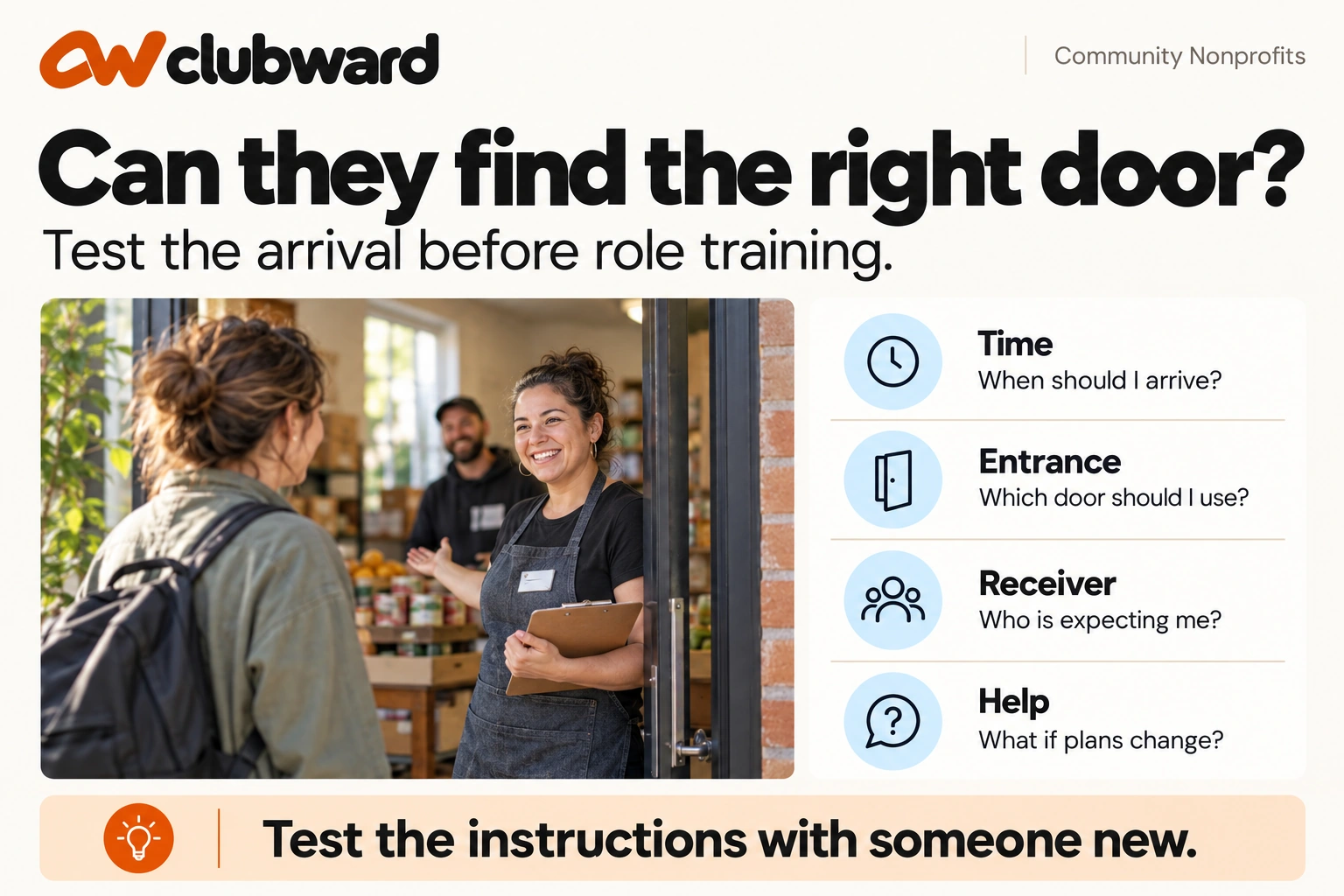
Ask a willing colleague or volunteer who does not already know the route to try the arrival task with your instructions. Explain that you are testing the message and handoff. Invite them to say what they are looking for as they work through it.
GOV.UK describes moderated usability testing as observing people attempt specific tasks, with thinking aloud helping researchers understand their actions and uncertainty. Apply that limited method to this arrival review. Read the usability-testing guidance.
Use a realistic task such as “You accepted the Saturday pantry shift; show me where you would go and who you would ask for.” Avoid giving clues that are absent from the message. Step in where necessary for safety or to avoid disrupting the venue.
Record the instruction that helped, the point where the person hesitated, and the clarification they needed. Do not score their speed. The useful result is an explanation of what the information and receiving arrangement need to provide.
Give the receiving role an explicit backup
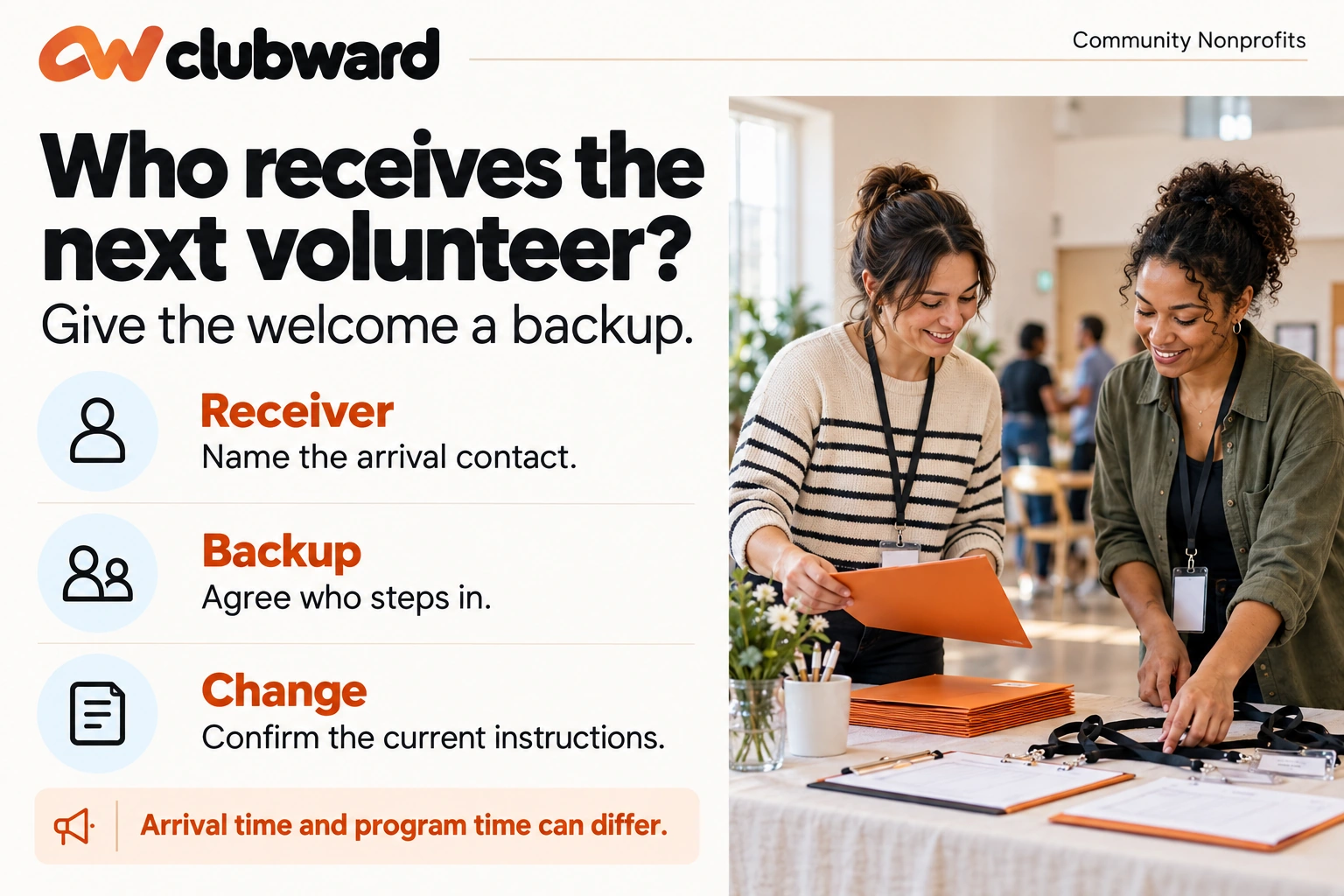
Name who receives volunteers during the arrival window and how that person knows whom to expect. Ask them to identify a backup through your normal staffing process. The backup should know where the current assignment list and arrival instructions are kept.
Test a simple interruption: the receiving person is helping a participant when a new volunteer arrives. What should the volunteer do, and who notices them? Write an approved next step that does not depend on walking into restricted rooms or interrupting an unrelated activity.
Check the contact route in the message. If it names a shared number or inbox, verify who monitors it during arrival. If it names a person, confirm that the arrangement is authorized and supported when that person is away.
Keep the backup instruction short. A volunteer needs to know what to do next, while the internal plan may contain more detail about coverage. Avoid putting a long organizational chart into a message intended to help someone reach one receiving point.
Work through a community pantry example
Imagine a Saturday pantry program using a community hall. The confirmation says to arrive at 8:30, while the calendar invitation shows the public opening at 9:00. The message names the hall but does not identify the volunteer entrance.
In a practice walkthrough, a new volunteer goes to the public entrance and finds it closed. The receiving coordinator is preparing materials at a side door. The correction is not a longer description of the pantry’s mission; it is a clearer arrival time, entrance, and receiving contact.
Revise the message to distinguish volunteer arrival from public opening. Ask the venue contact to confirm the entrance description, and have the coordinator check the actual route. Then give the receiving role an agreed backup for the arrival window.
Repeat the task with the revised instructions. Check whether someone can locate the entrance and explain what happens if the coordinator is temporarily occupied. Record any remaining ambiguity before using the template for the next group.
Make the message short enough to use on arrival
Put the practical arrival information near the beginning: date, reporting time, venue, entrance, receiving person or role, and help route. Follow with the few preparation details needed before arrival. Keep broader program background in a suitable separate location.
Use specific names that match the venue. If the door is identified by a visible sign, use that description after checking it. Avoid instructions such as “come around the usual way,” which require knowledge a new volunteer has not yet acquired.
Review any question you ask the volunteer to answer. The GOV.UK Design System recommends making the purpose of a question clear and asking only for information that is needed. Use that principle when reviewing pre-arrival confirmations. See its question-design guidance.
Give each requested action a clear response route. If you need confirmation of availability, say where to send it and who will review it. Avoid adding a checklist of acknowledgments without a plan for handling the answers or supporting someone who has a question.
Plan for changes and late arrivals
Use your organization’s approved approach for someone who is delayed or cannot attend. Make the contact and next step easy to find in the assignment message. Do not create a new attendance policy while revising directions.
Ask the program lead what should happen when a volunteer arrives after the initial briefing. Identify who receives them and how the required preparation is completed before they start the assigned work. Keep that decision connected to the role’s actual requirements.
For a venue change, make a list of affected messages and receiving responsibilities. Update the source details, notify the people who need them, and check what happens if someone follows the previous directions. Assign an owner to that final check.
Keep uncertainty visible internally. If the venue has not confirmed an entrance or opening arrangement, record the unanswered question and a decision date. Do not send a polished message that presents an unconfirmed detail as settled.
Review the first arrival with the receiving team
After the program, ask the receiving team which questions came up and what the instructions did not cover. Record specific observations, such as a volunteer asking which door to use. Avoid turning one comment into a claim about every volunteer’s experience.
Compare the observation with the version of the message that person received. A confusing arrival may reflect an old template, a late venue change, or an unclear sign. Identify the actual sequence before changing the new template again.
Ask new volunteers for feedback without making them responsible for redesigning the process. A simple question about where they hesitated can provide a useful starting point. Let them decline, and keep personal circumstances out of the general review unless necessary and appropriately handled.
Choose one correction, give it an owner, and test it at the next suitable program. Report what was checked and what remains unresolved. For the next intake, check whether volunteers can find the receiving person and whether the team records any remaining arrival questions.
Check what happens before the receiving window
Include one early-arrival scenario in your walkthrough. Ask the program lead what a volunteer should do if they reach the venue before the designated receiver is available. Use a venue-approved instruction and include only the detail the volunteer needs.
Then check the opposite situation: the receiver is delayed. Name the backup who can provide an update and the channel volunteers should use. Confirm that the contact route is monitored at the relevant time. Keep these instructions with the current assignment message, and revisit them when the venue or receiving team changes. The aim is a clear supported next step, without asking a newcomer to guess whom to interrupt.
Keep the arrival guide ready for the next coordinator
Store the approved template with its owner, last-check date, and links to venue information. Identify which details must be checked for every program and which are stable until the venue changes. This gives the next coordinator a review task rather than a document to copy blindly.
Keep the receiving responsibilities beside the template. The volunteer-facing message and internal coverage plan should describe the same arrival window. Review them together before a new intake or a program at a different venue.
When evaluating a club management platform for volunteer coordination, use this exact journey as a scenario. Ask how assignments, preparation, contact information, and receiving responsibilities would be handled in the proposed setup. Have the coordinator demonstrate how they would check the next arrival.
To explore the workflow with Clubward, request a volunteer-onboarding demo. Bring one upcoming community program and its current arrival message. Use the walkthrough to identify what your team needs before a volunteer reaches the door.
From Clubward Editorial Team
More from Clubward