

A family reaches the swim club gate with two guests. The attendant finds a pass purchase, yesterday's arrival and a cancellation, but cannot tell how many visits remain. The useful fix is a record that separates what was bought, what was expected and what actually happened, with a clear rule for when each guest uses an allowance.
Start by defining the counting event. Tie every visit to the host household, record the number of people admitted and keep corrections visible. Give unresolved questions to a named lead. That lets the desk welcome eligible visitors while a manager reviews the few cases that need judgment. You can build this process in a simple log before deciding whether to replace your current tools.
Choose the unit before choosing the tracker
Write one sentence that tells a new attendant when the allowance changes. “A visit uses one pass per guest when the guest arrives” gives staff a specific event to look for. “Members receive four passes” leaves the desk to decide whether that means four people, four reservations or four days. Those interpretations produce different balances even when everyone writes down the same arrivals.
Decide whether your unit belongs to a household, an individual member or another membership arrangement. Two adults on the same household might arrive separately with friends. If they share an allowance, the second attendant needs the household's balance, including the first visit. If privileges are individual, combining the records would give the desk an incorrect answer. Put that distinction beside the rule rather than asking staff to infer it from a surname.
Choose the period with equal care. A calendar month, a membership year and a pool season end at different times. Record the start and end dates you actually use. A season balance that resets during a renewal could inadvertently count the same included passes twice. Agree on whether a renewal changes the current allowance or starts the next period, then test an account near that boundary.
Separate a household allowance from any daily restriction. A household can have one monthly visit left and still be unable to use it on a day when guests are restricted. Staff should be able to explain which rule applies and what the host can do next. An unused balance is one part of the admission decision; it does not settle every question about a particular visit.
Keep purchases, plans and arrivals separate
A receipt answers whether money was taken. An expected visit says who plans to come. The arrival record says who came through the gate. If your rule counts attendance, an unused reservation should not quietly become a used visit. Staff need a way to distinguish those events even if they appear together on one screen or one paper sheet.
If your club sells passes in advance, decide how the desk handles an unused paid pass and who can approve a refund or credit. A cancellation may restore an allowance without returning money. A refund may return money after a visit was already counted. Record the outcome of each decision separately so the next attendant does not assume that one automatically resolved the other.
For example, a household buys five visits and uses two. A third planned visit is canceled before arrival. Under an arrival-based rule, three paid visits remain. If the household asks for a refund for the canceled visit, the treasurer still needs to decide whether the club's refund policy allows it. Until that decision is recorded, the pass count and the open payment question should both remain understandable.
Settle reentry before opening weekend. If one guest leaves for lunch and returns with the same host, does that use another pass? If your rule allows same-day reentry, give staff a quick way to find the earlier arrival. If the host must be present again, say so plainly. A second attendance entry can be useful without reducing the balance again.
Build a log a new volunteer can read
Keep the working record short enough to use at the desk. It needs the date, host reference, guest count, status, allowance change and any unresolved action. Add a payment reference when the visit involves a charge. Use the club's existing member identifier where possible; two households with the same surname should not be indistinguishable when the line is moving.
Choose labels that describe what happened. “Expected” means the group has not yet been admitted. “Arrived” means someone checked the group in. “Canceled” means the expected visit will not happen. “Corrected” explains why an earlier count changed. “Awaiting decision” means an identified person still needs to resolve the case. Your team may need fewer labels, but each label should have a clear job.
Keep sensitive details in their usual authorized records. The guest log can point to a waiver or account question without copying a private explanation into a shared shift sheet. Give the attendant the information needed for admission. Give the person resolving a payment dispute access to the relevant account record. The same view need not serve every role.
A note such as “manager approved” is hard to follow later. Record who decided, the date, the rule or exception involved and the effect on the balance. A brief entry can be enough: “Shift lead corrected duplicate arrival; one visit restored.” Avoid personal opinions about the member. Another staff member should be able to explain the transaction without interpreting someone's tone.
Work through a household balance
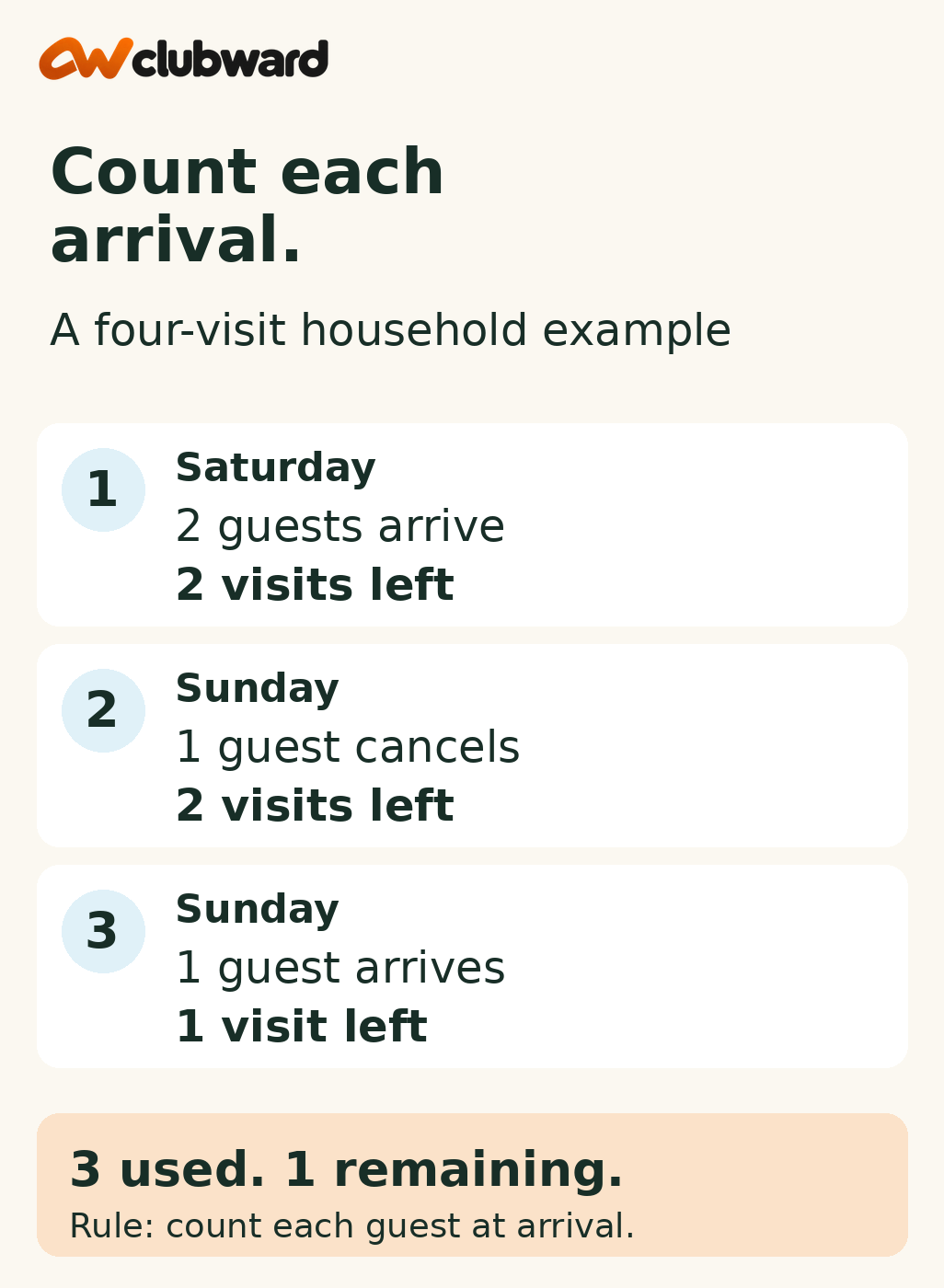
Suppose a household has four included guest visits for the month, counted when each guest arrives. Two guests come on Saturday. The household has used two visits and has two left. On Sunday, one expected guest cancels before arrival and a different guest attends. The cancellation uses no visit; the arrival uses one. Three visits are used and one remains.
Now add a duplicate. An afternoon attendant records Sunday's arriving guest again because they cannot find the morning entry. The log appears to show four used visits. The lead checks the visit and corrects the duplicate rather than deleting both entries or granting an unexplained extra pass. The household returns to three used visits with one remaining, and staff can see why.
The correction is not a special benefit for the household. It restores the count to the visits that actually occurred under the rule. Keep discretionary exceptions distinct. If a manager grants an extra visit after a closure, the record should show the added allowance and its reason. Mixing corrections with goodwill grants makes it difficult to tell whether a count was wrong or a policy exception was approved.
Before adopting a tracker, give this example to someone who did not build it. Ask them to find the balance, explain the duplicate and describe what happens next. If the answer depends on a private message or the original attendant's memory, change the record. The objective is a count another person can reproduce, not a total everyone has to trust without explanation.
Make the arrival conversation short
The attendant's first task is to identify the host and the visiting group. Then they check the applicable guest rule, confirm any required steps and record the arrival. Put ordinary decisions in that order so staff do not start collecting payment before discovering that the host cannot bring guests that day.
Give staff a natural explanation when something is missing. “Your household has one visit left, and two guests are here. Let me check the options for the second guest” is clearer than announcing that an account is invalid. The next step might be a paid visit, another eligible host or a manager's decision, depending on your rules. Do not ask volunteers to invent a new option.
Prepare for a host who believes the count is wrong. Show the visit dates and guest numbers that produced the balance, then identify the entry they question. Staff can record the disagreement without deciding it at the desk. Tell the host who will review it and when they should expect an answer. Record that promise so the next shift can follow through.
If the desk loses access to its usual record, use the club's agreed fallback. That might be a limited paper arrival log and a lead who can decide uncertain admissions. Define how those entries will be reconciled later. A fallback that creates an unexplained second balance can leave the morning and afternoon crews working from different versions of the same account.
Give exceptions an owner
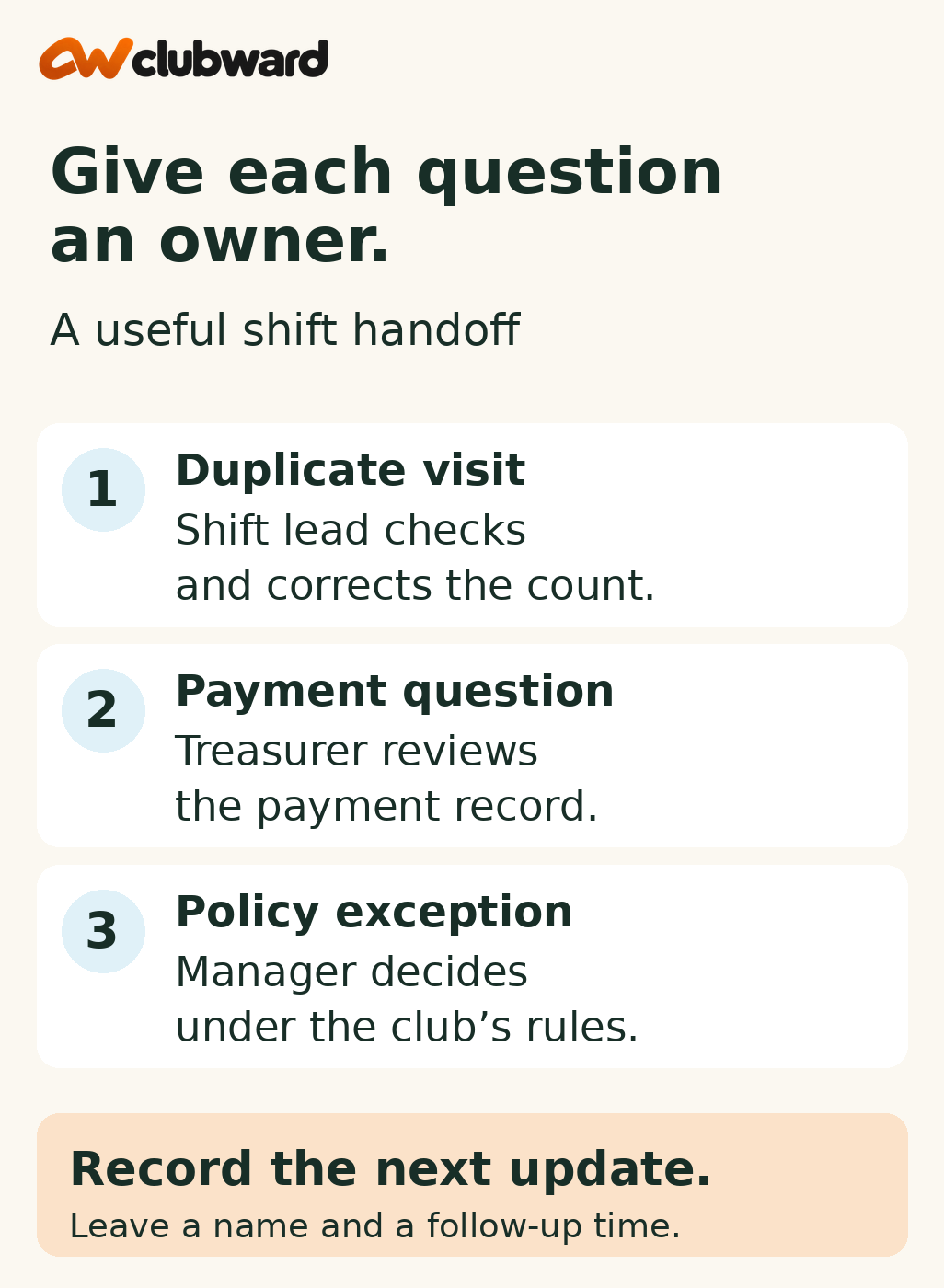
Do not ask the afternoon crew to reread every morning admission. Hand over the open decisions with the person responsible and the next update expected. A duplicate may belong to the shift lead, a missing payment to the treasurer and a policy exception to the manager. Distinguish the person who recorded the question from the person authorized to resolve it.
For a disputed charge, note the payment reference and what the host says happened. For a closure, note which visit was interrupted and the decision still needed. For a rule question, identify the provision the staff could not apply. Specific questions are easier to resolve than a general note that a family was unhappy.
Give the desk a phrase that acknowledges the issue without promising a result: “I can see the visit and the payment question. Our manager will review whether the pass should be restored. Here's when we'll get back to you.” The promise is an update, not an exception. It should fit the actual authority and availability of the person handling the case.
At closing, check the cases that are still open and the balances that changed because of corrections. If the same issue returns repeatedly, examine the rule or record before retraining everyone. A policy that depends on one experienced volunteer's interpretation will remain difficult for a new crew, regardless of how carefully they were shown the counting process.
Reconcile money without confusing admission
A guest fee can be included, prepaid or charged at the visit. Write down which arrangement applies before asking staff to collect anything. If two arrangements can apply to the same household, decide how staff choose between them. Otherwise a family may use an included visit and pay for it because two people followed different parts of the process.
Use a payment reference rather than asking the desk to remember a cash amount. At the end of the shift, the person reviewing payments can compare charged visits with recorded receipts and identify missing or duplicate entries. Keep that task separate from deciding whether a guest was admitted correctly. A correct admission can still have an unresolved payment question.
Consider a group of three guests when the household has two included visits remaining and the rule allows an additional paid visit. Record two allowance uses and one paid visit. The receipt belongs to that paid visit, not to the entire group. If the third guest cancels before arrival, the reviewer can see which count and payment decision need attention without undoing the other two admissions.
A balanced cash drawer does not prove that every guest record is right. Likewise, a correct guest count does not establish that every payment settled. Review each question in its own record, connect the references and assign the remaining work. This gives a treasurer and a shift lead a shared explanation while keeping their responsibilities clear.
Test the handoff before the busy season
Choose three recent situations that your staff had trouble explaining. Include one routine arrival, one cancellation and one correction or exception. Remove private details and give the cases to a volunteer who was not involved. Ask them to identify the host, calculate the balance and describe the next action. Watch where they pause or look elsewhere.
Time the exercise only to understand the process. Separate time spent finding a household from time spent reviewing an exception. One difficult case can make a short sample look slow even if ordinary admissions are straightforward. Keep the case details beside the observation so the team knows what it is trying to improve. Do not turn a few practice visits into a promised speed gain.
Change the smallest useful part first. A clearer household reference may solve a lookup problem. A separate cancellation label may solve a counting problem. A named lead may solve a handoff problem. Test the same cases again after that change. If you replace the entire process at once, it becomes harder to know which change helped and which created new work.
Before opening, agree on who updates the rule sheet, who trains replacement staff and who reviews the first weekend's exceptions. Put the current version where the desk can find it. If a board decision changes a guest limit, state when the new rule starts and how existing purchases are handled. A policy change should not silently rewrite the meaning of past visits.
Evaluate a platform with your own cases
Bring the same arrival, cancellation and correction cases when you compare club management platforms. Ask the person demonstrating the system to follow each case using the ordinary staff role. Look for the information staff enter, where the resulting balance appears and how the next shift learns what happened. A smooth sales demonstration is useful only if the everyday path is clear.
Ask what happens when the club changes its allowance period, corrects a duplicate or approves a one-time exception. Have the demonstrator show the outcome, not just describe a setting. If one uncommon exception needs a manager, that can be reasonable. If every routine visit needs managerial help, consider whether the process will suit the people who actually staff your gate.
Discuss existing records before agreeing to switch. Identify who owns the starting balances, which records can be transferred and how you will check them. A sample household with purchases, visits and a correction is more useful than an empty account. Compare the expected balance with the result and decide who signs off before staff use the new record for admissions.
Ask how your club gets its guest history out again. The useful answer includes the format, the fields available and the person responsible for helping if a report is unclear. Check the practical export against your reconciliation needs. Ownership is easier to exercise when someone has already tried the process before a rushed renewal or a change of volunteers.
A starter log for the next shift
Try these fields on a few visits before adding more columns. Each field should answer a question someone at your club actually needs to resolve.
| Field | What to enter | Why it helps |
|---|---|---|
| Host | Household or member reference | Find the right allowance |
| Visit | Date and guest count | Explain who used the visits |
| Status | Expected, arrived, canceled or corrected | Separate plans from attendance |
| Balance change | Visits used or restored | Reproduce the remaining total |
| Payment | Receipt or open question | Connect the financial review |
| Next action | Owner and expected update | Finish unresolved work |
For a paper log, number the entries so a correction can refer to the original line. In a spreadsheet, use a stable visit reference rather than a row number that changes when someone sorts the sheet. Do not combine two unrelated households into one entry simply because they arrived together. Each host should have an understandable record of the allowance used.
Review the log with a new attendant before printing a large stack or copying it across the season. Ask which fields are unclear and whether any field invites information the desk does not need. A shorter, well understood record can be more useful than a detailed form that staff skip when the gate gets busy.
Keep a completed example beside the blank version during training. Use a routine visit and a corrected duplicate so staff can see how the entries differ. Explain who checks the log at closing and where open cases go afterward. The template becomes useful when the next person knows both how to complete it and how to act on what is recorded.
Keep the first review focused
After the first weekend, review a small set of ordinary arrivals and every unresolved exception. Check whether staff used the right host, counted the right unit and left enough information for another shift. Note which questions were resolved and which still need an owner. An exception total on its own does not explain whether your rules worked.
Ask volunteers what they had to explain more than once. A repeated question about the reset date calls for a clearer explanation of the allowance period. Repeated duplicate entries call for a better arrival lookup or correction path. A complaint about the rule itself belongs with the people who approve policy. Treat these as different kinds of work.
Keep changes proportionate. If a short note beside the balance answers the recurring question, use it before writing a longer procedure. If the record is already clear but staff cannot see it in their role, review access and training with the responsible administrator. Give the next crew one dependable way to complete the visit rather than another checklist to reconcile afterward.
Choose where completed logs will be kept and who handles later questions. The desk should know how to find last weekend’s visit without keeping extra copies in personal messages. When a new volunteer takes responsibility, hand over the record location and unresolved cases together. That preserves continuity while giving the departing volunteer a clear point at which their part of the work is finished.
Bring a difficult visit to the walkthrough
Your club does not need to settle every unusual case before asking for help. Start with a guest visit that is hard to explain today and the rule you intended to apply. Bring the balance before and after, the payment question if there is one, and the handoff the next shift needs. That makes the conversation concrete.
Explore guest passes in Clubward alongside the process your desk uses today. Then bring your guest rules to a personal walkthrough so your team can work through the arrival, the exception and the next shift's view together.
From Clubward Editorial Team
More from Clubward