

You finally have a spot for a family that’s been waiting to join your swim club. You’re about to send the offer when they ask, “We paid $50 when we signed up. Does that come off the bill?” You find their name on the waitlist. The receipt is in an old inbox, and the volunteer who took the payment is away this week.
Start with the original receipt and the terms the family saw when they joined the list. Check whether the payment goes toward the joining fee, comes off the first dues bill, or stays a separate application fee. Connect it to the same household when you make the offer. If the family gets a credit, put it on the right line of the first bill and mark the earlier payment as used. The family should be able to see what they paid before and what they owe now.
Here’s how to follow that payment from the waitlist to the first bill, even when one volunteer looks after the list and someone else does the billing. There’s an example you can try with your team and a short test you can bring to a software demo.
What did the family pay for when they joined the list?
Find the wording on the signup form and the receipt. Your club might use “waitlist deposit,” “application fee,” or “waitlist fee.” Those names can sound alike to a family. Write down what the payment actually does and when the family can expect to see it again. That sentence belongs on the signup page and in the confirmation they can save.
Real clubs do this in different ways. Seven Locks Swim & Tennis Club says its waitlist payment goes toward the first summer’s dues when membership is processed. Lowry Swim Club says its deposit goes toward the initiation fee, the one-time charge for joining. The published 2025 bylaws for North St. John’s Swim and Tennis Club describe a waitlist fee that stays separate from both the bond and dues. Each example has a different answer to the family’s question.
It’s worth checking when the payment counts, too. A club may let the family use it when the offer is accepted, when the joining fee comes due, or when another condition has been met. Rama Swim Club’s waitlist FAQ explains when its payment is deducted from the initiation fee, including how that works with installments. The useful thing to borrow is the level of detail. Your board and treasurer can tell you which wording fits your club’s approved terms.
If your club charges nothing to get on the list, a simple line saying that can save a few emails. You can still tell people what they might owe if you offer them a place. If the exact dues are set later, say when the family will get the current amount and what they’ll have to do to accept.
Give the payment a home the next volunteer can find
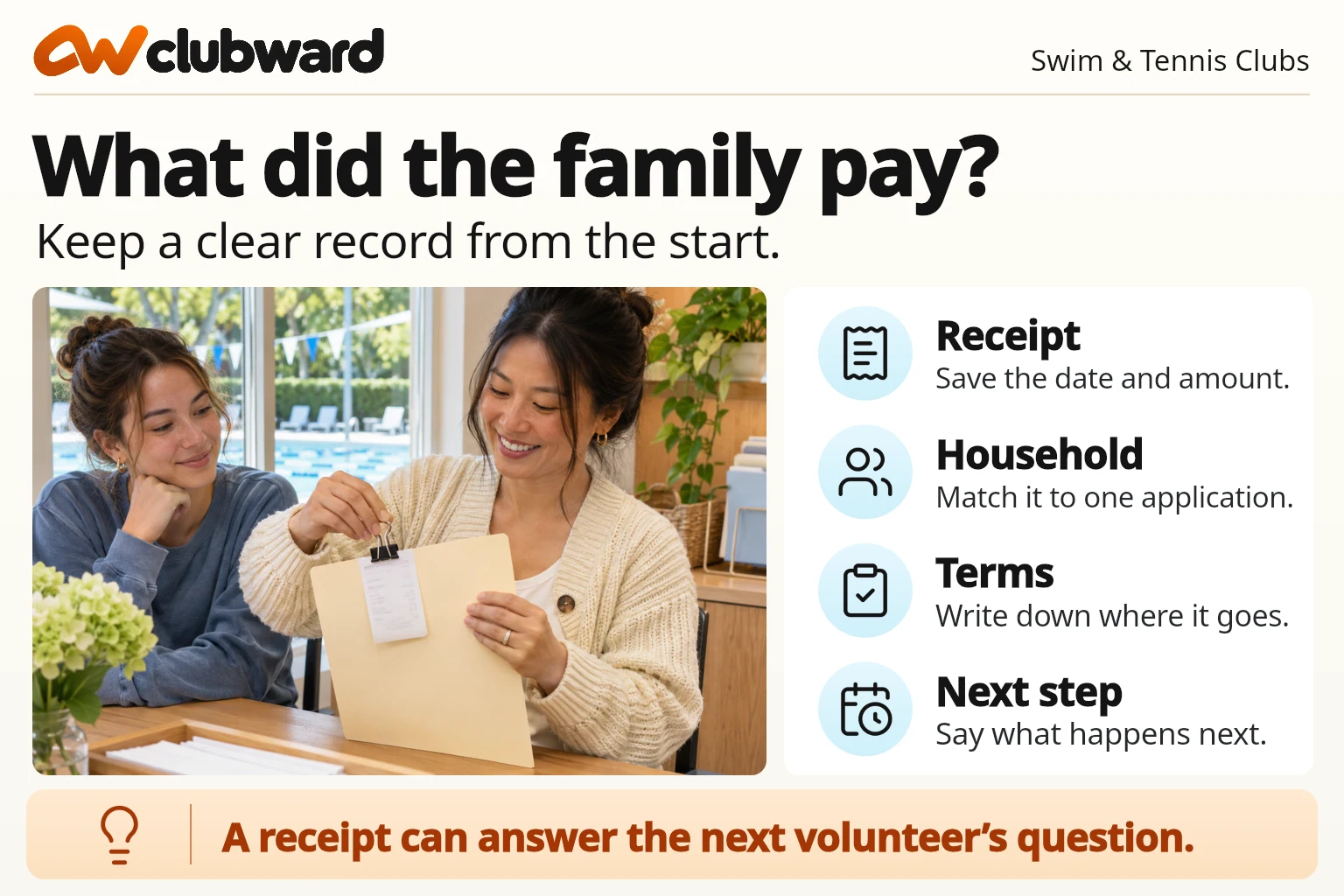
Save the amount, payment date, receipt reference, and the waitlist application it belongs to. Keep the terms or confirmation close enough that the next person can find them. On a busy day, you want the treasurer to open one application and trace the original payment without searching the old chair’s inbox or guessing which of two people shares a last name.
Use the application number or another reference your club can keep from season to season. A family might apply using one adult’s email and make the payment with the other adult’s name on the receipt. An email address is helpful when you’re looking for a match. It’s even better when the email can change without breaking the connection between the signup and the money.
Give the waitlist chair a quick way to see whether the payment is confirmed, missing, or waiting for the treasurer to check. Keep private payment details with the people who need them. The chair generally needs the amount, receipt reference, and the decision about where it goes. Payment card or bank details can stay with your payment provider.
| What to record | What it lets you answer later |
|---|---|
| Application number and household | Which family and which place in the process does this payment belong to? |
| Amount, date, and receipt reference | What did they pay, and where can the treasurer check it? |
| Terms they accepted | Does this amount stay separate, get credited, or need another decision? |
| Where it went | Was it applied to an invoice, returned, or left open for review? |
If your club takes checks as well as online payments, decide who marks each one as received and who checks that it has cleared. Write down which status gives the family a place on the list under your policy. A volunteer can acknowledge that an envelope arrived while the treasurer is still checking the payment. Give both people the words they need to describe where things stand.
Keep the application, the offer, and the bill connected
Once you have a place to offer, open the original application before you build the invoice. Check the household that’s being offered a spot and whether the current contact is the same person who applied. If an old email address bounced, follow your usual contact process. Keep the old receipt connected to the application while you confirm where to send the new message.
A list of names can help you decide who’s next. This payment check starts after your club has picked the family to contact. If you’re still working out how many spots to offer or whether the people on the list are ready, start with our guide to checking whether the waitlist reflects real demand. Once someone has a place to offer, the billing question becomes much easier to see on its own.
When an old payment can be applied, write down which line it reduces. A joining fee and the first season’s dues can both be due around the same time. They may have different dates, and your club may spread the joining fee over more than one bill. Check the exact bill and the exact line before promising a total in the offer.
Take a minute to review the offer from the family’s side. Tell them the membership they’re being offered, the amount already on file, where it’s applied, and what’s still due. Give them a deadline and one contact who can help if the receipt looks different from what they remember. Use the same words on the offer and the invoice, so “joining fee credit” has the same meaning in both places.
Follow one $50 waitlist payment to the first bill
Here’s a made-up example you can use with your committee. The Parker family paid $50 to join Brookside Swim Club’s waitlist. The terms for their application say the $50 comes off the one-time joining fee when they accept a spot. The joining fee is $225 and the first season’s dues are $325. Both are due together in this example.
| First bill | Amount |
|---|---|
| One-time joining fee | $225 |
| Waitlist payment applied to joining fee | −$50 |
| First season’s dues | $325 |
| Total still due | $500 |
The treasurer saves the original $50 receipt with the new bill and notes that the family used that payment on this invoice. The membership chair sees the same amount when preparing the offer. The family can add $225 and $325, subtract $50, and see why their balance is $500. Anyone covering the next volunteer shift can get to the same answer from the record.
Now try the same figures if the accepted terms say the $50 comes off first dues. The total for this bill still works out to $500 because both charges are due together. The lines change. The joining fee stays $225 and the dues line comes to $275 after the adjustment. If your club bills those charges on different dates, the family’s next payment can change even though the combined total works out the same.
Try a third version with a separate application fee. The family can still see the earlier payment on the application. Under this version, the first bill shows the full $225 joining fee and $325 dues, for $550 due. Show the terms for the earlier $50 so they can understand why it’s absent from the amount due.
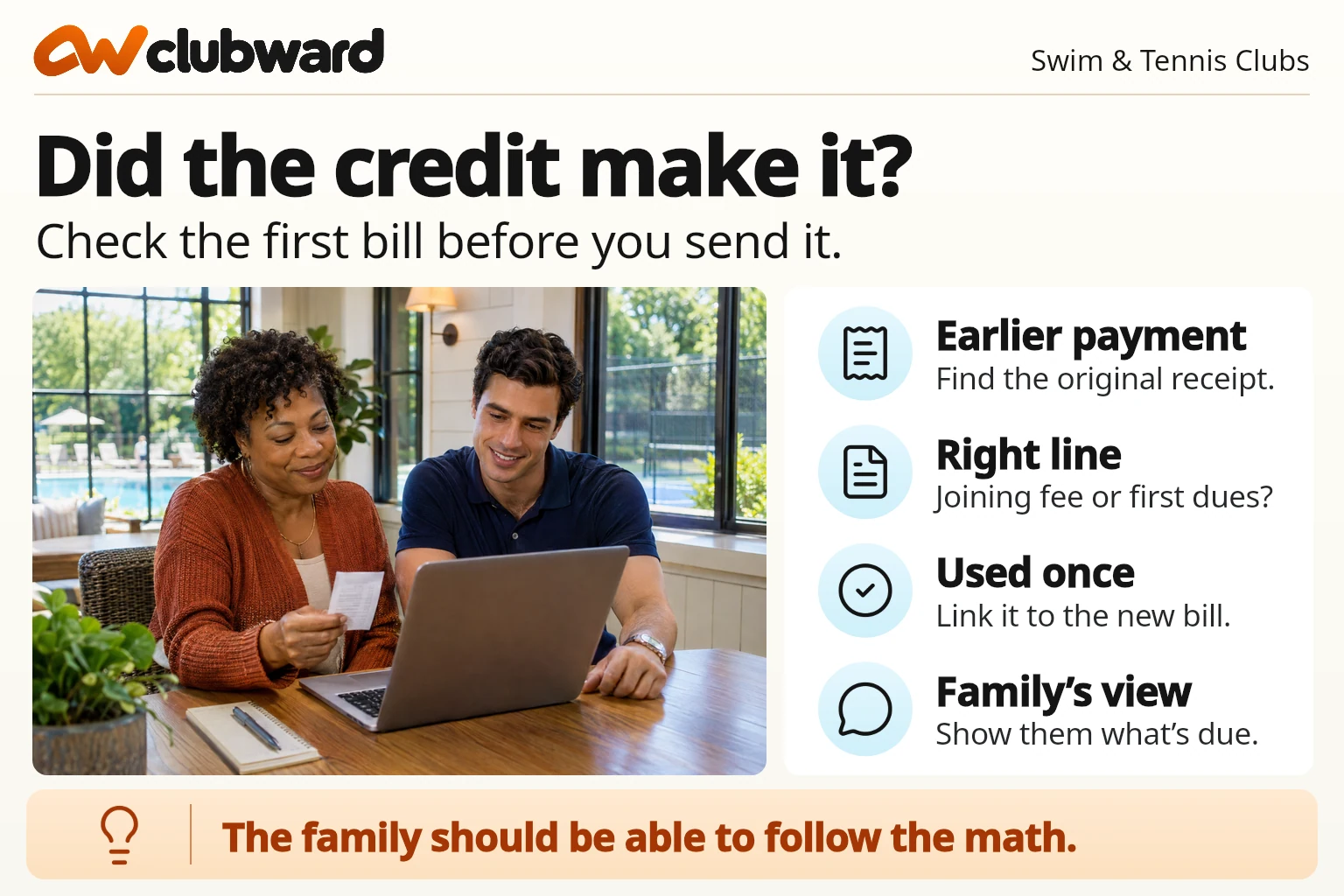
Have another volunteer compare all three versions. Ask them to point to the line getting the credit, show what it leaves due, and explain where they can tell the payment has been used. If they can follow the math without calling the person who made the bill, you’ve got a process someone can pick up when the treasurer is away.
Write the offer so the family can check the math
If the Parkers took a screenshot of the signup receipt, they could compare it with the sentence below. Use the same clear labels from your own terms and only give a total after the person who owns billing has checked it.
Hi Alex, we’ve got a family spot for you at Brookside this summer. Your joining fee is $225, and we’ve put the $50 you paid when you joined the waitlist toward it. Your season dues are $325, so $500 is due in all. Please let us know by Friday if you’d like the spot. I’ve included the bill so you can see the details. If the earlier payment looks different from what you remember, reply here and I’ll help you check it.
If the payment is still being checked, acknowledge that you’ve heard from the family and tell them what happens next. You might write, “Thanks for sending that receipt. I’m checking it with our treasurer and will get back to you by Wednesday.” Keep a note about the offer deadline and have the person with authority decide how to handle it if the club’s review takes longer.
After the family accepts and the agreed steps are done, point them to the information they’ll need for their first visit. Our new member onboarding checklist gives you a welcome email and a first-visit plan. The handoff is easier when the welcome volunteer can see which membership the family accepted and whether anything is still waiting on the billing team.
What if someone can’t find the original receipt?
Start with the date, amount, and the name the family used to apply. Ask for a receipt reference if they have one. Give the treasurer enough information to check the club’s payment record. If the family’s name appears twice, mark the match for review and leave a note on the application so another volunteer can see someone is already working on it.
Suppose Alex used a different email when the family applied than the one on the current offer. A reply from a new address alone doesn’t settle which household should get a credit. Check the original application and payment through your club’s usual process. Once you confirm the match, update the contact reference and leave the payment history attached to the right application.
If there are two receipts, check whether two payments actually went through. Sometimes a confirmation is forwarded twice. Other times two adults paid while both were trying to get the family onto the list. Keep the receipts visible while the treasurer checks them. If the club decides to correct a duplicate payment, record the outcome alongside the original entries and tell the family how it affects their bill.
It helps to make the open question specific. “Who paid the April 4 deposit?” gives the next volunteer a starting point. “Check account” could mean almost anything. Ask the person reviewing it to save what they found and who should contact the family. That way the family gets one clear answer even if they first spoke to someone else.
Decide who checks a declined or expired offer
A family might accept, ask to wait another season, or miss the deadline. Ask what the club already approved for each outcome. The membership chair needs to know what happens to the place in line. The treasurer needs to know what happens to the payment. Give both people a way to see the current decision and whom to ask about an exception.
If the approved terms carry the amount forward, keep the original receipt linked and record when it can be used. If the amount is being returned, record the return and who’ll confirm it. If it remains an application fee under the terms, send the family a short explanation when they ask. Use the wording they were given when they signed up and keep a record of the reply.
Here’s a case worth practicing. A family declines in May and gets another offer the following spring. The new treasurer should be able to see their original receipt, the outcome of the first offer, and whether the payment is still available. If the only answer is in an old email, move that decision into the application record before the next round of offers.
Keep track of older payments when the rules change
A long waitlist can span a change in fees, a new treasurer, and a different payment tool. Imagine Brookside changes its waitlist terms after the Parkers join. The signup page now says the payment goes toward first dues, while the Parkers’ confirmation says it goes toward the joining fee. Staff need a way to find the earlier terms and ask the board or treasurer which rule applies to that family’s offer.
Before you send a batch of offers, look for the first application made under the new wording and the last one made under the old wording. Save the date and policy reference on each record. If families were told about a change, keep that notice with the terms. The person reading the file later can work out which question to bring to the board without opening every email that went out that season.
Mark older amounts that are still open when a new treasurer takes over. You can do it with a small table in the same place you keep the waitlist. Ask the outgoing treasurer to show one payment already used, one amount that can still be used, and one that needs a decision. Have the incoming treasurer find each one using the application number. If they get stuck, add a pointer to the right receipt or decision while the person who knows where it lives is still there.
For an installment plan, check the date and invoice where the payment will apply. If the club approved putting the $50 on the second installment, the first invoice can explain when the family will see it. The person checking offers next month should be able to find that same note and see whether the second invoice has gone out. An amount that will be applied later needs a place on the follow-up list.
When the terms leave a question open, save the answer approved for that family with the bill. You’ll have something to point to when another volunteer needs to explain the amount.
Check the first few bills before you send the rest
Try three sample applications in a quiet hour. Pick one with a confirmed payment, one with a receipt that needs to be matched, and one that already used its credit. Ask your backup to open each record and explain what the family should see. Save the results with the date and the person who checked them, so you have something concrete to compare if you change billing tools.
- Can the membership chair find the original terms and the application number?
- Can the treasurer find the receipt and tell which charge it should reduce?
- Does the first bill show the credited amount and match the offer?
- Can the next volunteer see that the credit was used and where it went?
- Can someone handle a missing receipt or a delayed payment without sending the family a second bill?
Recheck the first invoice after a system move or a change to your membership packages. If you import an application list and its payment history from separate places, ask the team to follow one older payment right through to the first bill. That will show whether the new setup kept enough detail for the volunteer answering the phone. Tell the team where to look up an older receipt if the new platform holds only a reference.
Once your test works, spot check a few real offers before the next batch goes out. Compare the amount due with the amount in the email and look for a second invoice that might reuse the same receipt. If you find a mismatch, pause that case and ask who can correct it. You can keep sending the offers you’ve checked and give the other family one person to follow up with.
Bring one waitlist receipt and one first bill to your demo
If you’re comparing platforms, give each vendor the same sample. A family paid $50 to get on the list. Their rules apply it to a $225 joining fee and their first dues are $325. Ask to see the payment history, the staff view, and the bill that shows $500 due. Then change the example so the credit was already applied and ask how staff would catch a second attempt.
Ask where each step happens in the proposed setup. Some teams use one system for applications and a separate tool for collecting money. What matters to your volunteers is knowing where they can see the receipt, which person can apply the payment, and how they check the bill the family gets. Write down any step the treasurer would still need to do by hand, especially when old payments come from a different tool.
The Clubward platform connects membership packages, household records, and dues invoices. If you’re curious how that would fit your club’s process, book a membership walkthrough and bring a sample receipt and the first bill you’d want to send. We’ll follow that one family’s example together and help you check how the handoff would work for your team.
From Clubward Editorial Team
More from Clubward