HOA & Condo Communities
The Guest Has Permission. Which Amenity Rule Applies Today?
Connect guest permission to the current amenity rule, a recorded exception, and one clear front-desk answer.

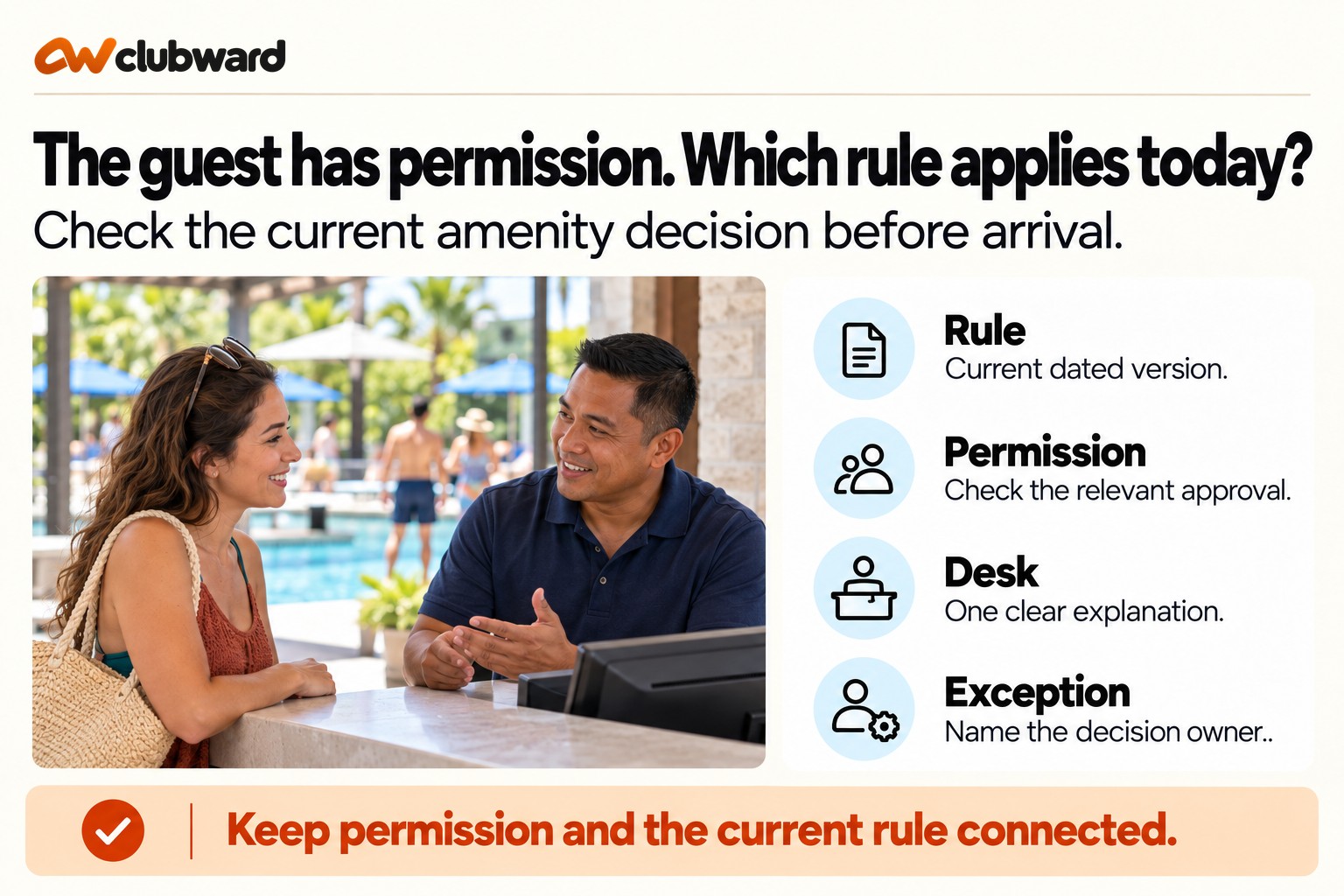
A resident arrives at the pool with a guest and an email saying the visit is approved. The attendant checks the current instruction and sees a different guest limit. The resident has brought permission; the employee still needs to know which amenity rule applies to this visit, on this date, for this household.
Resolve that question by connecting three things: the current approved rule, the visitor's eligibility, and any specific exception. Permission should identify what was approved and when it applies. A general email, an old pass, or a previous successful visit should not force the attendant to interpret a board decision at the entrance.
A useful guest procedure gives staff an ordinary path, an exception path, and a clear place to send unresolved cases. It also tells residents what to bring and what an approval means. Start with one amenity and three realistic arrivals, then turn the answers into an instruction the next shift can use.
Separate a resident's access from a guest's permission
Begin by identifying who is requesting entry. An approved resident, a household member, a visiting guest, a contractor, and a participant in a scheduled activity may follow different community procedures. Record those distinctions in the operating instruction using the categories your community actually recognizes. Do not create new visitor classes simply to make a spreadsheet easier to fill.
Next identify the amenity and the date. Permission for a clubhouse gathering does not necessarily explain pool entry, and a guest approval for Saturday does not establish permission for the following weekend. Staff need the scope of the approval before they can apply it. Make that scope easy to find without opening the entire history of the household.
Use the approved policy to define the ordinary guest requirements. These might include a resident host, a guest allowance, a permitted visit period, or a check-in procedure. The point is to make the existing decision usable, rather than inventing a universal guest rule. Where the wording leaves an important question unanswered, route it to the authorized policy owner before asking the front desk to improvise.
Keep the host and guest questions distinct. A resident's membership or access status may establish the host's eligibility. It does not, by itself, answer how many guests may accompany them or whether an exception applies. The attendant should be able to explain both decisions in plain language.
Name the source staff should use today
Choose the current approved operating instruction and identify its owner. Include an effective date and a version marker that staff can recognize. A board minute may record the decision while a desk instruction explains its application. Link the two internally so an authorized reviewer can trace the instruction to the decision without requiring every employee to read meeting records.
Explain what happens when documents disagree. For example, the employee might find a current desk instruction, an older sign, and a resident's email. The procedure should direct the employee to the current instruction and a named reviewer for any conflicting approval. It should not ask them to decide which document sounds more authoritative.
Review the places residents encounter the rule: the amenity page, guest-pass instructions, confirmation messages, posted signs, welcome materials, and conversations with management. Each should point toward the same practical answer. Updating only the desk copy may leave residents following a reasonable instruction that the team has already replaced.
When a rule changes, identify the visits already approved under the earlier instruction. The responsible community authority should decide how those approvals are handled. Staff need the resulting direction before the effective date. An announcement of a new limit does not automatically resolve an existing exception or explain a promised visit.
Make an approval specific enough to apply
A useful approval identifies the host, the amenity, the visit date or period, the approved guest scope, the approving role, and any conditions staff must check. If it is an exception, state that explicitly in the internal record. “Approved” alone does not tell the attendant whether the decision covers one person, several guests, one occurrence, or an ongoing arrangement.
Keep the resident's confirmation shorter than the internal decision record. Give them the amenity, date, arrival instruction, and any action they must complete. Include a contact route for changes. The resident should be able to understand the visit without receiving internal debate, private household details, or unrelated policy history.
Set an end point for temporary permissions. This could be a specified occurrence, a date, or the completion of the approved visit. Record what closes the approval and who checks unresolved cases. An expired exception should remain available as history when appropriate, while being clearly distinguishable from permission for a new arrival.
Do not expand an exception through casual wording. If an approval covers a Sunday family visit, a message saying “your guests are fine” may be read as an ongoing arrangement. Use the actual scope in the confirmation and in the staff view. Precision helps both the resident and the employee carry the same decision forward.
Build a three-case decision sheet
Use three cases to test the procedure. The first is an eligible resident arriving alone. The second is an eligible host bringing a guest within the ordinary rule. The third is a guest visit that depends on an exception or has conflicting information. Each case should end with an action and an owner.
- Resident arrival: Check the approved resident access procedure and direct the person through the ordinary arrival process.
- Ordinary guest arrival: Check the host, the amenity, the visit period, and the guest conditions defined by the current instruction.
- Exception or unresolved arrival: Check the specific approval, its scope, its effective period, and the reviewer who can decide a conflict.
Keep the decision sheet focused on the service moment. It should tell the attendant what to check, what a completed check allows them to do, and when they have reached their authority limit. A long list of policies without actions is difficult to use while residents wait at the entrance.
Add one example beneath each case. Use ordinary situations from your amenity operation, without copying private household records into a shared training document. Ask a second employee to apply the sheet without help from the writer. Any missing fact they need is a candidate for a clearer instruction.
Give unresolved cases a place to go
Some arrivals will remain uncertain even with a clear procedure. The approval may lack a date, the host may not match the record, or an older confirmation may describe different conditions. Define the escalation route before those cases occur. Name the role available during amenity operating hours and identify the backup when that person is away.
The attendant's job is to describe the unresolved question accurately. A useful handoff says, “The guest has an approval for the clubhouse, but today's request is for pool entry.” It gives the reviewer the relevant facts without turning the resident's request into an accusation. Keep the explanation specific and proportionate.
Give staff a short resident-facing response: “I can see the approval you brought. I need our designated reviewer to confirm whether it applies to today's pool visit.” Adapt that wording to the community's actual procedure. Avoid promising an outcome before the person with authority has reviewed the case.
Once a decision is made, record its scope and communicate the next action. The next shift should not have to reconstruct the same question from memory. If the case reveals an unclear ordinary rule, send that issue to the policy owner separately from the immediate arrival decision.
Work through a dated guest exception
Consider a community whose ordinary instruction allows a defined number of accompanied pool guests. A resident requests an additional guest for a family visit on October 10. The authorized reviewer approves that specific visit. The confirmation identifies the date, the pool, the host, the permitted guest scope, and the arrival procedure.
Before the visit, management checks that the exception appears in the operating information available to the pool attendant. The desk instruction remains the ordinary rule; the exception is a separate dated decision. This allows the attendant to apply the standard process for other households while recognizing the approved variation for this arrival.
On October 10, the resident brings the confirmation. The attendant verifies the relevant scope and follows the community's check-in procedure. If the number of arriving guests differs from the approval, the employee routes that difference to the reviewer rather than extending the exception independently.
On the following weekend, the old email remains in the resident's inbox, but its date is visible. The staff view distinguishes the completed visit from current permission. If the resident requests the same arrangement again, management can review a new request without treating the earlier decision as a permanent guest allowance.
Prepare staff for a rule change
Before a new guest instruction takes effect, show staff the precise change. Use an old-and-new comparison that focuses on the actions they must perform. Explain the effective date, the treatment of prior approvals, the revised resident message, and the escalation contact. Avoid handing over a long policy document with only “please review” as the instruction.
Practice one ordinary arrival and one exception. Have an employee explain the current rule to a colleague playing the resident. Then introduce an older email and ask them to identify what remains uncertain. The rehearsal should test how the employee finds the answer and reaches a reviewer, not whether they can remember every clause.
Include seasonal, substitute, and weekend employees who will apply the procedure. A change is incomplete if the weekday office understands it while the Saturday attendant uses the old instruction. Check the shift coverage for the effective date and confirm that the incoming employee receives the current material.
Retire outdated operating copies through the community's normal document process. Preserve decision history where needed, but mark historical material clearly. Staff should not have to guess whether an old sign or attachment is still active simply because it remains easy to find.
Make resident communication answer the next question
Write the resident message around what they need to do. Explain when the instruction applies, how a guest visit works, what the host should prepare, and where questions go. If an existing approval needs review, state the next action and the date by which management will provide an answer.
Check that the message makes sense without knowledge of the board discussion. A resident does not need the internal history to plan a visit. They need a usable instruction. Replace vague phrases such as “updated guest procedures apply” with the relevant action, while keeping the message faithful to the approved rule.
Review confirmation templates as well as the announcement. The community may send a clear update on Monday while an unchanged guest-request response repeats the old process on Tuesday. Identify the owner of each active template and confirm that it reflects the effective instruction.
Offer the community's established help route for people who cannot complete the usual digital step. The procedure should explain how staff handle that request and preserve a clear decision record. An employee should not need to invent a parallel guest process simply because the resident asks in person.
Check one visit across the whole operation
Choose an upcoming guest visit and follow it from request to arrival. Review the resident's initial instruction, the information management receives, the approval, the confirmation, and the staff view. Ask whether each stage identifies the same amenity, date, host, and conditions.
Then change one detail. Move the visit date, change the amenity, or ask what happens when an approval is withdrawn by the authorized role. Trace the effect through the record and the messages. A process that works only for the first request may leave staff without a clear answer when the plan changes.
Ask the attendant to find the current instruction using their normal access. They should not need management's private inbox or broad access to unrelated household information. Note any separate handoff the team still needs and assign it. A connected record is useful only when the person applying the rule can reach the relevant facts.
For a personalized Clubward demo, bring these same three arrivals: resident, ordinary guest, and dated exception. Follow each through the workflow and ask how your chosen policy becomes a clear staff action. Include a changed date so the evaluation tests an actual operating handoff.
Use repeated questions to improve the instruction
After the first week, review a small sample of guest questions. Separate missing information from disputed decisions. A missing date may call for a better confirmation field. Repeated uncertainty about whether hosts must remain present may need a clearer approved instruction. A request to change the policy belongs with the community's decision-making process.
Record the issue, the example that revealed it, the responsible owner, and the proposed next step. Avoid collecting personal detail that the review does not need. The aim is to improve the procedure, not to build a narrative about individual residents or employees.
Give leadership a practical summary. Explain which part of the process is unclear and what decision would resolve it. “Guest questions increased” is difficult to act on. “The confirmation does not state whether the approval covers one occurrence” points toward a specific correction.
Review the corrected instruction with the next shift. Use the same scenario that caused the question and confirm that the employee can now reach a consistent answer. That closes the improvement loop and prevents a revised document from becoming another update nobody knows how to apply.
Check what changes when the host is different
A guest approval belongs to a particular operating context. Before staff apply an earlier confirmation to a new arrival, check whether the host is the same person or household recognized by the approval. If a different resident is now hosting, follow the community's procedure for that change. Do not assume that a guest's name alone carries the permission across households.
Consider an approved family visit where the original host cannot attend and a neighbor offers to accompany the guests. The employee should identify the changed fact and refer it to the designated reviewer if the current instruction does not resolve it. The reviewer can apply the approved policy and document the outcome. The attendant should not have to invent a transferable permission rule at the gate.
Use this scenario during staff practice because it distinguishes identity from permission. A guest can be recognized, a confirmation can be genuine, and a visit can still differ from what was approved. The response should acknowledge the resident's information while explaining the specific question that remains open. That is more useful than treating every disagreement as a missing pass.

Keep the operating record proportionate
Decide what information each role needs before adding fields to the guest procedure. The reviewer may need the original request and decision context. The attendant may need the host, amenity, effective period, conditions, and current status. The resident needs a clear confirmation and next step. Giving everyone the entire record can make the useful answer harder to find.
Use your community's established access and record-handling procedures for personal information. Avoid putting private explanations into a widely visible desk note when an operating condition is sufficient. If an attendant needs help with an individual case, the escalation route should let an authorized reviewer handle that detail without broadcasting it to the waiting line.
Review new fields after a few visits. Ask what decision each field supports and who uses it. If nobody can explain its purpose, reconsider whether it belongs in the operating view. A concise, current instruction can be more usable than an exhaustive form that staff cannot scan during arrival.
Make a small change that the team can verify
Start improvement with the point where the current process loses clarity. If the approval lacks a date, fix the confirmation and staff view. If the rule changes without reaching weekend attendants, fix the shift handoff. If exceptions remain active after their visit, define a closing step. Avoid replacing the whole process before understanding the specific failure.
Assign one owner to the correction and name the visit or shift used to test it. For example, the office lead can revise the guest confirmation, the amenity supervisor can check the current staff instruction, and the Saturday attendant can apply the three-case sheet to a practice arrival. Each person should know what evidence shows their step is complete.
Review the result with the people who receive the consequences. Ask the resident-facing team whether the instruction was understandable, the attendant whether the decision was reachable, and the reviewer whether unresolved cases arrived with enough context. Use those answers to make the next correction small and specific. An improvement is complete when the changed instruction works during a visit, not only when someone approves the document.
Set a review date when the revised procedure first goes into use. Choose a small number of completed visits, including an ordinary guest and an exception. Compare the request, approval, confirmation, and arrival instruction for each. Ask whether another employee could explain the outcome from the record. Where they cannot, identify the missing fact and the person responsible for providing it. Keep the correction with the procedure so a substitute or future supervisor can understand why the instruction changed and how to apply it during the next visit.
Leave the next shift one current answer
Before the amenity opens, the responsible lead should confirm the current instruction, effective date, active exceptions, and escalation coverage. Check any approval that will matter during the shift. If an unresolved case remains, make its owner and next review time visible to the appropriate employee.
A guest procedure is ready when a resident can plan the visit, an attendant can apply the ordinary rule, and a reviewer can resolve an exception without reconstructing a message chain. Keep those three outcomes at the center of the work. The current rule and a specific dated permission should support each other rather than compete at the entrance.
From Clubward Editorial Team
More from Clubward