Property Management Companies
How Property Managers Can Turn Amenity Request Patterns Into a Better Staff Plan
Recurring amenity requests can reveal a coverage problem, an unclear process or missing resident information. This review turns the pattern into a practical next step.

The property team receives more clubhouse and amenity questions every evening, so the obvious answer seems to be more coverage. Yet the request total alone cannot show whether the team needs another person, a clearer reservation status, better resident onboarding or a handoff that reaches the front desk too late.
Good staffing decisions begin with the work behind the volume. A request that takes thirty seconds because the answer is visible is different from one that requires searching three systems and calling a manager. Ten password questions are different from ten disputed bookings. If those categories are mixed, the staffing plan will address the symptom while the process continues producing avoidable work.
Use a two-week request review to connect each contact with its reason, timing, effort and resolution path. Then decide whether the next step belongs in resident communication, amenity setup, staff authority, shift coverage or client policy. The goal is not to make residents stop asking for help. It is to make the common request easier to answer and reserve skilled attention for the cases that actually require judgment.
Read the signal without rushing to a conclusion
Operational signals are useful because they direct attention. They are dangerous when a team treats them as an explanation. A higher count, lower count or changed routine does not identify the cause by itself. Begin with the recorded event, check whether the data was captured consistently and add the context that the people closest to the work can provide.
Use a defined comparison period and keep unlike events separate. A policy question is not the same as a broken credential. A registered participant is not the same as an attendee. An interested volunteer is not the same as a confirmed shift. Clean categories protect the decision from a dramatic total that combines several different problems.
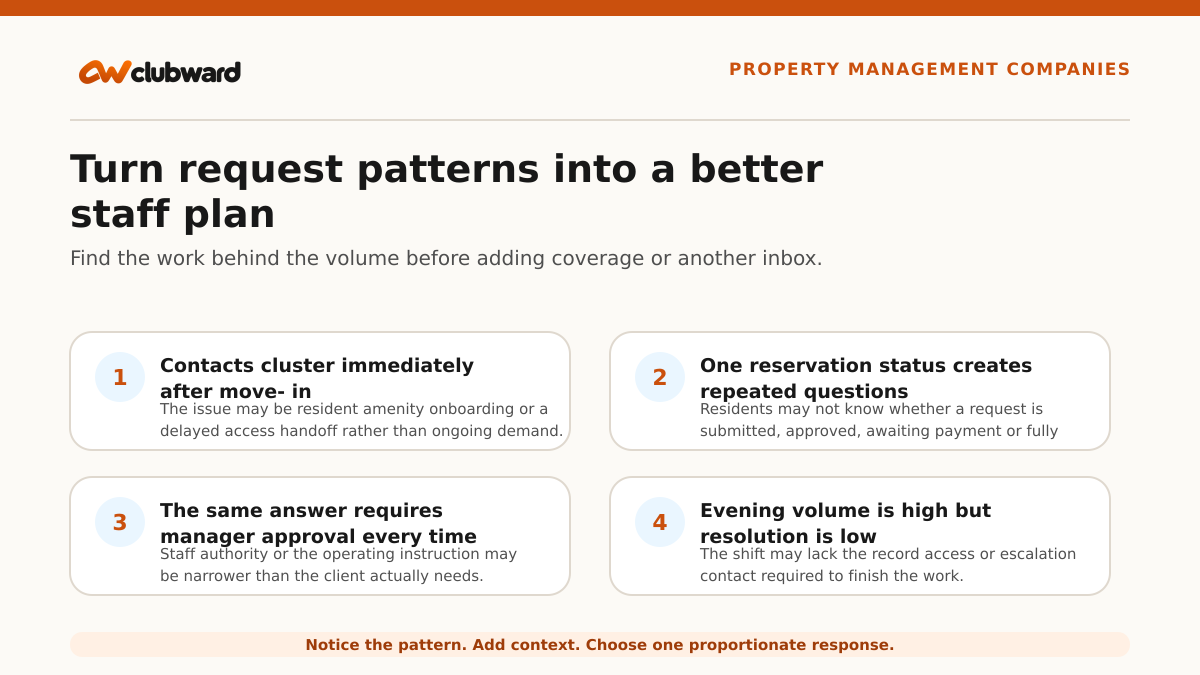
- Contacts cluster immediately after move-in: The issue may be resident amenity onboarding or a delayed access handoff rather than ongoing demand.
- One reservation status creates repeated questions: Residents may not know whether a request is submitted, approved, awaiting payment or fully confirmed.
- The same answer requires manager approval every time: Staff authority or the operating instruction may be narrower than the client actually needs.
- Evening volume is high but resolution is low: The shift may lack the record access or escalation contact required to finish the work.
- Questions continue after an announcement: The message may be broad, poorly timed or disconnected from the facility and resident action it affects.
Ask the questions that change the next decision
A useful review is short enough to repeat and specific enough to change what the team does next. Put the relevant record, instruction and operating context together. Avoid turning the meeting into a search for someone to blame. The point is to find the first place where information, ownership or capacity stopped matching the work.
- What was the resident trying to complete?: Group access, reservation, guest, payment, facility-status and general-information requests separately.
- When did the work arrive?: Use meaningful operating windows rather than a daily total that hides opening, evening and event peaks.
- How much active effort did it require?: Distinguish quick answers from cases involving research, approval, vendor coordination or repeated follow-up.
- Could the first person resolve it?: Record whether the staff member had the information and authority needed at the first contact.
- Which handoff preceded the request?: Move-in, booking approval, access changes and closures often create work elsewhere when completion is not visible.
- What result matters to the client?: Frame the improvement around consistent amenity service, clear accountability and useful reporting—not activity for its own sake.
Record the answer that is known, the question that remains and the person who can resolve it. If the team cannot support a conclusion, keep the item open rather than filling the gap with a story. A transparent “needs review” state is more useful than a confident but unsupported explanation.
Turn the pattern into one practical next step
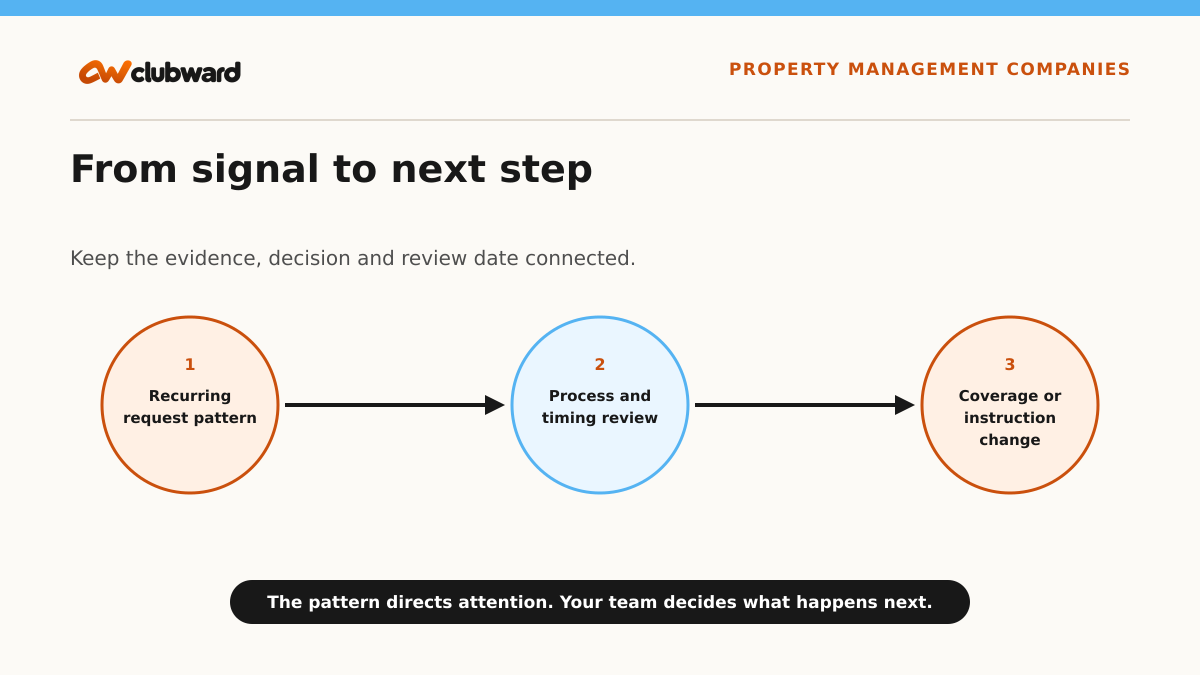
The best first response is usually smaller than a policy rewrite or new staffing model. Choose a reversible step that tests the leading explanation: clarify a message, expose a status, change a cutoff, assign an owner, update a role guide or review a narrow audience. Keep the original pattern visible so the team can tell whether the change helped.
1. Create a small request taxonomy
Use six to eight reason codes that staff can apply quickly. Avoid a catch-all category large enough to hide the real pattern.
2. Sample effort as well as count
Estimate active handling time and number of handoffs for representative cases instead of turning the exercise into constant time tracking.
3. Map the first blocked decision
Find the earliest moment when the staff member lacked a status, record, instruction or authority. That is often the best improvement point.
4. Separate process fixes from coverage fixes
Update the resident path or staff instruction when the work is avoidable. Adjust staffing when necessary work consistently exceeds available coverage.
5. Design the smallest viable change
Choose one response template, visibility change, handoff field, shift adjustment or escalation rule and name its owner.
6. Review the next two weeks
Compare the same request types and service windows. Keep the change only if it improves resolution without creating a new gap.
Work through a realistic example
A management team sees forty-two amenity contacts between 4:00 and 8:00 p.m. over two weeks. At first, the volume supports adding another evening staff member. The request review tells a different story. Eighteen contacts ask whether clubhouse reservations are approved. Ten come from recent move-ins whose access status is not visible to the evening desk. Eight concern a recurring gate problem, and six require a policy decision.
The team changes three things before altering coverage. Reservation confirmations state the current status and next action. Move-in handoffs include the amenity effective date and household scope. Gate issues receive one tracked maintenance owner rather than a new investigation at every contact. Policy cases remain with the manager.
During the next two weeks, the team reviews the same time window. If quick-status questions fall while policy and facility work remain high, the manager can now evaluate evening coverage using necessary work instead of preventable searching. The client report explains the request pattern, the changes tested and the remaining decision without promising a result the data has not yet shown.
Keep the response proportionate and human
Patterns describe recorded activity, not motivation or character. A household that stops visiting, a participant who misses class or a volunteer who cannot cover a shift may have context the organization does not know and does not need to investigate. Use the signal only to improve the relevant service or offer a respectful next step.
Before contacting anyone, ask whether the message provides value. Useful outreach can clarify an updated schedule, offer an appropriate option, check whether help is needed or invite a reply. Avoid language that makes people feel monitored or assumes a personal reason. Let the team edit, approve or decline any suggested response.
Protect access to the underlying information. Front-desk staff need the answer for the current interaction; managers may need the pattern; a board or client may need an aggregate decision summary. Not every role needs every detail. Define who reviews, who acts and what can be shared.
Decide what the evidence can support
Write the decision in three layers. First, state the observation without interpretation: what changed, during which period and in which workflow. Second, list the context the team verified, including data quality, schedule changes, facility conditions and known process differences. Third, record the action the evidence supports today. Keeping those layers separate prevents a reasonable observation from turning into an unsupported claim about people or future results.
Use a threshold that is practical for the decision, not one chosen because it looks precise. A pattern that affects access, participant safety, money handling or a critical role may deserve attention after one well-documented case. A participation or communication pattern usually needs several comparable observations. State the reason for the threshold and revise it when the team learns that it produces too much noise or misses important work.
Also name what the review cannot answer. The record may show that attendance changed, but not why a person stayed home. It may show that evening requests take longer, but not prove another employee is required. It may show that a rule generates questions, but not determine the board’s preferred policy. This boundary does not weaken the review. It keeps the next conversation honest and directs the unresolved decision to the right owner.
When several actions are possible, compare them by usefulness, effort, reversibility and risk. A message or instruction update is easier to test than a permanent schedule change. A temporary coverage adjustment can show whether capacity is the real constraint. Choose the smallest action that can produce meaningful evidence, and set an end date so a trial does not quietly become permanent.
Measure the operating result, not the story
Choose measures that show whether the process became clearer or the next step became more useful. Do not promise that one message will retain a member, fill a class or solve coverage. The first goal is better judgment: cleaner records, fewer avoidable handoffs, earlier visibility and an action the team can explain.
- First-contact completion: Measure how often the first staff member can finish a common request.
- Handoffs per request: Watch for contacts that bounce between people before reaching an owner.
- Necessary effort by service window: Compare real work with available coverage at the times residents need it.
- Repeated-status questions: Track questions caused by a status that residents or staff cannot see.
- Unresolved age: Review requests that remain open beyond the team’s stated follow-up expectation.
Review the same measures after a reasonable operating period. If the signal changes, check whether the underlying recording practice changed too. If nothing improves, reconsider the explanation before escalating the response. Learning that the first idea was wrong is a useful result when the test was small and respectful.
Run a 20-minute signal review
Spend the first five minutes confirming the signal and comparison period. Put the relevant records on screen and remove unrelated events. Spend the next five minutes checking the operating context: schedule, facility, role, access rule, communication and known data limitations.
Use the third five-minute block to choose one next step, one owner and one effective date. Write down what result would make the team keep, revise or stop the change. In the final five minutes, decide when to review the next sample and which role needs the updated instruction.
Close the review with a plain-language summary: what changed, what the team believes may explain it, what action will be tested and when the result will be reviewed. That summary is more useful than a dashboard screenshot with no decision attached.
Leave a decision record the next person can use
A decision record should fit on one screen. Include the signal, comparison period, context checked, affected workflow, chosen action, owner, effective date and review date. Add the current status—proposed, approved, in progress, complete or stopped—so another shift or leader can understand whether they are reading an idea or an active instruction.
Link the record to the source workflow rather than copying sensitive details into a broad note. The person carrying out the change should see the approved instruction and the information needed for that role. The person reviewing the outcome should be able to return to the same period and definition. This makes continuity possible without relying on the original reviewer’s inbox or memory.
At the review date, close the loop even when the result is inconclusive. Keep the change, revise it, end it or extend the test with a stated reason. Record one lesson that will improve the next review. A closed decision trail helps boards, managers and program leaders distinguish deliberate operating changes from temporary workarounds.
Where a connected club management platform helps
Clubward is positioned for the resident-facing amenity side of community operations: households, eligibility, access, reservations, facilities and relevant communication. The amenity workflows described for HOA and neighborhood teams can give property-management staff a shared operating picture without claiming to replace rent collection, leasing, general accounting or a full property-management suite. Bring a representative request pattern to a demo and confirm the plan, permissions and integrations required for your team.
Use this decision checklist
Before the team acts on the pattern, confirm:
- Two-week review window
- Request reason
- Facility or amenity
- Time received
- First-contact owner
- Resolution status
- Active effort sample
- Number of handoffs
- Preceding workflow
- Process-fix candidate
- Coverage decision owner
- Follow-up comparison date
The value of an operational trend is not that it makes the decision for you. It gives your team a better place to look, a shared record to discuss and a way to connect the next action with the people and work it affects.
From Clubward Team
More from Clubward