Community & Recreation Centers
The Instructor Is Out. Who Tells the Front Desk and Families?
An instructor absence becomes confusing when the staffing decision, room plan and participant message move separately. Bring them into one operational handoff.

An instructor sends a message at 6:10 a.m. saying they cannot teach the 9:00 class. The program coordinator starts looking for a substitute. The front desk sees the class on the schedule and assumes it is running. A facility worker sets up the room, while participants receive no update because no cancellation decision has been made.
The confusion is not caused by the absence alone. It comes from moving the staffing decision, program status, room plan and participant communication through separate channels. A complete handoff should turn the initial notice into one approved operating status, then give each audience the action it needs.
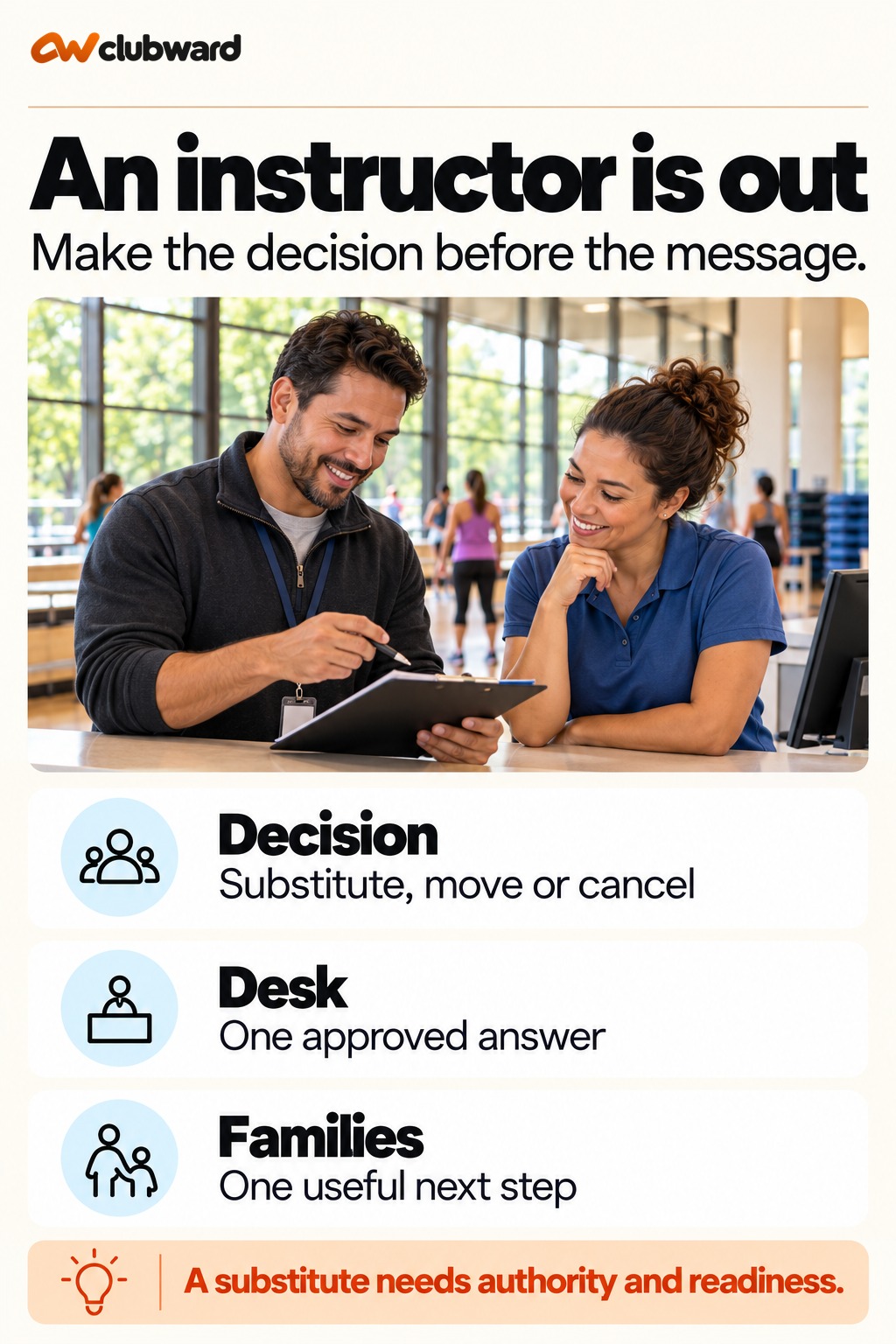
The answer is a short decision path: receive the absence, assess options, name the decision owner, set a deadline, publish the program status, notify affected groups and leave a record for the next shift. The front desk should never have to decide whether a class is cancelled. Participants should not receive a tentative staffing conversation. They need the current approved answer and a clear next step.
Why a simple change becomes a complicated shift
- The absence is sent to one person: A text to the coordinator is fragile when that person is driving, off duty or handling another issue. Use a known intake point and backup owner.
- Substitute search has no deadline: The team keeps trying while participants travel to the center. Set a decision time based on the class start and communication needs.
- The calendar stays unchanged: If the visible program record still says “scheduled,” staff and participants will trust it over a side conversation.
- Every audience gets the same message: A participant needs status and next action. The substitute needs the lesson and room details. The facility team needs setup instructions.
- The next shift receives no history: A reschedule, credit or follow-up question can continue after the original coordinator leaves. Record the decision and open items.
Build a handoff packet people can actually use
- Program instance: Name the exact class, date, time, room and participant group.
- Decision owner and deadline: Identify who chooses substitute, reschedule or cancellation and by what time.
- Current status: Use one state such as substitute pending, confirmed, relocated, rescheduled or cancelled.
- Audience actions: List what the instructor, front desk, participants and facility team each need.
- Financial or attendance handling: Reference the approved credit, transfer or attendance process without improvising it.
- Next-shift note: Record unanswered questions, follow-up owner and due time.
Move the decision from one role to the next
1. Capture the absence in one place
Record the class instance, instructor, time received and any relevant facts. Avoid copying private health information into an operational note.
2. Assess the realistic options
Check qualified substitute availability, room constraints, program requirements and the communication window. Do not promise a substitute before one accepts.
3. Set the decision deadline
Choose the latest time that still allows a useful participant message and front-desk update. A 9:00 class may need an answer well before opening.
4. Publish one approved status
Change the program instance and create messages from that status. The status should be concise enough for staff to recognize immediately.
5. Send audience-specific actions
Give the substitute assignment details, the facility team setup changes, the front desk an approved answer and participants the current plan.
6. Close after follow-up is assigned
Record any reschedule, credit, transfer or attendance work and give it an owner. The absence is not fully closed while participant commitments remain unclear.
A worked handoff example
Consider a youth art class that is scheduled for 9:00 a.m. in Studio B. The instructor reports an absence at 6:10. The program coordinator is the decision owner, with a 7:15 deadline. One qualified substitute may be available but cannot confirm until 6:50.
The program record moves to “substitute pending” internally while no unconfirmed promise is sent to families. At 6:55 the substitute accepts. The coordinator confirms the assignment, sends the lesson outline and arrival instructions, and updates the class to “running with substitute.” The front desk receives the instructor’s name and an approved answer. The facility team keeps the existing room setup. Families receive a concise confirmation that the class will run as scheduled with a substitute.
If the substitute had declined, the same process would have produced a cancellation or reschedule decision at 7:15, not an endless search. The participant message would include the approved next step. The next shift would see the status and any follow-up owner instead of reopening the entire investigation.
Measure whether the handoff works
- Decision made by deadline: Measure whether each absence reaches an approved status before the communication cutoff.
- Front-desk readiness: Sample whether staff can answer the class-status question without contacting the coordinator.
- Participant message completion: Confirm that every affected roster received the update through the approved channel.
- Room and setup accuracy: Track avoidable setups for cancelled or relocated programs.
- Open follow-up age: Review credits, transfers or reschedules still unassigned after the program time.
Run a morning absence drill
Choose a real program format and simulate an absence before opening. Give the coordinator a start time, roster, room, instructor requirements and two imperfect options: one substitute who can confirm later and one alternate room with a conflict. The coordinator must set a decision deadline and create the status that the front desk will use.
Have different team members play the front desk, participant, facility worker and substitute. Each person should state what they need and what they should not receive. The participant does not need the staffing discussion. The substitute does need arrival and lesson details. The facility worker needs the room decision. The front desk needs the approved status, next update and escalation owner.
At the deadline, force a decision. If the class runs, verify the assignment and room. If it cancels, follow the approved participant and financial process. Then hand the record to someone who was not in the exercise. Ask them to explain the status and remaining work. Any missing answer becomes a field, owner or message improvement. A drill is successful when the next shift can continue without calling the original coordinator to retell the morning. Keep the final example for the next staff practice session.
Also decide what the front desk should do when a participant arrives before the update is read. Give staff one recovery path: verify the saved program status, use the approved explanation and offer the recorded next step. They should not negotiate a substitute, credit or room change at the counter. The recovery path protects the participant from another version of the story and keeps an early communication miss from becoming a new policy decision.
Connect the class, space and staff decision
Clubward brings programs and shared-space reservations together in its programs and spaces workflows. Its staff operations include scheduling, coverage and timecard review. For an instructor absence, bring a roster, room and staffing requirement to a walkthrough. Ask how the approved decision reaches the substitute, front desk and families in your setup.
Separate accepting a shift from approving a substitute
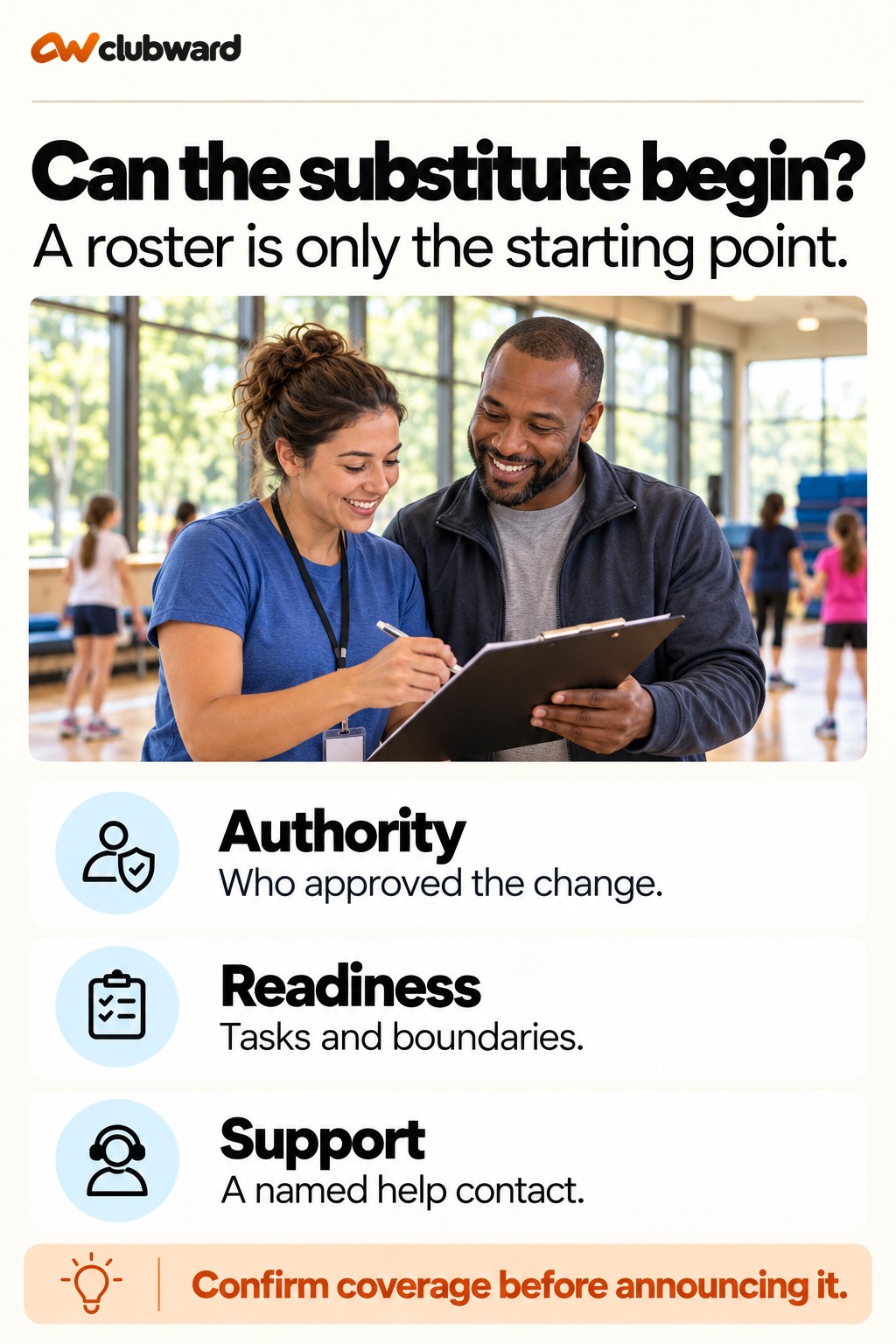
A person saying “I can come” answers an availability question. It does not settle whether they are approved to lead that program, whether the planned activity is within their responsibilities or whether the center can support the session. The decision owner should make those checks before describing the class as covered. Record availability, approval and readiness as separate states.
Define substitute authority for the program before an absence occurs. The director might approve a substitute, while a coordinator can contact the approved list and assemble the assignment. The front desk can relay the final status but cannot make a new staffing decision. Use your center’s actual role boundaries. A confident message from the wrong role is still an incomplete handoff.
For the sample youth art class, suppose the substitute accepts at 6:55 a.m. The coordinator checks the center’s approved assignment requirements, confirms that the planned activity fits the substitute’s scope and records the decision. Only then does the class move to “running with substitute.” If approval is still pending, keep the internal status pending and preserve the decision deadline.
Keep personal absence information out of the shared brief. The receiving roles need to know which class is affected and what to do. They generally do not need the absent instructor’s private explanation. A suitable public message describes the class plan, substitute arrangement or cancellation without turning the staffing record into a broad disclosure.
Choose the decision deadline from the participant’s journey
Work backward from arrival rather than forward from the first substitute call. Consider when families leave home, when the desk opens and when a facility worker begins setup. These times help the decision owner choose a useful deadline. The deadline should leave room to communicate the outcome, not merely mark the last possible moment to find someone.
For a 9:00 class, the center might choose the sample 7:15 decision point because families and opening staff need an answer early. That is a worked planning example, not a universal deadline. A different program, travel pattern or notification process may require another time. Set the window based on how your participants actually use the center.
Give the substitute search a stopping condition. If the approved substitute is not confirmed by the deadline, the authorized owner chooses the permitted alternative: reschedule, cancellation or another approved arrangement. A continuing search can run alongside that decision, but it should not keep families in an indefinite “maybe” state while they begin traveling.
If a late confirmation changes an earlier message, treat it as a revised decision. Confirm whether the center’s approved process permits that change, then update all affected roles from the same status. Do not tell one family that the class is restored while the desk and remaining participants still see cancellation. Sometimes preserving the communicated outcome is the clearest choice.
Build the substitute’s assignment brief
The substitute needs more than a roster. Include the exact class instance, room, arrival time, activity plan, setup owner, participant information they are permitted to use, task boundaries and help contact. Keep the brief short enough to read before arrival. Link the relevant current procedure rather than adding an entire manual to every absence message.
Explain what has already been communicated. If families were told the class will run with a substitute, the instructor should know that. If a room changed, state the current room and the route participants will use. If one activity was removed from the plan, identify the approved replacement. The substitute should not have to reconstruct these decisions from separate messages.
Ask the substitute to confirm practical readiness with a focused question. “Can you arrive at 8:30, use the approved art activity and contact the duty coordinator for anything outside the plan?” provides a clearer check than “All good?” A missing answer becomes a specific assignment issue that can be resolved before the class begins.
Identify the boundary between preparing and leading. A setup worker may place materials and check the room, while the approved instructor leads the activity. Do not interpret a prepared room as evidence of an approved leader. Conversely, an approved leader may still need someone to unlock the room or provide the current materials. The assignment brief joins those two checks.
Give each receiving role an action
The front desk needs the current class status, instructor name where appropriate, room, participant answer and escalation route. The facility team needs the setup outcome and any change to room use. Families need whether to attend, where to go and what happens next. The next coordinator needs open follow-up, not every detail of the morning’s search.
Use a small audience list with an owner and completion state for each update. “Families notified” should refer to the approved roster and channel, not to one message copied to a colleague. If the center knows that a particular participant needs an authorized alternative contact method, assign that follow-up within the existing process rather than assuming the general message reached them.
Ask the desk to confirm that it can find the saved status. Ask the facility owner to confirm that the correct room action is understood. Those acknowledgments check operational readiness. They are different from a delivery receipt, which may only show that a message was transmitted. A handoff should reveal where a person must act, not only where information was sent.
When a family arrives without having read the update, use the same approved answer. The desk can acknowledge the inconvenience and offer the recorded next step. It should not improvise a credit, promise an extra session or search for a new substitute at the counter. A consistent recovery answer prevents a missed message from becoming a separate policy decision.
Work the cancellation branch to completion
Now change the example: the substitute declines at 6:50. At the sample 7:15 deadline, the authorized coordinator confirms cancellation under the center’s operating process. Update the specific class instance, release or retain the room as directed, tell the desk and notify families. A generic note on the program series may leave the affected date unclear.
Give families one useful next action. If the approved process provides a transfer or credit review, state the route and responsible team. If the next session remains unchanged, say so. Avoid announcing an unapproved make-up date simply to make the message feel complete. The decision owner should distinguish a confirmed cancellation from a proposed replacement session.
Record administrative follow-up separately. A cancelled class can have a settled attendance outcome while a transfer request remains assigned to program administration. The next shift should see that ownership and due time. Otherwise, a family calling later may receive another explanation from someone who assumes nothing happened because the financial or enrollment follow-up is still open.
Check the facility calendar after the class changes. The room may become available, remain held for an approved replacement use or need a setup reversal. Let the authorized space owner decide. A staffing cancellation should not silently create a reservation decision for another group. Keep the class outcome and the room outcome connected without treating them as the same action.
Hand unresolved questions to the next shift
Before the original coordinator leaves, write a short continuation note: the decision, time, messages completed, room outcome and outstanding participant requests. For each open request, add the owner, next action and due time. The new coordinator should be able to pick up the work without calling the absent instructor or repeating the substitute search.
Suppose one family asks to move to another class that is nearly full. Record the request as pending capacity review, not as a promised place. The membership or enrollment owner checks the center’s existing rules. The desk’s answer can identify that owner and the next update. Keeping the request pending protects both the family’s expectations and the next class’s approved capacity.
If the substitute reports a changed activity during the session, record the operational effect and assign any necessary follow-up. The handoff should capture useful facts such as a room issue or missing material. It should not become an informal performance discussion visible to unrelated staff. Keep sensitive personnel matters in the center’s authorized management process.
Test readiness with two imperfect options
For a rehearsal, offer the coordinator a substitute who can arrive late and another who is available but not approved for the planned activity. Ask which facts must be checked before either option becomes a confirmed assignment. The exercise is useful because it separates availability from authority and a running class from a supported class.
Have a front-desk colleague use only the final brief to answer a family’s question. Have a facility worker explain whether Studio B needs setup, release or a different arrangement. Have the next coordinator identify the remaining transfer request. If any role needs the original conversation, improve that role’s part of the brief rather than adding every conversation to the record.
Review the first real absence after changing the procedure. Look for a specific point where the decision arrived too late, a role lacked an action or a participant received conflicting information. Choose one improvement and name its owner. A substitute process becomes useful when the class plan, receiving staff and participant expectations agree at the moment people need to act.
Check two classes when one instructor covers both
An absence can affect several class instances without requiring the same outcome for each. Suppose an instructor leads morning art in Studio B and afternoon crafts in another room. A substitute may be approved and ready for the morning session while the afternoon plan remains unresolved. Record a decision and owner for each instance instead of sending one ambiguous message for the entire day.
Check the substitute’s agreed scope before assigning the second session. Availability for one class does not establish availability for another. The coordinator should confirm timing, activity readiness and room context. If the afternoon decision has a later deadline, retain that deadline and give the desk an accurate pending status. Do not imply that the entire schedule is covered because the first assignment was accepted.
Participant messages should identify the affected class and date. Families attending only the afternoon session need their own current answer, not a morning confirmation that appears to include them. The facility team also needs separate setup outcomes if the rooms differ. Keep those actions in the same absence record while preserving the distinct class decisions.
When the next shift takes over, ask it to explain each instance independently. The colleague should find the morning outcome, afternoon status, responsible owner and next update without repeating the staffing search.
Confirm which update each family received before answering a question about the other class or its status.
Final checklist
Before marking the handoff complete, confirm the following items in the saved record:
- Exact class instance
- Time absence received
- Backup decision owner
- Decision deadline
- Qualified substitute status
- Room and setup impact
- Published program status
- Front-desk answer
- Participant message
- Credit or transfer rule
- Next-shift note
- Follow-up owner and due time
Map your program, facility and staffing handoffs in a personalized Clubward demo.
From Clubward team
More from Clubward