Community & Recreation Centers
The Class Ran Late: A Program-to-Timecard Review Checklist
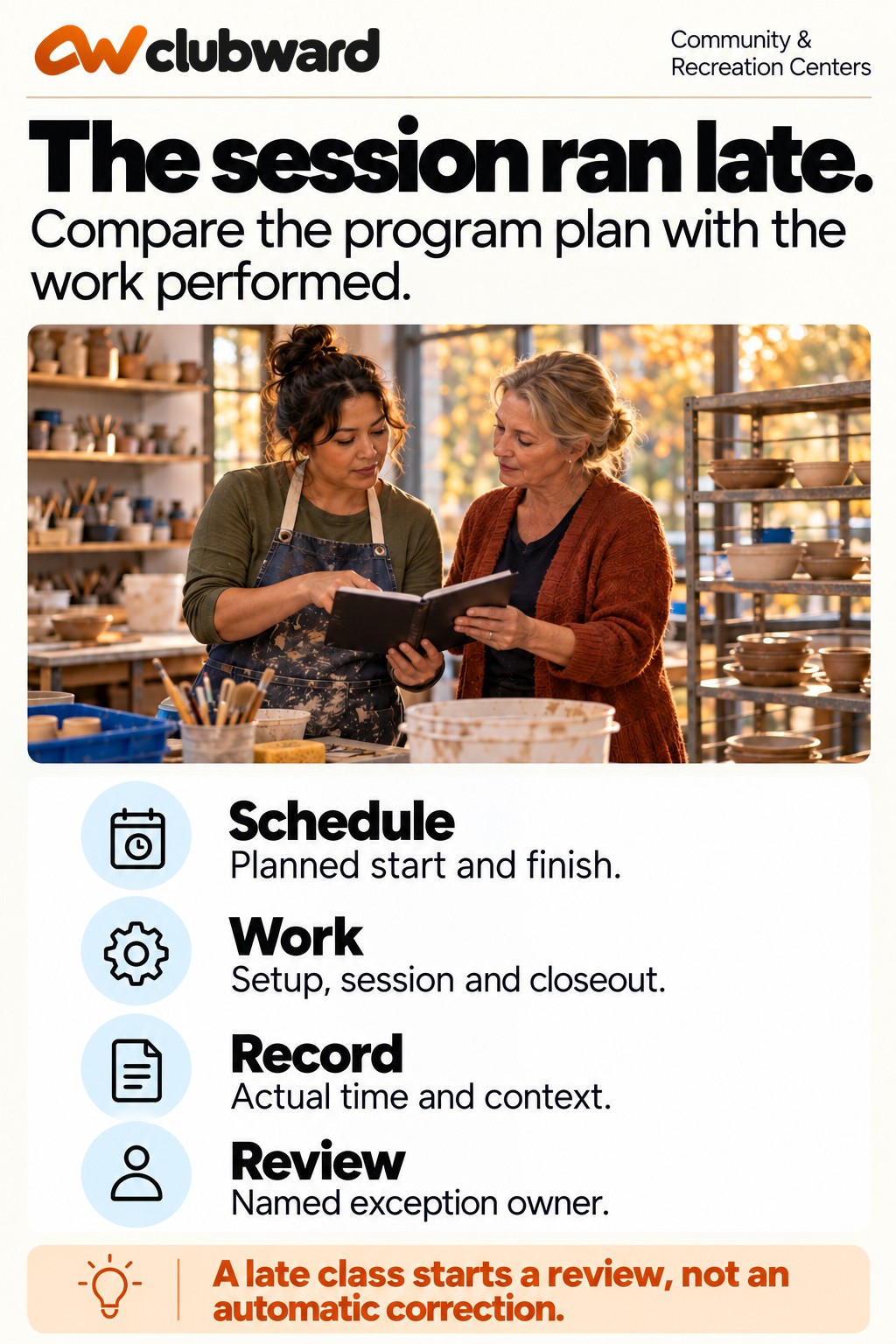
Compare a late class with assigned work and recorded time, then give the authorized reviewer the evidence and next question.

When a class runs late, compare the work that was scheduled with the time actually recorded, then assign any difference to the appropriate reviewer. Do not treat the program's advertised finish time as proof that the instructor stopped working then. A useful review follows the session, the duties completed afterward, the time record, and the person authorized to resolve an exception.
Use one session to build a program-to-timecard worksheet. Record the planned work window, what changed, the evidence available, and the next action. Keep scheduling improvements separate from a decision about an individual time entry. Your established time-recording and review procedures should govern that decision.
This checklist helps recreation directors and program coordinators prepare a clear handoff. It is an operational review, not a payroll calculation. It does not replace your organization's employment policies or the guidance of its responsible payroll and personnel professionals.
Choose a session with a specific question
Start with the class, date, instructor, room, and disputed or unexplained difference. “Tuesday ceramics finished late, and the recorded work continued after the scheduled shift” gives the reviewer a starting point. “The staff hours seem high” does not identify a session or an event.
Write the question neutrally. Ask which duties occurred after the planned finish and how they relate to the recorded time. Avoid labeling the entry excessive, incorrect, or approved before the appropriate person has inspected it.
Identify the schedule version used when the work was assigned. A later revised timetable can explain a planning correction, but it should not silently replace the schedule the employee originally received. Preserve the relevant context through your authorized records.
Name the session coordinator and the time-record reviewer. The coordinator can supply program context. The reviewer has the responsibility assigned by your organization for deciding what action the time record needs. One person may perform both roles, but the responsibilities should remain clear.
Map the whole planned work window
A participant timetable describes when a class starts and finishes. A staff work plan may also include preparation, room access, attendance tasks, cleanup, equipment return, and a handoff. Record those assigned duties separately from the public session time.
For a sample ceramics class, participants attend from 4 PM to 5 PM. The instructor is scheduled from 3:30 PM to 5:30 PM to prepare materials and clean the studio. The worksheet should show both windows so the reviewer does not mistake every minute after 5 PM for an unexplained overrun.
Check who owns cleanup and room reset. If the instructor believes those duties belong to them while the coordinator believes facilities staff handle them, the work plan needs clarification. Do not resolve that misunderstanding by assuming the tasks did not happen.
Include a room handoff when another program follows. The planned session may end at 5 PM, but the room needs to be ready for a different group later. Record the actual assigned responsibility rather than inferring it from the calendar alone.
Build the worksheet in six fields
Keep the review short enough for a coordinator and reviewer to use together. It should connect the session with the time record and show what remains unresolved. A long narrative without a next action can hide the same ambiguity as an unexplained total.
- Session: Program, date, room, instructor, and relevant session reference.
- Planned work: Scheduled start and finish, assigned preparation, delivery, cleanup, and handoff duties.
- Recorded time: The actual entry being reviewed, including any existing explanation.
- Changed conditions: What happened during or after the session that differed from the plan?
- Evidence and question: Which records or first-hand accounts help explain the difference, and what remains unknown?
- Owner and next action: Who will review the exception, what decision is needed, and where the outcome will be recorded?
Use the minimum personal information needed for the review. Keep time records and individual staff details in their authorized location. A shared room-planning discussion does not need a copied employee timecard containing unrelated entries.
Mark facts, explanations awaiting confirmation, and decisions separately. “Class ended at 5:20 PM” and “instructor reports equipment cleanup afterward” may have different evidence. Both can be useful without being presented as equally verified.
Follow a late ceramics session
Suppose the sample ceramics instructor is assigned work from 3:30 PM to 5:30 PM. A delayed equipment setup pushes the participant session twenty minutes late. The instructor then completes the assigned studio cleanup and records work until 5:50 PM.
The coordinator collects the original work plan, session note, and time entry. The note explains that participants left at 5:20 PM. The instructor describes the cleanup duties completed afterward. The review question concerns the twenty-minute difference between the scheduled work finish and the recorded finish.
The worksheet does not conclude that the time entry should be reduced or accepted automatically. It gives the authorized reviewer the session context and the specific question. That reviewer follows the organization's procedure and records the outcome in the appropriate record.
Separately, the coordinator examines the setup delay. If the equipment could not be prepared within the assigned window, the next session may need a different preparation plan. This planning change should not erase what happened during the earlier session.
Ask the instructor for the work sequence
Ask a practical question: “Please walk through the work between the planned finish and your recorded finish.” Give the instructor a chance to identify cleanup, equipment issues, participant assistance, or another assigned duty. Do not ask them to choose a reason from a list that assumes the answer.
Record the explanation in clear language with its source. A coordinator's summary should preserve the instructor's meaning and identify any question still needing review. Avoid adding a conclusion about approval that the instructor did not state and the reviewer has not made.
If the account conflicts with another record, identify the conflict specifically. A room log showing a later handoff may be relevant, but it does not explain every duty by itself. Ask the owner who can clarify the event rather than treating one timestamp as the complete story.
Keep the conversation focused on the session being reviewed. A broad discussion of an employee's performance or other private matters does not belong in the program worksheet unless your authorized personnel process requires it in a separate record.
Inspect recorded time without overwriting it casually
Review the entry through the approved time-record process. Confirm that you are looking at the correct person, date, and work period. An entry associated with another room or a different session can produce an apparent mismatch before the work itself is examined.
When an entry needs clarification, preserve the original record and follow the designated correction procedure. Do not make an informal edit in a planning spreadsheet and assume the official time record changed with it. The worksheet should point to the actual review outcome.
Ask the responsible reviewer what evidence they need to complete the decision. They may need the assignment, the employee's explanation, or a program note. The coordinator's job is to provide the relevant context, not to invent a payroll rule.
Communicate the next step accurately. “The time entry has been sent to the designated reviewer with the session explanation” describes a handoff. “The hours are approved” describes a decision and should be used only when that decision has actually been made.
Separate three kinds of differences
A session can run late without an incorrect time entry. A time entry can contain an error even when the session ran as planned. A work assignment can omit a necessary duty that someone nevertheless performed. Give the reviewer enough context to distinguish these cases.
For a program delay, record the event and its effect on assigned work. For a recording question, identify the entry and the specific detail needing clarification. For a planning omission, identify the task and ask who should own it next time.
Several cases can overlap. The ceramics setup delay may expose a planning gap, while the instructor's entry still needs review through the normal procedure. Keep separate next actions so one decision does not pretend to resolve the entire situation.
Use those distinctions in your internal summary. The program coordinator can plan an earlier equipment check. The time reviewer can complete the individual review. The room scheduler can inspect the next program's buffer. Each owner receives the question that belongs to them.
Check the room handoff after a late finish
Identify the next activity scheduled in the same room. Record whether the overrun affected setup, participant arrival, or the staff handoff. A late session can create a second operating question even when its own cleanup is completed correctly.
Ask the room or program owner what actually changed. Did the next instructor enter later? Was equipment left in the room? Did the front desk direct participants to wait? Preserve the concrete effect rather than describing the whole afternoon as disrupted without evidence.
Give the next-session owner the information needed to continue. That may include the room's actual readiness, remaining tasks, and who is completing them. Avoid announcing that the space is ready simply because the first participant group has left.
Use the event to improve the planned buffer if appropriate. Consider the work required between sessions and who performs it. A calendar gap is useful only when it corresponds to enough time and responsibility for the actual reset.
Use evidence proportionately
Start with records your organization already uses: the work assignment, schedule, session note, time entry, and relevant handoff. Ask for a direct explanation where those records leave a question. Do not create a broad collection of staff movements to answer a narrow session review.
Choose evidence for the question it can support. A participant attendance sheet can show the class context. A room note can explain a delayed start. Neither automatically proves every minute of an employee's work or establishes the correct personnel decision.
Keep a clear reference to each record instead of duplicating it into multiple working files. That makes it easier for the authorized reviewer to inspect the relevant version and limits unnecessary distribution of private staff information.
When evidence is unavailable, say which question remains open and who can resolve it. Do not turn the absence of a session note into proof that no work occurred. The review should distinguish what is known from what still needs an authorized decision.

Prepare an exception handoff the reviewer can use
Lead with the session and the difference. “Tuesday ceramics was planned through 5:30 PM; the instructor recorded work through 5:50 PM after a twenty-minute session delay and cleanup” gives a reviewer the relevant sequence. Include the source of the cleanup explanation.
Attach or reference the authorized records through the approved channel. State the unresolved question and the requested next action. Keep the handoff neutral so the reviewer can assess it rather than inheriting an unsupported conclusion.
Name the person who will record the outcome and tell the relevant staff member what happens next. If the review remains open when the coordinator changes shifts, the incoming owner should know its state and where the evidence can be found.
After the reviewer responds, record the actual decision or requested clarification. Do not close the worksheet because the message was sent. A completed handoff and a completed exception review are different milestones.
Plan the next session from the cause
Once the event is understood, choose a planning change connected to its cause. If equipment preparation took longer than the assigned window, inspect the preparation tasks. If the class ran over because the activity plan was too full, review the session design with the instructor.
For the ceramics example, the coordinator could test preparing materials before the instructor's arrival through an assigned support role, or allow an appropriate preparation window. The choice depends on the actual duties, available staff, and room access.
Do not shorten cleanup on paper without deciding which tasks can safely and appropriately change through your established process. A tighter timetable that retains the same work can recreate the overrun next week.
Give the trial an owner and a review point. After the next relevant session, compare the planned work, actual sequence, and room handoff. Check whether the change solved the identified issue rather than merely producing a different schedule entry.
Review a pattern without guessing its cause
If several sessions show similar differences, group them by the actual question. Late starts, cleanup duties, room conflicts, and recording corrections need different analysis. A single category called “extra hours” can hide the operational cause.
Review a small set of comparable sessions with the appropriate owners. Ask whether the same preparation task, room condition, or handoff appears repeatedly. Keep individual time decisions within their authorized process while looking for a planning improvement.
Use the evidence you have rather than claiming a trend from one afternoon. Describe the observed cases and the next check. A useful management question is whether the assigned work window includes the duties the program actually requires.
Share the planning takeaway without unnecessary employee detail. A room buffer problem can be discussed as a program operations issue. The individual time-record review belongs with the people authorized to handle it.
Use a complete intake note for the next late session
Give the program coordinator a short intake structure that captures the event while the details are available. It can begin with the session reference, the planned participant time, the assigned staff work window, and the actual event that changed the sequence.
Ask for the duties affected by the change. “Participants left twenty minutes late and the instructor then completed the assigned equipment wash and room reset” identifies work to review. “The instructor stayed late” records an outcome without explaining the task.
Include the source of the explanation and any record reference. If the coordinator observed the room handoff, say that. If the instructor supplied the cleanup account, preserve that attribution internally. The reviewer can then see which questions need a further conversation.
End with the unresolved question, the owner, and the next action. For example, the time reviewer needs to inspect the entry, while the program coordinator needs to check why equipment preparation was delayed. Both actions can be tracked without combining them into one vague exception.
Use this structure consistently enough that incoming staff can understand it. Do not require a lengthy narrative for a simple event. The useful standard is whether a reviewer can locate the session, understand the difference, and identify what they must decide.
Check a substitute instructor case separately
A substitute may inherit a timetable without receiving the full work assignment. Test that situation in the worksheet rather than assuming the regular instructor's understanding transfers automatically. Identify which preparation and cleanup duties the substitute was told to perform.
Suppose the public class ends at 6 PM and the substitute's assignment also ends at 6 PM. The studio procedure requires an equipment reset afterward, but the assignment never identifies its owner. If the substitute completes it, the review needs the task context and the recorded time.
Send the individual time question through your designated review procedure. Separately, ask the program owner to clarify future substitute assignments. They should specify the required duties, the work window, the room handoff, and the escalation contact before the next session.
Practice the handoff with a colleague who did not write the assignment. They should be able to identify when participant instruction ends, what work follows, and who handles an unexpected delay. A complete roster alone does not answer those questions.
Keep the correction focused on the actual omission. The substitute may need a clearer assignment or an accessible room procedure. Do not describe the event as a training failure without checking what instruction was provided and what the person understood.
Close the communication loop with each responsible owner
After the authorized review, tell the relevant coordinator what outcome affects their next action. They may need to know that the individual review is complete, that more information is required, or that a planning change has been assigned. Share only the staff information appropriate to their role.
The instructor should receive the next-step information through the organization's established process. Avoid relying on a program chat to communicate a personnel decision. The responsible reviewer should make sure the staff member knows where to ask a question about the outcome.
For a room buffer correction, tell the next program owner what changes in the schedule and who performs the reset. For an equipment preparation change, tell the assigned staff what duty moves and when. These practical instructions make the planning decision usable.
Verify that the revised assignment is actually available before treating the improvement as complete. A coordinator's note proposing a longer preparation window is not the same as the next instructor receiving that assignment. Inspect the relevant schedule and handoff through the normal process.
Retain a short closure record connecting the event, review, and planning action. At the next comparable session, the coordinator can check whether the cause recurred. If it did, review the evidence again rather than assuming that the earlier change must have worked because everyone received a message.
Keep the review method available to the backup coordinator, including the designated time reviewer and approved records location. When another session changes unexpectedly, the backup can gather context and assign the question without inventing a new procedure. That continuity matters when the regular program owner is away and an instructor needs an accurate next step before the next scheduled class.
Bring a session-to-timecard case to Clubward
Clubward supports staff scheduling and timecards. Bring one session, its assigned work window, and a recorded-time question to a walkthrough. Keep the program context and the human review responsibility visible.
Ask how the staff and program records fit your current procedure. Include preparation, cleanup, a late finish, and a named exception reviewer. The useful test is whether the right person can find the relevant context and complete their part of the review.
Book a personalized Clubward demo around that session. Aim for a clear connection between planned duties, recorded work, and the next authorized action.
From Clubward Editorial Team
More from Clubward