Community & Recreation Centers
How Recreation Centers Can Respond When Registration and Attendance Move Apart
A full roster does not guarantee a full room. This process helps recreation teams understand the gap before changing capacity, staffing or outreach.

The class roster is full, the waitlist is growing and the room looks half empty. That contradiction can push a recreation team toward the wrong decision. Adding another session may spread the same attendance across more rooms. Cutting the program may remove something participants still value. Sending reminders may miss a schedule or check-in problem.
Registration and attendance measure different moments. Registration shows intent and access to a seat. Attendance shows recorded use at a particular session. The gap between them deserves investigation, especially when space, staffing and waitlist decisions depend on the answer.
Start with session-level facts: who registered, who attended, when absences appeared, whether check-in was complete, which room and instructor were involved, and what changed in the calendar. Then group the likely causes into participant communication, schedule fit, room experience, staff coverage, registration policy or data quality. Choose a response that tests the leading explanation without disrupting a program that still serves its community.
Read the signal without rushing to a conclusion
Operational signals are useful because they direct attention. They are dangerous when a team treats them as an explanation. A higher count, lower count or changed routine does not identify the cause by itself. Begin with the recorded event, check whether the data was captured consistently and add the context that the people closest to the work can provide.
Use a defined comparison period and keep unlike events separate. A policy question is not the same as a broken credential. A registered participant is not the same as an attendee. An interested volunteer is not the same as a confirmed shift. Clean categories protect the decision from a dramatic total that combines several different problems.
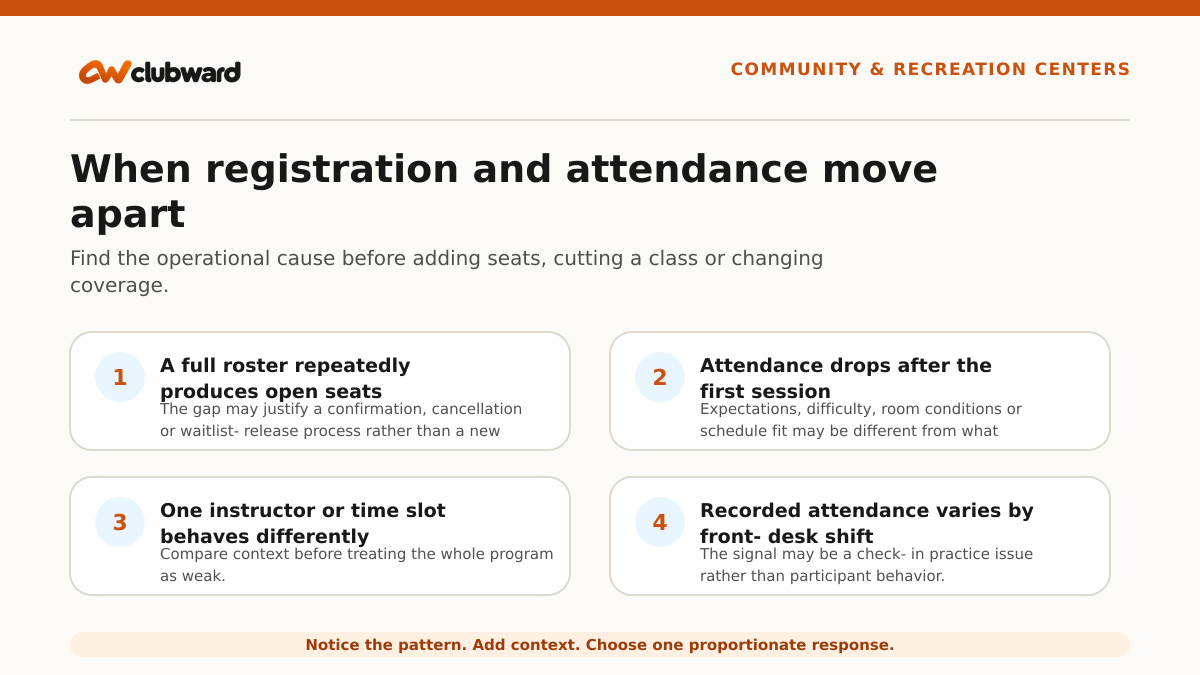
- A full roster repeatedly produces open seats: The gap may justify a confirmation, cancellation or waitlist-release process rather than a new class.
- Attendance drops after the first session: Expectations, difficulty, room conditions or schedule fit may be different from what participants understood at registration.
- One instructor or time slot behaves differently: Compare context before treating the whole program as weak.
- Recorded attendance varies by front-desk shift: The signal may be a check-in practice issue rather than participant behavior.
- Waitlisted participants cannot use released seats: The release timing or communication path may be too slow to turn an absence into access.
Ask the questions that change the next decision
A useful review is short enough to repeat and specific enough to change what the team does next. Put the relevant record, instruction and operating context together. Avoid turning the meeting into a search for someone to blame. The point is to find the first place where information, ownership or capacity stopped matching the work.
- Is attendance recording complete?: Confirm the check-in method, late arrivals, alternate entrances and instructor-managed rosters.
- Does the gap repeat?: One weather event or school conflict should not drive a permanent capacity decision.
- Which participant groups are affected?: Review age, household and program context only to the extent needed to improve the operation.
- What changed after registration?: Room moves, instructor substitutions, time changes and unclear start dates can weaken attendance.
- Can the seat be released fairly?: Define notice, cutoff and waitlist rules before asking participants to confirm or cancel.
- What decision is reversible?: Prefer a test that can improve the next few sessions before changing the entire program schedule.
Record the answer that is known, the question that remains and the person who can resolve it. If the team cannot support a conclusion, keep the item open rather than filling the gap with a story. A transparent “needs review” state is more useful than a confident but unsupported explanation.
Turn the pattern into one practical next step
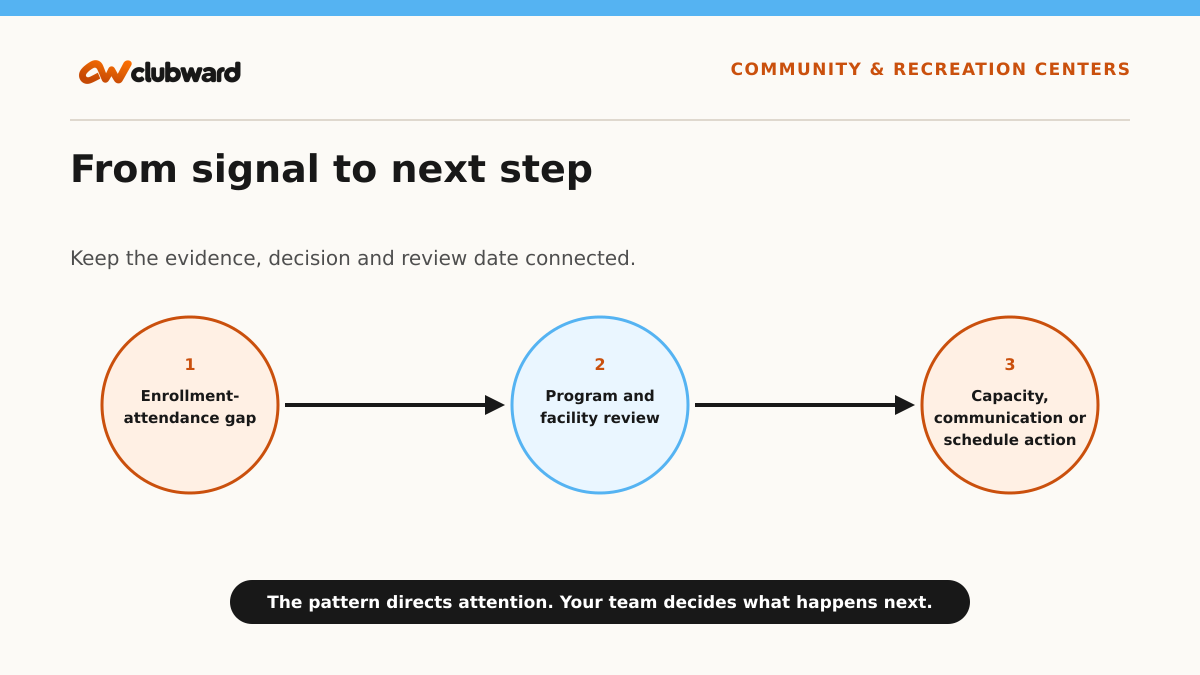
The best first response is usually smaller than a policy rewrite or new staffing model. Choose a reversible step that tests the leading explanation: clarify a message, expose a status, change a cutoff, assign an owner, update a role guide or review a narrow audience. Keep the original pattern visible so the team can tell whether the change helped.
1. Build a session comparison
Place registration, capacity, attendance, waitlist and recorded changes together for comparable sessions.
2. Validate the check-in path
Observe one arrival and compare the front-desk record with the instructor’s actual room. Resolve missing data first.
3. Ask one useful participant question
Use a brief, optional question focused on the schedule, communication or experience—not a broad survey that creates more work.
4. Choose the leading operational cause
Document the evidence for the current hypothesis and what would disprove it.
5. Test one next step
Try a confirmation reminder, waitlist release time, room clarification, schedule adjustment or staff check-in change.
6. Review several sessions
Compare attendance, participant questions and staff effort before expanding, reducing or redesigning the program.
Work through a realistic example
A beginner fitness class has twenty registered participants and a waitlist of eight. Attendance averages eleven for three sessions. Check-in is complete, but the team notices that many absences are concentrated among participants who registered before the room changed. The new room is on another floor, and the confirmation email still names only the building.
The coordinator updates the location detail, sends a concise reminder and asks registered participants to release their seat by noon on class day when they know they cannot attend. Waitlisted participants receive offers in order under a stated response window. The team does not add a second class yet.
After three more sessions, the coordinator compares attendance, released seats, waitlist acceptance and front-desk questions. If attendance improves, the signal pointed to communication and seat release. If the gap remains, the team can investigate schedule fit or program expectations with better evidence. The decision is based on the operating pattern, not the emotional force of a full roster.
Keep the response proportionate and human
Patterns describe recorded activity, not motivation or character. A household that stops visiting, a participant who misses class or a volunteer who cannot cover a shift may have context the organization does not know and does not need to investigate. Use the signal only to improve the relevant service or offer a respectful next step.
Before contacting anyone, ask whether the message provides value. Useful outreach can clarify an updated schedule, offer an appropriate option, check whether help is needed or invite a reply. Avoid language that makes people feel monitored or assumes a personal reason. Let the team edit, approve or decline any suggested response.
Protect access to the underlying information. Front-desk staff need the answer for the current interaction; managers may need the pattern; a board or client may need an aggregate decision summary. Not every role needs every detail. Define who reviews, who acts and what can be shared.
Decide what the evidence can support
Write the decision in three layers. First, state the observation without interpretation: what changed, during which period and in which workflow. Second, list the context the team verified, including data quality, schedule changes, facility conditions and known process differences. Third, record the action the evidence supports today. Keeping those layers separate prevents a reasonable observation from turning into an unsupported claim about people or future results.
Use a threshold that is practical for the decision, not one chosen because it looks precise. A pattern that affects access, participant safety, money handling or a critical role may deserve attention after one well-documented case. A participation or communication pattern usually needs several comparable observations. State the reason for the threshold and revise it when the team learns that it produces too much noise or misses important work.
Also name what the review cannot answer. The record may show that attendance changed, but not why a person stayed home. It may show that evening requests take longer, but not prove another employee is required. It may show that a rule generates questions, but not determine the board’s preferred policy. This boundary does not weaken the review. It keeps the next conversation honest and directs the unresolved decision to the right owner.
When several actions are possible, compare them by usefulness, effort, reversibility and risk. A message or instruction update is easier to test than a permanent schedule change. A temporary coverage adjustment can show whether capacity is the real constraint. Choose the smallest action that can produce meaningful evidence, and set an end date so a trial does not quietly become permanent.
Measure the operating result, not the story
Choose measures that show whether the process became clearer or the next step became more useful. Do not promise that one message will retain a member, fill a class or solve coverage. The first goal is better judgment: cleaner records, fewer avoidable handoffs, earlier visibility and an action the team can explain.
- Recorded attendance completeness: Verify that session records reflect the people in the room.
- Released-seat use: Track whether timely cancellations become real opportunities for the waitlist.
- Location and schedule questions: Watch for repeated confusion after communication changes.
- Attendance consistency: Compare several sessions rather than celebrating or reacting to one result.
- Staff effort per recovered seat: Ensure the process is practical enough to sustain.
Review the same measures after a reasonable operating period. If the signal changes, check whether the underlying recording practice changed too. If nothing improves, reconsider the explanation before escalating the response. Learning that the first idea was wrong is a useful result when the test was small and respectful.
Run a 20-minute signal review
Spend the first five minutes confirming the signal and comparison period. Put the relevant records on screen and remove unrelated events. Spend the next five minutes checking the operating context: schedule, facility, role, access rule, communication and known data limitations.
Use the third five-minute block to choose one next step, one owner and one effective date. Write down what result would make the team keep, revise or stop the change. In the final five minutes, decide when to review the next sample and which role needs the updated instruction.
Close the review with a plain-language summary: what changed, what the team believes may explain it, what action will be tested and when the result will be reviewed. That summary is more useful than a dashboard screenshot with no decision attached.
Leave a decision record the next person can use
A decision record should fit on one screen. Include the signal, comparison period, context checked, affected workflow, chosen action, owner, effective date and review date. Add the current status—proposed, approved, in progress, complete or stopped—so another shift or leader can understand whether they are reading an idea or an active instruction.
Link the record to the source workflow rather than copying sensitive details into a broad note. The person carrying out the change should see the approved instruction and the information needed for that role. The person reviewing the outcome should be able to return to the same period and definition. This makes continuity possible without relying on the original reviewer’s inbox or memory.
At the review date, close the loop even when the result is inconclusive. Keep the change, revise it, end it or extend the test with a stated reason. Record one lesson that will improve the next review. A closed decision trail helps boards, managers and program leaders distinguish deliberate operating changes from temporary workarounds.
Where a connected club management platform helps
Clubward connects member and household records, classes, activities, shared-space reservations and front-desk arrivals for community and recreation operations. The current community-center overview positions programs, spaces, staff coordination and member access as a connected workflow, with capabilities depending on the selected plan and modules. Use a real full-roster, low-attendance scenario in a demo to confirm the registration, waitlist, room, attendance and communication setup.
Use this decision checklist
Before the team acts on the pattern, confirm:
- Program and session
- Room capacity
- Registered count
- Waitlist count
- Recorded attendance
- Check-in completeness
- Instructor and room changes
- Participant questions
- Cancellation rule
- Waitlist release rule
- Tested next step
- Review period
The value of an operational trend is not that it makes the decision for you. It gives your team a better place to look, a shared record to discuss and a way to connect the next action with the people and work it affects.
Map your registration, attendance, room and staffing signals in a personalized Clubward demo.
From Clubward Team
More from Clubward