

A membership fee increase can be financially necessary and still cost a club something harder to recover: member trust. Families want to know whether the change is fair, what it pays for, and whether the next invoice will match what they were told. A good announcement answers those questions before frustration turns into a lost renewal.
Before raising dues, review the costs you may be able to reduce. Our guide, Before You Raise Membership Dues: 5 Ways Small Clubs Can Reduce Operating Costs in 2027, covers that first decision. When a change is still necessary, the next challenge is communicating it clearly and delivering the promised experience.
The difficult part is often the date. An approval date, a new membership period, and a payment date can describe different events. If the notice says new dues begin in April, a member paying installments on an earlier renewal may reasonably wonder whether their remaining payments change. That question deserves an answer before the notice goes out.
Why a dues increase can put member trust at risk
Members may understand rising expenses but still question whether the club has done enough to control avoidable work and costs. An unexplained increase, vague promise or mismatched invoice can make a necessary decision feel arbitrary. Rather than asking members to simply trust the board, show the specific reason, the timing and what will stay the same.
That means resisting overpromises. Do not say an increase will guarantee new amenities or improved programming unless those benefits are approved and funded. The more credible message is grounded in the club’s actual priorities, paired with a clear route for questions.
The announcement begins with an approved decision
Before drafting, someone needs to explain precisely what the board has approved. That includes the membership types affected, the old and new amounts, the effective date, and any exceptions. If one of those details remains undecided, the communication is not ready to describe it as settled. A polished paragraph cannot supply missing authority.
The reason for the change should also come from the decision. Perhaps the club is funding a defined maintenance need or adjusting how it supports its ordinary operations. Whatever the reason, members need an explanation the board is comfortable standing behind. Avoid adding an attractive improvement to the announcement unless that improvement is actually part of the approved plan.
Acknowledge that dues affect household budgets. “We know dues are part of your household planning” respects the reader without assuming the increase feels small or that everyone will agree with it.
Three dates that need separate names
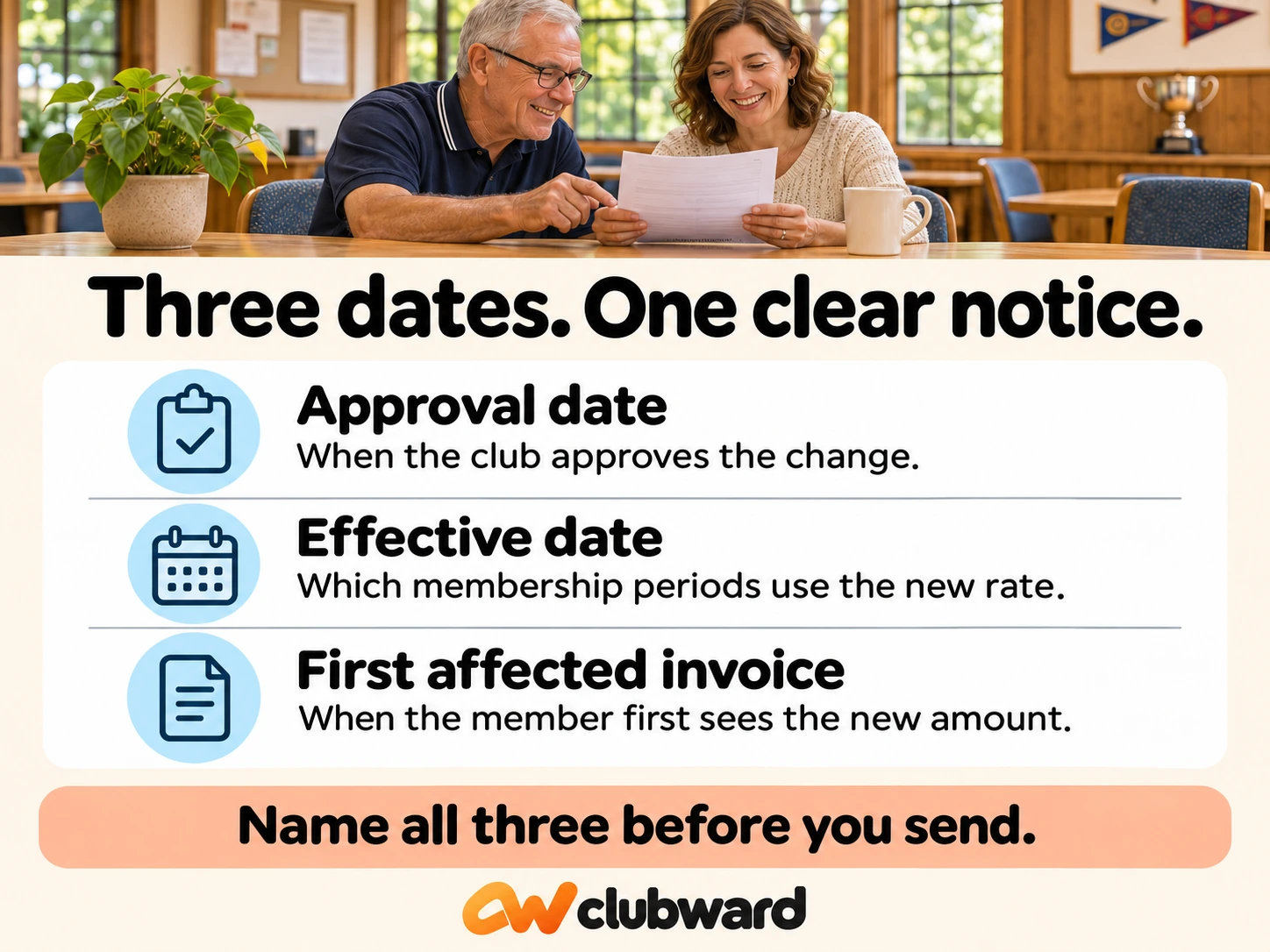
The approval date tells the team when the decision was made. It may matter for internal records and preparation, but it does not necessarily determine which membership periods use the new rate. A January board decision can apply to renewals beginning in April. Those dates should not be used interchangeably.
The effective date identifies the point at which the approved change applies under the club's decision. Its meaning needs to be explicit. Does it refer to a membership period beginning on that date, an invoice issued on that date, or another agreed event? The right answer comes from the club's actual terms and approval.
The first affected invoice is the practical date a member may notice. A household renewing in May could receive its invoice before May, while another household is still paying an earlier arrangement. The announcement should make clear how the effective rule connects to those invoices, rather than leaving the member to infer the connection.
A decision sheet for the people implementing the change
A short internal sheet can carry the details that different volunteers need. It should point to the approved decision and make open questions visible. The sheet does not need to become another policy document. Its job is to help the person preparing invoices and the person answering member questions apply the same understanding.
- Approval: the decision reference, approval date, and person authorized to answer interpretation questions.
- Affected memberships: the packages or membership groups included in the change.
- Amounts: the previous and new dues, with the relevant billing period named.
- Effective rule: the event that determines whether the new amount applies.
- Existing arrangements: how already paid renewals, installments, credits, and approved exceptions will be handled.
- Member explanation: the actual reason the board has agreed to share.
- Response route: who receives questions, what they can decide, and when members should expect an answer.
- Verification: the sample invoices and notices reviewed before the change is used.
Each unresolved detail needs an owner before the announcement is finalized. For example, the communications volunteer may be able to improve a sentence, but they should not decide how an existing installment arrangement changes. Routing that question early protects the notice from becoming the place where the club accidentally makes a new policy.
One change, three member situations
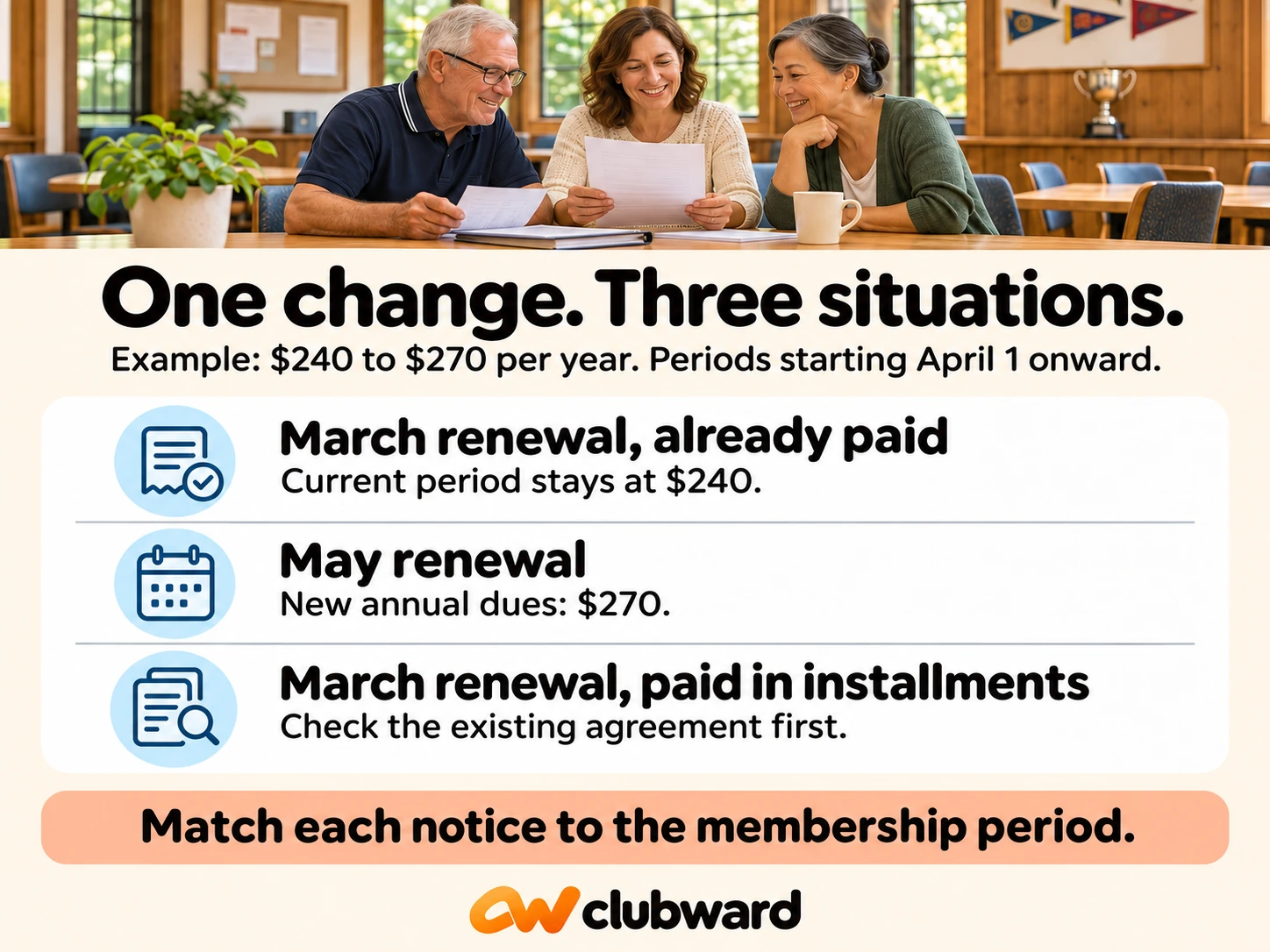
Consider a club planning annual dues of $270 instead of $240 for membership periods beginning on or after April 1. These amounts provide a simple worked example. The important part is the rule tying the amount to the membership period, which determines what each household should be told.
A household whose March renewal was already paid has a period beginning before April 1. Under the example rule, that renewal remains at $240. The announcement can reassure the household about that specific arrangement without implying that every future payment or renewal is exempt. Its next affected renewal should be explained separately when relevant.
A household whose next period begins in May falls after the effective date. Its notice can say that the May renewal will use the new $270 amount and identify when to expect the invoice. The amount and timing now describe that household's situation, rather than making it work through a general board statement.
A third household renewed in March but pays in installments. The club needs to check the existing arrangement against the approved rule before sending an individual notice. A payment happening in May does not by itself establish that the underlying membership period began in May. Staff need both pieces of information to explain the amount.
If the approved decision uses a different trigger, these outcomes may differ. That is why the worked cases belong beside the actual rule during preparation. The exercise is not about choosing a universally correct fee policy. It is about making the policy your club approved understandable and consistently applied.
A clear explanation of the amount
The announcement should state the previous amount and new amount in the same units. Annual dues should be compared with annual dues, and a monthly amount should be labeled as monthly. If payment options have different totals or charges, describe the relevant arrangement clearly rather than comparing numbers that represent different commitments.
In the worked example, the change from $240 to $270 is $30 for the annual membership period. A reader can understand that amount without a percentage. If the club chooses to include a percentage as well, the arithmetic and reference amount should be checked. Extra calculations are useful only when they make the decision easier to understand.
The notice should also distinguish dues from other amounts when necessary. A deposit, optional purchase, or separate activity charge should not quietly appear inside a number described as membership dues. If several charges are changing together, a short breakdown may be more helpful than a single total with a vague explanation.
An adaptable member announcement
The following notice keeps the amount, applicable period, and next step together. Replace its bracketed fields with approved details before use. Different member groups may need different first-invoice sentences. A household with an existing arrangement should receive an explanation that fits that arrangement, not a paragraph intended for a new applicant.
Subject: Your next club renewal and the new dues amount
Hi [name],
[Club] has approved a change to dues for [membership type]. For membership periods beginning on or after [effective date], annual dues will change from [old amount] to [new amount]. Your first renewal at the new rate will begin on [date]. We expect to issue that invoice on [date].
The board approved this change to [specific approved reason]. This supports [approved work or operating need].
Your current arrangement [continues through its agreed period or changes as specified here]. Please review your renewal statement when it arrives. If the amount or date differs from this notice, contact [role] at [official contact] so we can check your membership with you.
Thank you for being part of [club].
Questions the front desk should be ready to answer
One common question is whether the change affects a payment already made. The answer should refer to the membership period and approved rule, not simply the day money arrived. Staff can explain the relevant dates and identify any case that needs a treasurer's review. They should not guess at an exception to avoid an awkward conversation.
Another question is whether a member can continue an existing arrangement. The response needs to reflect what was actually agreed. If an installment plan continues unchanged for its current period, say so clearly. If a future renewal has different terms, explain that separately so the member can distinguish today's obligation from the next decision.
There may also be questions about options. Only offer choices that the club has approved and can administer. If a staff member needs permission before agreeing to an arrangement, the useful answer is a named review route and a response date. A promise that someone will investigate is different from a promise that a request will be approved.
Once the new fee is approved, tailor the next communication to each member’s actual status. Our membership renewal email templates include invitation, pending-payment and confirmation examples, so a member who already paid does not receive the same message as someone who has not started renewal.
The invoice is part of the announcement
A well-written notice can still leave members confused if the next invoice tells a different story. Before release, compare the actual example invoice with the message intended for that member group. The membership type, period, rate, and timing should agree. Any adjustment should have an explanation the person answering questions can find.
This check is especially helpful when a club has several packages. A board might approve one change while another membership remains unchanged. The team needs an example of both, so the implementation is checked for where the new amount applies and where it should not. Testing only the changed case misses half of that decision.
A credit adds another useful case. The membership dues may be $270, while the amount payable is lower after an approved credit. The notice should not confuse the standard rate with the household's remaining balance. A member can need both numbers, with a clear explanation of what each represents.
For a club considering new tools, a billing and statements walkthrough can focus on those examples. Bring one ordinary renewal, one credited account, and one existing arrangement. Ask how the team would explain each invoice and preserve the context needed when a different volunteer takes over the conversation.
Make communications, renewals and billing tell the same story
A strong notice is only one part of the member experience. A household might read an email, check its portal, review an invoice and speak to someone at the front desk. If each place shows different amounts or dates, even a carefully written announcement loses credibility.
This is where connected club operations matter. Clubward brings membership records, household context, billing, renewals and communications into a shared workflow, making it easier for the team to explain what a member owes and what comes next. The benefit is not sending more reminders. It is giving members and staff consistent answers without hunting through disconnected tools.
For clubs evaluating a change of platform, ask for a walkthrough of the complete scenario: update an approved membership price, confirm which renewals are affected, review a household invoice and prepare a clear member communication. The demo should focus on the specific workflow and any exceptions your club actually uses.
For members who want to check their own information, a member portal can provide a place to review household details, invoices and recorded payments, where those options are enabled. For staff answering questions, member email templates can help keep the explanation consistent with the account being discussed.
A handoff that survives a change of volunteer
The person announcing the decision may not be the person answering questions next month. A useful handoff includes the final approved notice, the effective rule, examples of the affected invoices, and the current owner for exceptions. The covering person needs the decision behind the amount, not just a folder of old emails.
The same care applies to public information. If the club updates a membership page, printable form, or welcome packet, those materials should describe the same rate and effective rule. A short inventory helps the team find the places members actually use. It need not become a redesign of every communication channel.
When the first replies reveal a gap
A member's question can identify a missing explanation even when the underlying fee is correct. If several people ask which renewal changes, the notice may need a clearer date sentence. If one account shows the wrong amount, it needs an account review. Those are different problems and should lead to different corrective actions.
For an individual mismatch, the club can acknowledge the question, check the record, and give a response date. The person handling it should know whether routine payment follow-up needs to pause while the amount is reviewed. The member should not receive a firm payment request from one volunteer while another has promised to investigate.
For a broader communication gap, the club may need a clarification for the affected group. Explain what the original notice left unclear and provide the correct information. Avoid presenting a clarification as a new board decision unless the decision itself changed. Members need to understand whether the terms changed or the explanation improved.
A practical review before sending
A small rehearsal can use three people in different roles: the person responsible for the decision, the person preparing an invoice, and the person answering a member. Each should be able to explain the same example. A disagreement during that rehearsal is a useful issue to resolve before the notice becomes the member's problem.
Once the change is communicated, keep the first review date visible. The team can check whether invoices matched the notice and whether questions received answers. That review is about the quality of the implementation. It should not turn a few replies into a claim that every member understood or accepted the increase.
A correction should identify what changed
Suppose the club sends a notice saying that new dues apply to invoices issued after April 1, while the approved decision actually refers to membership periods beginning after that date. The team has found a wording problem with practical consequences. A correction should state the intended rule and identify the group whose first invoice may differ from the original explanation.
That correction can remain short. It might explain that the earlier message used the invoice date where it should have named the membership period. The club can then provide the right example and a contact for checking an individual account. Acknowledging the exact ambiguity is more useful than sending the full original notice again with one sentence silently changed.
If an invoice has already been prepared from the wrong interpretation, correcting the notice alone is unfinished work. The authorized person needs to review the affected records and confirm what members will actually receive. The communications owner and invoice owner can close the issue together when the explanation and amounts agree.
A final question for the committee is whether a member could use the notice to predict the next invoice correctly. Try that with an ordinary renewal and an exception. If the answer depends on an unstated assumption, resolve the assumption before sending. This keeps the review anchored to the member's actual decision and account.
Frequently asked questions about increasing club membership dues
How much notice should a club give before increasing membership fees?
Check the club’s bylaws, membership agreement, approval process and applicable requirements before setting a deadline. Give members enough time to understand the approved rate, when it applies and any response they need to make. No single notice period fits every club.
Should a membership fee increase affect members who already paid?
Follow the approved effective-date rule and the existing membership terms. In the worked example here, a March membership period already paid at $240 stays at that rate; a new period beginning in May uses $270. Do not treat a later installment date as a new renewal without checking the underlying agreement.
What should a club membership fee increase letter include?
State the old and new rate, billing period, effective rule, first affected renewal or invoice, board-approved reason and a named contact. If there are different membership types or installment arrangements, use tailored examples instead of implying everyone is affected in the same way.
How can clubs reduce nonrenewals after a dues increase?
Start with consistent records and clear communication: explain the reason, make billing changes predictable, answer individual concerns and avoid sending reminders after a renewal has already been confirmed. Review the member’s overall experience rather than assuming the fee alone explains a decision not to return.
Make the next renewal easy to explain
The strongest announcement rests on a decision the club can apply, an example it can explain, and a contact who can resolve the remaining questions. Those elements let the member see what changes for them without navigating the committee's entire planning process.
If you are evaluating that workflow, use renewals on opposite sides of the effective date as the starting point. Include an already paid account and an installment arrangement, then trace the explanation from the decision to the invoice. Book a personalized Clubward demo to discuss how your team would handle those situations.
From Clubward Team
More from Clubward