

A membership invoice is past its due date, but that does not tell the treasurer everything needed for a useful reminder. A payment may be waiting to post. A household may be questioning a charge. Someone may have replied to a different staff member yesterday. The first decision is whether the account needs a payment request, an explanation, or a little more investigation.
A practical follow-up process starts with the remaining amount, the evidence behind it, and a named owner for the next conversation. Once those three things are clear, the reminder can be short and specific. The member should understand which invoice you mean, what you believe remains unpaid, and how to resolve a question without starting the conversation again.
This guide uses a simple account tracker and three adaptable messages. The examples are suggestions for organizing your club's work, rather than a substitute for its approved membership terms. The aim is a respectful conversation that reaches a clear outcome, whether that outcome is payment, a corrected account, or an agreed review.
The balance and the next action are different questions
An account can have an outstanding amount without needing another reminder today. Suppose a household owes $130 and has just submitted a payment for that amount. The balance still needs attention until the payment is checked, but asking the member to pay again would be the wrong next action. The tracker should make that distinction visible.
Likewise, a member may agree that an invoice exists while disagreeing with one line. Repeating the total does not answer the question. The next action belongs with the person who can review the charge, not necessarily the person who sends routine reminders. A good handoff carries the disputed item and the promised response date.
These situations suggest two separate fields: the confirmed remaining amount and the review state. The amount explains the account. The state explains what staff should do next. Combining them into a single label such as unpaid makes it harder to distinguish a member who needs a reminder from an account already being resolved.
There is also a difference between receiving a reply and resolving the balance. A message saying that the member will investigate is useful progress, but it is not a payment. Recording the reply alongside a next review date lets the club acknowledge that progress without treating the account as settled or sending another message immediately.
A short review before the first reminder
The starting point is the invoice your club actually issued. Its reference, membership period, due date, and responsible account contact should agree with the information used for follow-up. If those details disagree, the mismatch deserves a review before anyone writes to the household. Otherwise, the reminder may confidently describe the wrong obligation.
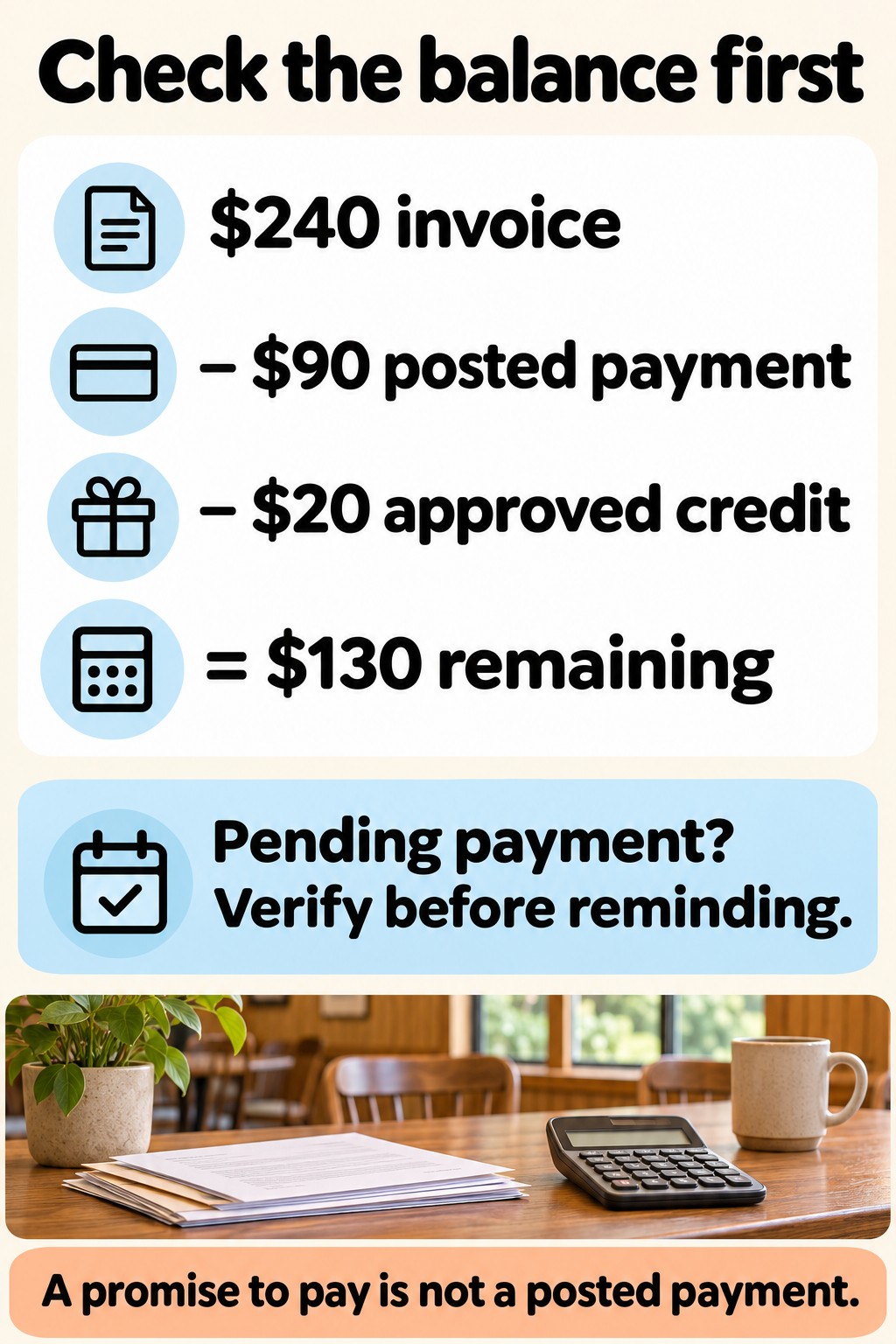
Next comes the activity connected to that invoice. Posted payments and approved credits belong in the calculation of the remaining amount. Pending activity belongs beside that calculation, with its own explanation. Treating an unconfirmed payment as fully resolved hides unfinished work; ignoring it entirely can lead to an unnecessary second request.
For example, a $240 annual invoice with a $90 posted payment and a $20 credit leaves $130 outstanding. If there is also a pending $130 payment, the account needs a payment check before a reminder. If only $100 later posts, the remaining $30 becomes the amount to review, rather than the original $240.
The arithmetic is only part of the review. The contact history may show that the household already asked a question, received an extension, or was told to wait while staff checked an adjustment. Any approved arrangement should travel with the account, including who approved it and when the club will revisit it.
A small club can make this review manageable by assigning one person to prepare the list and another authorized person to handle exceptions. That does not require two people to inspect every ordinary account. It means a confusing amount has somewhere to go, with a clear boundary between routine follow-up and a decision needing authority.
A tracker that explains the work
The tracker is most useful as a view of open follow-up work, not a second accounting system. Keep references to the underlying records so staff can find the invoice and activity behind an amount. When the source changes, the follow-up row should be checked against it rather than becoming an independent version of the truth.
- Account and invoice reference: enough information to find the correct record without exposing a household's details to unrelated staff.
- Membership period and due date: the period being discussed and the deadline your club communicated.
- Original amount, posted payments, and credits: the components behind the remaining amount.
- Pending activity: what is being checked, who is checking it, and when they expect an answer.
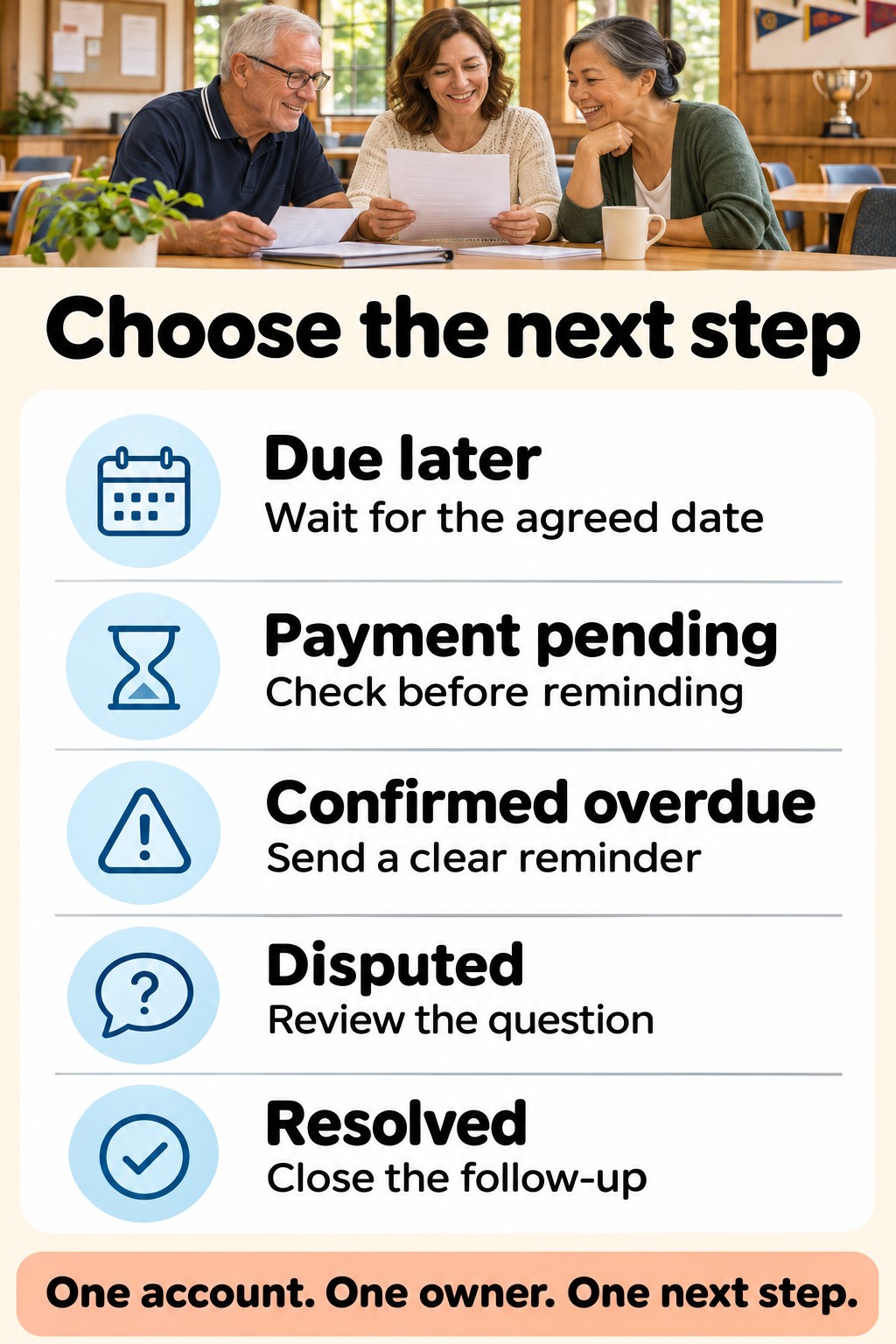
- Review state: due later, payment pending, confirmed overdue, disputed, or resolved.
- Owner and next action: one responsible role, one concrete step, and a review date.
- Last contact and outcome: what the member was told, any reply, and any commitment made.
Those fields can fit into an existing shared work list if access is appropriate. The important design choice is that another authorized person can understand the next action without reading an entire inbox. A row saying “treasurer checking credit; update member Friday” is more useful than a row saying “emailed” with no explanation.
Notes also need a practical boundary. The tracker can record that the member requested a private discussion and identify the person handling it. It need not repeat sensitive personal circumstances for everyone using the list. The operational question is what the club agreed to do next, not how much private background it can collect.
Five states with different next steps
Due later means the account has an amount to pay, but the agreed deadline has not passed. A routine upcoming-payment notice may be appropriate under your club's process. An overdue reminder is not. If the due date itself is uncertain, resolve that uncertainty before selecting the message.
Payment pending means there is specific activity to check. The row should identify the relevant reference and the person reviewing it. A review date keeps pending from becoming an indefinite parking place. Until that check is complete, staff can acknowledge the member's action without asking for a duplicate payment.
Confirmed overdue means the remaining amount, due date, and contact history support a reminder now. This is the ordinary follow-up queue. The message can name the invoice and amount directly, with a straightforward route to review or pay through the club's established process.
Disputed or mismatched means someone needs to explain or correct the account before routine reminders continue. Record the particular question, the authorized reviewer, and the date the member should hear back. A disagreement about one charge should not disappear into a general note that the member is difficult to reach.
Resolved means the club has checked the outcome and closed the follow-up action. That might follow a posted payment or an approved correction. Record what resolved it. A promise to pay is progress toward resolution, but the next review remains open until the agreed outcome has actually been checked.
The first reminder gives the member an answer
A useful first reminder begins with context rather than pressure. The member may know they owe something but not recognize the membership period or understand how a credit was applied. Naming the invoice and the remaining amount gives them a concrete starting point. One clear next step is easier to act on than several competing instructions.
Hi [name], we're following up on invoice [reference] for [membership period]. Our checked balance as of [date] is [amount]. Please sign in through your usual member portal to review the invoice. If you already paid or the amount looks different from what you expected, reply so we can check the account with you.
The date in that message matters because it explains the information being used. It does not imply the account can never change after the message is sent. Before adapting the wording, the sender should be able to point to the same amount in the current record and explain any payment or credit already included.
Your club may prefer another established payment route. Use the route members already recognize, and confirm the destination before sending. The reminder does not need to collect payment details through a reply. It needs to connect the person to the correct account process and offer a clear contact when the record needs explanation.
When a member says they already paid
This reply changes the task. Instead of repeating the request, the club now has information to investigate. A payment reference, approximate date, and relevant invoice may help the authorized reviewer locate the activity. Ask only for what your process needs, using the appropriate private channel rather than requesting unnecessary financial details in a shared conversation.
Thanks for letting us know. We're checking how the payment was applied to invoice [reference]. There's no need to submit another payment while we check this. [Role] will update you by [date]. If you have a payment reference available, please share it through [approved contact route].
The promise in that reply should be one the club can keep. If the reviewer needs more time, a short update is better than letting the promised date pass unnoticed. The tracker gives the covering staff member a way to see that responsibility even if the original sender is away.
Once the activity is found, the member deserves the outcome in plain language. Perhaps the payment was applied correctly and the reminder crossed with it. Perhaps it belongs to another invoice, or an amount remains. Explain the specific result and update the tracker so the next person does not restart the same investigation.
A second reminder should add useful information
A second message is justified by a fresh account check and the club's agreed follow-up process, not simply by the age of the first email. If the member has replied, the next message should reflect that conversation. If there has been no reply, make the contact route and requested response clearer without inventing consequences.
Hi [name], we reviewed invoice [reference] again on [date]. The remaining amount is [amount]. Please contact [role] at [official contact] by [date] if the amount looks wrong or you need to discuss the options our club offers. You can review the invoice through your usual member account.
Options should be ones the club has actually approved. A staff member should not improvise a payment arrangement, waive a fee, or promise continued participation to make the conversation easier. Equally, a reminder should not threaten a restriction that the club has not decided to apply. Separate the communication from the authority to change terms.
For a small volunteer team, this is where a named escalation contact becomes valuable. The routine sender can explain who will handle a question and when to expect an answer. The member is not left navigating between committee members, while the reviewer receives the invoice context instead of an unexplained forwarded message.
One household, three possible outcomes
Consider the same $240 invoice, $90 payment, and $20 credit. The confirmed remaining amount starts at $130. In the first case, a pending $130 payment later posts against that invoice. The reviewer checks the result, closes the reminder action, and tells the member that the account has been updated.
In the second case, the member pays $100 and asks about the final $30. The tracker now shows $30 remaining and a question for the treasurer. The original reminder amount is no longer the current amount. A new request should wait for the answer to that question, with the review date visible to covering staff.
In the third case, no pending activity is found and the member has not replied. The account remains in confirmed overdue after the review. The next communication follows the club's approved process and uses the current amount. Nothing about the absence of a reply establishes why the member has not paid.
These outcomes show why a sequence based only on elapsed days is an incomplete operating plan. The same initial balance can lead to three different next actions. A useful reminder process follows what changed in the account and conversation, while keeping the next review from being forgotten.
Handoffs need a promise and an owner
The point of a handoff is that the member should not have to repeat the whole story. A covering treasurer needs the invoice reference, the checked amount, the open question, and the promised response date. They also need to know what they are authorized to decide and which decisions belong elsewhere.
A short handoff might read: “Invoice 1042 has $30 remaining. Member questions the adjustment. Treasurer will check the approval record and reply Thursday. Routine reminders paused until that response.” This records the work without labeling the member or burying the next action in a long narrative. For example, a pending adjustment needs its own reviewer even when another person has already contacted the household.
Where several people can contact members, one owner should coordinate each open account. Others may contribute information, but the tracker should make clear who sends the next response. This gives the club a simple way to avoid two well-intentioned volunteers sending different answers from separate inboxes.
A small trial before using the list widely
Before adopting the tracker across the club, try it with a handful of accounts covering the different states. Include a pending payment, a corrected amount, a member question, and an ordinary overdue invoice. The test is whether someone unfamiliar with each account can identify the next action and find its supporting record.
Another useful check is the stop condition. After an account is resolved, can the team tell that follow-up has ended? After a dispute is opened, can the covering person see that reminders are paused? If those distinctions depend on remembering a conversation, the tracker needs a clearer state or a better handoff.
The review can also examine the messages themselves. Do they identify the correct period and current amount? Is the contact route working? Does the requested action match what the member can actually do? These checks are about making the process understandable, rather than polishing a message that still points to an unresolved account.
Reviewing the list without judging the member
A weekly account review can be a discussion of unfinished work rather than a roll call of people who have not paid. The difference is practical. “Six accounts need attention” tells the committee very little. “Two payments need checking, one credit needs approval, and three reminders are ready” gives each person a task they can understand.
For the first few reviews, it helps to notice why rows remain open. Some will be waiting on the member, while others will be waiting on the club. A reminder queue that mixes those situations can conceal an internal delay. A question about a charge should remain visible as work for the club until someone has answered it.
The club can also distinguish contact attempts from completed conversations. An email sent to an outdated address has not reached the person who can act. If a contact detail needs checking, the next step should say so. Sending the same notice again does not solve that particular problem, even if it makes the activity list look busy.
Consider a covering volunteer reviewing the list on Saturday. One member was promised an answer on Friday, but the reviewer has not recorded an outcome. Before anyone sends a payment request, the covering volunteer can ask whether the response was completed. The useful discovery is an unfinished promise, not a new reason to press the member.
A modest set of review notes is enough: how many accounts are waiting on a payment check, how many questions need an answer, and how many confirmed reminders are ready. These are descriptions of the club's work. They should not become claims about member intent, willingness to pay, or the effectiveness of a message without supporting evidence.
When the same confusion appears repeatedly, the team has a specific improvement to investigate. Perhaps the membership period is hard to recognize on the invoice, or the credit explanation is unclear. A small wording or handoff trial can then address that observed question. The next review can ask whether staff still need the same explanation, without promising a particular payment result.
Closing the loop also includes the person who raised the question. If staff correct an amount, a brief explanation helps the member understand the new balance. If the original amount was correct, showing how it was calculated is more useful than saying the system confirms it. The underlying record should support either answer.
Over time, the process should become easier for a substitute to follow. The goal is not a more elaborate spreadsheet or a longer sequence of notices. It is a clear account, a respectful conversation, and a visible next action that survives a change of shift. That is a useful standard for reviewing both the tracker and the tools supporting it.
Connecting the account to the conversation
A billing and statements walkthrough can start with the account you need to explain: its invoice, posted payments, credits, and remaining balance. Bring the open question too. For this follow-up process, consider whether your team can trace that amount, identify the responsible person, and carry the unresolved question into clear next steps.
If your club is still designing how dues are collected, begin with the membership period, approved amount, responsible account contact, and intended payment route. This tracker begins after an invoice exists. Keeping those questions separate helps the team improve the specific part of the process that is causing confusion, instead of redesigning everything around one unanswered balance.
Make dues collection easier with Clubward
Your team has better things to do than chase every payment by hand. Clubward makes collecting dues easier with automated dues collection and arrears collection tools, helping your club manage recurring payments and follow up on overdue balances. Keep the account history behind each conversation in view, so members get a clear answer and your team knows what needs attention.
Book a personalized Clubward demo to see how automated dues collection and arrears follow-up could work for your club.
From Clubward Team
More from Clubward