Operations
A Club Board Report That Ends With Decisions
Build a board brief around a decision, defined measures, credible evidence, practical options, and named next actions instead of unexplained totals.

Begin your next club board report with the decision you want the board to make. Then provide the evidence, definitions, options, and owner needed to act on it. If a page does not help someone understand the operation or make a decision, reconsider why it belongs in the main report.
A useful report can still include routine updates. The difference is that readers should be able to distinguish information to note from a question to resolve. Put those purposes in plain language near the beginning, so board members know how to prepare for the meeting.
This guide offers a practical structure for an operational decision brief. It is intended for a club manager, secretary, or volunteer preparing a discussion. Use your organization’s existing governance and financial review processes for formal approvals.
Choose the question before the measures
Write the question as a decision with a clear boundary. “What happened this season?” is useful background, but it may be too broad for a single agenda item. “Should we offer a second Tuesday workshop next month?” gives the report a specific purpose.
State who is being asked to decide and what is within that decision. In the workshop example, the board might consider whether to authorize a trial session within an agreed resource limit. The program team would still need to confirm the room, staffing, and participant instructions before making a public commitment.
Describe the consequence of leaving the question unanswered without manufacturing urgency. Perhaps the team needs a direction before preparing the next program calendar. Give the actual planning date your organization has agreed, and explain what work depends on it. Avoid adding a dramatic deadline simply to make the report sound important.
Keep related questions separate when they require different evidence. Whether to run another workshop is different from whether to change the overall membership offer. A focused brief can acknowledge that connection while keeping the present decision small enough to understand and evaluate.
Put a short answer near the beginning
Draft a recommendation in two or three sentences. State the proposed action, the main reason, and the condition that matters most. For the sample workshop, you might recommend a limited trial, subject to confirming an instructor and suitable space before registration opens.
Follow with a sentence describing the alternative if the condition cannot be met. The board should understand whether the team proposes to defer the activity, change its scope, or bring the question back. This makes the recommendation more useful than a general request to “explore opportunities.”
Keep the recommendation honest about uncertainty. If the evidence is incomplete, identify the missing information and explain how it affects the decision. A board can consider a conditional next step without being told that a forecast is a guaranteed result.
Try reading only the first paragraph aloud. Can someone tell what decision is requested, why it matters, and what will happen next? If the answer is unclear, edit that paragraph before adding more charts or background. The opening should orient the discussion rather than summarize every detail.
Define the period and the terms
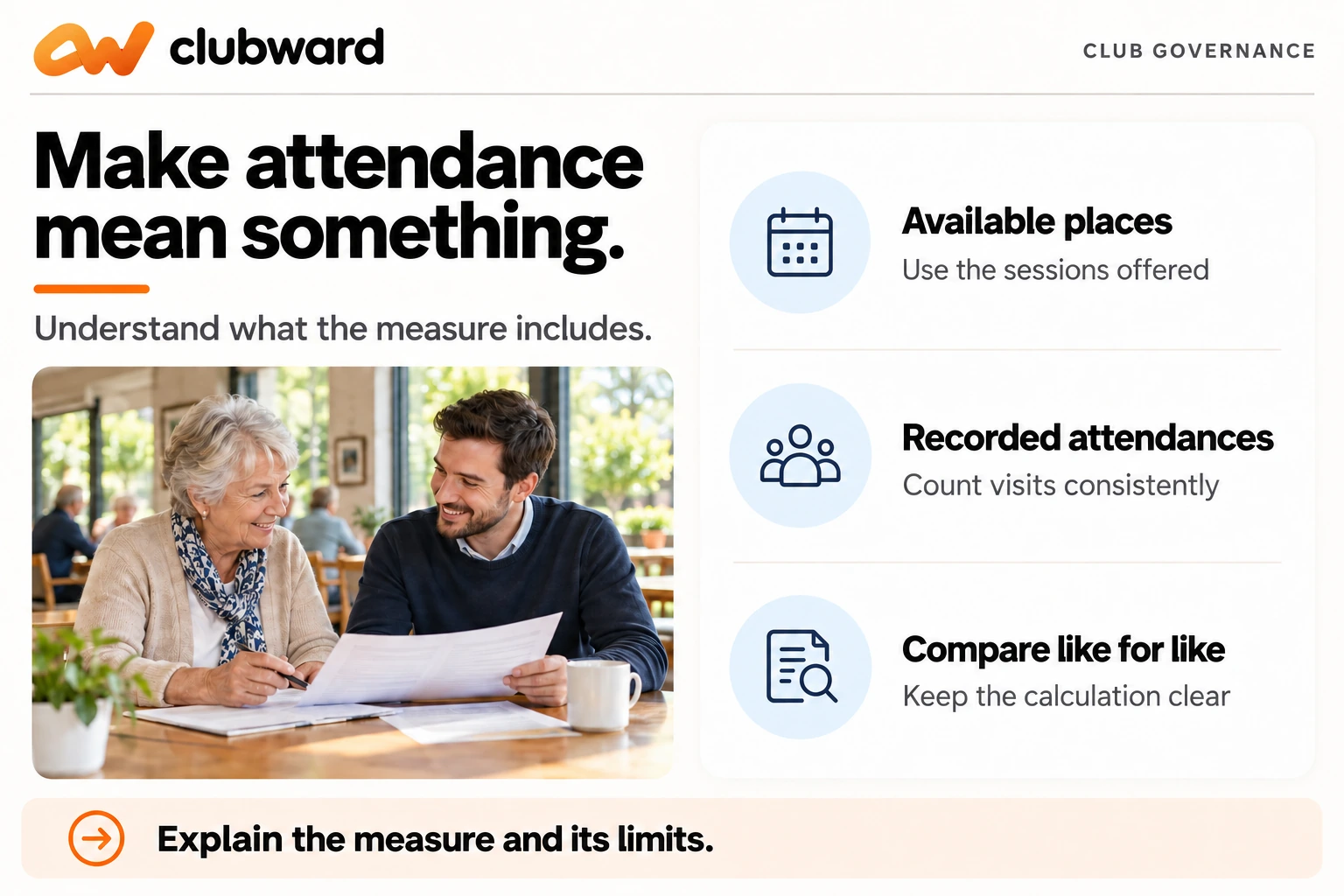
Give every measure a period, a definition, and a source. If you report registrations, explain whether the count includes cancellations or people awaiting confirmation. If you report attendance, say which sessions are included and how the count was recorded. Keep those definitions consistent within the comparison.
Use working definitions when a term could be understood differently. For this report, you might define “confirmed places” as registrations approved for the selected sessions as of the stated review date. Have the person responsible for the source data confirm that the report matches the intended meaning.
Treat billed amounts and collected payments as separate report labels. In your own report, explain exactly which records are included in each and have the responsible financial owner validate the figures. Do not combine them under a vague label such as “income” if that hides the question the board is trying to answer.
Check comparison periods as carefully as the totals. If one period contains four sessions and another contains six, explain the difference before interpreting the result. You may decide to compare a per-session measure, but write down the calculation and its limits so readers can judge whether it is appropriate.
Show the calculation, then explain its limits
Consider a sample program with four sessions and twelve available places at each session. That gives forty-eight available session places. If the attendance records show thirty-six attended places across those sessions, the illustrative attendance-to-capacity calculation is thirty-six divided by forty-eight, or seventy-five percent.
That arithmetic answers a narrow question. It does not establish why some places were unused, whether a different time would work better, or whether members want an additional session. Put those questions beside the calculation rather than allowing the percentage to stand in for evidence you do not have.
Next, identify what you would inspect before recommending a change. You might review session-level attendance, cancellations, questions received by the coordinator, and the suitability of another time. Use the records your organization actually has, and label any proposed research as a next step rather than a completed finding.
Avoid decorating a hypothetical number with a trend line that suggests a real history. If you include an illustrative chart or dashboard in a working template, mark it clearly and replace it with verified data before presenting it as your club’s result. Keep the original calculation available for checking.
Give the board a small number of real options
Offer alternatives that your team could actually carry out. For the workshop example, one option is to keep the current schedule while improving the attendance record. Another is to test one additional session under defined conditions. A third might be to collect more specific member interest before committing resources.
Describe each option using the same questions: what would change, what work would be required, what evidence supports it, and what remains uncertain? A balanced comparison lets readers understand the tradeoffs without burying the preferred option inside a longer, more flattering description.
Be explicit about dependencies. An additional session may require a suitable instructor, an available room, preparation time, and clear participant communication. In your actual report, confirm each dependency with its owner. Do not present an unconfirmed resource as if the decision has already made it available.
Include the option of keeping the current approach when it is a reasonable choice. Explain what would be monitored and when the question would return. Maintaining the current arrangement can be an active decision if the board understands its rationale and the next review point.
Keep the main report readable
Use a compact sequence: decision requested, recommendation, evidence, options, and next steps. Put detailed records in supporting material when they are needed for verification. The main report should contain enough information to assess the decision without requiring readers to reconstruct your reasoning from several unrelated attachments.
Choose headings that describe the content. “What the attendance record shows” is clearer than “Insights” when the section contains a specific calculation. “What must be confirmed before a trial” tells readers why the next checklist matters. Let the headings carry part of the explanatory work.
Use a table only when it makes comparison easier. A short set of options can work well in rows with consistent columns. A long narrative squeezed into narrow cells may be harder to read on a phone or printed page. Check the version board members will actually receive.
Write captions that explain what a visual contributes. A caption should name the period, clarify whether the example is illustrative, and point out a relevant limit. Do not use captions to introduce unsupported claims that the surrounding report avoids making.
Assign the next action while the decision is clear
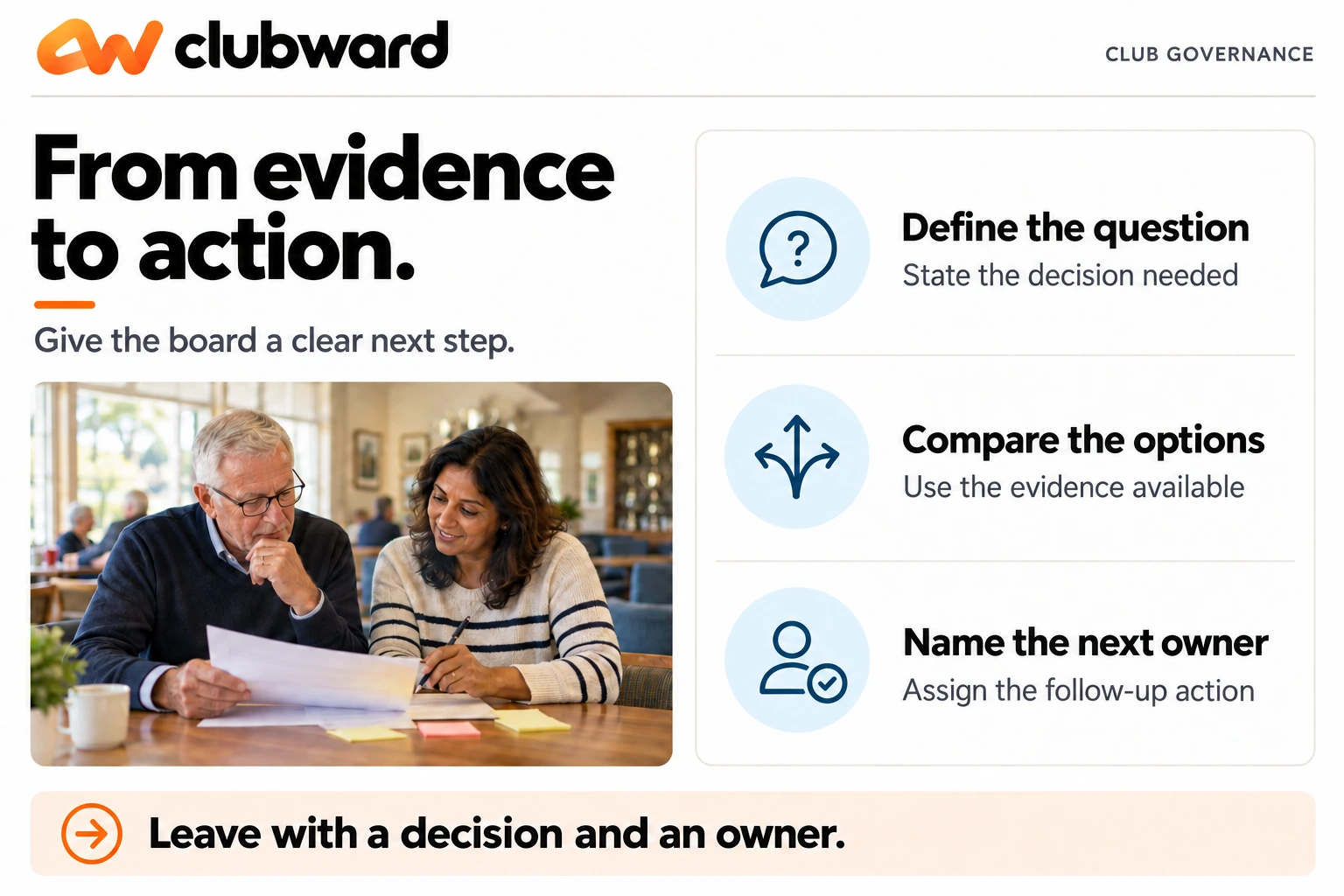
Give each approved next step an owner, a due date, and a completion condition. “Program team to follow up” leaves too much room for interpretation. “Program coordinator to confirm room and instructor availability before opening registration” describes an action another person can verify.
Separate approval from implementation. A decision to explore a trial does not automatically authorize every detail of the activity. Record any conditions, spending boundaries, or further approvals using your organization’s normal process. Make those limits visible to the person carrying out the work.
Keep a small action record alongside the report. Include the decision date, the agreed wording or reference to the official record, the assigned owner, and the next review. Use that record to prepare the following meeting rather than relying on someone’s memory of the discussion.
If the board defers the decision, record what additional evidence is needed and who will obtain it. A deferral with a clear request is a useful outcome. An unresolved item with no owner simply returns to the next agenda without becoming easier to decide.
Review the brief before it reaches the board
Ask the source owner to check the figures and definitions. Ask a colleague unfamiliar with the draft to identify the requested decision. These are different reviews: one checks the evidence, while the other checks whether the explanation is understandable.
Use a short checklist. Confirm the period, source location, calculation, comparison basis, stated limitations, and recommendation. Verify any links in the version being shared. Remove private information that the board does not need to assess the question, and follow your organization’s access rules for supporting records.
Look for words that imply more certainty than the evidence supports. “Will increase participation” may need to become “a trial would test whether this time attracts additional participants.” Make the sentence describe what the proposed action can establish, rather than promising a result that has not occurred.
Check whether the recommendation remains sensible if one assumption is wrong. If the trial depends on an unconfirmed instructor, explain the fallback. If the evidence comes from a small group of sessions, define a proportionate review rather than extrapolating to the entire membership.
Use operational questions in a platform review
When evaluating a club management platform, bring a question like the workshop decision to the demonstration. Ask where the relevant records live, who can review them, and how your team would establish consistent definitions. Have the demonstrator distinguish a displayed measure from the underlying records used to interpret it.
Start with a program the board needs to review. Walk through its enrollment, attendance, and billing in Clubward’s programs and shared spaces tools, then check which records can support your decision brief. Confirm the modules, reporting options, and any custom measures your club would need.
Use the demonstration to test the proposed process with sample data. Ask what your coordinator would record, what your manager would review, and what information could support the board discussion. Note any reporting requirement that needs a separate answer before treating the platform as a fit.
Bring your decision brief to a Clubward demo. We can use your board question to walk through the relevant member records, program activity, and reporting steps, with the evidence and handoffs your team needs at the center of the conversation.
Make the following report build on the last one
Begin the next review with the previous decision and its open actions. Report what was completed, what changed, and what still needs attention. Use the same definitions where the comparison depends on them, and explain any revision rather than silently changing the basis of the numbers.
If you ran a trial, compare the result with the question the trial was designed to answer. Record the period and conditions, then explain what you learned and what remains uncertain. Avoid treating one favorable outcome as proof that the same approach will work in every program.
Keep the reporting method light enough to maintain. A practical brief should help a volunteer or staff member prepare the next decision without recreating an entire analysis. Preserve the useful structure, retire irrelevant detail, and keep the connection between evidence, decision, and owner visible.
Bring a decision, not just a dashboard
For your next meeting, choose one operational question and build a short decision brief around it. Define the measures, show the calculation, compare workable options, and name the next owner. Add supporting detail only where it helps readers assess the recommendation.
To explore how your club’s operating records could support that process, book a Clubward demo and bring one board question with the definitions behind it. Ask the team to show the relevant workflow and identify any reporting requirements that need further confirmation.
From Katelyn Pauley
More from Clubward