Operations
Train Your Next Volunteer Without Repeating the Whole Season
Build and rehearse a volunteer guide with a clear trigger, useful steps, decision limits, a help contact, and a record of what was practiced.

Choose one routine task your next volunteer will perform and write a short guide they can use while doing it. Include the purpose, the moment to start, the steps, the limits of their authority, the help contact, and the record that shows the task is complete. Then rehearse it with someone who did not write the guide.
You do not need to capture an entire season in the first training session. Start with the work a person is expected to do on their next shift. Give them a clear route for the ordinary case and an equally clear point at which to ask for help.
This guide offers a practical method for volunteer coordinators and seasonal managers. The examples focus on everyday community-club tasks. They are a starting point for your own approved procedures, not a substitute for role-specific qualifications, emergency instructions, or requirements your organization must establish separately.
Begin with the next shift, not the whole handbook
List the tasks a new volunteer will actually encounter during the next shift. Choose a small set that fits their assigned position and access. A welcome volunteer might prepare materials, direct members to an activity, and record a question for the coordinator. Keep unrelated management tasks out of that first practice session.
Ask an experienced person to describe one task from beginning to end. Watch for phrases such as “then I just check” or “everyone knows where that is.” Turn those hidden steps into explicit instructions: which record to check, what information to look for, and what to do when the expected answer is missing.
Separate the purpose from the steps. “Prepare a useful welcome point” explains why the task matters. “Check the current activity list, place the approved materials, and confirm the help contact” gives the volunteer something to do. Both belong in the guide, but they serve different needs.
Choose a task owner who can approve the instruction. The person drafting a guide may know the routine well, yet still need a manager to confirm a boundary or escalation route. Resolve those questions before teaching the guide as the club’s standard practice.
Give each guide a predictable structure
Use the same core fields so volunteers know where to look. Start with the task name and purpose. Add the trigger, required information or materials, steps, stop conditions, help contact, and completion record. Keep the structure recognizable while allowing each task to contain the details it needs.
A trigger is the moment the guide becomes relevant. For example, “before the welcome desk opens for the afternoon program” is more precise than “daily.” It tells the volunteer when to begin and helps the coordinator assign the task in a shift plan.
Write the steps as actions with observable results. “Check the activity list” can become “confirm the current time and room against the coordinator’s approved activity list.” Avoid adding unnecessary detail about every possible screen or piece of equipment if it makes the main sequence difficult to follow.
End with a completion condition. The next person should be able to tell whether the work is ready. For a welcome cart, that might mean the approved materials are in place, the current activity information is available, and the volunteer knows the contact for unresolved questions.
Put limits beside the step that needs them
Tell the volunteer what they can decide and what must be referred. Place that boundary close to the relevant action. A guide that explains how to find a reservation should also explain what to do if the requested change falls outside the volunteer’s assigned authority.
Use a specific help route. Name the position responsible, how to reach the assigned person during the shift, and the backup if they are unavailable. Avoid relying on a personal phone number that the next volunteer may not have or a vague instruction to “ask someone senior.”
For a sample welcome task, the volunteer may be able to direct a participant to the confirmed room. They should refer an unresolved eligibility or account question to the authorized owner. Write that distinction in the guide so the volunteer is not asked to improvise an answer.
Review access alongside the instruction. A step is not usable if it requires a record the volunteer is not authorized to see. Ask the responsible manager to confirm the intended access and adjust either the procedure or the assignment through the approved process.
Keep the guidance close to the work
Decide where the volunteer will look when the task begins. Put the current guide there, or provide an obvious route to it. If your team uses a digital guide, verify the actual device and account the volunteer will use. If it uses a printed sheet, identify the owner responsible for replacing old copies.
Connect your club’s guidance to positions and daily work with Clubward’s staff training and procedures, including training for seasonal staff and volunteers. Bring one procedure to a demo so our team can show where a volunteer would find it and confirm the setup your organization needs.
Keep a short guide focused on the task in front of the volunteer. Link or point to fuller policy material where necessary, but do not require someone to search a long handbook to find the next ordinary step. Test whether the guide supplies enough information to proceed within the assigned boundaries.
Avoid using the guide as a place to hide unresolved decisions. If the rule is unclear, record the question for the owner and provide an interim instruction approved by that owner. Do not ask a new volunteer to make a policy choice because the written procedure is incomplete.
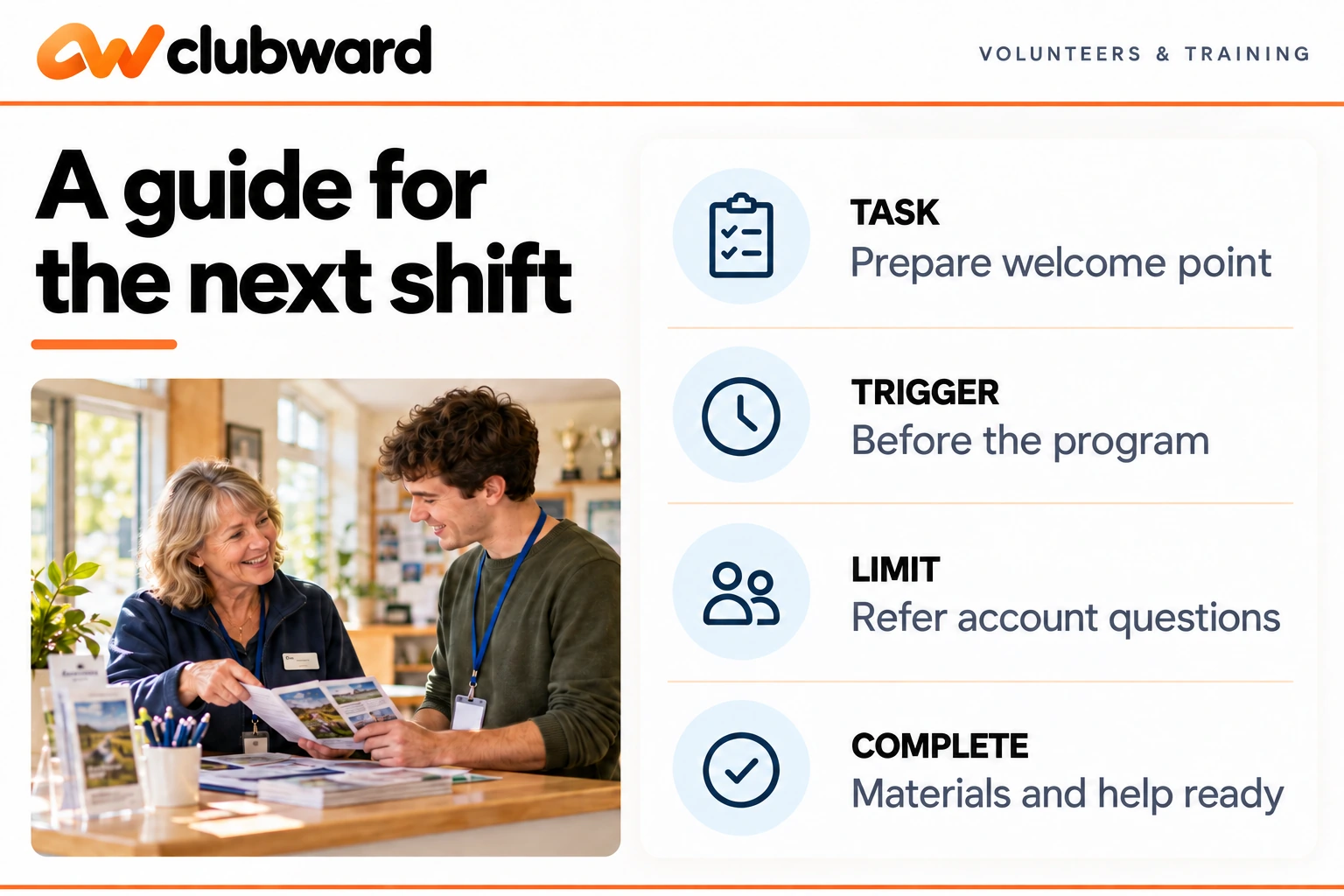
Practice scenario one: prepare the welcome point
Set up a sample practice session before the next activity. Give the volunteer the guide, a demonstration activity list, and the approved materials. Ask them to prepare the welcome point as they would at the start of a shift, explaining what they are checking.
The coordinator should observe without immediately filling every gap. If the volunteer cannot find the room information, note the missing label or unclear location. Ask what they expected to see. The exercise is a way to improve the guide, not a contest to see whether the volunteer can guess the writer’s intentions.
Include one ordinary variation, such as a missing supply. Ask the volunteer to identify the next authorized action and the person to contact. Decide whether the guide should include a simple replacement step or an escalation, using your actual operating rules.
Finish by checking the completion condition together. Can the next volunteer understand what is ready and what remains open? Record the useful change you made to the guide, such as adding the supply location or clarifying which activity list is current.
Practice scenario two: a member asks for a change
Use a sample reservation or program question with no private data. Ask the volunteer to find the relevant instruction, identify what information they can provide, and explain when the request needs the coordinator’s decision. Keep the exercise within the volunteer’s intended role.
For example, a participant asks to move to another session. The volunteer might collect the program name and direct the request to the authorized owner. The guide should not imply that the place is confirmed or that an account adjustment will occur before the responsible person has made that decision.
Have the volunteer explain the next step in plain language. A useful response tells the member what will happen next without inventing a promise. If your organization has an approved response expectation, include it accurately; otherwise avoid adding a deadline simply to make the practice answer sound complete.
Review what should be recorded for the next shift. Include only the information needed to continue the request in the authorized place. Keep personal detail out of general training notes, and distinguish a practice record from a real member enquiry.
Practice scenario three: the instructions conflict
Give the volunteer two sample pieces of information with different room names. Ask them to identify the authoritative source and the person who can resolve the discrepancy. This tests whether the guide explains how to handle uncertainty rather than only how to follow a perfect sequence.
The correct training outcome is not necessarily an immediate answer about the room. It may be a clear pause and referral within the volunteer’s authority. Teach the person how to support the member while obtaining the decision, using the process your organization has approved.
Ask the guide owner to explain what happens after the discrepancy is resolved. The current activity record, participant message, and staff instruction may each need review. Assign the updates so the next volunteer does not encounter the same conflict and repeat the investigation.
Use the exercise to improve the maintenance process as well as the guide. If nobody owns the authoritative activity information, appoint that owner through your normal management process. Training cannot make an unresolved responsibility disappear; it can reveal where a decision is needed.
Record what the person practiced
Keep a practical training record with the task, guide version, practice date, reviewer, and follow-up items. Use your organization’s normal system and privacy rules. Record what was actually observed rather than treating attendance at a session as proof of every capability.
Separate “introduced to the task” from “practiced with support” and “approved for the assigned work” if those distinctions help your team. These are suggested internal labels, not formal certifications. Define them clearly and have the responsible manager decide how they fit your operating process.
For the welcome-point exercise, a follow-up might be another practice locating the current activity list. Assign the next check and tell the volunteer what they should do until then. Avoid a vague note such as “needs confidence” when a specific task would make the next step clearer.
Give the volunteer access to the current guide after the practice. The point is not to test how much they can memorize in one sitting. Ask them to show where they would look on shift and how they would contact the right person if an unfamiliar situation arises.
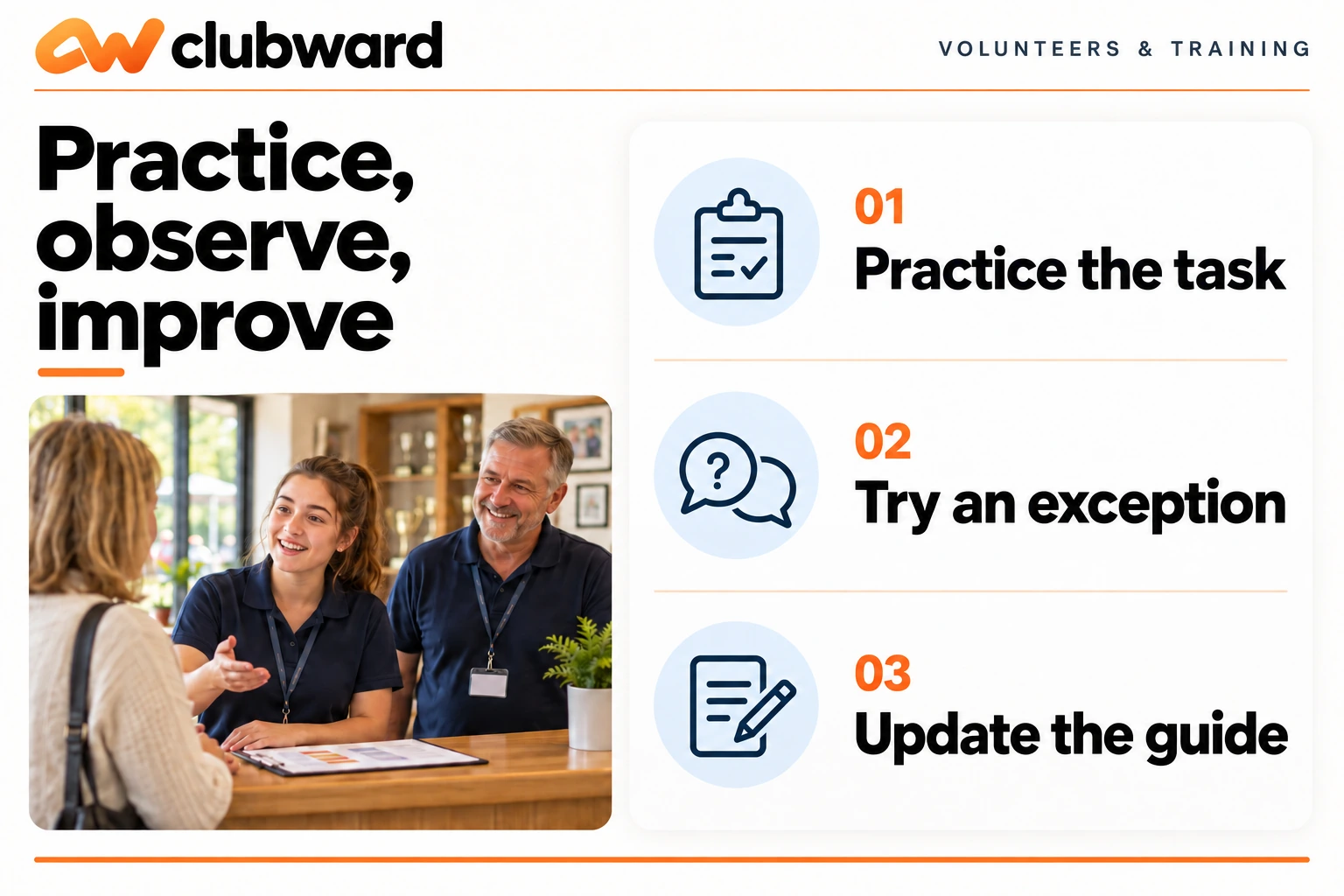
Review procedures when the work changes
Assign an owner and review date to each guide. Also identify the changes that should trigger an earlier review: a new location, a revised policy, a different access arrangement, or an updated workflow. Connect the guide to the person who knows when those changes occur.
Keep version information simple and visible to staff. State which guide is current and retire obsolete copies through your normal process. If the instructions change between shifts, tell the affected volunteers what changed and whether another practice is needed before they perform the task.
Use Clubward’s staff tools to organize position-based access and your club’s procedures. Available capabilities vary by plan and selected modules. Walk through a procedure update with our team, including how you will notify affected volunteers and confirm that they have the current instructions.
Review feedback from the people using the guide. A volunteer who repeatedly asks where to find a record may have identified a missing step. Ask for the specific point of confusion and adjust the instruction with its owner, rather than simply repeating the same explanation more loudly.
Build a small set of guides over time
Start with the tasks that recur and have a stable approved process. Add guides in a sensible order based on the next shifts your team needs to cover. Avoid writing a large collection that nobody has tested in the actual working context.
Use one task as the model for the next. Keep the predictable fields, but preserve the differences that matter. A welcome-point setup and a reservation enquiry may share a help contact while having different triggers, access needs, and completion records.
Schedule a brief review after the first few uses. Ask what worked, what needed explanation, and which exception was missing. Record actual observations and avoid claiming a measured training benefit unless your team has collected evidence that supports it.
Let experienced volunteers contribute examples, with the guide owner checking the final instruction. Their practical knowledge can become useful training material when it is translated into clear steps and boundaries. Keep personal shortcuts separate from the club’s approved way of working.
Bring one procedure to the next conversation
Choose a routine task, write its purpose and steps, define the boundary for help, and rehearse it with a new person. Update the guide from what you observe, then make it available where the next volunteer will need it.
To explore this approach in a club management platform, book a Clubward staff-training demo and bring one procedure you explain every season. Ask the team to show how your instructions, positions, and permissions would work together for a new volunteer on their next shift.
From Katelyn Pauley
More from Clubward