Operations
Your Court Is Booked. Who Owns the Next Step?
Map confirmation, access, setup, changes, cancellation, and follow-up so the next person knows who owns each step of a shared-space reservation.

A useful reservation rule answers more than “is this slot available?” It tells your team who confirms the booking, prepares the space, handles a change, and closes out the reservation afterward. Start by assigning those responsibilities for one frequently booked space, then test an ordinary change against the rule.
Imagine a member has reserved a court for an evening game. The booking appears on the calendar, but the gate contact is unclear and another group is asking about the next slot. Your operating question is simple: who owns the next step? Build the answer into the reservation process before asking staff to handle it from memory.
This guide offers a practical ownership method for courts, community rooms, and other shared spaces. Use your organization’s approved access, cancellation, and payment policies as the boundaries.
Write the reservation journey in plain language
Choose one space and describe the journey from request to completion. Begin with how a member finds a suitable slot. Continue through confirmation, access instructions, preparation, arrival, changes, departure, and release of the space. Finish with any record or follow-up that your team needs.
For each stage, ask what the next person needs to know. A booking coordinator may need a confirmed time and purpose. A facility attendant may need the layout and equipment request. The person closing the building may need to know when the room should be empty and who to contact if it is not.
Keep the journey specific to the space. A court reservation and a community-room booking may share a calendar while requiring different operating checks. Do not make the room’s setup instructions disappear inside a generic rule written primarily for courts. Use a shared structure with the relevant details for each space.
You can begin with a paper draft. The first goal is a clear agreement about responsibility. Once the team agrees, decide where each part belongs in your platform, participant instructions, and staff guide. Avoid creating a new document that duplicates every record without identifying which one is authoritative.
Name one owner for each decision
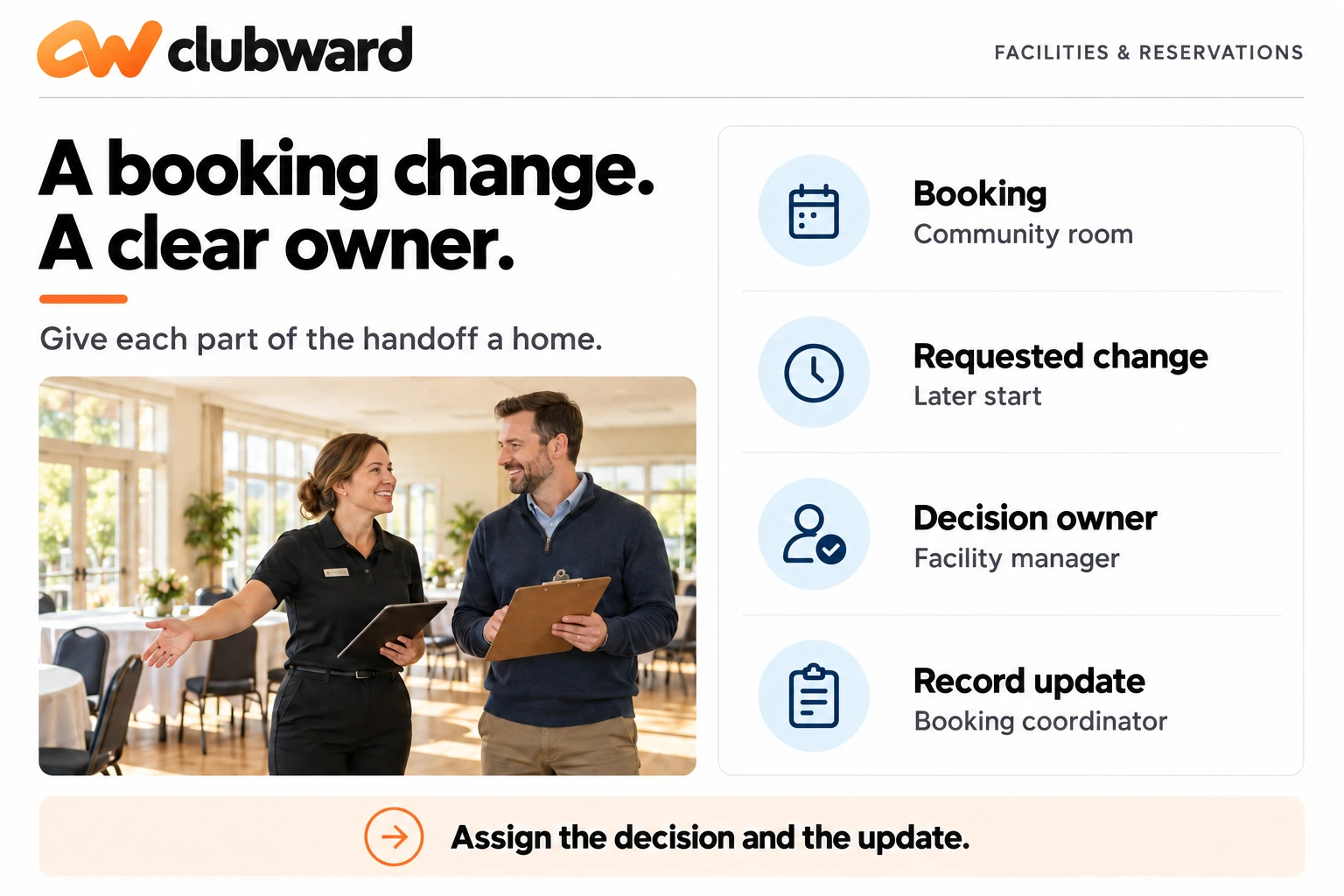
Separate the person who makes a decision from the person who records it. Your facility manager might authorize a room change while a coordinator updates the reservation and informs the member. Both actions need ownership, but they do not need to belong to the same person.
Use a compact responsibility list: action, owner, information needed, completion condition, and escalation contact. For a booking confirmation, the completion condition might be that the member has the agreed date, time, location, and relevant instructions. For setup, it might be a check by the opening attendant against the approved layout.
Assign a backup for time-sensitive decisions. Name the position that takes over when the usual owner is away, and explain how staff can tell that the handoff has happened. “Ask a manager” is incomplete if nobody knows which manager is available or what information that manager needs.
Keep the number of owners proportionate. You do not need a committee to decide whether a routine booking message has been sent. Reserve escalation for the decisions that require it, such as a request outside the approved rules or a conflict that the coordinator cannot resolve within their authority.
Separate the booking from access and preparation
Review your confirmation message alongside the staff preparation instructions. The member needs to know where to go and what to do. The opening owner needs to know what must be ready. Give both people the information relevant to their role without assuming the calendar entry contains every answer.
For a sample court booking, the checklist could include the court identifier, start and finish time, access route, equipment expectations, and the contact for a facility problem. For a community-room booking, add the agreed layout, setup window, storage arrangements, and the condition in which the room should be left.
Walk through the space before adopting a new instruction. Follow the member’s route from the entrance to the booked area. Ask whether the directions identify the correct door, whether a staff handoff is required, and what should happen if the expected contact is unavailable.
Clubward’s Programs & shared spaces overview describes keeping track of reservations for rooms, courts, and amenities, alongside facility availability and operating context. Ask how those elements apply to your selected modules and setup. The same page notes that capabilities vary by plan and selected modules; do not assume a specific access or enforcement arrangement from the overview alone.
Give changes a complete path
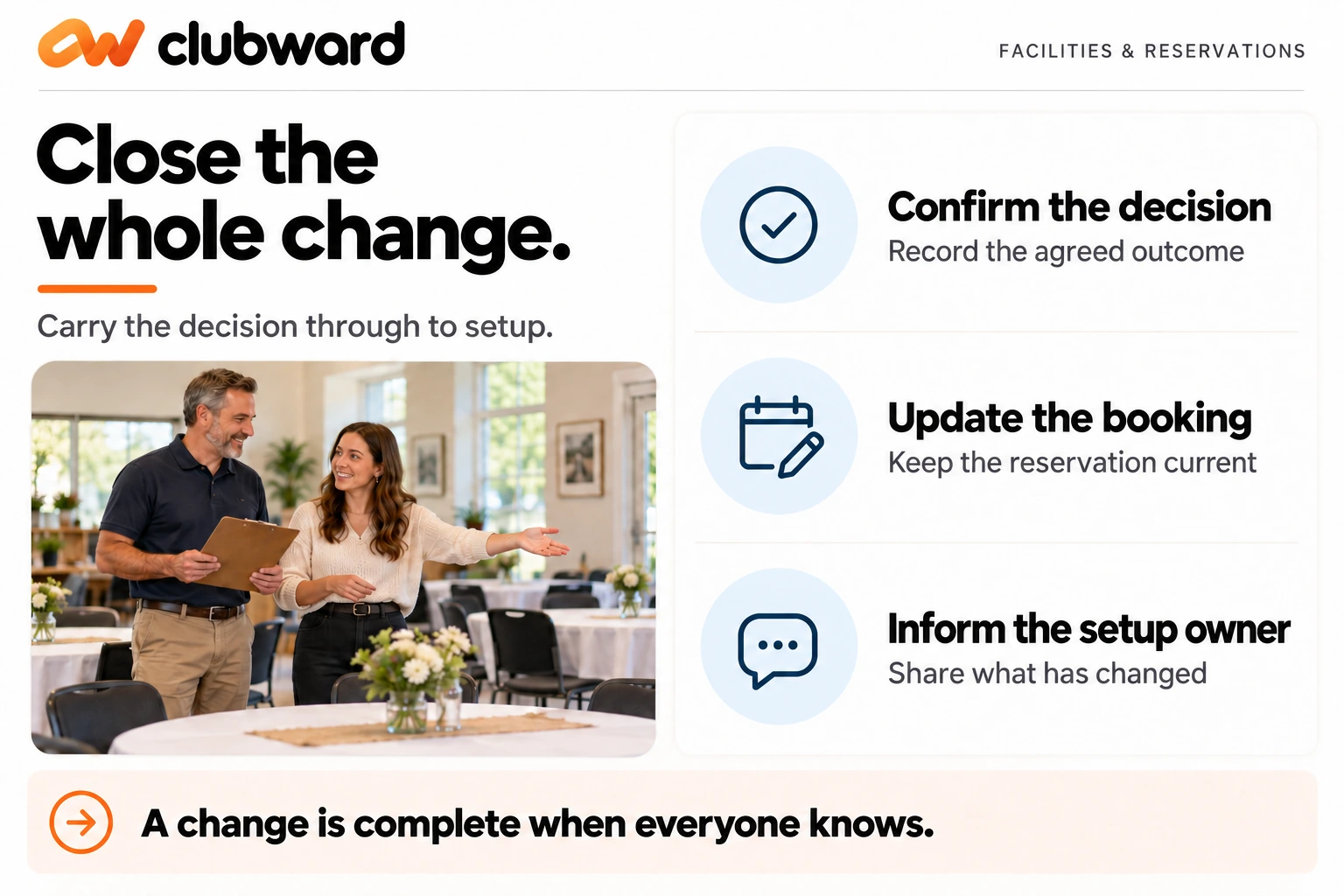
Define the steps for a change request before choosing a notification template. Who receives the request? Who checks availability and the applicable rule? Who confirms the decision? Who updates the operational records? Who makes sure the people preparing the space know what changed?
Suppose the sample community-room booking moves from Wednesday evening to Thursday afternoon. Ask the coordinator to check both the new booking and the work attached to the old one. An opening assignment, equipment preparation, or posted direction may need attention as well as the calendar entry.
Write a completion condition for the entire change. For example: the new time is confirmed, the original slot has the correct status, preparation owners have acknowledged the updated plan, and the member has received the final instructions. Adapt this to your actual tools and policies rather than treating the example as an automatic workflow.
Keep an exception visible until its owner resolves it. If a change cannot be confirmed immediately, give the member a realistic next step and record when the coordinator will respond. Avoid using “pending” as a substitute for a person, an action, and a review time.
Make cancellations understandable
Review the member-facing cancellation explanation against your approved policy. State where a member should send the request, what information to include, and how the result will be communicated. If a deadline or financial term applies, use the current authorized wording and have the responsible owner verify it.
Keep cancellation handling distinct from account adjustments. The person updating a booking may not have authority to change a charge. Your staff guide should identify the correct decision owner and explain what evidence they need, without asking front-line staff to invent an answer under pressure.
For your rehearsal, use a cancellation that arrives shortly before the session. Ask how staff will know whether the space should be released, whether preparation should stop, and whether another member may reserve it. Use the policy already approved for that space to decide the outcome.
Do not promise a refund, credit, replacement slot, or automatic release unless your organization has approved that promise and your process supports it. If the rule is unclear, record the question for a policy decision. A clearer message cannot repair an unresolved decision about what the organization will offer.
Define what staff do when nobody arrives
Choose an observation that staff can record without guessing a person’s intentions. A useful note might describe the check made at a particular time and the next action taken under the approved rule. Avoid attaching a judgment such as “unreliable member” to an operational record.
Decide who is allowed to change the booking status and under what conditions. If your organization uses a waiting period, confirm the current rule and where it is documented. Do not let different staff members quietly substitute their own timing because the instructions are difficult to find.
In a sample practice exercise, the court is empty when the attendant checks it. Have the attendant explain the next authorized action, where to record it, and whom to contact if another member asks to use the court. The exercise should reveal whether your rule produces a clear response.
Include the possibility that the information is incomplete. A member may contact the office while the attendant is elsewhere. Your process should explain where the most recent decision is recorded and how staff check it before taking an action that affects the reservation.
Use a small ownership matrix
Build the matrix around actions people actually perform. Start with confirmation, access, setup, changes, cancellation, release, and follow-up. Add only the rows your space needs. Keep the owner and completion condition close together so a person can scan the matrix during a busy shift.
For each row, test three questions: can the owner find the information, are they authorized to act, and can another person tell when the action is complete? If any answer is unclear, refine the row before adding more complexity. A longer matrix is not necessarily a more usable one.
For the community room, “setup” might belong to the opening attendant with the condition “layout checked against the approved booking details.” For the court, setup may be a simpler facility check. Let the completion condition describe the work instead of forcing both spaces into identical instructions.
Use the matrix in the shift handoff. Point to the open items rather than repeating every completed booking. If a different team will handle an unresolved change, name that team’s assigned owner and record the information they need. Recheck that the member has one consistent route for an answer.
Rehearse a court and a room side by side
Give two staff members the same type of problem in different spaces: a member requests a later start time. Ask each person to work from the relevant instructions, explain who can decide, and identify what must change before the request can be confirmed.
The court exercise might focus on the next reservation and the agreed access arrangements. The room exercise might add setup, equipment, and the person closing the building. Let these differences remain visible. They show which details belong in the space-specific instructions.
Then switch roles. Ask someone who did not write the instructions to find the answer without a verbal explanation. Note where they hesitate, what label they search for, and which contact they choose. Use those observations to improve the guide rather than treating hesitation as a personal failure.
Finish by recording the changes you made. Examples include adding the closing owner to room bookings or placing the cancellation contact beside the member instructions. Use real observations from your exercise and keep the sample practice records separate from live reservations.
Evaluate the platform through an operating scenario
When reviewing a club management platform, bring a real workflow with sample data. Ask to see a booking, a change, and the resulting view for the person responsible for the space. Follow the process through to completion rather than stopping after a slot appears on a calendar.
Clubward’s programs and spaces walkthrough invites discussion of facility availability, booking rules, capacity, and updates when plans change. Use those topics to build your questions. Ask the team to distinguish available configuration from staff procedures and anything that needs further confirmation.
Record unanswered questions in plain language. For example: “Who can authorize the requested change in our proposed setup?” or “How will the opening attendant find the latest room instructions?” Keep the answer attached to the scenario so your team can review the proposed process afterward.
Do not score the demonstration only on how quickly the first booking is created. Include whether the next owner can understand the result, whether the limits of their authority are clear, and whether the member receives a consistent answer. Those are the operating outcomes your ownership map is designed to test.
Review the rule after people use it
Choose a modest review period and collect specific questions from staff. Record the space, stage of the booking, unclear instruction, and action needed. Avoid collecting personal details that are unnecessary for improving the rule. Look for decisions that repeatedly need clarification.
Separate an instruction problem from a policy problem. If staff cannot find an approved cancellation contact, improve the guide. If the organization has not decided how to handle a particular request, send that question to the appropriate decision owner. Do not rewrite policy indirectly through a training note.
Make one owner responsible for maintaining each space’s instructions. Add a review date and update the places where members and staff encounter the rule. Retire superseded copies through your normal process so the next shift is not left choosing between contradictory instructions.
Give the next step a clear owner
Start with one court or room this week. Map its reservation journey, assign the decisions, and rehearse a change and a cancellation. The useful output is a process that lets the next person act within clear boundaries and explain the next step to a member.
To explore that process in Clubward, book a shared-spaces demo with one booking scenario and your current rules. Ask the team to walk from the initial reservation through the handoffs that make the space ready to use.
From Katelyn Pauley
More from Clubward