Community & Recreation Centers
Your Waitlist Is Growing. Should You Really Add Another Class?
A growing waitlist is a useful signal, but another class needs more than an empty room. Check real interest, staffing, space and handoffs before expanding your program.

Your Tuesday pottery class has a waitlist. A board member suggests adding Thursday. An instructor says they might be available. Someone has spotted an empty room on the calendar.
It sounds like an easy way to welcome more people. But an empty room and a long list of names do not yet tell you whether Thursday will work.
Before adding another class, confirm three things: enough people want the actual alternative you can offer, the whole session can be delivered with the resources available, and someone owns the decision to proceed. A short demand and capacity review can turn an appealing idea into a dependable program.
A waitlist tells you where to investigate
A registration waitlist records interest in a particular offer. That offer includes a time, location, price, instructor, age group and level. Change one of those details and you are testing a different proposition.
Someone waiting for beginner swimming at 4 p.m. may be unable to attend at 6 p.m. A household may have joined two lists while looking for one place. A person who wanted an activity last month may have made other plans. None of that makes the waitlist unhelpful. It means the number needs context.
Recreation teams also have real delivery constraints. In its June 2026 summer camp findings, the National Recreation and Park Association identified facility space, staff training and hiring among the challenges agencies reported. The practical lesson for a smaller class is similar: enthusiasm and operational capacity need to be considered together.
Start with the question the team is actually trying to answer: “Can we offer another suitable place to these participants?” That is more useful than “Can we make the waitlist smaller?”
Turn the list into a clear demand picture
Choose one person to prepare a short snapshot of the current list. Include the program, session, date of the snapshot and the number of distinct participants waiting. Review duplicate entries without deleting a household's legitimate interest in more than one activity.
Check whether people have already accepted places in another session. Where the information is unclear, ask rather than guessing. The purpose is to understand remaining demand, not to remove people because they have been waiting a long time.
Then identify the parts of the original offer that appear important. Is this the only after-school time? Does the class serve a particular experience level? Are families coordinating around a sibling's program? Those details can explain why an alternative with available space has not attracted the same registrations.
Use a small working table with participant interest, acceptable alternatives and any clarification needed. Keep sensitive personal information out of shared planning notes. Staff should know the practical requirement they need to resolve without circulating a participant's private background.
A cleaned-up list is still an estimate of demand. The next step is to ask about an offer people can actually evaluate.
Ask about a specific alternative before building it
“Would you like another class?” is an easy question to answer yes to. “Would you attend Thursdays from 5 to 6 p.m., at the community center, for the same six-week session and listed fee?” produces a more useful answer.
Prepare one or two feasible options with your program and facility teams before contacting participants. Do not send five speculative choices that would require five different staffing plans. Give people enough detail to judge whether the proposed option fits their lives.
Explain that you are checking interest and that the session is not confirmed. State when you will provide an update. An interest reply should not look like an enrollment confirmation or a promise of priority that your registration policy does not provide.
A short message can say: “We are exploring an additional beginner pottery session on Thursday evenings. Before we confirm it, would this time work for you? Please reply by the date shown. We will let everyone on the waiting list know the outcome and explain how places will be offered.”
Record yes, no, another time requested and no response separately. Silence is not a commitment. Keep the original waitlist position intact unless your published process and the participant's choice call for a change.
Look for the real capacity limit
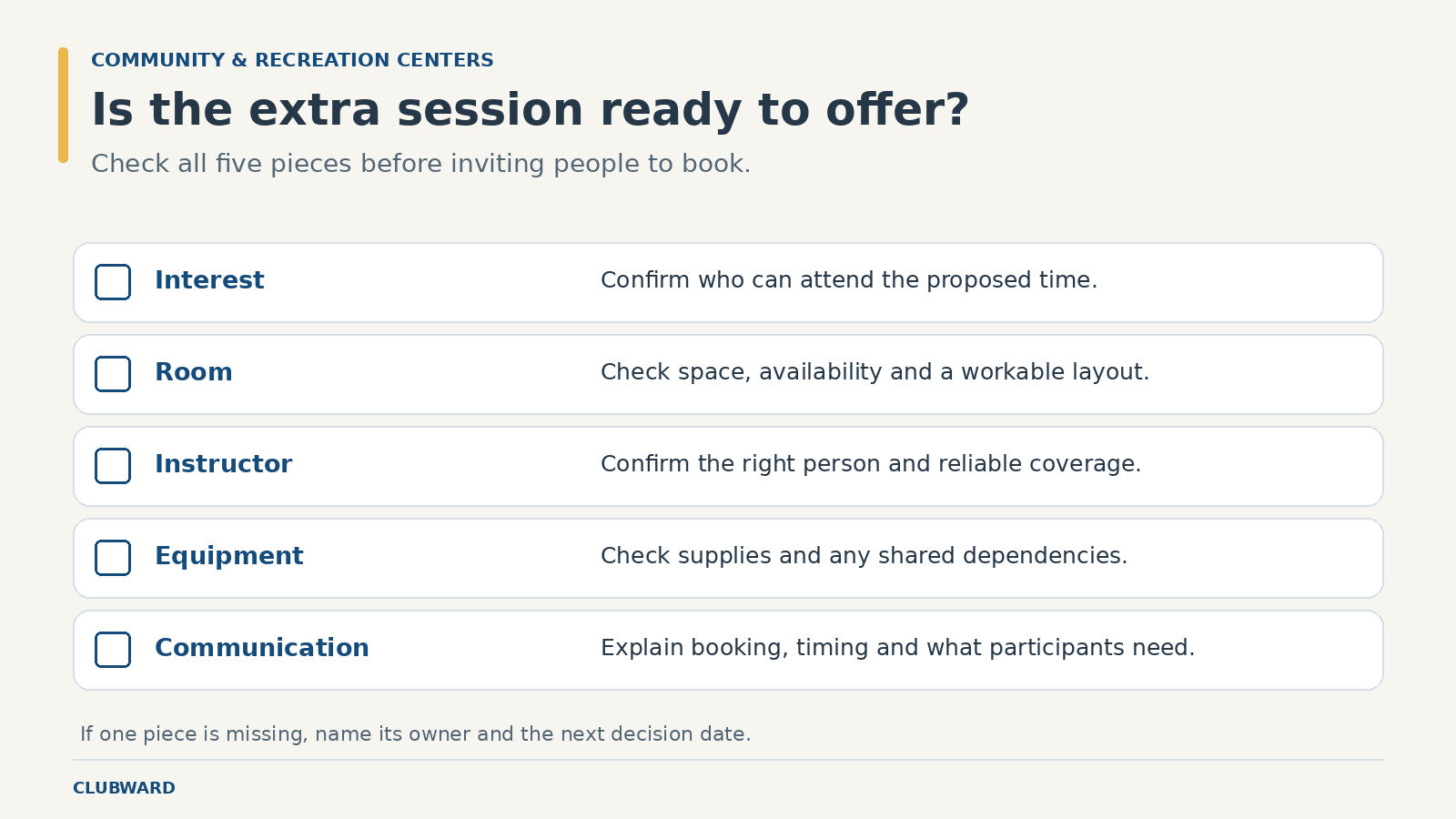
The available room is one part of the plan. A session also needs preparation, suitable equipment, staff time, participant support and a way to restore the space for whoever uses it next.
Walk through the proposed session from arrival to departure. Ask who opens the room, sets up, welcomes participants, teaches, handles a question at the desk, cleans up and locks away supplies. Check whether the same person has been casually assigned several jobs that happen at once.
- Space: Is the room suitable for the activity, and is it available for setup and cleanup as well as teaching?
- Instruction: Has the instructor confirmed every session date, the preparation expected and the approved participant limit?
- Support: Can the desk, custodial team and any required assistants absorb the additional work?
- Equipment: Are materials available when needed, including storage, preparation and replacement time?
- Participant needs: Have the relevant staff reviewed access, accommodation and program requirements for the proposed arrangement?
- Disruption: What happens if a room, instructor or key resource becomes unavailable?
Use the limits established for the activity and facility by the responsible people. An apparently empty space should not become a reason to improvise room occupancy, instructional ratios or qualifications.
Check what the extra session would displace
A room can be available on paper because the preparation work is not on the calendar. An instructor may be free only if another employee covers their usual responsibility. Those are real tradeoffs, even when no new invoice appears.
Ask the facility team what the proposed slot currently supports. It might provide equipment maintenance time, room turnover, staff breaks or a flexible space for programs affected by weather. Turning that time into a permanent class can remove the breathing room the rest of the schedule relies on.
Review whether the new session would draw participants out of an existing class that still needs enrollment. Moving people to a more suitable time can be a good decision, but count the transfer honestly. It is different from serving an entirely new group.
Look at the calendar across the full course. A six-week room reservation that works for five weeks is an unresolved plan, not a nearly finished one. Check special events, closures, instructor commitments and the time needed to communicate any planned variation.
Where a conflict appears, write down the available choices and their owners. You can then decide whether to change the time, use another suitable space, offer a shorter pilot or wait for the next program cycle.
Set the decision rule before replies arrive
A program team can talk itself into almost any outcome if it decides what counts as enough demand after seeing the responses. Agree on the conditions in advance.
Write down the minimum confirmed participation your organization requires, the maximum the program can responsibly serve, the resources that must be secured and the date by which a decision must be made. Use your actual budget and program goals to choose these conditions.
For a fee-supported class, have the responsible person review the additional costs and the treatment of cancellations or low enrollment. Include preparation and support work as well as instruction and supplies. For a subsidized program, document the community purpose and approved support rather than pretending every worthwhile activity must pay for itself.
Be clear about what qualifies as confirmation. An expression of interest can justify further planning. It is not the same as completed registration under your normal process. If launch depends on a minimum enrollment, explain that condition before accepting registration and apply your published cancellation and refund arrangements.
Name the person who makes the final decision. Set a review date that leaves time to tell participants and staff what is happening. A missed decision deadline becomes someone else's last-minute scramble.
Choose the smallest workable response to the demand
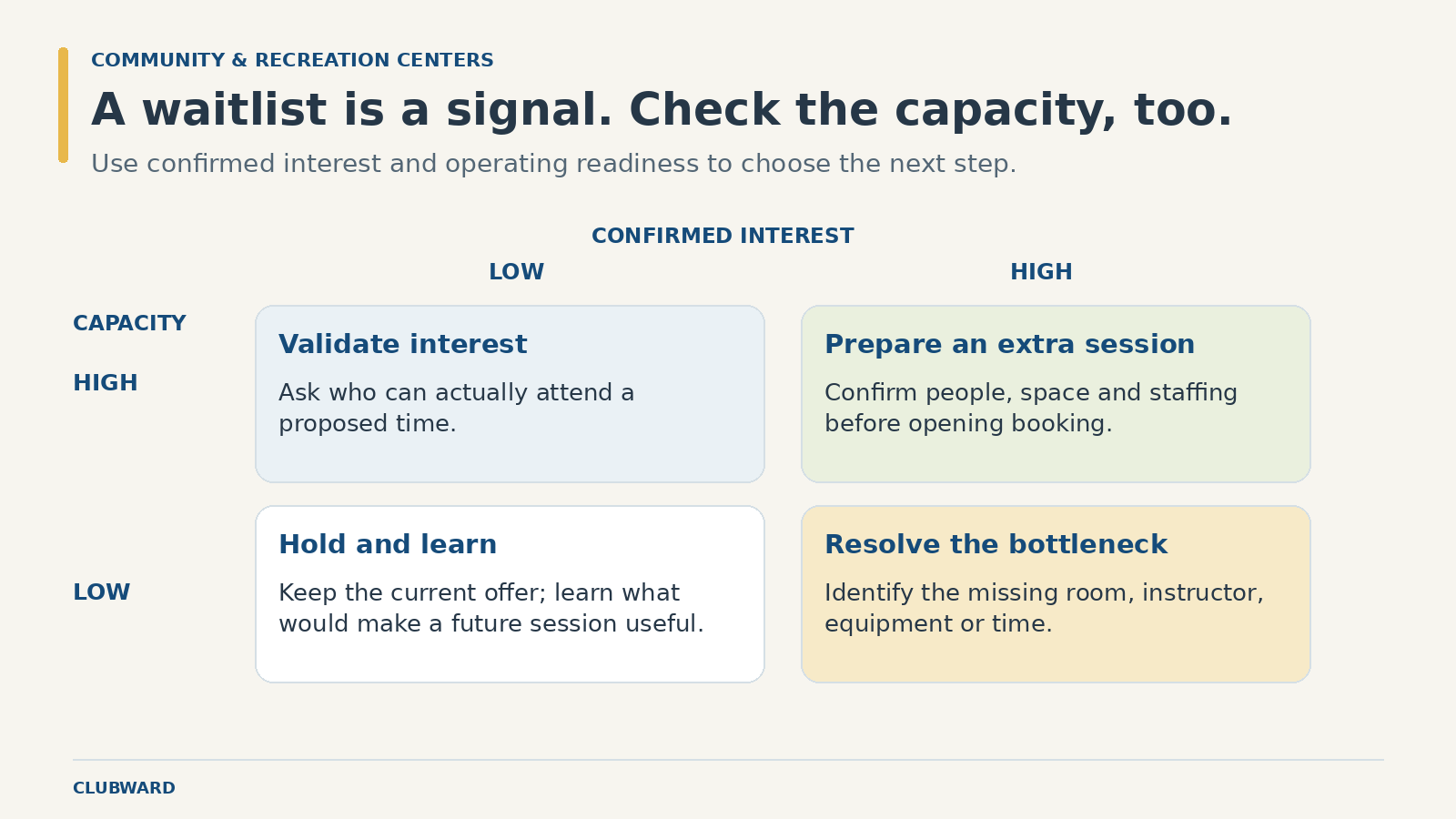
Another recurring class is one possible answer. It is not the only useful one. Match the response to what you have learned about the participants and the limiting resource.
Demand is confirmed and capacity is ready
Proceed through your normal approval and registration process. Reserve the full operating window, confirm staffing and prepare the participant message. Preserve the agreed maximum even if the new session immediately becomes popular.
Demand is confirmed but one resource is missing
Give someone ownership of that specific constraint. If a qualified instructor is unavailable, another room does not solve the problem. If equipment preparation is the limit, adding participants to the same class may make delivery worse. Set a deadline for resolving the constraint or choosing another option.
Capacity exists but interest in the alternative is uncertain
Run a defined interest check before committing to a full cycle. Consider whether a different time, a trial workshop or the next scheduled enrollment period would be more useful. Describe the option accurately so participants are choosing something real.
Neither the demand nor the capacity is clear
Pause the expansion decision and communicate what you are reviewing. Keep the list current and give people a date for the next update. A thoughtful “not confirmed yet” is better than an extra session that is repeatedly changed or withdrawn.
Make the offer fair and easy to act on
Once the additional session is approved, use your established registration and waitlist rules to offer places. Do not let a helpful staff member's personal email list become a second queue with different priorities.
Tell participants exactly what is being offered, how long they have to respond, what completes registration and whether accepting changes their place on the original list. Explain what happens when an offer expires. Make the action available through the channels your community actually uses.
Give the front desk the same information before the message goes out. Staff should be able to answer ordinary questions about dates, fees, location, eligibility and the next available option without forwarding every caller to the program coordinator.
If the session will not proceed, close the loop. Thank people for responding, explain the practical outcome and identify the next option or update. You do not need to share internal staffing discussions to communicate respectfully.
The goal is a clear path into participation. A new class that requires three follow-up emails to understand can create the very friction it was intended to remove.
Use a short decision record the next coordinator can follow
Keep the final decision in one place with the demand snapshot, proposed session details, confirmed resources, unresolved conditions, decision owner and participant update date. Attach or link the useful records rather than copying every email into a new document.
For example, a planning record might say: “Additional Thursday beginner session approved once the room block and instructor dates are confirmed. Program coordinator owns confirmation by Tuesday. Registration opens through the established waitlist process after both are complete.” That sentence identifies the condition, owner and next action.
A decision not to expand deserves a record too. “Demand confirmed; equipment preparation capacity unavailable this cycle; review next cycle” is useful history. Without it, a new coordinator may repeat the same investigation and contact the same households with another uncertain offer.
Keep the decision record brief enough that people will read it. Its job is to preserve the reasoning and the handoff, not to become a second program administration system.
Review whether the extra session solved the original problem
After the program begins, compare interest replies with completed registrations and actual attendance. Review how many participants came from the original waitlist and how many moved from another session. Each result tells a different story.
Ask the instructor and support team whether the time allocation worked. Did cleanup run into the next booking? Did participant questions require more desk coverage than expected? Were materials ready for every session? These details help you plan the next cycle more accurately.
Also ask participants whether the alternative met the need that put them on the list. A class can fill while still missing the original audience because the new time was unsuitable for those households.
Use what you learn to adjust the next program schedule. The useful success measure is more people able to take part in a well-run activity, with work your team can sustain.
Bring demand and delivery into the same conversation
Clubward's reservations and programs workflows connect program sessions, rosters, attendance and waitlists with shared-space reservations. Its staff operations workflows bring schedules and coverage into the wider operation. These connected views can give your team more context for a program decision.
Your team still chooses whether an additional session makes sense. Bring a full class, its waitlist, a proposed alternative and a real staffing constraint to a personalized demo. We can walk through the relevant modules and confirm how the handoffs would work for your center.
Explore Clubward in a personalized demo for your community center. Let us start with the program your team would love to offer more often, and the practical work needed to make it happen.
From Katelyn Pauley
More from Clubward