Sports & Social Clubs
The Calendar Is Busy. Which Activities Deserve Another Date?
Use a balanced participation worksheet to decide whether a club activity should repeat, change format, pause, or receive a small follow-up test.

A busy club calendar can look like a sign that every activity should return. It can also hide an uneven experience: the same members fill the most visible events, a waitlist reflects one inconvenient time, a popular activity consumes more staff attention than expected, or a smaller gathering creates a stronger path to a second visit.
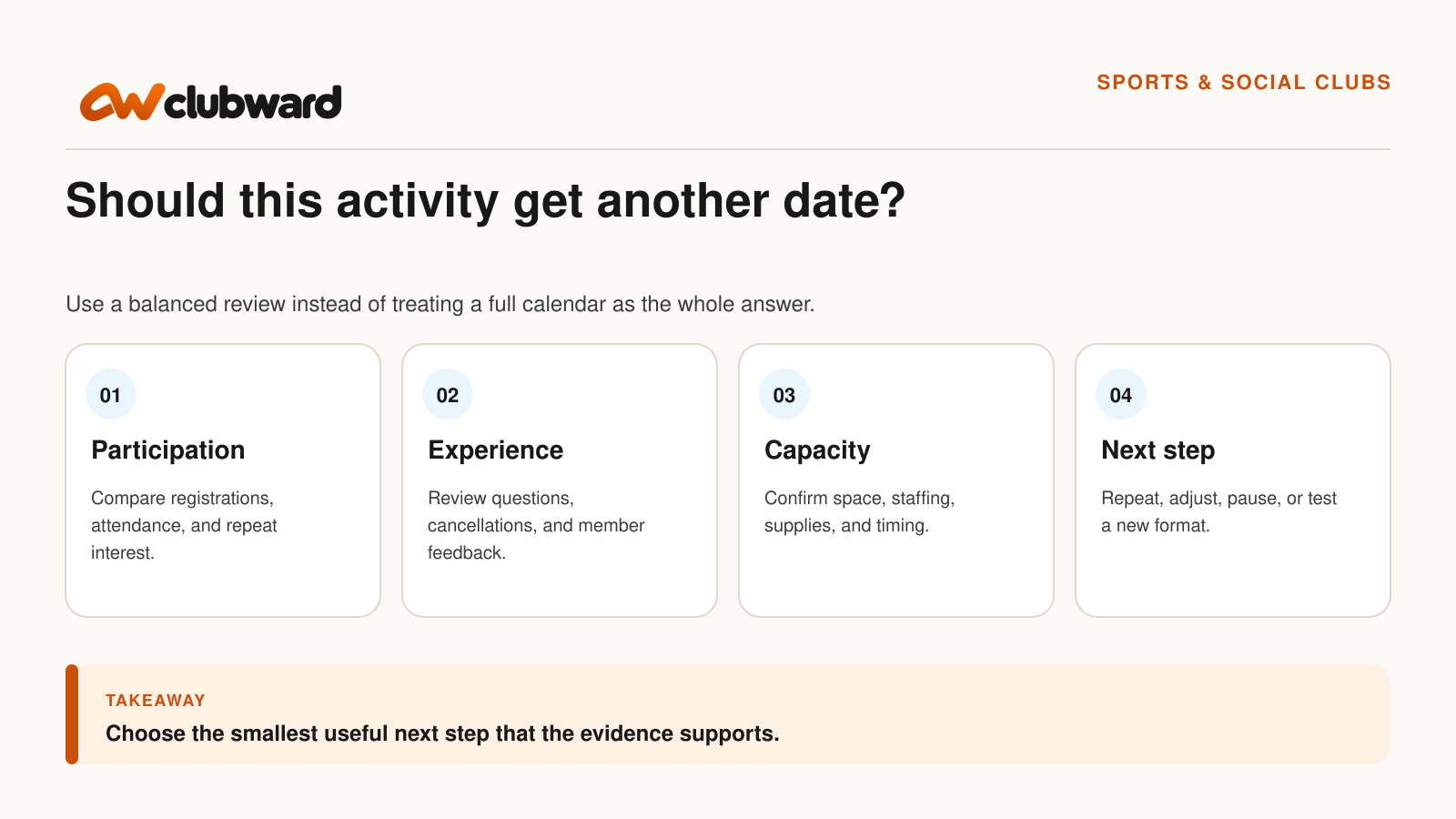
Use a repeat-decision worksheet before simply adding another date. Review participation, member experience, operating capacity, and the specific idea you want the next date to test. Then choose the smallest useful next step: repeat, adjust, pause, or try a limited variation.
The worksheet does not turn attendance into a verdict. It creates a structured conversation so the team can use records without pretending they explain more than they do.
Write the decision as a real question
“Was the event successful?” is too broad. “Should we offer the beginner doubles clinic again on a different evening?” is easier to answer. It names the activity, intended change, and decision the team can make.
State the planning window. The question may be for next month, the next season, or a one-time trial. Do not manufacture urgency, but do give the team the real date by which a room, court, host, or member message must be confirmed.
Keep a larger strategy question separate. Whether to repeat one activity is different from whether the club should change its whole programming mix. A focused review can contribute to that wider discussion without claiming to settle it.
Define participation before comparing it
Registration, attendance, repeat attendance, waitlist position, cancellation, and inquiry are different signals. Write down which ones the team actually has and how each is defined.
A full registration list does not prove that everyone attended. A long waitlist does not prove that a second date at another time will fill. A small group does not prove that the activity lacked value. Use the measure for the narrow question it can answer.
Compare like with like. If one activity had three sessions and another was a single gathering, total attendance alone may be misleading. The worksheet should record the format, capacity, price if applicable, duration, and audience so the team can interpret the counts.
Look at who joined, not only how many
Review whether participants were first-time attendees, regulars, returning members, guests, or people already involved in similar activities. Use categories the club legitimately maintains and avoid creating sensitive profiles that are not needed for programming.
Ask whether the activity helped a member take a next step. A new member may have met a group they can join again. A regular participant may have tried a different format. A guest may have asked about membership. Record observable follow-up, not assumptions about motivation.
Notice who could not participate. The barrier may be capacity, time, location, equipment, experience level, or unclear communication. Group the reasons staff actually received, and label unknowns as unknown.
Review the member experience with evidence
Collect the questions, cancellations, access problems, and follow-up messages connected with the activity. Note whether members understood the level, equipment, guest rule, location, arrival time, and what would happen next.
Use direct feedback carefully. One comment can reveal a practical problem, but it does not automatically represent the full group. Record the comment’s topic and decide whether to verify it with other evidence or a small change.
Ask the host or staff member what required extra explanation. Repeated questions often point to a missing instruction or a mismatch between the activity description and the experience. The next date may need a clearer message rather than a different program.
Measure the operational load
List the court or room time, setup, host or instructor coverage, front-desk work, supplies, communication, and closeout required. Include the transition before and after the activity, not only its published duration.
Identify scarce dependencies. A room may be available while the only qualified host is not. A second date may fit the calendar but displace an activity that serves a different group. A small equipment limit may matter more than the number of inquiries.
Do not convert every contribution into a false financial precision. A practical worksheet can use hours, spaces, roles, and known costs where available. The goal is to make tradeoffs visible enough for a proportionate decision.
Choose among four honest next steps
Repeat the same format
Use this when the activity met its operating requirements and the team has a clear reason to believe another date serves the same need. Confirm the room, owner, member audience, and review point rather than treating the repeat as automatic.
Adjust one important variable
Change the time, capacity, experience level, message, or follow-up when the records point to a specific friction. Avoid changing several variables at once if the team wants to learn what improved the experience.
Run a limited test
Use a small trial when interest exists but the team lacks evidence about timing, format, or operational fit. Define what the test is designed to learn and what result would lead to a larger repeat, another adjustment, or a pause.
Pause and preserve the learning
Pausing is not the same as declaring failure. Record why the activity is not returning now, what would need to change, and when the question could be reviewed. That keeps the next team from rebuilding the same discussion from memory.
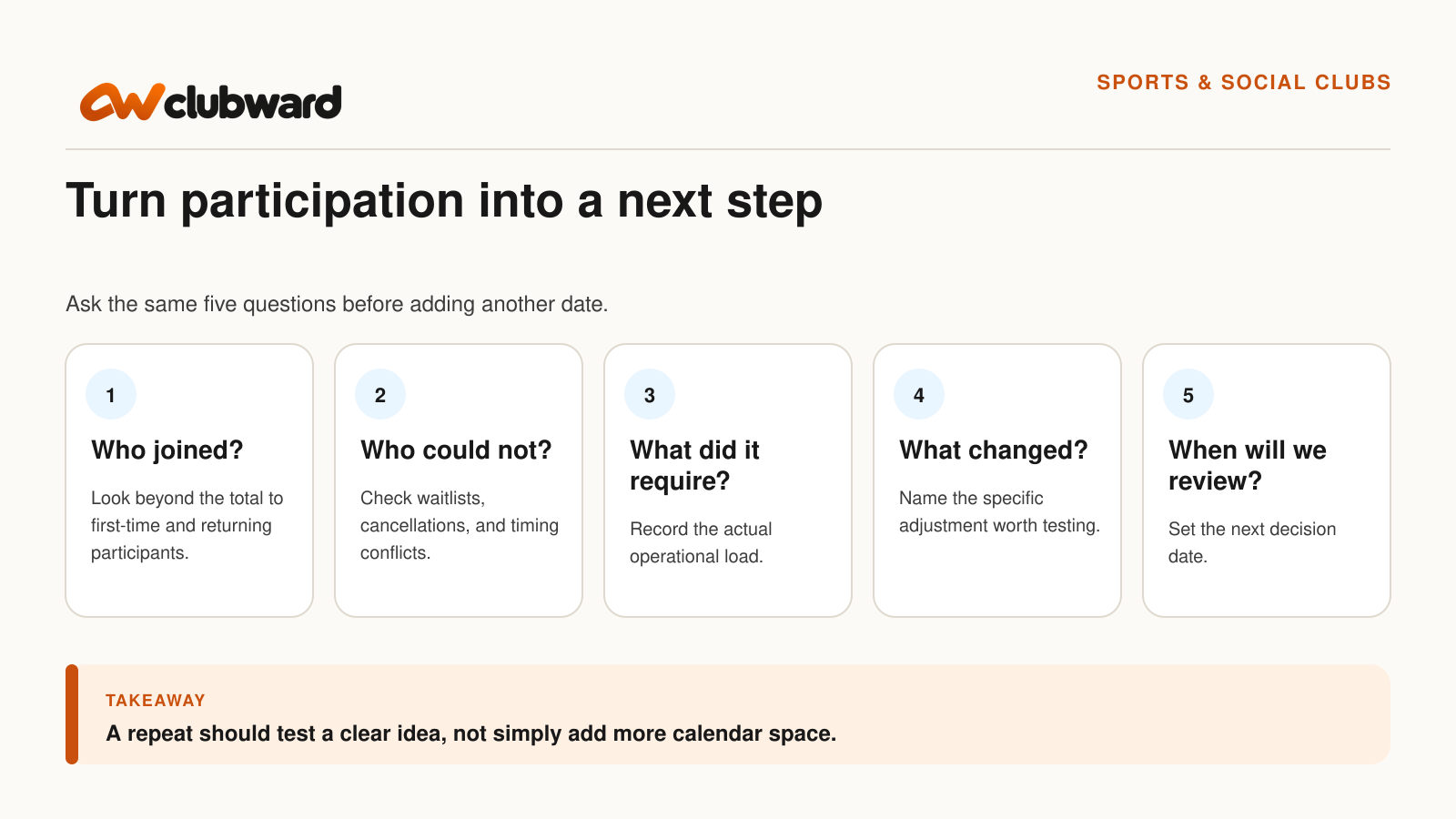
Use a five-question worksheet
Who joined? Record confirmed participants, actual attendance, first-time or returning status when legitimately available, and any useful follow-up.
Who could not join? Review waitlists, cancellations, timing conflicts, capacity limits, and unanswered inquiries without assuming the reason for every absence.
What did the activity require? Name the space, time, staff, volunteer, equipment, communication, and closeout work.
What should change? Choose one adjustment supported by the evidence and explain what the next date would test.
When will the team review it? Set the next decision date, owner, and information to collect.
Work through a practical example
A social club offered a beginner game night with twenty available places. Eighteen people registered, fifteen attended, three cancelled, and four later asked whether another date was planned. The room worked, but the host spent extra time explaining the format because the description assumed prior knowledge.
The numbers support interest, but they do not prove that an identical repeat is the best choice. The experience record points to a clear adjustment: rewrite the description and opening instructions for true beginners. The operating review confirms that the room and host can support one more limited date.
The team’s next step is therefore specific: repeat once with a clearer beginner message, keep the same capacity, track attendance and questions, and review after the session. That decision is more useful than “the event was successful.”
Connect the activity to the member journey
Ask what a participant can do next. The answer may be another session, a related group, a reservation, a volunteer role, or simply a clear way to hear about future activities. Do not use follow-up as pressure. Make it relevant to the activity and easy to decline.
Connect the activity review to the work behind the event: memberships, reservations, front-desk access, payments, and member follow-up. If you’re exploring Clubward for your sports or social club, bring one event to a demo so we can walk through those steps and confirm the modules your team needs.
When evaluating LookForward or another insight tool, ask what record produced a signal, which date range and definition it uses, and what action the team can take. A signal should lead to an investigation and a proportionate next step, not an automatic conclusion about a member.
Protect the worksheet from becoming a scorecard contest
Do not rank every activity by one total. Clubs offer programs for different purposes: welcome, skill development, competition, social connection, family participation, or use of a shared space. Record the intended purpose before judging the result.
Avoid setting universal thresholds without context. Ten participants may be appropriate for a workshop designed for twelve and insufficient for a venue designed for fifty. Use the program’s stated capacity and purpose.
Keep the worksheet readable. A short evidence table, a paragraph on the experience, a capacity note, and a next-step decision are usually more useful than a dashboard filled with decorative charts.
Review the decision after the next date
Return to the exact idea the repeat was meant to test. If the team changed the time, did the intended audience find it easier to attend? If the description changed, did beginner questions decrease or become easier to answer? If capacity increased, did the room and host still support the experience?
Record what changed and what remained uncertain. One repeat may justify another careful step, but it should not be stretched into a guarantee about the whole calendar.
Preserve the decision, owner, and review date alongside the activity record. That gives the next coordinator a useful starting point instead of a vague note that the event “went well.”
Avoid the signals that create false confidence
A full registration list can hide no-shows, last-minute cancellations, duplicate household bookings, or a narrow group taking every available place. Use the confirmed attendance and the program context before calling capacity the only problem.
High attendance can coexist with a weak member experience. If the activity required confusing instructions, an overloaded host, or repeated front-desk interventions, the next date should address those costs instead of copying the same format.
A waitlist is useful, but it is not a forecast. Some people will accept another date, some wanted only the original time, and others may have joined several lists. Use a fair offer process and record actual responses before expanding further.
Low attendance is not a complete verdict either. The message may have reached the wrong audience, the time may have conflicted with another event, or the activity may serve a small but important purpose. The worksheet should separate an unclear offer from a genuinely weak fit.
Do not treat an insight label as a decision. Whether a signal comes from staff observation, a report, or LookForward, confirm the source records, date range, and definition. Then choose a proportionate action a person can review.
Make the decision visible to the whole operating team
Once the committee or manager chooses a next step, update the activity owner, reservation or room record, member message, front-desk brief, and review date. A decision that lives only in meeting notes will not reliably reach the people carrying it out.
If the activity will not repeat, close the related waitlist or inquiry path and give members a clear answer. If the team is testing a new time, make the difference explicit. If the decision is deferred, say what evidence is still needed and when the question returns.
The operating record should let another coordinator understand the choice without recreating the discussion. Keep the evidence concise, the selected action clear, and the remaining uncertainty honest.
Include a communication owner in the decision. Members who joined, waited, cancelled, or asked about another date may need different messages. Do not promise a future activity until the space, host, and approval are confirmed. A short, accurate update protects trust better than an enthusiastic announcement the operating team cannot yet support.
When the next date opens, preserve the connection to the decision. Record which variable changed and what the team plans to review. That makes the repeat a learning step instead of another isolated event on an already crowded calendar.
Keep the member-facing explanation simple: what is available, what changed, and how to take the next step. The internal worksheet can hold the evidence and tradeoffs; the announcement should not force members to read the planning discussion.
Check the announcement on mobile and confirm the booking or inquiry link before it goes out.
Bring one activity decision to a Clubward demo
Choose an activity with registrations, attendance, a waitlist or cancellation pattern, and a real operational tradeoff. Book a personalized Clubward demo and ask the team to show how the relevant records, reservations, member follow-up, and LookForward workflow could support the decision, including any capability or setup that needs confirmation.
From Katelyn Pauley
More from Clubward