Sports & Social Clubs
The Club Calendar Is Full. Why Are the Same Members Still Missing?
A full schedule can coexist with a narrow participant base. Review who is engaging, where access breaks down and which response would genuinely help.

Courts are booked, event photos look lively and the monthly calendar is full. The club appears active. Yet the same core group attends most activities while another set of members has quietly stopped participating.
A busy calendar measures supply and total use; it does not automatically show the breadth of engagement. The missing members may face schedule conflicts, unclear booking rules, limited beginner options, repeated waitlists, a change in interests or circumstances that have nothing to do with the club. A pattern can invite a closer look, but it cannot explain the person on its own.
Use participation signals to create a thoughtful review. Compare a member or household with its own recorded activity, look across reservations and events, consider capacity and cancellation patterns, and let the team add appropriate context. Then approve one next step: no action, a useful schedule update, a warm personal message, a booking-process improvement or a program experiment designed for an identified gap.
Read the signal without rushing to a conclusion
Operational signals are useful because they direct attention. They are dangerous when a team treats them as an explanation. A higher count, lower count or changed routine does not identify the cause by itself. Begin with the recorded event, check whether the data was captured consistently and add the context that the people closest to the work can provide.
Use a defined comparison period and keep unlike events separate. A policy question is not the same as a broken credential. A registered participant is not the same as an attendee. An interested volunteer is not the same as a confirmed shift. Clean categories protect the decision from a dramatic total that combines several different problems.
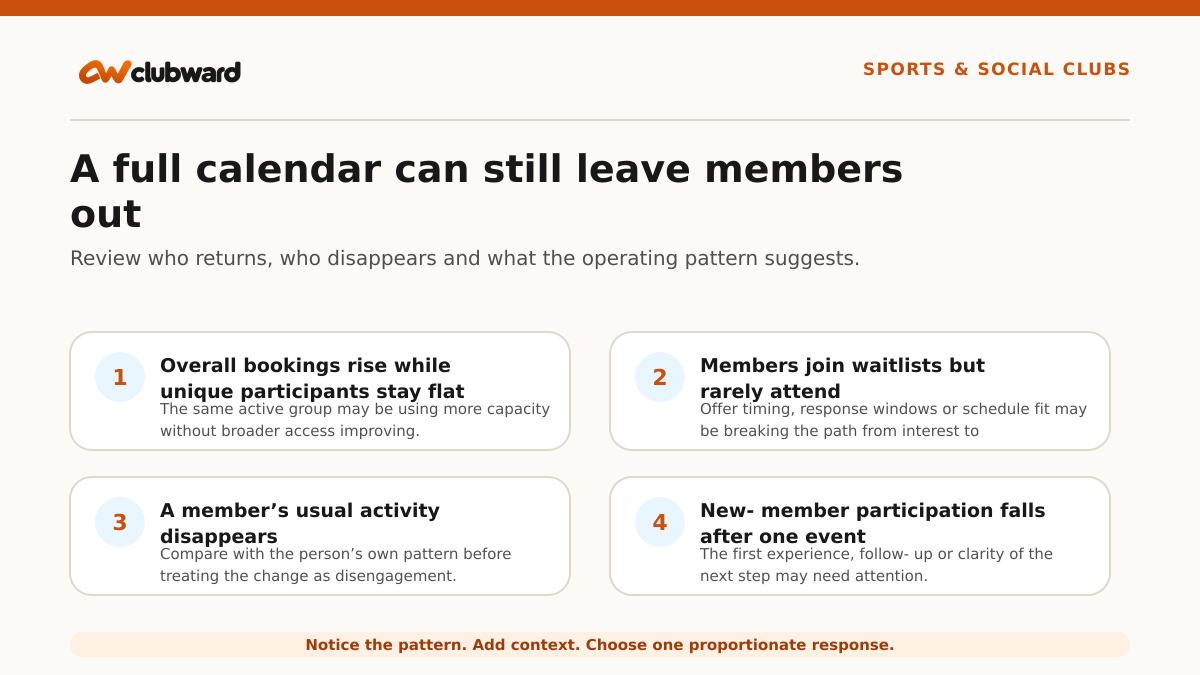
- Overall bookings rise while unique participants stay flat: The same active group may be using more capacity without broader access improving.
- Members join waitlists but rarely attend: Offer timing, response windows or schedule fit may be breaking the path from interest to participation.
- A member’s usual activity disappears: Compare with the person’s own pattern before treating the change as disengagement.
- New-member participation falls after one event: The first experience, follow-up or clarity of the next step may need attention.
- Certain times attract only one member segment: The schedule may serve that group well while unintentionally limiting others.
Ask the questions that change the next decision
A useful review is short enough to repeat and specific enough to change what the team does next. Put the relevant record, instruction and operating context together. Avoid turning the meeting into a search for someone to blame. The point is to find the first place where information, ownership or capacity stopped matching the work.
- Which activity changed?: Separate court bookings, social events, classes and informal visits rather than combining them into one engagement score.
- Is the record complete?: Account for guest attendance, shared reservations, cancellations and check-in habits.
- What capacity or rule affected access?: A full event and an underused event call for different responses.
- What does the team already know?: Staff and committee context should explain the signal, not be replaced by it.
- Would outreach add value?: A message should answer a likely need or offer a relevant next step, not merely announce that the club noticed an absence.
- How will the club learn from the response?: Record useful program or process feedback without turning a personal reply into a public metric.
Record the answer that is known, the question that remains and the person who can resolve it. If the team cannot support a conclusion, keep the item open rather than filling the gap with a story. A transparent “needs review” state is more useful than a confident but unsupported explanation.
Turn the pattern into one practical next step
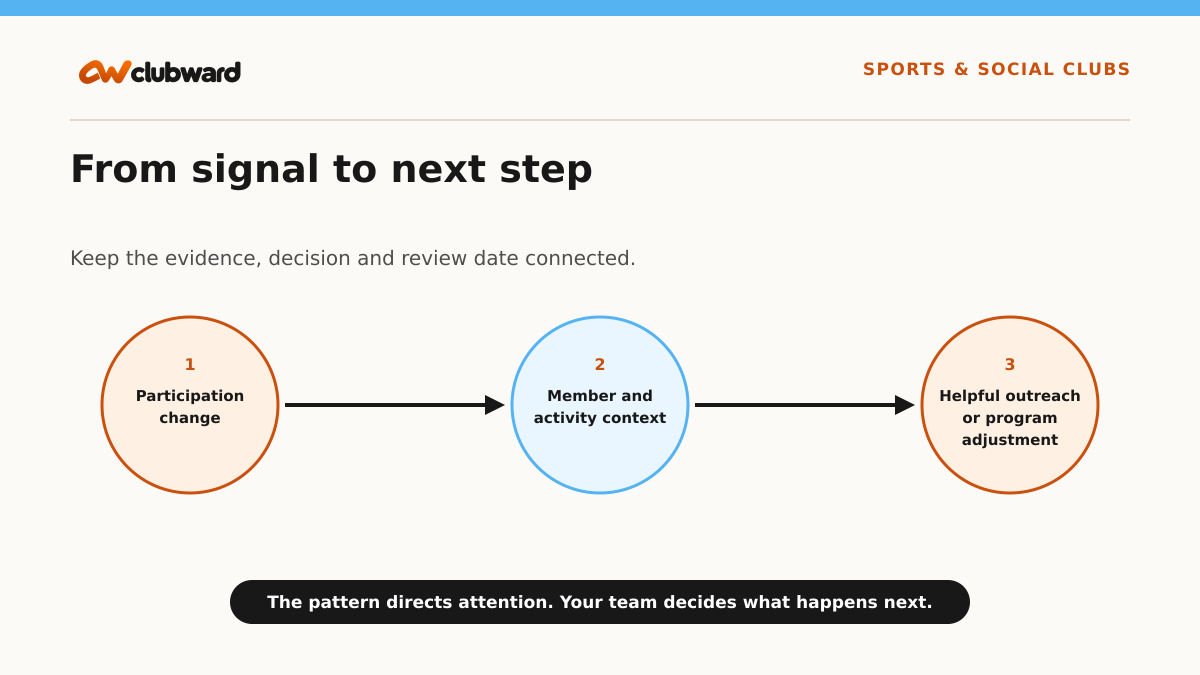
The best first response is usually smaller than a policy rewrite or new staffing model. Choose a reversible step that tests the leading explanation: clarify a message, expose a status, change a cutoff, assign an owner, update a role guide or review a narrow audience. Keep the original pattern visible so the team can tell whether the change helped.
1. Choose a narrow signal
Review one meaningful change such as repeated waitlist misses, a drop in a usual activity or low second-event participation.
2. Compare the right period
Use comparable weeks or seasons and note closures, holidays and program changes.
3. Review access to the activity
Check availability, booking rules, cancellations, guest limits and communications that could affect participation.
4. Add human context
Let the membership or program team review what is known before approving an action.
5. Draft one useful response
Answer the likely barrier, invite a relevant next step or change the process. The team should be able to edit or decline it.
6. Observe the operating result
Look for a better booking path, useful reply or clearer program decision rather than promising retention from one message.
Work through a realistic example
A racquet club’s social calendar is full, but new adult members rarely attend a second event. The first event has open capacity, so availability is not the issue. Staff review the registration and learn that the second event requires a partner selection that is not explained clearly to newcomers.
The membership team does not send a generic re-engagement sequence. It updates the event description, adds a “pair me with someone” choice and drafts a short message for recent first-time participants explaining the next event and the new option. A staff member reviews the audience and wording before anything is sent.
The club then compares second-event registrations and questions over the next month. A reply may reveal another barrier, or the change may have little effect. Either result is useful because the team tested a specific explanation. The full calendar remains good news, but the operating review makes room to ask who can actually use it.
Keep the response proportionate and human
Patterns describe recorded activity, not motivation or character. A household that stops visiting, a participant who misses class or a volunteer who cannot cover a shift may have context the organization does not know and does not need to investigate. Use the signal only to improve the relevant service or offer a respectful next step.
Before contacting anyone, ask whether the message provides value. Useful outreach can clarify an updated schedule, offer an appropriate option, check whether help is needed or invite a reply. Avoid language that makes people feel monitored or assumes a personal reason. Let the team edit, approve or decline any suggested response.
Protect access to the underlying information. Front-desk staff need the answer for the current interaction; managers may need the pattern; a board or client may need an aggregate decision summary. Not every role needs every detail. Define who reviews, who acts and what can be shared.
Decide what the evidence can support
Write the decision in three layers. First, state the observation without interpretation: what changed, during which period and in which workflow. Second, list the context the team verified, including data quality, schedule changes, facility conditions and known process differences. Third, record the action the evidence supports today. Keeping those layers separate prevents a reasonable observation from turning into an unsupported claim about people or future results.
Use a threshold that is practical for the decision, not one chosen because it looks precise. A pattern that affects access, participant safety, money handling or a critical role may deserve attention after one well-documented case. A participation or communication pattern usually needs several comparable observations. State the reason for the threshold and revise it when the team learns that it produces too much noise or misses important work.
Also name what the review cannot answer. The record may show that attendance changed, but not why a person stayed home. It may show that evening requests take longer, but not prove another employee is required. It may show that a rule generates questions, but not determine the board’s preferred policy. This boundary does not weaken the review. It keeps the next conversation honest and directs the unresolved decision to the right owner.
When several actions are possible, compare them by usefulness, effort, reversibility and risk. A message or instruction update is easier to test than a permanent schedule change. A temporary coverage adjustment can show whether capacity is the real constraint. Choose the smallest action that can produce meaningful evidence, and set an end date so a trial does not quietly become permanent.
Measure the operating result, not the story
Choose measures that show whether the process became clearer or the next step became more useful. Do not promise that one message will retain a member, fill a class or solve coverage. The first goal is better judgment: cleaner records, fewer avoidable handoffs, earlier visibility and an action the team can explain.
- Unique participant breadth: Compare total registrations with the number of members or households participating.
- Second-activity path: Track whether newcomers can identify and complete a relevant next step.
- Waitlist-to-attendance conversion: Review whether released spaces reach people in time to use them.
- Team-approved outreach: Confirm that people review the audience, message and offer before action.
- Process insight captured: Record booking, schedule or program feedback that can improve the next cycle.
Review the same measures after a reasonable operating period. If the signal changes, check whether the underlying recording practice changed too. If nothing improves, reconsider the explanation before escalating the response. Learning that the first idea was wrong is a useful result when the test was small and respectful.
Run a 20-minute signal review
Spend the first five minutes confirming the signal and comparison period. Put the relevant records on screen and remove unrelated events. Spend the next five minutes checking the operating context: schedule, facility, role, access rule, communication and known data limitations.
Use the third five-minute block to choose one next step, one owner and one effective date. Write down what result would make the team keep, revise or stop the change. In the final five minutes, decide when to review the next sample and which role needs the updated instruction.
Close the review with a plain-language summary: what changed, what the team believes may explain it, what action will be tested and when the result will be reviewed. That summary is more useful than a dashboard screenshot with no decision attached.
Leave a decision record the next person can use
A decision record should fit on one screen. Include the signal, comparison period, context checked, affected workflow, chosen action, owner, effective date and review date. Add the current status—proposed, approved, in progress, complete or stopped—so another shift or leader can understand whether they are reading an idea or an active instruction.
Link the record to the source workflow rather than copying sensitive details into a broad note. The person carrying out the change should see the approved instruction and the information needed for that role. The person reviewing the outcome should be able to return to the same period and definition. This makes continuity possible without relying on the original reviewer’s inbox or memory.
At the review date, close the loop even when the result is inconclusive. Keep the change, revise it, end it or extend the test with a stated reason. Record one lesson that will improve the next review. A closed decision trail helps boards, managers and program leaders distinguish deliberate operating changes from temporary workarounds.
Where a connected club management platform helps
Clubward connects memberships, reservations, programs, guest access and front-desk work for sports and social clubs. LookForward is designed to surface unusual activity patterns and suggested responses for team review, including a change in recorded member visits, underused capacity and incomplete follow-up. The team keeps control of whether to proceed, adjust the response or take no action. Bring one real participation question to a demo and confirm the plan, modules and data required.
Use this decision checklist
Before the team acts on the pattern, confirm:
- Specific activity signal
- Comparable review period
- Unique participants
- Capacity and availability
- Booking rules
- Cancellations and waitlists
- Member or household context
- Known schedule changes
- Team reviewer
- Proposed next step
- Approval decision
- Result review date
The value of an operational trend is not that it makes the decision for you. It gives your team a better place to look, a shared record to discuss and a way to connect the next action with the people and work it affects.
From Clubward Team
More from Clubward