Staff & Volunteers
Tired of re-training staff? Clubward trains your staff for you
New season. New faces. The same training all over again? Clubward helps staff and volunteers learn their role in the platform, with your club’s procedures and policies alongside them.

You have shown someone how to check in a household. Then how to use a guest pass. Then where to find a member’s balance, and when to ask a manager for help.
The next person starts on Thursday. You do it again.
By opening weekend, the same explanation has become a standing appointment in your calendar. Except it is rarely in your calendar. It happens between phone calls, at the front desk, and while you are trying to finish something else.
Your staff and volunteers want to do a good job. They need a clear way to learn it. And you need a way to welcome new people without personally repeating every platform walkthrough.
Clubward Staff Training automatically teaches new staff and volunteers how to use Clubward based on their position and role. Add your standard operating procedures and policies, and their introduction to the platform becomes an introduction to the way your club works, too.
Set up the expectations once. Give each new person a relevant starting point. Spend your time helping people feel part of the team, instead of explaining the same screen again.
Every new season should not mean starting from scratch
A community club holds a surprising amount of knowledge in people’s heads.
Someone knows how guest passes work. Someone else knows what to do when a household cannot be found. The long-serving volunteer remembers which questions go to the membership coordinator. The seasonal supervisor knows the opening routine because they learned it last summer.
That knowledge matters. But when it depends on who happens to be working, a new team member’s experience can vary from one shift to the next.
The usual fixes create their own work. A long handbook needs explaining. A group training session misses the person who joins later. A folder of recordings may be useful, but someone still has to decide which ones a new hire should watch. Shadowing helps with context, yet it can leave both people guessing about what has already been covered.
The problem is not that your team needs help. That is part of running a welcoming organization. The problem is making the manager the delivery system for every piece of routine training.
Clubward gives that routine work a repeatable home. New people learn how to use the platform for their responsibilities, while your team provides the local knowledge, judgment, and encouragement that make your club yours.
The right training for the role they actually have
A front desk attendant, treasurer, and event volunteer all belong to the same club. They do not need the same introduction to Clubward.
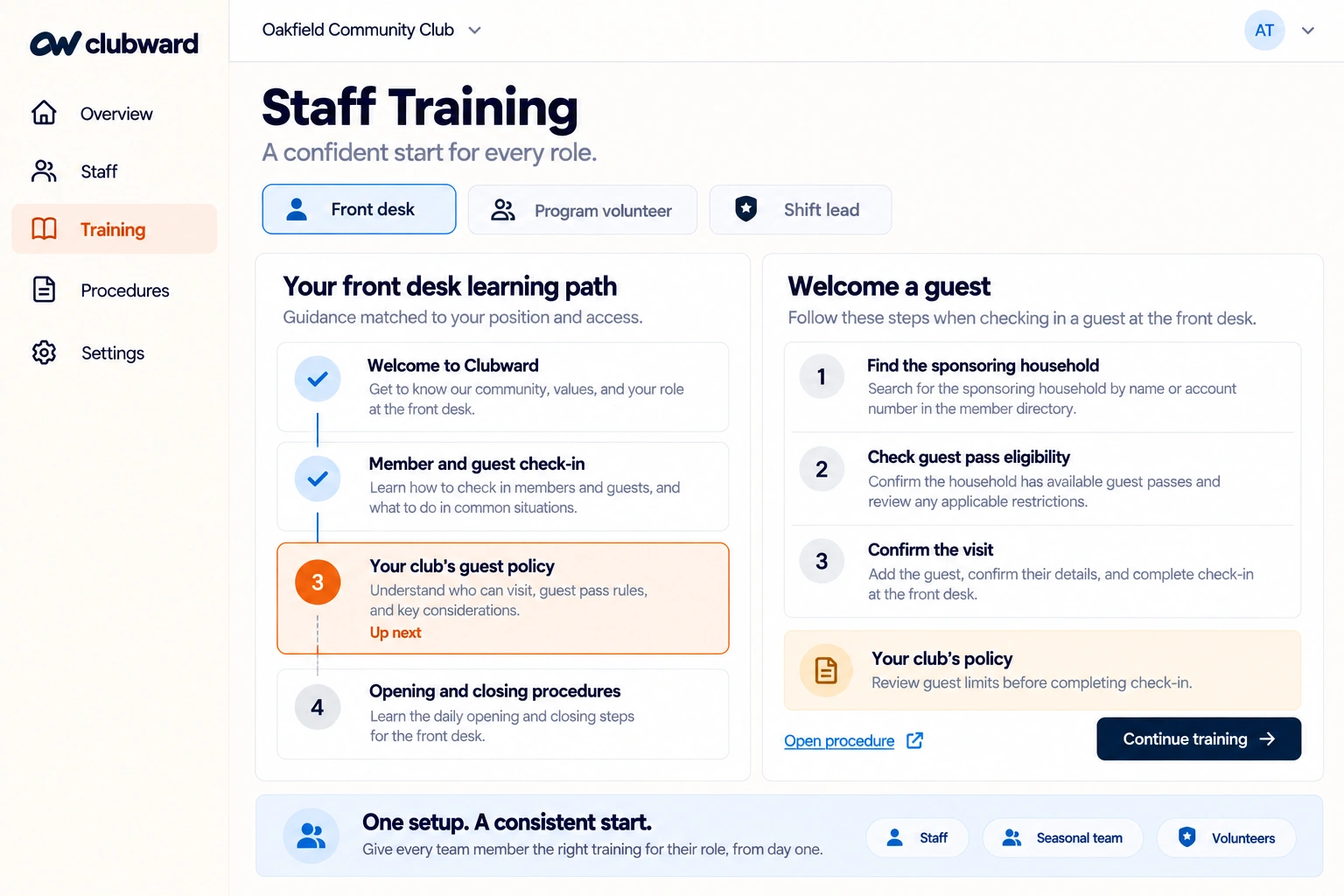
Staff Training uses a person’s position and role to guide their learning. The point is practical: help them understand the work they are there to do, without asking them to learn the whole platform first.
This follows a useful learning principle. The CDC’s Quality Training Standards emphasize understanding the learners, using relevant content and real-world examples, and providing support after training. Applied to a club, that means starting with the tasks a person will actually encounter and giving them a clear place to turn when they need help.
Here is what that can look like across your team.
Front desk and check-in staff
Their first questions are immediate: How do I find a household? What am I looking for before admitting someone? How do I handle a guest? When should I involve a supervisor?
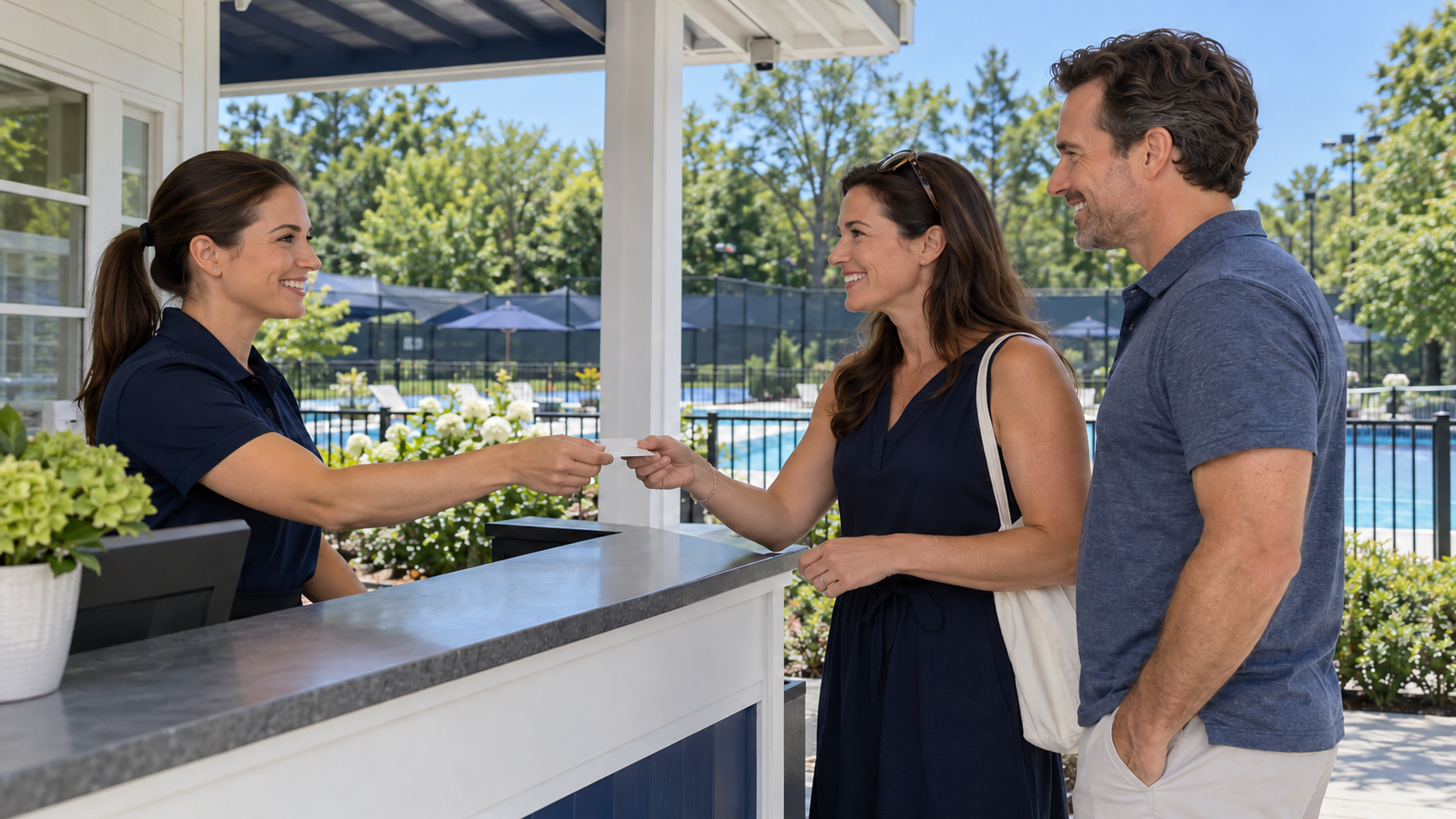
Their training should connect those Clubward workflows with your club’s check-in procedures. A new attendant needs to understand both the screen and the expectation behind it. Your guest policy gives context to the guest-pass workflow. Your escalation procedure explains what to do when a situation falls outside the usual process.
You can then use your time at the desk to work through real situations together, instead of beginning with every button and menu.
Staff responsible for payments
Someone helping with payments needs a different starting point. Their learning should center on the payment-related work permitted by their role, with your procedures for handling questions, discrepancies, and requests that need approval.
That distinction matters at a busy club. Knowing where information appears is one part of the job. Knowing when a decision belongs to someone else is another. Put those expectations alongside the relevant platform training so the two stay connected.
Supervisors and team leads
A supervisor needs to understand the Clubward workflows their team relies on and the responsibilities that come with overseeing them. Their training can be framed around the tasks assigned to their role, supported by your procedures for handovers, escalations, and day-to-day coordination.
For the manager, the benefit is continuity. You have a shared starting point for what a supervisor should know, rather than relying on how much time the previous supervisor had to explain it.
Volunteers and occasional helpers
A volunteer giving a few hours should have a clear, manageable path into the work. They should not have to sort through a whole operations manual to find what matters for their event or position.
Volunteering Australia’s National Standards for Volunteer Involvement treats relevant induction, role information, training, and ongoing support as part of good volunteer involvement. For a community club, that is a useful reminder: a warm welcome includes helping people understand their contribution and feel comfortable asking for help.
Role-based training gives volunteers that clearer starting point. Your personal welcome makes it feel human.
Bring your SOPs and policies into everyday training
Clubward can teach your team how to use Clubward. You bring the procedures that make the training specific to your organization.
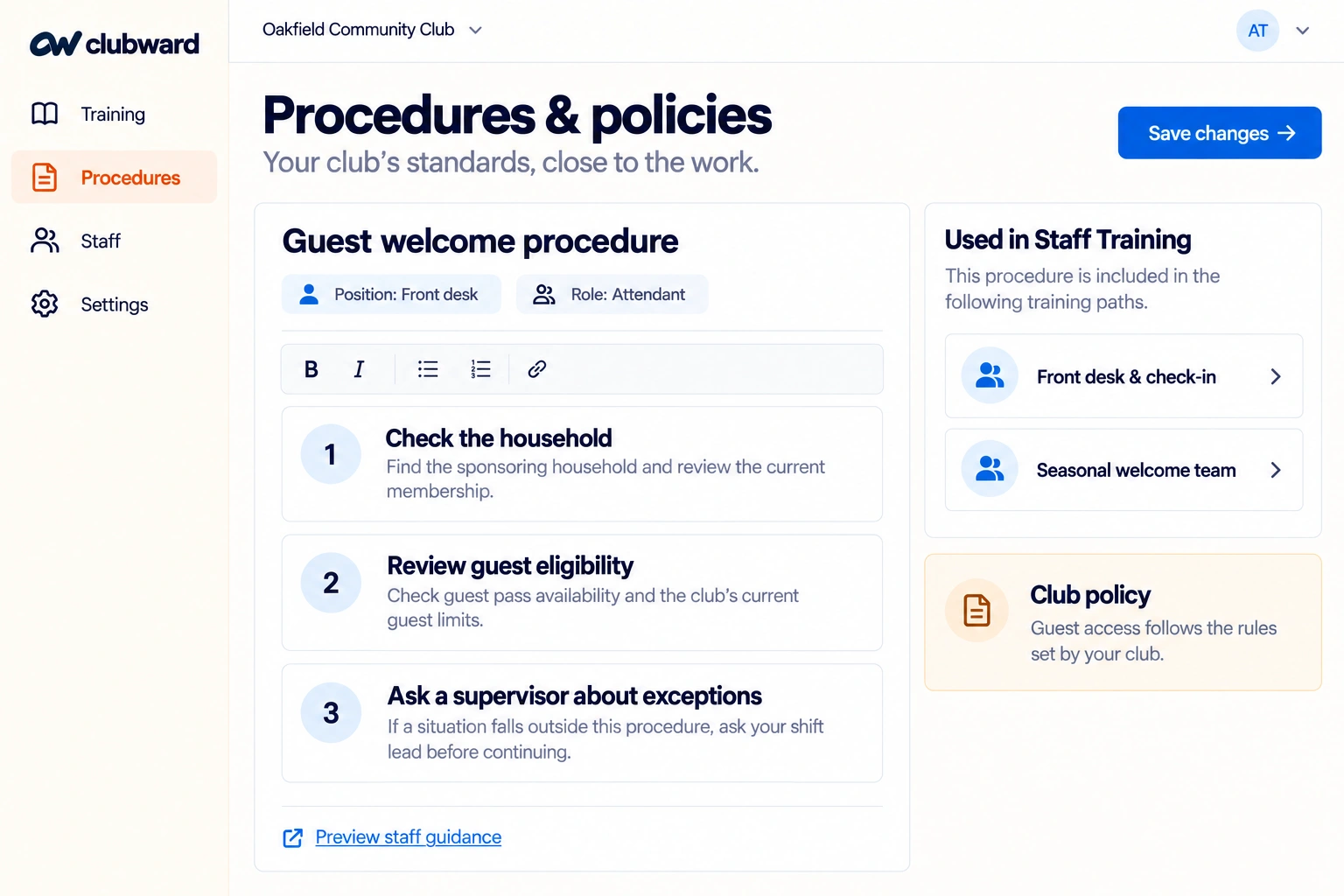
Add your standard operating procedures and policies so staff can learn the platform in the context of your club’s expectations. That might include your guest policy, member information handling, opening and closing procedures, or the process for escalating a concern.
A useful SOP answers a practical question. It tells someone what to do, when to do it, and where to get help. A policy explains the expectation they need to follow. Together, they give a new team member more than a list of screens to remember.
For example, a guest check-in procedure might cover:
- What to verify before admitting a guest.
- How to use the relevant Clubward workflow.
- Which exceptions require a manager’s decision.
- Who to contact when the usual process does not fit.
Keep the wording clear enough for someone on their first day. If a procedure depends on years of unwritten knowledge, it is not ready to stand on its own.
Putting these materials into Staff Training helps make awareness and consistent enforcement part of onboarding. Your expectations have a defined place in the process, instead of depending on a reminder in a group chat or a document someone may never have found.
It also makes policy conversations easier to ground. A supervisor can point back to the agreed procedure, explain how it applies, and identify where someone needs more support.
Set it up once, then maintain what matters
“Set it and forget it” should mean that you can stop rebuilding routine onboarding for each new person. It should not mean that your club’s procedures never need another look.
A practical setup begins with the roles you already have and the questions you already answer.
1. Start with your positions and responsibilities
List the positions that use Clubward. Keep the list tied to real work: front desk, membership support, payments, supervision, or event help, for example.
For each position, ask what someone needs to do in the platform and what decisions belong to another role. A clear role gives the training a clear purpose.
2. Add the procedures people need most
Start with the recurring questions that interrupt your day. You do not need to turn every piece of institutional knowledge into a polished handbook before you begin.
Write down the standard process for those common situations. Name the person or role responsible for exceptions. Use the same language your team uses at work.
3. Introduce new people through their role
When a new staff member or volunteer joins, their role becomes the starting point for learning Clubward. Automatic platform training takes care of the recurring introduction, with your club’s materials supplying the local context.
Make the welcome personal. Tell them why their role matters, who will support them, and when they will have time to learn. Automation works best when it creates room for that conversation.
4. Check understanding in the real setting
Follow the digital introduction with a practical conversation or demonstration. Ask a new attendant to talk through a guest check-in. Ask a supervisor how they would handle an exception. Let a volunteer point out anything that remains unclear.
The CDC’s guidance on evaluating training distinguishes learning from applying that learning at work. For club managers, the useful takeaway is straightforward: finishing training is a starting point; seeing someone use it helps you understand where further support is needed.
5. Review changes before the next busy period
Before the season begins, check whether your roles, policies, or procedures have changed. Remove outdated instructions and resolve any conflicting versions.
You are maintaining a shared foundation rather than rebuilding it. The next person starts from what your club knows now, not from whatever someone remembers from last year.
Stay ahead of the season, with clearer expectations
Opening day has a way of making every unfinished task urgent at once. Training feels different when it is part of preparation instead of something squeezed between arriving members.
Use the weeks before your busy period to decide what each role needs to know. Make sure the materials reflect this season’s procedures. Agree on who will answer questions and who will check practical readiness.
For returning staff, start with what has changed. A familiar face can still need an introduction to a new responsibility or an updated policy. For new people, provide enough context to understand the club before expecting them to work independently.
This also supports a more organized approach to compliance responsibilities. Clubward helps you put your policies into training and reinforce expectations. Your club still owns the policies, the supervision, and the decisions about what is required for each position.
OSHA’s education and training guidance emphasizes role-specific responsibilities, opportunities to ask questions, and additional training when tasks or working conditions change. In a club setting, platform training should sit alongside the applicable workplace instruction, hands-on practice, and professional certifications a role requires. Learning Clubward does not replace lifeguard certification, emergency drills, or equipment-specific training.
That is how you stay ahead: give routine platform learning a dependable process, then focus your attention on the preparation only your organization can provide.
A more confident team starts with a better welcome
For a new employee, uncertainty can sound like, “I do not want to bother the manager again.” For a volunteer, it can feel like everyone else already knows what to do.
A clear introduction changes that experience. It tells people their role matters enough to prepare them properly. It gives them a starting point, a common set of instructions, and a way to understand what is expected.
For managers, the benefit is equally practical. You can stop being the only place basic platform knowledge lives. You can use conversations to coach, answer real questions, and improve the way your team works together.
That leaves more room for the part people remember: a friendly welcome, a calm front desk, and a team that helps members feel at home.
Explore Clubward Staff Training to see how role-based platform learning and your club’s procedures fit together.
Questions about Clubward Staff Training
Does Clubward train staff and volunteers?
Yes. Staff Training automatically helps new staff and volunteers learn how to use Clubward based on their position and role. The aim is to give each person relevant platform training for the responsibilities they have.
Can we add our own standard operating procedures and policies?
Yes. You can add your organization’s SOPs and policies to support training in the way your club operates. Keep those materials current and clear about the expected action, the responsible role, and when someone should ask for help.
Will everyone receive the same training?
Training is based on position and role. A person helping at check-in needs different platform knowledge from someone responsible for financial administration. Your club’s role setup gives that learning its context.
Does automated training replace in-person onboarding?
It handles the repeatable introduction to using Clubward. Your welcome, site orientation, hands-on instruction, and conversations remain valuable. Use those moments for the details that need human judgment or practice in your facility.
Can Staff Training support our compliance process?
It helps make policies and procedures part of staff preparation and supports consistent expectations. Compliance depends on your organization’s requirements and how you put them into practice; software training alone does not establish it. Keep the required certifications, supervision, and workplace training appropriate to each role.
Is this useful for clubs with seasonal teams?
Yes. Seasonal teams are a natural fit for a repeatable introduction that does not depend on a manager delivering every walkthrough again. Review your procedures before each season, introduce new people through their roles, and give returning staff clear guidance on what has changed.
Let Clubward handle the repeat walkthroughs
Your team deserves a clear introduction. You deserve a process that does not start over every time someone joins.
Clubward Staff Training brings role-based platform learning and your club’s procedures together, so you can spend less time repeating instructions and more time supporting the people behind your community.
Take a closer look at staff training software for community clubs, or choose a time for a personalized demo. We will focus on the roles, recurring questions, and onboarding challenges that matter to your club.
From Clubward
More from Clubward